
A joist package can look complete while leaving a reviewer unable to trace its loads and design assumptions to the governing requirements. That’s why a software output or specification label alone isn’t proof of compliance. For engineers and detailers asking how to ensure SJI joist compliance, the process starts by documenting which requirements apply and how each project input carries through design and documentation.
Establish the applicable SJI specification and edition, confirm project loads, and document the assumptions behind the design. This workflow explains how to set governing requirements before design begins, check inputs and design decisions, and connect calculations to approval drawings and production information. Specialized software can support consistent inputs and document generation, but qualified engineering review remains essential. GMatrix-7’s OWSJ (SJI) module and automated approval drawing and bill-of-material generation can support the process. Software isn’t a substitute for professional judgment.
Key Takeaways
- Confirm the governing SJI requirements, project criteria, and delegated-design responsibilities before joist design begins.
- Trace project loads, geometry, and joist conditions into the engineering checks instead of relying on a designation or software output alone.
- Learn how to ensure SJI joist compliance through a reviewable record linking requirements, design assumptions, calculations, and approval documents.
- Use a structured pre-submittal review to coordinate loads, joist designations, bearing, connections, and project-specific conditions.
- Assess whether specialized software can improve input and document consistency, while keeping qualified engineering review central to the workflow.
How to Ensure SJI Joist Compliance Starts with the Project Criteria
Compliance begins with a documented design basis, not a joist designation or software output. Identify the SJI requirements that apply to the joist type, then show how the project criteria and supplied information align with them. A clear record makes decisions easier to review and helps expose missing or conflicting inputs before they reach calculations and approval documents.
Begin with the contract documents, structural drawings and specifications, design criteria, loading information, joist schedules, and stated delegated-design responsibilities. Identify the adopted building-code edition and referenced standards from the project documents. Confirm unclear references with the engineer of record. Don’t assume an edition applies just because it was used on another project.
Which SJI requirements and editions apply to this project?
First confirm the joist type and series. An Open web steel joist may have a different series and design context from a composite joist, so establish the applicable specification only after confirming the designation. Check the contract for required editions, amendments, and references. Verify publication titles and editions with SJI and the project engineer before design proceeds.
As a starting point for verification, ANSI/SJI 100-2020 is identified for K-, LH-, and DLH-Series joists, SJI COSP-2020, and ANSI/SJI 200-2015 for CJ-Series composite joists. SJI revisions may be in process. Confirm current status and contractual applicability rather than treating this list as a project-specific determination.
Which project inputs must be resolved before design?
Check that the documents establish geometry, spans, support conditions, joist spacing, and bearing details. Gather applicable gravity, uplift, collateral, and other specified loads, then verify load criteria and combinations against the project documents. Record who supplies design inputs, who performs delegated design, who reviews submittals, and which submission formats and milestones apply.
Flag gaps instead of filling them with undocumented assumptions. For example, if a schedule gives a joist designation but the loading criteria or bearing condition is unclear, record the question and get direction from the responsible project professional before relying on the designation.
Close this intake stage with a concise compliance-basis statement. Name the governing documents and verified references, joist type, design assumptions, responsible parties, and unresolved inputs. This statement sets the basis for the checks and document coordination involved in how to ensure SJI joist compliance.
How SJI Joist Design Requirements Translate into Engineering Checks
An SJI requirement is useful in design when it becomes a check tied to a specific joist and the project conditions. The applicable review depends on joist type and series, governing references, loads, geometry, supports, and project-specific restrictions. Confirm standard references against the contract documents and the project engineer’s direction. The Steel Joist Institute’s SJI standard specifications provide an authoritative source for applicable publications and related resources.
Next, define the engineering checks that follow from those inputs. Depending on the joist and criteria, the review may address member design, stability, connections, bearing, and serviceability. Don’t assume every project needs an identical checklist. A change in restraint, load placement, or support behavior can affect which checks are relevant and what design assumptions need to be documented.
How should loads and design assumptions be traced?
Map each load case and combination to its source, such as a specified load on the structural drawings or a criterion in the project documents. Record the span, spacing, support conditions, restraint assumptions, and serviceability criteria used for design. This lets a reviewer follow the path from input to check instead of having to infer it from a joist designation.
A concise traceability statement might read: “The joist design uses the project-specified gravity and uplift criteria for the documented span, spacing, supports, and restraint assumptions; the resulting member, stability, bearing, connection, and serviceability checks are evaluated against the confirmed project references as applicable.” Adjust the statement to reflect the actual design. It should describe the work performed, not imply that checks were required or completed when they weren’t.
Which joist conditions warrant additional engineering review?
Request qualified engineering review when loading, geometry, supports, or restrictions fall outside the project’s established assumptions. Examples include unusual load placement, a change in support conditions, or project criteria that conflict with the joist schedule. Record the issue, its source, and the professional responsible for resolving it. Don’t force an atypical condition into a standard template without review.
Keep the scope clear, too. Reviewing design against applicable SJI criteria is not the same as evaluating erection safety or resolving requirements assigned to other project disciplines. Direct those questions to the responsible parties. Teams assessing a digital workflow can review GMatrix-7 OWSJ as a software option, while confirming which checks are supported and retaining qualified engineering judgment throughout the review.
Manual Checks vs. Specialized Software for SJI Joist Compliance
Manual calculations and specialized software can both support a rigorous joist workflow. The practical differences are how each handles inputs, review, document consistency, and revisions. A calculation sheet can show the work performed, while software may help organize design information or generate documents. Neither, by itself, proves that the correct project criteria were used or that every applicable requirement was addressed.
| Task | Manual control | Software support | Required human review |
|---|---|---|---|
| Input traceability | Record each value and its source in project documents. | May centralize entered information; confirm available features. | Check inputs against current criteria and drawings. |
| Calculation review | Organize calculations so another reviewer can follow assumptions and results. | May perform or organize supported analyses; verify scope and limitations. | Evaluate assumptions, exceptions, and results against applicable requirements. |
| Document consistency | Coordinate schedules and drawings through a controlled review process. | Can support document generation; GMatrix-7 automates approval drawing and bill-of-material generation. | Confirm generated information matches the reviewed design and project documents. |
| Revision control | Track changes and identify affected calculations and documents. | Assess how the selected workflow handles updates and revision history. | Confirm revisions are incorporated and superseded information is not relied upon. |
What should engineers evaluate in an SJI software workflow?
Confirm that the workflow supports the joist types and inputs required for the project. Review current product documentation to identify supported checks, outputs, and limitations rather than inferring capabilities from a product label. Then assess whether a reviewer can connect the entered criteria and reviewed results to approval drawings and project revisions. A polished output is useful only when its basis can be verified.
Can software guarantee SJI compliance?
No. Software can support calculations and documentation, but it can’t guarantee that a project meets every applicable requirement. Incorrect criteria, omitted loads, or unchecked exceptions can undermine otherwise consistent outputs. The engineer remains responsible for evaluating governing inputs, engineering judgments, software results, and final submittals, including independent qualified review where the project requires it.
Keep design compliance distinct from erection safety. OSHA addresses open-web steel joist erection and stability through its steel erection requirements. That is a separate scope from reviewing joist design against SJI criteria. A traceable workflow helps teams use manual checks and software appropriately, without treating either as a substitute for engineering judgment. That distinction is central to how to ensure SJI joist compliance.
A Step-by-Step SJI Joist Compliance Review Before Submittal
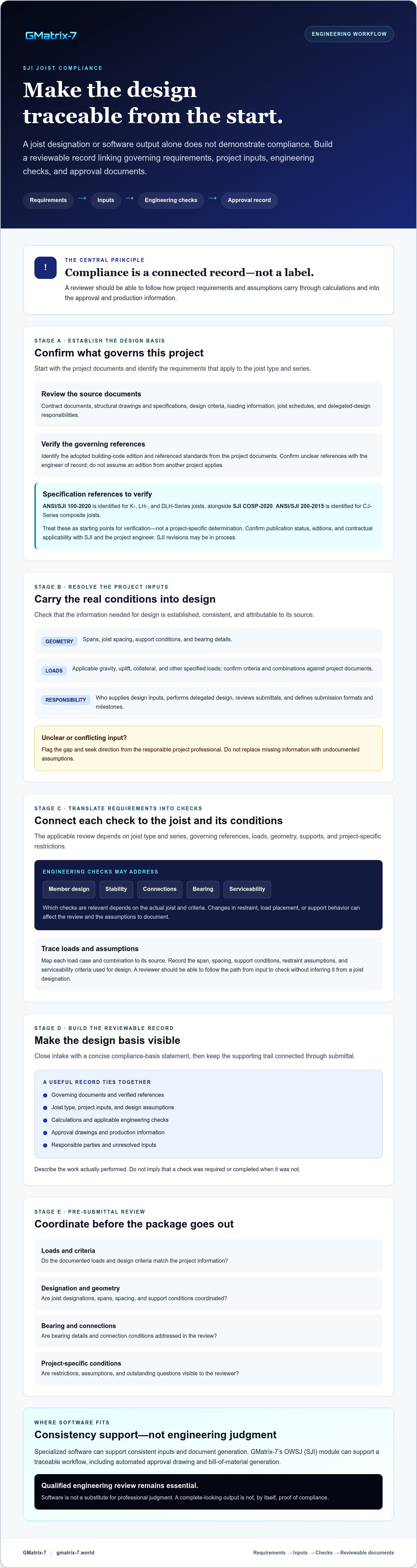
A consistent pre-submittal review connects confirmed project criteria to calculations, schedules, and approval documents. Follow the sequence below to catch mismatches before the package moves forward. Record findings as you go. A completed checklist supports review, but it is not an automatic certification of compliance.
- Confirm the basis. Check the required SJI specifications and editions, governing project criteria, referenced standards, and design assumptions against the contract documents. Resolve conflicting references with the responsible project professional.
- Verify loads. Compare specified load cases and combinations with their documented sources. Confirm that applicable gravity, uplift, collateral, and other project-specified loads appear in the design information.
- Cross-check geometry. Match spans, spacing, support conditions, and bearing details across structural drawings, schedules, and design records. Flag discrepancies rather than choosing an assumption without direction.
- Review joist designations and details. Confirm each designation corresponds to the intended joist type and project conditions. Check bearing, connections, and other specified conditions against the design basis and coordinated documents.
- Reconcile the package. Compare calculations and design outputs with joist schedules and approval drawings. Verify that revisions are consistent across documents and changed inputs are reflected in affected information.
- Close and record review items. Assign each exception or unresolved input to the responsible person, document its resolution, and note the reviewer, review date, and final approval status. Keep open items visible until they’re resolved.
What belongs on a pre-submittal checklist?
At minimum, include the governing SJI references and project criteria, design assumptions, loads, joist designations, spans, spacing, supports, bearing, connections, and specified project conditions. Add a clear status for each check, along with space to identify exceptions and decisions requiring professional-engineer review. The checklist should help another reviewer locate the supporting calculation or drawing, not simply mark a box as complete.
How should revisions and approval records be controlled?
Use consistent revision identifiers across calculations, drawings, schedules, and material information. Retain review comments, responses, accepted changes, and the documents affected by each revision. This creates a traceable history and helps prevent superseded information from being mistaken for the current design. For related guidance, consult the article on reducing errors in steel joist detailing workflows.
For teams assessing software-supported joist documentation, explore GMatrix-7 OWSJ workflows, including automated approval drawing and bill-of-material generation. Qualified engineering review remains essential to how to ensure SJI joist compliance and to confirm that the final package reflects project requirements.
Using GMatrix-7 OWSJ Software in a Traceable SJI Workflow
Specialized software can support a consistent handoff between joist design information and detailing documents. GMatrix-7 OWSJ (SJI), Bar Joists is an option for engineering and detailing teams evaluating this workflow. Its confirmed capabilities include automated approval drawing and bill-of-material generation. These outputs can help organize project information, but they don’t establish that the right criteria were selected or that every project requirement has been met.
How can automated outputs support reviewable joist documentation?
Generated drawings and material information are most useful when reviewers can compare them with the design basis and current project revisions. Keep engineering assumptions, input sources, review comments, and decisions visible alongside generated documents. For example, a reviewer should be able to identify which project revision a drawing reflects and trace a joist designation to its reviewed design information.
Use software to support documentation, not to replace engineering judgment. Qualified professionals still need to evaluate applicable requirements, confirm project inputs are complete, and review exceptions and final outputs. For broader technical context, consult Engineering OWSJ: The Definitive Guide to SJI Compliant Joist Design alongside the project-specific criteria.
What should a team confirm before adopting OWSJ software?
Assess fit against actual project workflows, not a generic feature list. Confirm supported joist types, required design inputs, available checks, output formats, and known limitations using current product information. Then consider whether generated approval drawings and bills of material fit the team’s review and revision-control process. If evaluating a demonstration, use representative project requirements and ask which functions are supported. Don’t infer capabilities that haven’t been verified.
- Confirm that the software’s supported joist types match the work your team performs.
- Check whether required inputs and outputs align with project documentation and review procedures.
- Identify limitations and determine how qualified reviewers will handle exceptions.
This verification is a practical part of how to ensure SJI joist compliance: select tools that support a traceable process, then review the engineering and documents independently. If you’re assessing workflow fit, explore GMatrix-7 OWSJ software and compare its documented capabilities with your team’s needs. Software supports the work; professional review remains essential.
Build a More Traceable Joist Review
A dependable SJI workflow starts by confirming project criteria and applicable requirements, then tracing loads, assumptions, and engineering checks through to approval documents. Consistent revision control and a clear record of open items help reviewers see what was evaluated and what still needs resolution.
That’s the practical answer to how to ensure SJI joist compliance: make the design basis visible, coordinate calculations and documents, and keep qualified engineering judgment central. Software can support this process, but it can’t guarantee compliance or replace review of project-specific requirements.
GMatrix-7 offers an OWSJ (SJI), Bar Joists software module with automated approval drawing and bill-of-material generation. If your team is evaluating tools for its joist workflow, explore GMatrix-7 OWSJ software and assess whether its documented capabilities fit your project needs.
With clear criteria and a reviewable record, your team can move forward with greater confidence at each step.
Frequently Asked Questions
What does SJI-compliant joist design mean?
SJI-compliant joist design means the design has been evaluated against applicable Steel Joist Institute requirements and project-specific criteria, with the basis documented for review. The joist type, loading, geometry, support conditions, and specified project requirements all inform the checks. A designation or software label alone doesn’t demonstrate compliance. The review record should connect governing references and project inputs to design decisions and submitted documents.
How do I know which SJI specification applies to a joist?
Identify the joist type and series, then check the contract documents for required SJI specifications, editions, amendments, and referenced standards. Different joist types may be governed by different specifications, so don’t select one based on familiarity alone. Confirm the adopted building-code edition and unclear references with the project engineer. Verify current publication titles and editions with SJI before design, since standards and project requirements may change.
Can joist design software ensure SJI compliance?
No. Software can support calculations and document preparation, but it can’t guarantee that a project meets every applicable SJI and project requirement. Incorrect criteria, omitted loads, or unchecked exceptions can undermine organized outputs. To understand how to ensure SJI joist compliance, treat software as workflow support: qualified professionals must verify governing inputs, evaluate assumptions and results, resolve exceptions, and review final submittals against project documents.
What information is needed to check a steel joist design?
A meaningful review needs governing project criteria and standards, joist type and designation, loads and combinations, span, spacing, geometry, support and bearing conditions, and relevant restraint assumptions. Include specified serviceability criteria and project-specific restrictions where applicable. The reviewer also needs current drawings and schedules, plus clear responsibility boundaries. If an input is missing or conflicting, document it and seek direction instead of silently assuming a value.
What should an SJI joist submittal include?
Follow the contract documents for required submittal contents and format. A package commonly needs the joist schedule and designations, applicable design information or calculations, governing assumptions and loads, and coordinated approval drawings showing relevant project details. Include revision identifiers and any requested material information. Check that the drawings and design records agree on spans, supports, bearing, connections, and specified conditions. Requirements vary by project, so confirm the exact package with the responsible reviewer.
Who is responsible for reviewing SJI joist compliance?
Responsibilities depend on the contract documents and delegated-design arrangement. The project’s specifying professionals establish project criteria and provide required design information; the joist designer or manufacturer completes the design assigned to them. The engineer of record and other designated reviewers assess submittals within their project roles. Confirm who resolves questions, reviews changes, and records acceptance. A software output or completed checklist doesn’t transfer or replace responsibilities assigned to qualified professionals.
How can I reduce errors in SJI joist detailing?
Use coordinated, current project information and consistent revision identifiers across design records, schedules, approval drawings, and material information. Cross-check joist designations, spans, spacing, loads, bearing, and connections, then record comments and how each was resolved. GMatrix-7 offers an OWSJ (SJI), Bar Joists module with automated approval drawing and bill-of-material generation. Confirm its supported inputs, outputs, and limitations, and have qualified reviewers verify generated documents against the design basis.


