
Relying on manual calculations for thin-walled steel isn't just inefficient; it's a liability in an industry governed by the rigorous ANSI/SDI AISI S100-2024 standards. You've likely felt the frustration of reconciling complex engineering inputs with the immediate demands of material procurement. Modern LGS structural design software has evolved from a simple drafting tool into a sophisticated engineering-led automation engine. This technology bridges the gap between theoretical compliance and fabrication-ready documentation, ensuring every thin-walled member meets global safety benchmarks without the risk of human error.
We understand that keeping pace with the Steel Deck Institute's latest requirements while minimizing material waste is a constant pressure on your workflow. This comprehensive guide provides the roadmap to master light gauge steel engineering through high-precision automation and seamless AISI compliance. You'll discover how to generate automated structural reports, produce accurate bills of materials, and streamline approval drawings to achieve a level of precision that manual processes simply can't match.
Key Takeaways
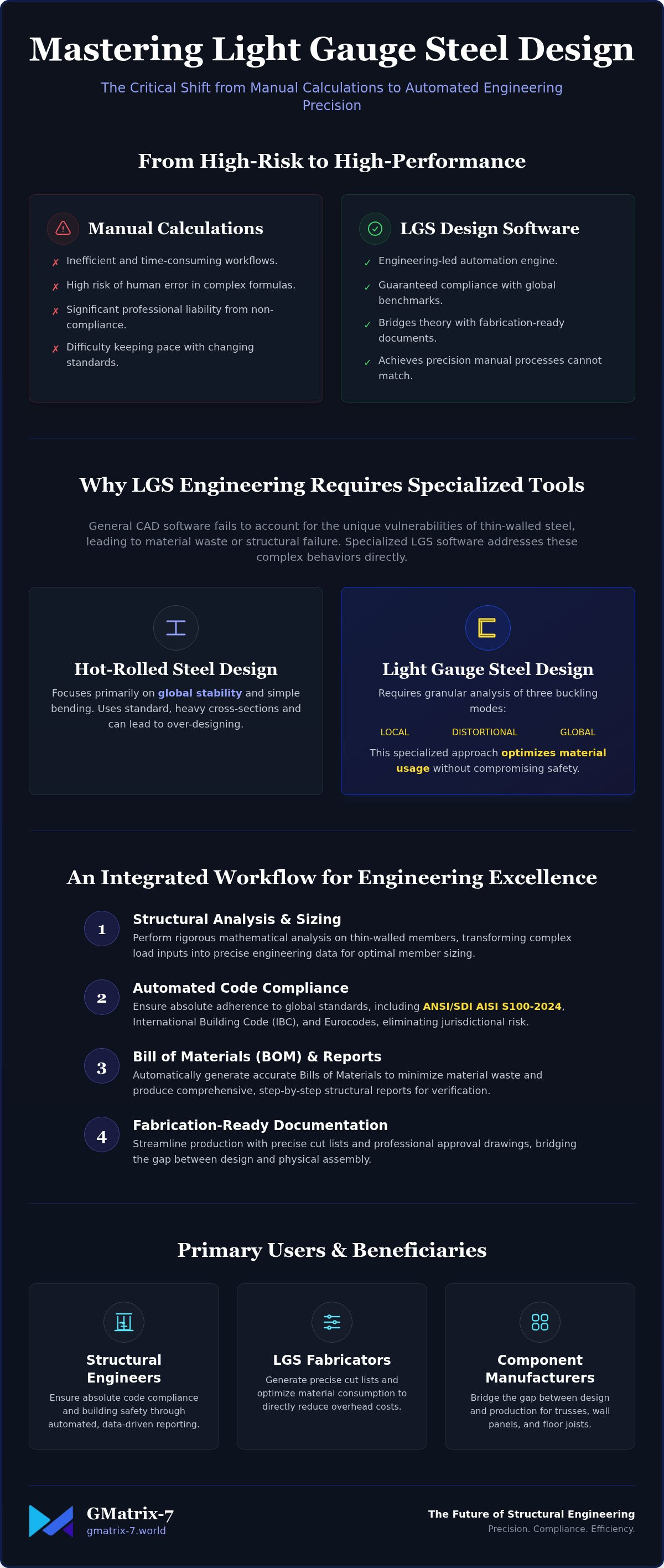
- Understand why high-performance LGS structural design software is the critical catalyst for transitioning from traditional heavy steel to optimized cold-formed engineering.
- Master the latest ANSI/SDI AISI S100-2024 specifications through automated compliance tools that eliminate the risks inherent in manual calculations.
- Achieve operational excellence by integrating automated Bill of Material (BOM) generation and precise member sizing into a single, unified workflow.
- Explore how the GMatrix-7 / LGS (AISI) module bridges the gap between complex structural analysis and the rapid generation of professional, fabrication-ready approval drawings.
What is LGS Structural Design Software?
LGS structural design software serves as the essential engine for modern engineering precision. It's a specialized class of technology engineered to calculate and validate the structural integrity of thin-walled members. Unlike general drafting tools, this software performs rigorous mathematical analysis on Cold-Formed Steel (CFS) components. The industry is witnessing a decisive shift from traditional hot-rolled heavy steel toward LGS in both commercial and residential sectors. This transition is driven by the material's superior strength-to-weight ratio, which allows for lighter foundations and significantly faster assembly. However, managing this efficiency requires software capable of predicting complex structural behaviors that standard tools simply ignore.
General-purpose CAD software lacks the specialized algorithms needed to account for the unique vulnerabilities of thin-walled steel. While a standard heavy beam might be analyzed for simple bending, LGS members are susceptible to various forms of instability due to their slender profiles. Advanced LGS structural design software provides the necessary computational power to optimize material usage without compromising safety. It transforms complex load inputs into precise engineering data; this ensures that every stud, track, and joist performs exactly as required under real-world conditions.
The Core Distinction: LGS vs. Hot-Rolled Steel Software
The primary challenge in LGS engineering lies in the behavior of thin-walled members. Traditional hot-rolled steel software focuses primarily on global stability, but LGS requires a much more granular approach. Specialized tools must calculate local, distortional, and global buckling simultaneously. These programs utilize advanced methodologies, such as the Effective Width Method or the Direct Strength Method (DSM), to determine the true capacity of a member. Because LGS often involves non-standard cross-sections and custom shapes, the software must be flexible enough to handle geometries that don't exist in standard hot-rolled libraries. This specialized focus prevents the over-designing of structures, which saves costs while maintaining peak performance.
Primary Users of LGS Engineering Tools
- Structural Engineers: They rely on these tools to ensure absolute code compliance and building safety through automated, data-driven reporting.
- LGS Fabricators: These professionals use the software to generate precise cut lists and optimize material consumption, which directly reduces overhead.
- Component Manufacturers: Specialized producers of trusses, wall panels, and floor joists use these modules to bridge the gap between design intent and physical production.
By integrating these specialized tools, firms can move beyond simple sketches into a world of verified engineering. The result is a workflow where safety and efficiency are no longer at odds, but are instead two sides of the same optimized coin.
Navigating Global Standards: AISI S100 and Structural Compliance
Engineering cold-formed steel requires absolute adherence to the AISI Design Standards. These specifications provide the legal and technical framework for thin-walled member safety. In 2026, the ANSI/SDI AISI S100-2024 standard remains the definitive benchmark for North American projects. For global firms, the challenge lies in the constant transition between these North American specs, the International Building Code (IBC), and various Eurocodes. High-tier LGS structural design software automates these transitions. It allows engineers to toggle between regional requirements without rebuilding models from scratch. This capability isn't just about speed; it's about eliminating the catastrophic risk of applying the wrong code to a specific jurisdiction.
Verifiable structural calculation reports act as your primary defense against professional liability. Manual spreadsheets are prone to hidden formula errors that can lead to structural failure or costly retrofits. Modern software generates comprehensive, step-by-step reports that display every calculation from local buckling checks to global stability analysis. This transparency provides peace of mind for both the engineer of record and the building official reviewing the submittal. Precision is paramount. Relying on outdated methods in an evolving regulatory landscape is a gamble that professional firms can't afford to take.
Automating AISI Structural Calculations
Buckling is the fundamental concern in LGS engineering. Software must perform iterative calculations for local, distortional, and global buckling to determine the true effective strength of a member. It simultaneously analyzes combined axial and bending stresses to ensure that studs and tracks can withstand complex loading scenarios. AISI S100 compliance is the non-negotiable baseline for structural safety in every LGS project. By offloading these complex iterations to a dedicated engine, you ensure that every member is optimized for both safety and material efficiency. This automation removes the bottleneck of manual verification.
Generating Professional Approval Drawings
Clear technical documentation is essential for securing building department permits. Your drawings must be more than simple framing layouts; they must reflect the actual structural capacity of every member. Advanced modules integrate structural data directly into technical drawing templates. This ensures that the detailing, such as screw patterns and connection points, matches the engineering analysis. For those seeking to unify their engineering and detailing workflows, exploring an integrated LGS structural module can significantly reduce the time spent on manual revisions and drafting errors. The result is a professional submittal package that commands respect and accelerates project timelines.
Core Functionalities of Advanced LGS Design Software
The true power of advanced LGS structural design software lies in its ability to transform complex engineering data into actionable production outputs. While basic tools focus on static analysis, premier platforms offer a holistic approach that manages member sizing under real-world load conditions. These systems provide the detailing precision necessary for intricate connections and assembly instructions; this ensures that what is designed in the office is exactly what is built in the field. By integrating directly with CNC machinery, the software establishes a seamless direct-to-fabrication workflow that eliminates the risks of manual data entry.
This technological integration extends beyond the primary structural frame. Modern solutions now generate precise load tables for various cladding and decking systems. This level of granular detail allows engineers to account for the specific performance of single skin or sandwich panels under intense environmental pressures. The result is a more resilient structure that utilizes every ounce of material to its maximum potential. Reliability is built into the workflow, ensuring that every panel and deck meets the highest safety standards without the need for redundant, time-consuming checks.
Automated BOM and Material List Generation
Precision in engineering is irrelevant if the procurement process is flawed. Automated Bill of Material (BOM) generation creates a direct link between the engineering model and the material list. Within seconds, the software generates an exact inventory of every component required for the project. This capability significantly reduces material waste by optimizing member lengths and gauges based on the actual structural requirements. Beyond the steel members, these automated lists track essential hardware, fasteners, and accessories; this prevents the costly delays associated with missing components during the assembly phase. Efficiency in procurement becomes a natural byproduct of rigorous design.
Load Table Generation for Panels and Decks
Calculating capacities for various building envelopes is often a manual bottleneck. Specialized software handles the rigorous math required to determine how single skin and sandwich panels respond to wind and snow loads. This is particularly critical for multi-story LGS structures where composite deck load tables are essential for floor stability. GMatrix-7 automates the generation of these tables; this replaces weeks of manual engineering with a few clicks of a button. By providing these data-driven insights instantly, the software allows firms to move from the design phase to the fabrication phase with unprecedented speed. This automation transforms a complex calculation task into a streamlined, high-value output.
Evaluating LGS Software: Scalability and Workflow ROI
Selecting the right LGS structural design software is a high-stakes decision that dictates your firm's operational ceiling. It isn't merely about drafting; it's about securing a long-term ROI through increased engineering throughput. While sophisticated platforms require an initial investment in training, the productivity gains manifest as a total transformation of the design cycle. The most robust solutions utilize all-in-one modules that unify design, detailing, and documentation. This consolidation eliminates the data fragmentation that occurs when switching between disconnected software packages. Scalability remains a non-negotiable requirement. Your chosen platform must handle the simplicity of a residential shed and the immense complexity of large-scale MBS projects with equal precision.
True efficiency relies on seamless integration with established BIM and CAD ecosystems. When your LGS structural design software communicates fluently with architectural models, you eliminate the information silos that cause project communication breakdowns. This interoperability ensures that every structural member is accounted for within the broader building context. It allows for real-time clash detection and collaborative adjustments before a single piece of steel is ever cut. Reliability in the digital phase translates directly to security during the construction phase.
Reducing Project Lead Times with Automation
Automation serves as the primary catalyst for reducing project lead times. Transitioning from manual detailing to automated approval drawings can accelerate your submittal process by several weeks. This speed doesn't sacrifice accuracy; it enhances it. Error-free BOMs prevent the site delays and procurement mistakes that frequently erode project margins. Automated detailing reduces material waste by up to 15% in large-scale projects through precise member optimization and cut-list generation. These savings allow firms to submit more competitive bids while maintaining higher profitability and a smaller environmental footprint.
Technical Support and Global Standards
Sophisticated engineering tools require a support structure that matches their technical depth. You shouldn't settle for generic help desks. You need expert-led support from professionals who understand the nuances of cold-formed steel. This partnership ensures that your team can overcome complex modeling challenges without stalling production. Ensuring the software stays current with global engineering shifts is equally critical. You must evaluate the frequency of updates to confirm the software supports the latest ANSI/SDI AISI S100-2024 standards. A commitment to regular feature updates is the hallmark of a world-class technology partner that values excellence above all else.
To experience the impact of engineering-led automation on your next project, explore the GMatrix-7 / LGS (AISI) solution and see the difference precision makes.
The GMatrix-7 / LGS (AISI) Solution: Engineering Excellence
GMatrix-7 / LGS (AISI) stands as the definitive benchmark for structural automation in the cold-formed steel industry. It's not merely a calculation tool; it's a comprehensive engineering environment that bridges the gap between high-level structural analysis and simplified, fabrication-ready output. The platform transforms the way engineers interact with the ANSI/SDI AISI S100-2024 standard by embedding compliance directly into the design logic. This ensures that every output, from member sizing to connection detailing, carries the weight of authoritative engineering precision. It's about providing the peace of mind that comes from a battle-tested, data-driven process.
The true strength of this ecosystem lies in its modular versatility. Users can transition seamlessly between LGS design and other structural requirements, such as GMatrix-7 / MBS (IBC) for metal building systems or GMatrix-7 / OWSJ (SJI) for open web steel joists and bar joists. This unified approach eliminates the friction of data migration between disparate tools and maintains a single source of truth for the entire project. By housing these complex engineering tasks within a single, stable environment, firms achieve a level of operational security that disconnected workflows simply can't provide. Excellence is no longer a goal; it becomes the standard output of your daily operations.
From Design to Detailing: A Unified Workflow
Generating professional approval drawings often represents a significant bottleneck in project timelines. GMatrix-7 / LGS (AISI) resolves this by automating the generation of high-fidelity documentation directly from the structural model. This ensures that every detail on the drawing is backed by rigorous engineering data, providing peace of mind during the permitting process. For fabricators, the precision of our automated Bill of Material generation is a critical asset. It eliminates the ambiguity of manual cut lists and ensures that material procurement is 100% aligned with the engineered design. Global engineering firms choose GMatrix-7 because it delivers a methodical, logical workflow that prioritizes accuracy at every stage of the project lifecycle.
Start Your Structural Automation Journey
The competitive landscape of 2026 rewards those who prioritize data-driven, compliant structural design. Adopting advanced LGS structural design software is no longer a luxury; it's a strategic necessity for firms that aim to lead the industry. By shifting toward an automation-led workflow, you reduce your liability, optimize your material usage, and accelerate your time-to-market. The transition from complexity to simplicity is possible when you have the right technological partner. It's time to move away from manual limitations and toward a future defined by engineering precision and commercial urgency.
Don't let outdated processes limit your firm's potential. Discover the GMatrix-7 / LGS (AISI) module today and secure your position at the forefront of engineering innovation.
Securing the Future of Cold-Formed Steel Engineering
Precision in thin-walled design requires more than just drafting; it demands automated compliance and integrated documentation. We've explored how specialized engines eliminate manual calculation risks and bridge the gap between complex engineering and physical fabrication. Integrating advanced LGS structural design software into your firm's workflow is the decisive step toward achieving operational excellence and long-term project profitability. Relying on outdated methods is a liability you can't afford in an industry that moves with such technical rigor and speed.
By leveraging AISI S100 compliant modules, you ensure every member meets the highest safety benchmarks. GMatrix-7 provides the tools necessary to transform your process through automated BOM generation and professional approval drawing automation. These features don't just save time; they provide the peace of mind that comes from absolute accuracy. It's time to move beyond the limitations of manual detailing and embrace a future defined by data-driven success. Optimize your LGS engineering with GMatrix-7 and lead your next project with absolute structural confidence.
Frequently Asked Questions
What is the difference between LGS framing software and structural design software?
Framing software primarily handles architectural layouts and panelization. Conversely, LGS structural design software performs the rigorous engineering calculations required to validate member integrity under load. It analyzes complex buckling behaviors and ensures every component meets specific safety standards. While framing tools focus on where the steel goes, structural software proves that the steel will actually hold, transforming a simple layout into a safe, code-compliant structure.
Does LGS design software automatically update to the latest AISI S100 standards?
Leading software providers issue regular updates to maintain alignment with the latest industry standards. For instance, the transition to ANSI/SDI AISI S100-2024 requires specific algorithmic adjustments that only dedicated engineering platforms can provide. You should confirm that your software maintenance agreement includes these critical updates to ensure your projects remain legally and technically compliant in every jurisdiction, as manual adjustments are simply too slow and error-prone for modern firms.
Can GMatrix-7 generate load tables for sandwich panels?
Yes, GMatrix-7 provides specialized capabilities for generating precise load tables for sandwich panels, single skin panels, and composite decks. This automation replaces weeks of manual engineering with a data-driven process that calculates exact capacities under various environmental pressures. It ensures that your cladding and decking systems are optimized for performance without the risk of over-engineering or material waste in your building envelope.
How does automated BOM generation reduce material costs in steel construction?
Automated BOM generation removes the risk of human error by extracting exact material quantities directly from the validated engineering model. This precision allows fabricators to optimize member lengths and gauges, which can reduce material waste by up to 15% on large projects. By ensuring procurement is 100% accurate, you eliminate the site delays and additional shipping costs associated with missing or incorrect components during the assembly phase.
Is it possible to integrate LGS design software with CNC fabrication machines?
Modern LGS structural design software creates a seamless link between the engineering office and the production floor. By exporting precise data files, the software integrates directly with CNC fabrication machinery to automate the cutting and punching process. This direct-to-fabrication workflow ensures that the final physical members are identical to the engineered model, maintaining structural integrity throughout the entire assembly process and eliminating the risks inherent in manual data entry.
What are the hardware requirements for professional structural engineering software?
Professional structural engineering software demands robust hardware to perform complex finite element analysis and iterative buckling calculations. You generally need a high-performance multi-core processor, a dedicated professional-grade graphics card, and a minimum of 16GB to 32GB of RAM. While specific requirements vary by software version, investing in a high-tier workstation is essential for maintaining the speed and stability required for high-stakes engineering projects and large-scale modeling.
Does GMatrix-7 support both AISI and IBC standards simultaneously?
Yes, GMatrix-7 / LGS (AISI) operates effectively within the International Building Code (IBC) framework. It allows structural engineers to apply the specific AISI S100 standards for cold-formed steel members while ensuring the entire project satisfies the broader IBC requirements. This dual-standard support provides the flexibility needed to handle diverse commercial and industrial projects across different global jurisdictions with absolute confidence in your engineering output.


