
Structural integrity isn't a variable you can afford to leave to chance. While manual spreadsheets were once the industry standard, the margin for error in modern SJI compliant joist design has narrowed to the point where traditional methods are a liability. You likely recognize the daily frustration of reconciling complex load cases with evolving code cycles, only to find that your bill of materials doesn't align with your final engineering drawings. It's a bottleneck that drains professional resources and introduces unnecessary risk into every project.
This guide empowers you to master the complexities of SJI 100-2020 standards while leveraging high-level automation to eliminate manual calculation errors. We'll examine how precision-engineered software like GMatrix-7 transforms the design workflow, moving from intricate inputs to optimized, compliant outputs. You'll discover how to generate seamless approval drawings and accurate BOMs that reduce material waste and ensure total structural certainty. We'll also explore the transition to streamlined, data-driven engineering that defines the current professional standard for open web steel joists.
Key Takeaways
- Grasp the technical nuances of SJI 100-2020 and IBC requirements to secure long-term structural reliability and mitigate liability.
- Eliminate manual calculation errors by integrating automated systems that guarantee SJI compliant joist design from conception to fabrication.
- Bridge the gap between engineering intent and production detailing through sophisticated, data-driven automation that ensures total documentation consistency.
- Optimize your project lifecycle with advanced coordination protocols and automated collision detection to minimize material waste and design revisions.
- Accelerate project delivery by instantly generating precise approval drawings and comprehensive Bills of Materials for even the most complex load cases.
Navigating the Complexity of SJI Compliant Joist Design
SJI compliance represents a rigorous adherence to the Steel Joist Institute's specifications for every phase of Open web steel joist (OWSJ) design, manufacture, and field application. In the high-stakes engineering environment of 2026, failing to meet these standards compromises structural integrity and exposes firms to severe legal liability. True SJI compliant joist design ensures that every member, from the standard K-Series to the massive DLH-Series, performs exactly as predicted under load. This precision is not just a regulatory hurdle; it is the foundation of professional excellence and structural safety.
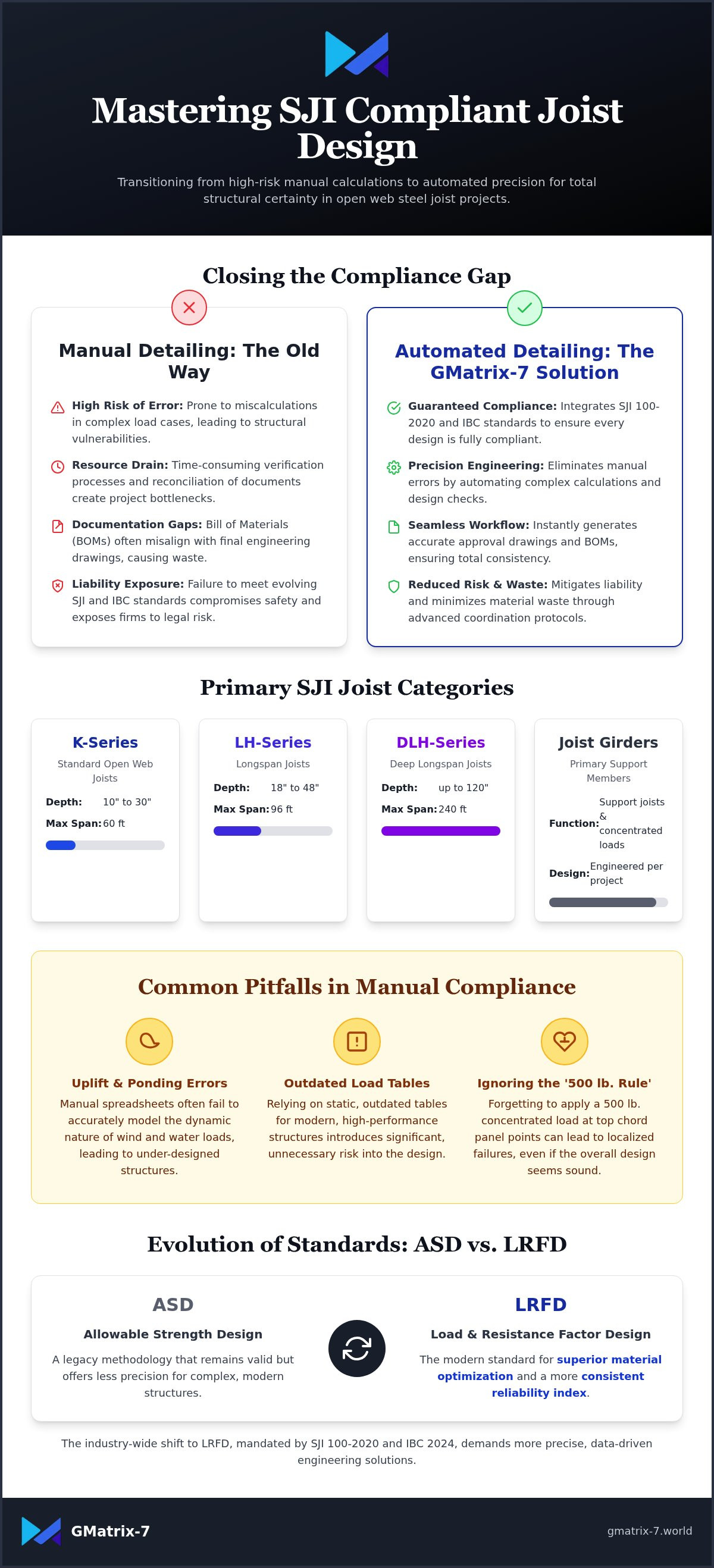
The current industry landscape covers four primary categories of joists, each with distinct performance parameters:
- K-Series: Standard joists with depths from 10 to 30 inches, optimized for spans up to 60 feet.
- LH-Series: Longspan joists ranging from 18 to 48 inches deep for extended spans up to 96 feet.
- DLH-Series: Deep Longspan joists reaching depths of 120 inches to support spans up to 240 feet.
- Joist Girders: Primary structural members engineered to support other joists and concentrated loads efficiently.
Forward-thinking engineers are moving beyond static load tables toward 'Virtual Joists.' This approach utilizes high-fidelity structural modeling to simulate real-world behavior more accurately than traditional 2D methods. By treating the joist as a dynamic component within a larger system, designers can identify potential issues long before the fabrication stage begins.
The Role of the Steel Joist Institute (SJI)
The SJI serves as the definitive authority, establishing industry-wide safety and performance benchmarks that protect both the public and the engineering profession. These specifications are directly integrated into the International Building Code (IBC). While the 2021 IBC remains the standard for many current projects, the 2026 project cycle requires a deep understanding of the evolving IBC 2024 requirements. Relying on certified manufacturer data through platforms like GMatrix-7 is the only way to validate that a design meets the current SJI 100-2020 requirements. This synergy between SJI standards and building codes creates a unified framework for safety and technical excellence.
Common Pitfalls in Manual Compliance Checks
Manual verification often fails when engineers encounter complex, non-standard load cases. Frequent errors occur during uplift analysis and ponding calculations, where the dynamic nature of wind and water loads exceeds the capacity of simple manual spreadsheets. Relying on outdated load tables for modern, high-performance structures is a risk that modern automation effectively eliminates. Accuracy requires a data-driven approach that accounts for every variable in real-time. For special profiles in OWSJ design, the '500 lb. rule' requires a minimum concentrated load of 500 lbs to be applied at any panel point of the top chord to ensure local stability. Failing to account for these specific SJI mandates can lead to localized failures even if the overall design appears sound on paper.
The Evolution of Standards: SJI 100-2020 and IBC 2024
The transition from legacy codes to the current SJI 100-2020 standard marks a definitive shift in how engineers approach structural efficiency. This update refines material strength requirements and introduces design methodologies that demand higher precision. As the 2026 engineering landscape adopts IBC 2024 requirements, the focus on SJI compliant joist design must evolve from simple load-matching to comprehensive systems analysis. This evolution ensures that structures aren't just built to code, but are optimized for long-term performance under diverse environmental stressors.
A primary driver of this change is the industry-wide transition from Allowable Strength Design (ASD) to Load and Resistance Factor Design (LRFD). While ASD remains a valid methodology, LRFD provides a more nuanced approach by applying separate factors to loads and resistances. This allows for a more consistent reliability index, particularly in complex structures where seismic performance and floor vibration are critical design constraints. Modern project specifications increasingly mandate LRFD to achieve superior material optimization and safety. Beyond the structural design, compliance also extends to field safety. Adhering to OSHA safety standards for steel joists is essential for ensuring that design intent translates safely into physical reality during the erection process.
Critical Load Cases for SJI Compliance
Achieving total compliance requires rigorous analysis of environmental variables like snow drift and wind uplift. SJI 100-2020 provides specific guidance on handling non-uniform loading on joist girders, a scenario that often triggers structural failure if miscalculated. Concentrated loads from rooftop units or suspended equipment necessitate an automated analysis of 'special' joist profiles. Engineering firms that utilize advanced OWSJ design software can navigate these complex load cases with total confidence, ensuring every member is sized correctly for its specific application.
Compliance Documentation and Professional Seals
The Engineer of Record (EOR) carries the final responsibility for reviewing joist placements and ensuring they align with the overall structural plan. SJI-compliant submittals must include detailed calculation reports that validate every design decision. Digital signatures and automated reporting have replaced manual paperwork, standardizing the approval process and reducing the risk of administrative errors. This digital workflow provides a verifiable audit trail, which is indispensable for modern risk management and project transparency. It's a shift that prioritizes data integrity and professional accountability at every stage of the project lifecycle.
Automated vs. Manual Detailing: Closing the Compliance Gap
The legacy "calculator" approach to OWSJ design is a fragmented methodology that no longer meets the demands of high-performance engineering. Relying on disconnected spreadsheets for vibration, uplift, and ponding analysis creates dangerous data silos. In contrast, an integrated system ensures that SJI compliant joist design is woven into every phase of the project, from initial structural modeling to the final bill of materials. Automation closes the gap between engineering intent and fabrication detailing, ensuring that what you design is exactly what the shop produces without transcription errors or lost data.
Precision engineering delivers a direct return on investment by eliminating material waste. Manual tools often force engineers into "conservative" designs because they lack the time to iterate for optimization. This leads to over-designed, heavy structures that inflate project costs and increase the carbon footprint of the build. By utilizing automated systems, firms can achieve a level of structural efficiency that manual methods simply cannot match. Compliance begins with a deep understanding of the SJI Standards and Specifications, yet static documents are only the starting point for a truly optimized project.
The Hidden Costs of Fragmented Design Tools
Relying on individual tools for specific load cases is a massive drain on professional productivity. Engineers lose hours re-entering data into separate uplift or bay analysis software, which increases the cumulative risk of manual errors across large-scale metal building projects. These fragmented workflows often result in "good enough" designs that are functionally safe but economically inefficient. Manual errors in complex projects don't just slow down approvals; they can lead to costly field fixes or structural failures that damage a firm's reputation and bottom line.
Standardizing the Workflow with GMatrix-7 OWSJ
GMatrix-7 represents the professional choice for manufacturers and engineers who require high-volume, high-accuracy detailing. The OWSJ module automates the generation of load tables and ensures total adherence to current standards. This software facilitates a seamless transition from complex structural analysis to shop-ready approval drawings in minutes rather than days. By integrating IBC 2024 compliance directly into the detailing environment, GMatrix-7 eliminates the friction between design and production. It's a world-class solution that provides the peace of mind that comes with total documentation consistency and structural certainty.
Best Practices for Optimizing Open Web Steel Joist Workflows
Workflow optimization in modern structural engineering moves beyond simple speed; it focuses on eliminating the friction between engineering intent and physical delivery. A robust protocol for early-stage coordination between the Engineer of Record (EOR) and the joist manufacturer is vital for project success. This proactive alignment ensures that SJI compliant joist design parameters, such as specific load envelopes and non-standard profiles, are locked in before detailing begins. Establishing these benchmarks early prevents the costly late-stage revisions that often plague complex industrial projects.
Implementing automated collision detection within the joist detailing environment is a critical step for high-performance teams. This technology identifies spatial conflicts with HVAC, plumbing, or electrical systems in real-time, allowing for immediate adjustments before the steel reaches the fabrication floor. Utilizing standardized SJI nomenclature across all technical documentation further ensures clarity, preventing the ambiguity that leads to field errors. Furthermore, incorporating real-time Bill of Material (BOM) generation allows project managers to track material costs and quantities throughout the design phase. This level of financial and material control provides a competitive edge in procurement and supply chain management.
Streamlining Approval Drawing Generation
Professional joist approval drawings must serve as a definitive roadmap for both the engineer and the erector. These documents must include clear joist designations, specific bearing requirements, and precise bridging layouts to meet safety standards. Automated detailing tools significantly reduce the RFI cycle by providing the EOR with comprehensive, data-rich documentation that addresses potential concerns upfront. Clear labeling for field-installed accessories, including bridging and headers, is essential for ensuring that the structural integrity of the final assembly matches the design model. Efficiency in this phase directly translates to faster project approvals and reduced downtime.
Precision Load Table Generation
Generating precise load tables for single skin and composite deck systems requires a rigorous analysis of deck-to-joist interaction. These tables are indispensable for accurate project bidding and efficient material procurement, as they define the safe operating limits of the entire floor or roof system. For firms seeking to maximize structural efficiency while maintaining total compliance, GMatrix-7 provides automated load table generation that guarantees absolute data accuracy for every joist series. Accurately calculating these values prevents the material waste associated with over-engineering. Joist spacing and deck load capacity share an inverse relationship, where increasing the distance between joists necessitates a corresponding reduction in the allowable uniform load on the deck.
GMatrix-7: The Authoritative Solution for SJI Compliant Detailing
GMatrix-7 stands as the premier platform for structural design and detailing automation. While fragmented tools struggle with the nuances of modern codes, the OWSJ module handles complex SJI 100-2020 load requirements with effortless precision. This system isn't just a utility; it's a comprehensive engineering engine designed to ensure that every joist profile meets the highest safety benchmarks. By integrating these standards directly into the design environment, the software eliminates the traditional friction between engineering analysis and shop-ready output. It's a professional alternative to the data silos that often slow down project timelines.
Reliability is the cornerstone of the GMatrix-7 ecosystem. Developed under the leadership of Dr. Simon B., a recognized authority in structural automation, the platform provides a level of security that manual methods cannot replicate. Engineers and manufacturers gain the peace of mind that comes from using a battle-tested solution. This technology doesn't just calculate; it optimizes, ensuring that your SJI compliant joist design is both structurally superior and commercially viable. Experience the synergy of high-speed detailing and total compliance through a professional consultation that refines your specific workflow requirements.
Unrivaled Accuracy in Automated BOMs
Precision in OWSJ engineering extends beyond the drawing set to the fabrication floor. GMatrix-7 facilitates Automated Bill of Material Generation, providing steel fabricators with 100% accurate material lists instantly. This capability eliminates the error-prone manual "take-off" process, which is often a source of significant financial leakage in large-scale projects. By ensuring that every ton of steel is accounted for before the first cut is made, the software drives overall project profitability and drastically reduces material waste. It's a data-driven approach that transforms the economic profile of joist production, allowing for tighter bids and more reliable procurement cycles.
A World-Class Partner for Structural Excellence
As a global leader in structural engineering software, GMatrix-7 provides more than just domestic compliance. The platform's sophisticated architecture allows it to adapt to various international standards, including AISI and IBC, making it a versatile asset for world-class firms. This adaptability ensures that your firm remains competitive in a globally minded industry while maintaining the rigorous standards required for safety and excellence. The transition from complexity to streamlined output is no longer a distant goal; it's a functional reality for those who choose superior technology. Experience the future of SJI compliant design with GMatrix-7 and secure your position at the forefront of structural engineering innovation.
Securing the Future of Structural Detailing
Mastering SJI compliant joist design is no longer just about following a checklist; it's about integrating precision at every stage of the project lifecycle. We've explored how transitioning to SJI 100-2020 standards and IBC requirements demands a shift from fragmented manual tools to high-performance automated systems. By bridging the gap between engineering intent and fabrication detailing, professionals can eliminate the transcription errors that drive up costs and introduce structural risk. Global structural fabricators and engineers now rely on data-driven workflows to ensure that every member is optimized for maximum efficiency and total safety.
GMatrix-7 provides the authoritative framework needed to navigate these complexities with absolute confidence. With advanced SJI 100-2020 compliance modules and Automated Bill of Materials (BOM) generation, the platform transforms intricate inputs into streamlined, shop-ready outputs. It's time to move past the limitations of legacy spreadsheets and embrace a world-class standard of structural excellence. Optimize your OWSJ workflow with GMatrix-7 and experience the peace of mind that comes with total structural certainty. Your next project deserves the precision of an industry leader.
Frequently Asked Questions
What are the primary requirements for SJI compliant joist design in 2026?
Primary requirements include strict adherence to SJI 100-2020 specifications and the latest International Building Code mandates. This involves verifying load envelopes, material strengths, and stability criteria for K, LH, and DLH series. For 2026 project cycles, engineers must also ensure their SJI compliant joist design accounts for refined seismic and floor vibration requirements. Total compliance is only achieved when design intent matches certified manufacturer data and professional submittal standards.
How does SJI 100-2020 differ from previous steel joist standards?
SJI 100-2020 introduces updated material strength requirements and more rigorous design methodologies compared to previous iterations. It was officially adopted on April 27, 2020, and became effective on July 1, 2020. These revisions refine how engineers calculate capacities for various joist series and establish clearer protocols for handling "special" profiles. This standard serves as the current benchmark for structural safety and performance in the steel joist industry.
Can I use standard IBC load tables for OWSJ design, or is SJI certification required?
SJI certification is required because standard IBC tables are high-level references that point to the specific SJI load tables for actual capacity values. While the IBC incorporates SJI standards by reference, the SJI load tables provide the granular data needed for K-Series, LH-Series, and DLH-Series joists. Relying solely on general building code summaries without SJI-certified data introduces structural risk and potential code violations during the building inspection phase.
What is the '500 lb. rule' in SJI design and why does it matter?
The '500 lb. rule' mandates that a minimum concentrated load of 500 lbs must be applied at any panel point of the top chord for special joist profiles. This requirement ensures local stability and prevents buckling in members subjected to non-uniform or unexpected loading. It's a critical safety threshold that protects the joist's integrity during both the construction phase and the building's operational life.
How does automated detailing software ensure SJI compliance for special joist profiles?
Automated software ensures compliance by applying SJI 100-2020 logic to complex, non-standard load cases that manual tables can't address. By integrating uplift, ponding, and snow drift analysis into a single environment, the software guarantees a SJI compliant joist design even for the most intricate profiles. This eliminates the transcription errors and data silos common in manual "calculator" workflows, providing a verifiable audit trail for every structural member.
What documentation is required for a joist design to be considered SJI compliant?
A compliant design requires a complete documentation package including professional calculation submittals, sealed approval drawings, and a detailed Bill of Materials. These documents must clearly outline joist designations, bearing requirements, and bridging layouts as specified by SJI standards. The Engineer of Record (EOR) carries the final responsibility for reviewing these submittals to ensure they align with the overall structural integrity of the project.
How do GMatrix-7 modules integrate with existing structural engineering workflows?
GMatrix-7 modules integrate by automating the transition from structural analysis to shop-ready documentation like approval drawings and BOMs. The software functions as a high-level consultant that bridges the gap between the EOR's design intent and the manufacturer's fabrication detailing. This seamless data flow reduces RFI cycles and ensures that the final physical product matches the optimized structural model without the need for manual data re-entry.
Is SJI compliance necessary for cold-formed or light gauge steel joists?
SJI compliance isn't required for light gauge steel joists as they're governed by American Iron and Steel Institute (AISI) standards. SJI specifically regulates the design and manufacture of open web steel joists and joist girders. While GMatrix-7 offers modules for both SJI and LGS (AISI) applications, it's essential to apply the correct regulatory framework based on the specific material and structural configuration of the project.


