

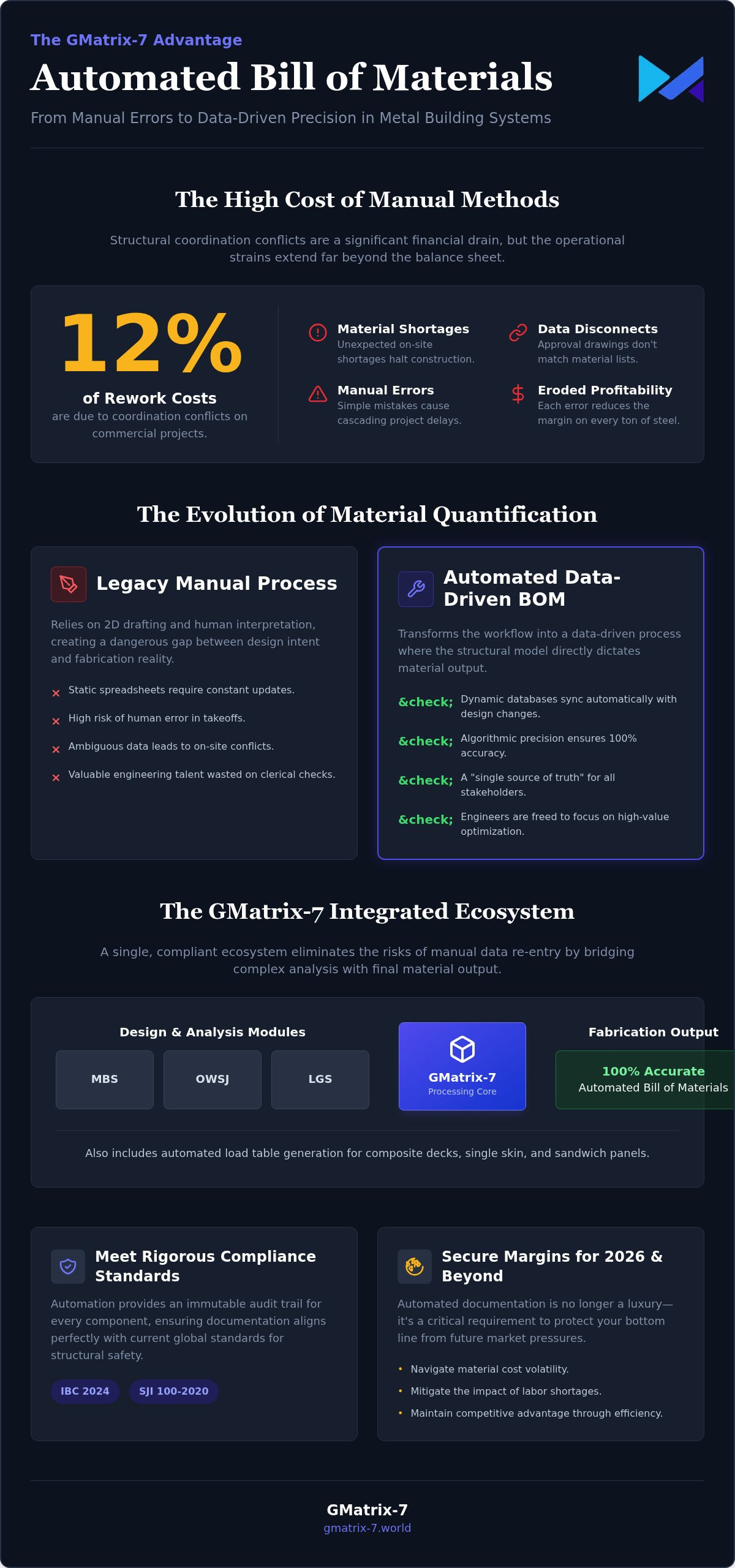
Structural coordination conflicts currently account for 12% of the total rework costs on commercial projects, a financial burden that sophisticated engineering firms can no longer accept. You've likely experienced the operational strain of on-site material shortages or the dangerous disconnect between approval drawings and shop material lists. These manual errors don't just delay timelines; they erode the profitability of every ton of steel. Transitioning to an automated BOM for metal buildings is no longer a luxury for the tech-forward; it is a critical safeguard for maintaining 100% accuracy in a high-stakes market.
This article explores how automated Bill of Materials generation revolutionizes metal building design by eliminating manual entry and accelerating fabrication workflows. You'll discover how GMatrix-7 integrates with IBC 2024 and SJI 100-2020 standards to deliver seamless compliance and reduced lead times. We will detail the technical shift toward data-driven documentation that secures your role as an industry leader while protecting your bottom line from the rising costs of structural steel in 2026.
Key Takeaways
- Understand the transition from 2D manual drafting to a data-driven automated BOM for metal buildings that ensures total synchronization between structural design and fabrication lists.
- Learn how specialized engineering workflows bridge the gap between complex analysis and final material output, including automated load table generation for composite decks and sandwich panels.
- Analyze the 2026 economic landscape, where material cost volatility and labor shortages make automated documentation a critical requirement for maintaining project margins.
- Identify the strategic advantages of integrating MBS, OWSJ, and LGS design modules into a single, compliant ecosystem to eliminate the risks of manual data re-entry.
The Evolution of Material Quantification in Metal Building Systems
Traditional material quantification once relied on 2D drafting and human interpretation. This legacy approach created a dangerous translation gap between design intent and fabrication reality. In the context of structural steel, a Bill of Materials (BOM) isn't just an inventory list; it's a precise engineering record of every member, plate, and fastener required to ensure structural integrity. Implementing an automated BOM for metal buildings transforms this workflow into a data-driven process where the structural model directly dictates the material output. This evolution eliminates the ambiguity of manual takeoffs and secures the "single-source-of-truth" necessary for modern engineering excellence.
From Manual Entry to Algorithmic Precision
Manual entry is a liability. In large-scale metal building systems (MBS), a single missed bolt or an incorrectly sized purlin can stall an entire site, leading to cascading delays and significant financial loss. These errors contribute to the estimated 12% rework costs that plague commercial projects. Algorithmic generation removes the human element from the calculation phase entirely. Instead of static spreadsheets that require constant manual updates, modern systems like GMatrix-7 utilize dynamic, software-linked databases. This ensures that any change in the structural analysis automatically ripples through to the material list. It's about achieving precision at scale. By transitioning to automated data, firms can reallocate their best engineering talent away from clerical checks and toward high-value design optimization.
Meeting IBC 2024 and SJI Compliance Standards
The 2026 regulatory environment demands higher transparency and more rigorous documentation. Compliance with IBC 2024 and SJI 100-2020 for open web steel joists (OWSJ) requires a level of detail that manual lists can't reliably sustain. Automation provides an immutable audit trail for every component in the building shell. When you use software that integrates design and material lists, you're not just saving time; you're securing a professional safeguard. GMatrix-7 pioneers this by ensuring that every component in the automated BOM for metal buildings aligns perfectly with current global standards. This level of integration is essential for passing structural safety audits and maintaining the pride of high-level achievement in a competitive market. Precise documentation isn't just a requirement. It's a hallmark of a battle-tested, authoritative partner.
Technical Mechanics: How GMatrix-7 Bridges Design and Fabrication
The technical bridge between structural analysis and fabrication is built on the precision of an automated BOM for metal buildings. GMatrix-7 operates by ingesting complex structural inputs and translating them into actionable data without human intervention. This workflow starts at the analysis phase, where the software evaluates member capacities and connections. Instead of requiring a separate detailing team to interpret these results, the system generates a comprehensive material list directly from the engineering model. This direct link is the foundation of Building Information Modeling (BIM) principles, ensuring that the physical reality of the building matches the digital intent with zero variance.
Automating Load Tables and Component Lists
A significant bottleneck in traditional workflows is the manual calculation of load tables for specialized components like composite decks and sandwich panels. GMatrix-7 eliminates this friction by integrating these calculations into the material quantification process. The software automatically generates precise load tables for single skin and sandwich panels, ensuring that the specified gauges and profiles are reflected accurately in the final BOM. For Light Gauge Steel (LGS) projects, the system utilizes AISI structural design tools to feed the fabrication list directly. Every stud, track, and fastener is accounted for based on the actual structural requirements. This level of granular automation provides the peace of mind that comes from knowing your material procurement is based on rigorous, data-driven optimization. To see how these modules integrate with your current workflow, you can explore the GMatrix-7 technical specifications for more details.
Synchronizing Approval Drawings with Shop Lists
Maintaining the "Golden Thread" of data is critical for project success. In manual workflows, the "re-detailing" phase often introduces errors where the approval drawings and the final shop material lists fall out of sync. GMatrix-7 solves this by generating both outputs from the same core dataset. When an engineer approves a drawing, they're simultaneously approving the material list that purchasing will use. This synchronization reduces friction between engineering and procurement departments, ensuring that what was designed is exactly what is ordered. By utilizing an automated BOM for metal buildings, firms eliminate the need for redundant checks and manual re-entry. The result is a streamlined cycle that moves from design approval to fabrication with unprecedented speed and reliability. This isn't just about efficiency; it's about establishing a world-class standard of excellence that protects structural project margins in a volatile market.
Economic and Regulatory Trends Driving BOM Automation in 2026
The 2026 economic environment imposes a rigorous mandate for structural efficiency. With structural steel prices averaging $2,519.61 per ton as of July 2026, even minor errors in material estimation translate into thousands of dollars in lost revenue. Nonresidential construction input prices saw an annualized increase of 7.1% earlier this year, compounding the pressure on project margins. In this climate, an automated BOM for metal buildings is no longer just a productivity tool. It is a financial necessity. Relying on manual takeoffs in a market characterized by high-value volatility is a risk that world-class engineering firms cannot afford. Precision is the ultimate safeguard for your bottom line.
Mitigating Material Waste and Cost Volatility
Precision serves as the primary hedge against fluctuating steel prices. When material costs are high, over-ordering leads to expensive scrap rates and capital tied up in unused inventory. Automated systems enable "Just-in-Time" fabrication by providing exact material specifications the moment a design is finalized. This optimization reduces waste and aligns with the growing global push for sustainable, zero-waste steel design. By using GMatrix-7, fabricators ensure that every pound of steel ordered is a pound of steel utilized. This lean approach is essential for scaling operations amidst a labor shortage of 499,000 unfilled construction jobs. Automation is the only scalable path when the human resources for manual detailing are simply unavailable. It transforms a resource bottleneck into a competitive advantage.
The Rise of Global Engineering Standards
Regulatory compliance has become increasingly complex as we navigate the requirements of 2026. The adoption of IBC 2024 and the strict requirements of SJI 100-2020 for open web steel joists have made manual compliance checks nearly impossible to manage at scale. Automated engineering documentation is now a standard requirement in many high-level tenders. GMatrix-7 supports this global shift by providing localized data and software-driven compliance for MBS, OWSJ, and LGS systems. This capability allows fabricators to compete in international markets with the confidence that their documentation meets the most rigorous safety audits. Reliability is built into the data. Transitioning to an automated BOM for metal buildings ensures that your firm remains a driver of industrial progress rather than a victim of regulatory lag. Excellence is achieved through data-driven certainty.
Strategic Implementation: Transitioning from Manual Lists to Automated Data
Transitioning to an automated BOM for metal buildings is a strategic maneuver that requires more than a simple software installation. It involves a fundamental reassessment of the detailing bottleneck that often exists between engineering and procurement. Many firms realize too late that their primary delay isn't structural complexity, but the manual translation of design intent into shop-ready data. By selecting targeted modules such as GMatrix-7 / MBS for IBC compliance, GMatrix-7 / OWSJ for SJI standards, or GMatrix-7 / LGS for AISI requirements, organizations can address specific pain points without disrupting their entire operation. This modular approach allows for a phased integration that respects current project commitments while building a world-class foundation for future growth.
Phasing the Digital Transformation
A successful digital transformation relies on a methodical roadmap. We recommend starting with automated approval drawing generation before moving to full BOM integration. This sequence allows your engineering team to validate the software's internal logic in a visual format, building trust in the system's output. During the initial transition period, running parallel workflows is a battle-tested strategy. By comparing legacy manual lists against the software's automated results, you can verify accuracy and fine-tune localized settings. Data migration from legacy systems should be treated with the same rigor as a structural safety audit. This ensures that your transition from static spreadsheets to dynamic databases is both seamless and secure.
Building a Culture of Precision
Adopting an automated BOM for metal buildings empowers your engineers to focus on high-value design rather than repetitive administrative tasks. This shift creates a "Guardian of Excellence" mindset within the team, where professionals oversee the optimization of the system rather than being bogged down by data entry. GMatrix-7 supports this organizational evolution by providing specialized tools for LGS and composite deck load tables that handle complex technical inputs automatically. Measuring the ROI of this transition involves tracking two primary metrics: the reduction in lead times for fabrication and the total elimination of structural coordination conflicts. Most firms report that the peace of mind provided by 100% data accuracy far outweighs the initial training investment. To secure your firm's position as a leader in structural efficiency, you can book a GMatrix-7 workflow assessment to identify your specific automation opportunities. This proactive approach ensures your team is equipped to handle the demands of the 2026 construction market with professional confidence.
The GMatrix-7 Advantage: Integrated BOM for MBS, OWSJ, and LGS
GMatrix-7 represents the pinnacle of structural engineering automation. While generic project management or PLM solutions offer broad utility, they lack the specialized engineering logic required for complex metal building systems. Our platform is built specifically for the rigors of heavy-industry detailing, ensuring that your firm maintains a dominant position in a competitive market. By utilizing an automated BOM for metal buildings, you secure a level of technical precision that manual processes simply cannot replicate. This ecosystem provides a seamless transition from structural intent to fabrication reality, positioning your business as a leader in industrial progress and structural safety.
Specialized Modules for Specialized Projects
The strength of GMatrix-7 lies in its specialized modules, each designed to handle the nuances of modern steel construction. The GMatrix-7 / MBS (IBC) module streamlines complex designs by automating the generation of approval drawings and material lists simultaneously, ensuring total synchronization. For bar joist manufacturers, the GMatrix-7 / OWSJ module provides SJI 100-2020 compliant precision that guarantees structural integrity and peace of mind. Meanwhile, our LGS tools implement the AISI S100 standard in action, handling the unique detailing requirements of cold-formed steel with algorithmic speed. This specialized focus ensures that every component, from primary frames to bar joists, is accounted for with 100% accuracy, eliminating the 12% rework costs that plague less precise workflows.
Our automated load table generator serves as a unique industry differentiator. It allows engineers to generate precise load tables for single skin, sandwich panels, and composite decks without manual interpolation. This capability saves weeks of engineering time and removes the risk of human error in critical calculations. By integrating these tables directly into the automated BOM for metal buildings, GMatrix-7 ensures that the specified gauges and profiles are reflected accurately in every procurement list. This is a battle-tested solution for firms that value excellence and data-driven certainty above all else.
Future-Proofing Your Structural Detailing
The structural engineering landscape is evolving rapidly, and staying ahead of regulatory shifts requires a partner that anticipates future standards. Our automated engineering documentation tools are constantly updated to reflect the latest global codes, ensuring your firm is prepared for the requirements of 2027 and beyond. This ongoing evolution protects your investment and ensures that your detailing process remains both cutting-edge and deeply dependable. It's time to move beyond the limitations of manual re-entry and embrace a future of algorithmic precision. Discover how GMatrix-7 can automate your structural BOM today.
Securing Your Competitive Edge in 2026 Structural Engineering
The shift toward algorithmic precision is no longer optional in a market defined by material volatility and rigorous regulatory oversight. By eliminating the translation gap between design and fabrication, you protect your project margins and ensure 100% material accuracy. Implementing an automated BOM for metal buildings allows your firm to navigate the complexities of IBC 2024 and SJI 100-2020 with absolute confidence. This technology transforms your workflow from a series of manual checks into a seamless, data-driven cycle of achievement.
GMatrix-7 provides the battle-tested reliability required for world-class results. Our system is IBC 2024 ready and SJI 100-2020 compliant, featuring advanced load table automation that sets a new industry standard. It's time to lead the industry with a partner that values excellence as much as you do. Optimize Your Structural Detailing with GMatrix-7 and secure your firm's legacy of precision.
Frequently Asked Questions
What is an automated BOM for metal buildings?
An automated BOM for metal buildings is a digitally generated material takeoff that originates directly from structural analysis data. Unlike manual lists created through human interpretation, this system synchronizes the engineering model with the final shop list to ensure zero variance. It eliminates the translation gap between design intent and procurement, providing a single source of truth for every component in the structure.
How does GMatrix-7 ensure compliance with IBC 2024?
GMatrix-7 integrates the latest IBC 2024 design codes directly into its core calculation engines. The software automatically evaluates every structural member and connection against these specific regulatory requirements during the analysis phase. This ensures that all generated documentation and material specifications meet current legal standards without the need for redundant manual verification.
Can automated BOM software reduce material waste in steel fabrication?
Automation significantly minimizes waste by providing exact material specifications for lean, Just-in-Time fabrication. By accounting for every bolt, plate, and member with algorithmic precision, firms avoid the over-ordering and high scrap rates common with manual takeoffs. This optimization is essential for protecting margins, particularly with 2026 structural steel prices averaging $2,519.61 per ton.
Is GMatrix-7 compatible with SJI 100-2020 for bar joists?
GMatrix-7 is fully compliant with SJI 100-2020 standards through its specialized OWSJ module. It automates the design and material quantification of bar joists while strictly adhering to these rigorous industry specifications. This specialized compatibility provides engineers with the security that their joist detailing meets authoritative global standards for safety and performance.
How long does it take to generate a full material list with GMatrix-7?
The generation process occurs almost instantaneously once the structural design is finalized. The software eliminates the weeks of manual takeoff time typically required for large-scale metal building systems. By bridging design and fabrication, GMatrix-7 moves from approved drawings to a comprehensive procurement list in a single, streamlined step that maximizes operational speed.
Does the software handle load tables for sandwich panels and composite decks?
GMatrix-7 includes specialized tools for generating precise load tables for single skin, sandwich panels, and composite decks. These technical calculations feed directly into the automated BOM for metal buildings, ensuring that gauge and profile specifications are perfectly aligned. This integration solves the common industry disconnect between panel design and final material quantification.
Can I customize the automated BOM output for specific fabricator requirements?
The software allows for sophisticated customization to match localized fabrication standards and specific data formats. Engineers can configure the output to align with unique shop requirements or existing purchasing systems. This flexibility ensures that the transition from engineering data to fabrication reality remains seamless regardless of the project's specific manufacturing constraints.
What are the primary benefits of automated engineering documentation?
The primary benefits include 100% data accuracy, significantly reduced lead times, and an immutable audit trail for safety compliance. By automating documentation, firms reallocate their engineering talent toward high-value design rather than repetitive administrative entry. It is a strategic move that maximizes profitability and secures structural project margins in a volatile market.


