

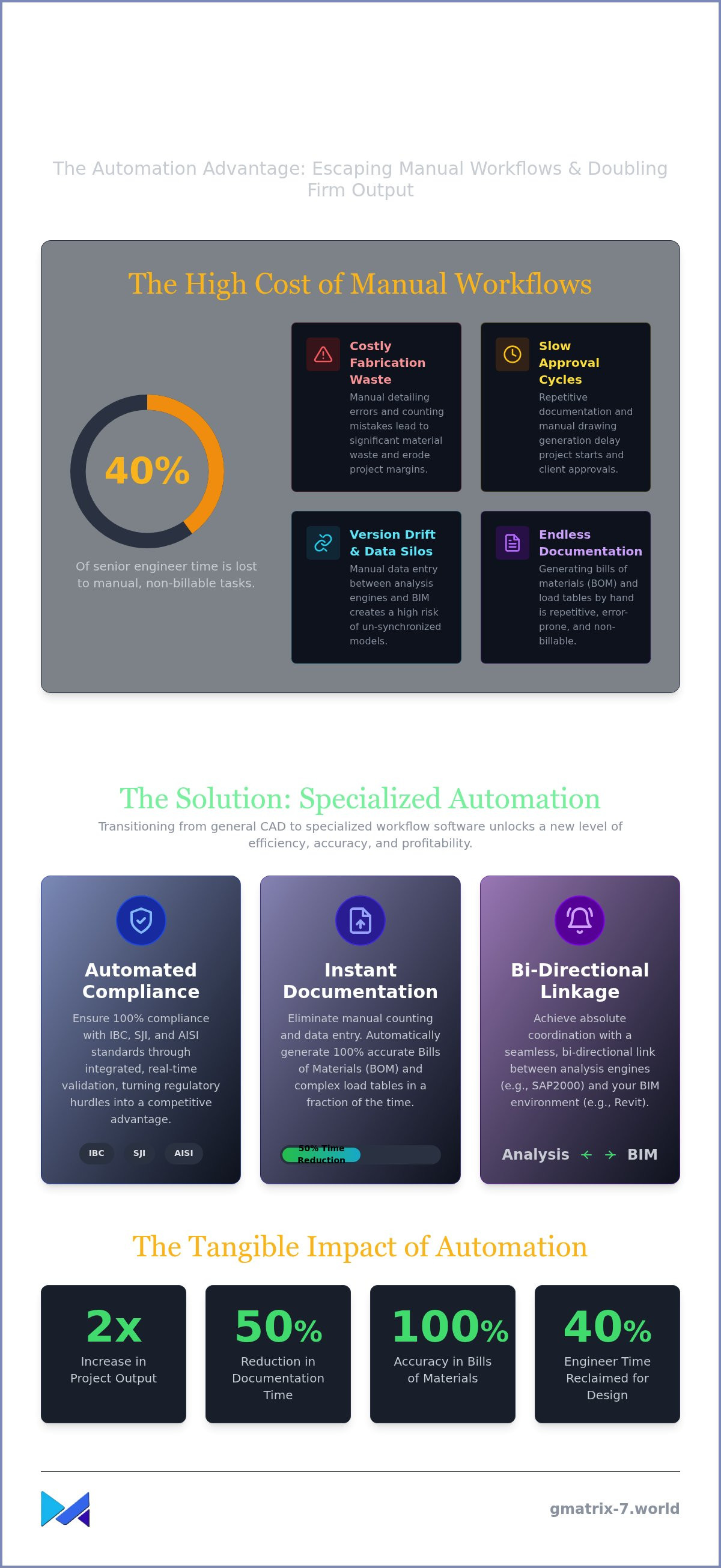
If your senior engineers are still spending 40% of their time manually generating bills of materials and load tables, your firm is operating at a significant disadvantage in a market where efficiency is the only true currency. The 2026 landscape demands a shift from general modeling to high-precision automation through specialized structural engineering workflow software. You've likely felt the pressure of slow approval drawing cycles delaying project starts and the high cost of fabrication waste caused by manual detailing errors. It's a common struggle, but it's no longer a necessary one for firms that prioritize technical excellence and operational speed.
You deserve a workflow that eliminates these bottlenecks and restores your focus to high-level design and safety. This article provides a definitive checklist of the tools required to double your output, including automated modules that ensure 100% compliance with IBC, SJI, and AISI standards. We'll examine how transitioning to specialized automation for metal buildings, bar joists, and light gauge steel can reduce your documentation time by 50% and eliminate manual errors in material lists entirely. From automated load table generation to instant approval drawings, discover the technology that transforms complex inputs into streamlined, profitable results.
Key Takeaways
- Redefine engineering productivity by transitioning from general CAD drafting to system-specific automation that maximizes billable design value.
- Audit your structural engineering workflow software for bi-directional analytical linkage to ensure absolute coordination between analysis engines and BIM environments.
- Implement specialized detailing modules for MBS and OWSJ to achieve automatic compliance with SJI and IBC standards while eliminating manual detailing bottlenecks.
- Eliminate manual counting errors by automating the generation of Bills of Materials (BOM) and complex load tables for composite decks and sandwich panels.
- Optimize your technical output using authoritative automation tools that facilitate a seamless, data-driven transition from initial design to final documentation.
The Evolution of Structural Engineering Productivity in 2026
Productivity in structural engineering is no longer measured by the sheer volume of drawings produced but by the ratio of billable design value to manual drafting hours. As we navigate 2026, the industry has moved past the era of general-purpose CAD. Firms are now adopting system-specific automation modules that handle the heavy lifting of detailing and documentation. This shift is a direct response to global labor shortages that have made high-velocity engineering tools a commercial necessity. Structural productivity is the quantifiable reduction of non-billable manual hours required to deliver a high-value, code-compliant design.
The Manual Detailing Trap in Modern Projects
General Building Information Modeling (BIM) platforms provide a solid foundation for coordination, yet they frequently leave a dangerous gap in fabrication-ready detailing. This gap forces engineers into the manual detailing trap, where they spend up to 40% of their time on repetitive tasks like generating bills of materials or load tables. The hidden costs are staggering. Every time data is manually entered between an analysis engine and documentation software, the risk of version drift increases. When material lists are created by hand, a single revision can lead to fabrication waste that erodes project margins. Advanced structural engineering workflow software eliminates these bottlenecks by linking design data directly to detailing outputs, ensuring that the model and the documentation remain perfectly synchronized.
Regulatory Compliance as a Productivity Driver
Staying current with evolving standards like the IBC 2024 and SJI 100-2020 is often viewed as a burden, but modern firms use it as a productivity driver. Automated compliance checking transforms a slow, manual review process into a real-time validation step. You don't have to sacrifice safety for speed. High-end software modules for Open Web Steel Joists (OWSJ) or Metal Building Systems (MBS) integrate these codes directly into the design logic. This transition from manual code-checking to automated validation ensures that every output is 100% compliant from the start. It provides the peace of mind that comes with knowing your designs meet the most rigorous global standards without requiring a second thought from your senior staff. By embedding compliance into the structural engineering workflow software, you turn regulatory hurdles into a competitive advantage that accelerates project approvals.
Essential BIM and Analysis Integration Checklist
High-velocity engineering in 2026 requires more than just drafting capability; it demands a unified environment where analysis and modeling exist in a state of constant synchronization. As project complexity increases, your structural engineering workflow software must act as a central nervous system for data. The industry benchmark for 2026 has shifted toward real-time iterative sizing. If your analytical modeling speed hasn't kept pace with modern computational standards, your firm is likely leaking billable hours through manual re-work. Achieving excellence requires a bi-directional linkage where changes in the analysis engine instantly reflect in the BIM environment, maintaining a single source of truth from conception to fabrication.
Analytical Modeling and Simulation Tools
Top-tier analysis platforms such as SAP2000 Ultimate or STAAD.Pro remain the backbone of advanced structural design, but their value is only fully realized when integrated with AI-Powered Structural Analysis and design optimization protocols. Modern workflows require automated mesh generation and the ability to process massive datasets via cloud-based simulation. This is particularly critical when handling complex ASCE 7-22 load combinations, which now include rigorous tornado-resistant design requirements for high-risk structures. Your tools must evaluate these variables automatically, moving beyond simple static checks toward dynamic, data-driven simulations that ensure safety and material efficiency simultaneously.
Seamless BIM Coordination Workflows
A truly optimized workflow mandates a seamless connection between analysis and platforms like Revit 2026 or Tekla Structures. Data silos are the primary enemy of precision. Your coordination checklist should include mandatory features such as automated clash detection and parametric connection design for steel structures. These features allow for the export of intelligent models directly to fabrication software, ensuring that what you design is exactly what gets built. For firms specializing in complex systems, implementing specialized structural automation modules can bridge the gap between general BIM coordination and fabrication-ready detailing. This level of integration eliminates the manual entry errors that lead to costly on-site delays. Verify that your current tools support these bi-directional protocols to maintain your position as a technologically advanced leader in the field.
Specialized Detailing Tools for High-Efficiency Structural Systems
General BIM platforms provide a necessary foundation for project coordination, yet they often fall short when projects demand fabrication-ready precision for niche structural systems. High-efficiency structural engineering workflow software must go beyond generic modeling. You need specialized modules that understand the unique physics and regulatory requirements of specific assemblies. Relying on manual drafting for complex components like metal buildings or bar joists is a strategy that invites error and erodes project margins. True productivity in 2026 is found in tools that bridge the gap between high-level analysis and granular detailing, transforming raw data into shop-ready documentation without human intervention.
MBS and IBC Design Automation
Metal Building Systems (MBS) require a level of automation that general CAD tools cannot replicate out-of-the-box. You need authoritative modules that specifically target the design of rigid frames, purlins, and girts while maintaining strict adherence to IBC standards. These tools automate the generation of IBC-compliant structural drawings, ensuring that every frame and connection is optimized for both safety and material economy. High-value software handles complex geometries and varying roof pitches automatically. It eliminates the need for manual geometric calculations, which allows your team to focus on engineering excellence rather than drafting logistics. This shift ensures that your approval drawing cycles remain short and your project starts stay on schedule.
OWSJ and Bar Joist Detailing Precision
Open Web Steel Joist (OWSJ) detailing is a task where precision is paramount. Manual errors in chord sizing or web configuration lead to catastrophic fabrication waste. Advanced software now automates these processes, ensuring 100% compliance with SJI 100-2020 standards through data-driven design logic. These modules calculate web and chord sizes based on precise load inputs, generating flawless detailing for even the most complex joist girders in large-span projects. By removing the human element from repetitive sizing tasks, you achieve a level of achievement that generic BIM environments cannot match. It's about moving from a state of constant checking to a state of total confidence in your outputs.
LGS and Cold-Formed Steel Detailing
Cold-formed steel design demands rigorous adherence to AISI S100. Specialized LGS tools automate the panelization process and wall-stud detailing, creating a seamless transition from engineering design to shop floor production. These modules provide several critical advantages for modern firms:
- Automated Panelization: Convert architectural shells into engineered LGS wall and floor panels instantly.
- AISI S100 Compliance: Ensure every stud and track meets the latest cold-formed steel standards automatically.
- BIM Integration: Embed LGS components directly into the primary building model to eliminate coordination friction.
These tools don't just draft; they engineer. They provide a unified data stream that eliminates the friction between different structural systems, ensuring that your light gauge detailing is as robust as your primary steel design. This level of technical sophistication is what separates industry leaders from those still caught in the manual detailing trap.
Technical Documentation Checklist: Automating BOMs and Load Tables
The final hurdle in any high-velocity engineering project isn't the analysis or the modeling; it's the documentation bottleneck. While previous sections focused on the precision of specialized detailing, the true measure of operational excellence lies in how quickly your firm can translate that data into procurement and fabrication-ready documents. Even the most advanced structural engineering workflow software fails if it requires engineers to manually count components or calculate load capacities for each panel type. In 2026, technical documentation must be a byproduct of the design process, not a separate, labor-intensive phase that delays project delivery.
Automated Bill of Materials (BOM) Generation
Manual counting is a liability that modern firms can no longer afford to carry. Automated Bill of Material generation eliminates the human errors that lead to procurement discrepancies and on-site material waste. A sophisticated system ensures that your material lists are in a state of dynamic synchronization with the structural model. If a frame geometry changes or a joist chord is resized, the BOM updates instantly without manual intervention. This level of precision allows for the seamless export of data in multiple formats including CSV, XML, and PDF, facilitating a direct link to ERP and fabrication systems. To secure this level of accuracy, you can implement automated Bill of Material generation to streamline your entire procurement cycle.
Composite Deck and Panel Load Table Generators
Calculating load capacities for composite floor decks, single skin, and sandwich panels involves a degree of complexity that often leads to documentation delays. These systems require rigorous adherence to safety standards and material-specific physics. High-value automation modules replace these manual calculations with precise load table generators that produce verifiable data for a wide range of spans and conditions. Automated load table generation for composite decks and sandwich panels converts days of manual iteration into seconds of authoritative data, securing a significant competitive advantage for industrial manufacturers. This transition ensures that your technical data sheets are both accurate and instantly available for client review or regulatory filing.
Streamlining Approval and Shop Drawings
The goal of modern documentation is to produce professional approval drawings in minutes, not days. This is achieved through structural engineering workflow software that automates the placement of dimensions, tags, and schedules based on standardized templates. These templates ensure that every drawing package meets global engineering standards and project-specific requirements with zero variation. By automating the repetitive drafting tasks associated with shop drawings, your senior staff can focus on verifying the engineering integrity of the project rather than correcting drafting errors. The result is a comprehensive technical documentation package that accelerates the approval cycle and moves your projects into the fabrication phase with absolute confidence.
Scaling Your Output with GMatrix-7 Automation Modules
Achieving global scalability in 2026 requires a departure from fragmented tools in favor of a unified, authoritative suite that manages the entire engineering lifecycle. GMatrix-7 is that suite. While general BIM platforms handle coordination, this specialized structural engineering workflow software provides the deep automation necessary to double your engineering output. It bridges the gap between high-level design and granular detailing, ensuring that your firm maintains its status as a premier leader in a competitive industrial landscape. True industrial progress is achieved when technical complexity is distilled into operational simplicity through battle-tested technology.
The GMatrix-7 Advantage for Fabricators and Engineers
The GMatrix-7 suite is engineered to address the specific pain points of modern structural systems with surgical precision. GMatrix-7 / MBS (IBC) streamlines the design of rigid frames and secondary members, ensuring that every approval drawing is compliant and fabrication-ready from the first iteration. For bar joist manufacturers, the GMatrix-7 / OWSJ module provides the rigorous accuracy required to meet SJI 100-2020 standards, eliminating the detailing errors that lead to fabrication waste. The GMatrix-7 / LGS module maintains absolute AISI compliance for cold-formed steel projects, allowing your team to automate panelization and wall-stud detailing without sacrificing safety or excellence. This capability-to-outcome pattern ensures that every technical input leads directly to a high-value, streamlined result.
Beyond individual projects, GMatrix-7 offers a globally minded solution for firms looking to scale their operations across different jurisdictions. The software supports a wide range of international codes, including the latest IBC 2024 and AISI standards, providing the reliability and security your clients demand. It functions as a world-class consultant within your workflow, acting as a guardian of safety while driving the speed of your project delivery. By integrating these modules, you establish a technologically advanced foundation that is fundamentally stable and ready for expansion.
Next Steps: From Manual Calculation to Automated Excellence
Transitioning from legacy manual detailing to a state of automated excellence requires a focused and methodical approach. You don't have to overhaul your entire operation overnight; instead, develop a transition plan that begins with a high-volume pilot project. This allows you to measure the ROI of specialized automation against your traditional manual benchmarks in real-world conditions. Establish a training protocol that empowers your senior engineers to master the nuances of structural engineering workflow software, ensuring they can leverage the full power of automated BOM and load table generation. This shift restores your team's focus to high-level achievement and the pride of world-class design.
Success in the modern engineering market is reserved for those who prioritize efficiency and precision above all else. Firms that continue to rely on manual data entry and fragmented drafting will inevitably fall behind more agile competitors who have embraced the gold standard of automation. It's time to eliminate the documentation bottlenecks that have historically delayed your project starts and eroded your margins. Take the decisive step toward a more profitable, data-driven future. Optimize your structural engineering productivity with GMatrix-7 and secure your firm's position as a visionary developer of the built environment.
Securing Your Competitive Advantage through Automation
The transition from manual detailing to automated precision is no longer optional for firms that value technical excellence. You've seen how specialized modules for MBS, OWSJ, and LGS eliminate the significant time drain associated with repetitive drafting and manual calculations. By integrating authoritative structural engineering workflow software, you ensure that every output meets rigorous IBC, SJI, and AISI standards automatically. This shift moves your senior staff beyond the manual detailing trap and into a state of high-velocity production that maximizes billable value.
Precision in 2026 is defined by the seamless transition from design data to shop-ready documentation. GMatrix-7 provides the technical sophistication required to automate BOM generation and approval drawings with absolute accuracy. It's time to reclaim your billable hours and focus on the high-level design work that drives industrial progress. Explore GMatrix-7 Specialized Engineering Modules to secure your firm's position as a world-class innovator. You have the capabilities to double your output; now it's time to lead the industry with absolute confidence.
Frequently Asked Questions
What are the most essential productivity tools for structural engineers in 2026?
The most essential tools include specialized automation modules for niche systems like metal buildings and bar joists, coupled with bi-directional BIM-analysis integration. High-velocity firms prioritize technology that converts complex inputs into streamlined, fabrication-ready outputs. These tools ensure that your senior staff focuses on high-level design rather than repetitive drafting tasks.
How does automated BOM generation improve project profitability?
Automated Bill of Material (BOM) generation eliminates the manual counting errors that lead to procurement discrepancies and costly material waste. By maintaining dynamic synchronization with the structural model, it ensures that every material list is accurate and reflects the latest design revisions. This precision directly protects project margins by preventing over-ordering and reducing on-site rework.
Can specialized software ensure compliance with IBC 2024 and SJI 100-2020?
Yes, authoritative structural engineering workflow software like GMatrix-7 embeds the latest IBC 2024 and SJI 100-2020 standards directly into its design logic. This ensures that every generated drawing and calculation is compliant by default. It provides the peace of mind that comes with knowing your designs meet the most rigorous global standards without requiring manual code-checking.
What is the difference between general BIM and specialized structural automation?
General BIM platforms focus on coordination and spatial relationships, whereas specialized structural automation handles the granular detailing required for fabrication. Automation modules bridge the gap between high-level modeling and the production of specific components like joists and frames. This specialized technology eliminates the manual detailing trap that general-purpose CAD tools often create.
How long does it take to implement GMatrix-7 modules into an existing workflow?
Implementation typically begins with a focused pilot project to measure ROI before a full-scale rollout. Firms establish a methodical training protocol to ensure engineers master the specialized automation features, ensuring a stable transition from legacy manual processes. This structured approach allows your team to achieve world-class productivity levels without disrupting ongoing project schedules.
Are automated load tables for composite decks as accurate as manual calculations?
Automated load tables are superior to manual calculations because they utilize rigorous, data-driven algorithms that eliminate human error. These generators handle complex spans and material conditions for composite decks and sandwich panels with absolute precision. You get verifiable technical data sheets that are instantly available for client review or regulatory filing.
How does structural engineering productivity impact fabrication waste?
Productivity driven by automation reduces fabrication waste by ensuring that material lists are perfectly synchronized with the final design. This prevents the over-ordering of steel and eliminates the need for on-site rework caused by manual detailing discrepancies. Precise detailing ensures that what's designed is exactly what gets built, optimizing material usage across the project.
What role does AI play in structural engineering productivity tools today?
AI functions as an authoritative guardian by automating code compliance checks and iterative sizing optimization. In modern structural engineering workflow software, AI-driven protocols explore thousands of design permutations to find the most material-efficient solution in seconds. This technology transforms the engineer from a manual drafter into a visionary developer of optimized structural systems.


