

If your metal building system design tool only produces a high-definition 3D model, is it actually accelerating your workflow, or is it merely masking the manual rework waiting in the detailing department? Most industry leaders recognize that a visual configurator is a sales asset rather than a structural solution. You've likely felt the sting of material waste or the delay of approval drawings that fail to meet the rigorous 2024 IBC standards. Precision is not optional.
This article proves why professional-grade engineering automation is the only way to ensure zero-error Bill of Materials and total compliance in 2026. We'll analyze how GMatrix-7 replaces manual detailing with sophisticated, data-driven outputs that satisfy the latest SJI and AISI requirements. You'll learn how to leverage technical superiority to achieve rapid drawing generation and absolute structural integrity. This transition ensures your projects move from the screen to the job site without the friction of technical errors.
Key Takeaways
- Distinguish between sales-focused visualization and the rigorous structural analysis required by the latest 2024 IBC standards.
- Master the transition from manual detailing to an automated metal building system design tool that generates error-free Bill of Materials.
- Accelerate project approval cycles by utilizing software that automates professional drawing generation and specialized load tables for sandwich panels.
- Evaluate software based on its ability to maintain total compliance with updated SJI and AISI standards for OWSJ and LGS components.
- Explore how GMatrix-7 integrates specialized modules to provide a unified, authoritative engineering solution for high-performance structural design.
Why 2026 Demands More Than a Basic Metal Building System Design Tool
The structural engineering industry is undergoing a fundamental transformation. In 2026, the reliance on static CAD drawings has become a liability. Modern projects require intelligent, data-driven structural models that do more than just look correct; they must perform under the rigorous scrutiny of updated building codes. As jurisdictions across the United States adopt the 2024 IBC, the margin for error has evaporated. For instance, updated requirements for tornado loads and enhanced wind resistance in specific regions demand a level of precision that manual detailing simply cannot sustain. Relying on an inadequate metal building system design tool often results in a disconnect between the visual intent and the structural reality, leading to costly material waste and project delays.
Manual detailing errors are the silent killers of profitability in large-scale projects. When a design tool lacks integrated engineering logic, the detailing phase becomes a bottleneck where errors multiply. A single miscalculated connection can ripple through an entire Bill of Materials, causing on-site delays that erode margins. Precision is the new currency. Professionals now demand systems that synchronize design, analysis, and detailing into a single, cohesive workflow.
The Limitations of Consumer-Grade 3D Configurators
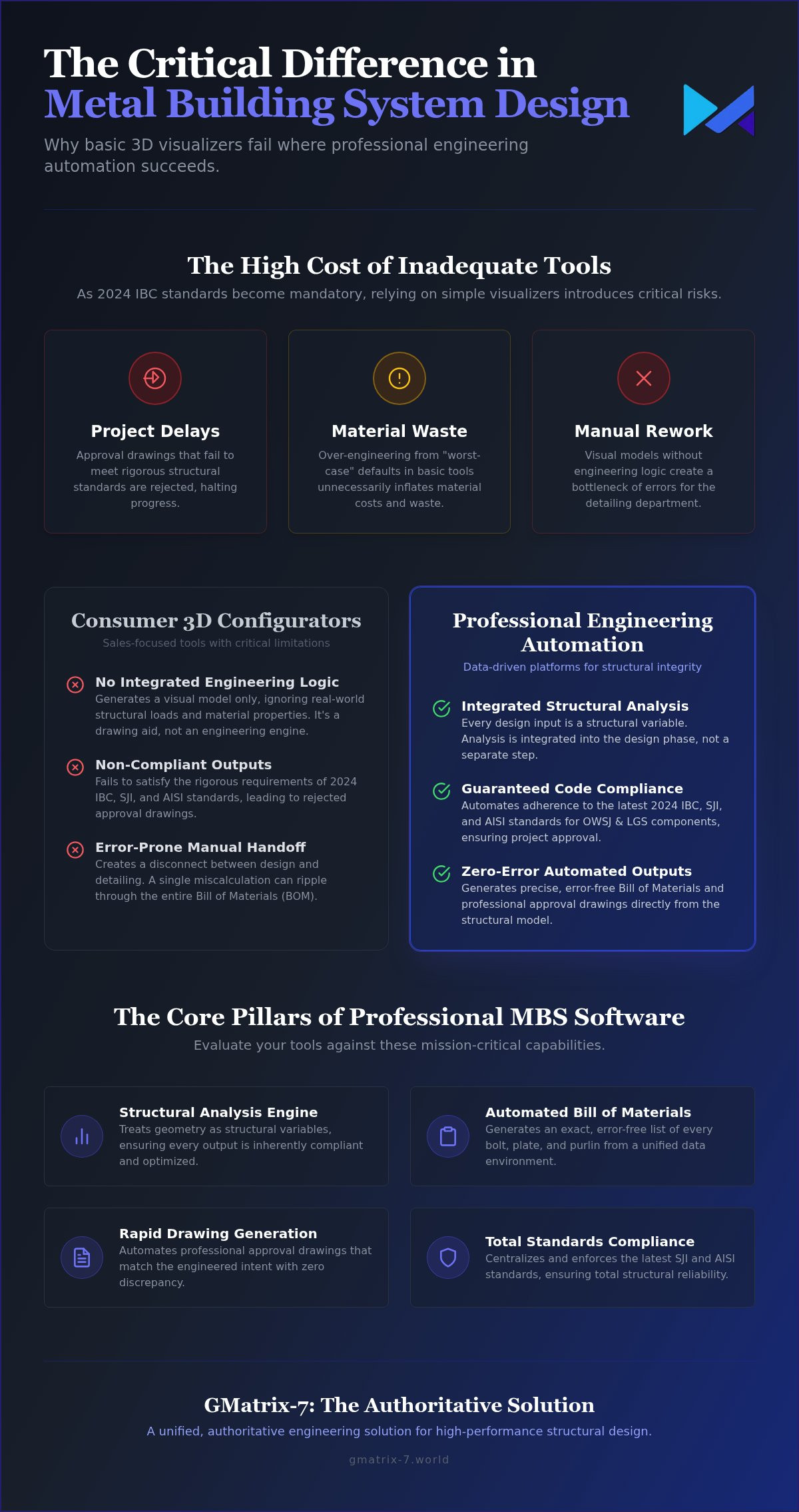
Many retail-facing tools prioritize the user experience of a homeowner over the technical requirements of a structural engineer. While these "drag-and-drop" configurators provide excellent visualization for simple structures, they frequently fail to account for complex real-world structural loads. They offer a false sense of security. Using non-compliant software for professional approval drawings is a dangerous gamble that often leads to rejection by building officials. These simplified tools typically default to "worst-case" scenarios to ensure safety, which results in significant over-engineering. This lack of optimization unnecessarily inflates material costs. For a foundational understanding of these structures, a Steel building overview highlights the necessity of precise component integration that basic visual tools often overlook.
The Rise of Structural Engineering Automation
A professional-grade metal building system design tool is defined by its ability to bridge the gap between design and fabrication. It's not just a drawing aid; it's an engine for structural integrity. The shift toward automation represents a "capability-to-outcome" workflow where technical inputs directly generate high-value results like automated Bill of Materials and IBC-compliant approval drawings. Global fabricators are abandoning fragmented systems in favor of integrated platforms. These systems ensure that every bolt, plate, and purlin is accounted for within a unified data environment. By automating the most tedious aspects of detailing, engineers can focus on optimization and safety. This evolution is the baseline for survival in a market that demands both speed and absolute accuracy.
The Core Pillars of Professional MBS Engineering Software
Professional engineering software separates itself from basic visualization by treating every geometric input as a structural variable. It's not enough to see a 3D representation; the system must understand the physical properties and load paths of every component. A high-tier metal building system design tool integrates structural analysis directly into the design phase. This ensures that every output is inherently compliant with IBC, SJI, and AISI standards. This integration eliminates the siloed approach where design and engineering exist in separate, disconnected environments. When selecting a professional metal building system design tool, the ability to centralize these standards is a primary differentiator that ensures structural reliability.
Precision documentation is the natural byproduct of this integrated approach. Rather than manually drafting each detail, the software automates the generation of professional approval drawings and comprehensive Bill of Materials. This automation ensures that the final product delivered to the job site matches the engineered intent with zero discrepancy. By centralizing these standards, engineers manage complex projects with a level of confidence that manual processes simply cannot provide. These systems ensure that every beam and column meets the rigorous engineering design and quality criteria mandated for high-performance structures.
Precision Load Table Generation for Cladding and Decks
The structural performance of cladding systems is often a point of failure in less sophisticated software. Professional platforms automate the generation of precise load tables for single skin and sandwich panels, accounting for varying spans and environmental pressures. This level of detail is critical for maintaining safety in industrial facilities. When dealing with composite floor decks, the complexity increases. The software must calculate the interaction between the steel deck and concrete slab to produce accurate load capacities. GMatrix-7 excels here, providing automated calculations that ensure panel performance data is both accurate and ready for immediate implementation.
Automated Detailing and SJI Compliance
Detailing Open Web Steel Joists (OWSJ) is a specialized task that demands absolute adherence to SJI 100-2020 standards. Manual detailing for complex bar joist configurations is slow and prone to errors that can compromise safety. Professional-grade engineering automation solves this by embedding SJI logic directly into the detailing engine. This reduces the detailing cycle from days to hours while maintaining total compliance. If you're looking to optimize your workflow, exploring the GMatrix-7 OWSJ module can provide the technical edge needed to handle these intricate structural requirements without the typical bottlenecks.
Comparison: Consumer 3D Configurators vs. Professional Engineering Platforms
Choosing between a visual configurator and a professional engineering platform is a choice between aesthetic marketing and structural reality. While consumer-grade tools focus on "no design experience needed" to attract homeowners, a professional metal building system design tool serves the rigorous demands of structural engineers and fabricators. Visual renders might satisfy a client's curiosity about building color or window placement, but they provide zero utility when it comes to securing a building permit or ensuring site safety. Professional platforms generate engineering approval drawings that are grounded in physical analysis, not just digital pixels. This distinction is critical for large-scale industrial projects where a single design error can result in catastrophic financial loss.
Workflow integration further separates these two categories. A consumer tool is essentially a standalone sales asset that requires a secondary, manual engineering phase to become viable. In contrast, professional software acts as a fabrication-ready data source that feeds directly into the production cycle. Adherence to industry-standard documentation, such as the Metal Building Systems Manual, is a hallmark of professional software that consumer tools simply cannot replicate. This ensures that every output meets the established criteria for safety, quality, and performance across the entire project lifecycle.
Data Accuracy and the Bill of Materials (BOM)
Data accuracy dictates project profitability. Inaccurate material lists lead to expensive field fixes and logistical nightmares. GMatrix-7 eliminates the manual "take-off" process by deriving the Bill of Materials directly from the engineered model. This ensures that every nut, bolt, and panel is accounted for with surgical precision. While a basic tool might offer a rough estimate, a professional metal building system design tool produces a fabrication-ready BOM that translates directly to the shop floor. This automation removes the human error inherent in manual entry, securing your margins and ensuring that material orders are exactly what the project requires.
Structural Integrity and Code Compliance
Structural integrity hinges on real-time code verification. In 2026, the complexity of IBC 2024/2026 standards, including the new requirements for tornado loads in high-risk regions, makes manual verification nearly impossible. Professional tools integrate these codes, alongside AISI S100 for light gauge steel design, into the core analysis engine. This ensures that every design choice is automatically vetted against global standards. Verifying software certifications is no longer just a checkbox; it's a fundamental requirement for modern engineering. By embedding these standards, professional platforms provide a level of reliability that aesthetic-focused tools simply aren't built to handle.
How to Evaluate a Design Tool’s Impact on Your Project Lifecycle
Evaluating the efficiency of a metal building system design tool requires a methodical audit of its technical output rather than a review of its visual interface. A truly professional tool must demonstrate its value at every stage of the project lifecycle, from the initial design phase to final site assembly. To ensure your technology investment delivers a competitive advantage, you must look beyond the screen. Precision is the baseline for modern structural engineering. Follow this four-step evaluation process to determine if your software is a professional asset or a technical liability.
First, audit the software's compliance with the latest global standards. In 2026, this means verifying support for the 2024 IBC, which includes stringent new requirements for tornado loads in high-risk regions. Second, test the speed of approval drawing generation. A professional platform should reduce this process from days to minutes. Third, verify the precision of the automated Bill of Materials. A fabrication-ready BOM eliminates the manual take-off process entirely. Finally, assess the tool's capability to generate specialized load tables for complex cladding like sandwich panels or composite decks. Many tools fail at this granular level, leaving engineers to perform manual calculations that invite error.
Calculating ROI: Speed vs. Accuracy
True return on investment is found at the intersection of rapid delivery and absolute accuracy. While some tools prioritize the bid process for simple building types, they often lack the technical documentation required for large-scale industrial projects. Measuring the reduction in engineering hours per project is essential. However, the impact of error-free detailing on fabrication and site labor is often where the greatest savings occur. Automated documentation not only speeds up the municipal approval process but also ensures that the components arriving on-site fit perfectly every time. If you are ready to eliminate detailing bottlenecks and secure your margins, you can request a GMatrix-7 technical demonstration to see these outcomes in action.
Scalability for Global Structural Projects
Modern fabricators must operate with a global mindset. Evaluating a metal building system design tool for scalability involves checking its multi-language support and its ability to switch between international standards like IBC, SJI, and AISI seamlessly. Cloud-based collaboration has become a mandatory feature for distributed teams, allowing engineers and detailers to work within a unified data environment. This connectivity ensures that everyone is working from the most current version of the structural model. High-level technical support is equally critical. When managing complex projects with unique structural requirements, having access to authoritative expertise ensures that technical hurdles don't become project-stopping barriers. This approach transforms the software from a simple utility into a driver of industrial progress.
GMatrix-7: The Authoritative Solution for High-Performance Structural Design
GMatrix-7 represents the pinnacle of structural engineering automation. It's more than a metal building system design tool; it's a comprehensive environment that provides total structural control through specialized modules. The GMatrix-7 / MBS (IBC) module serves as the core engine, allowing engineers to handle complex geometries while ensuring absolute adherence to the most recent building codes. This system doesn't just visualize a building. It engineers it. By integrating sophisticated analysis directly into the design phase, GMatrix-7 ensures that every output is optimized for safety and material efficiency. This authoritative approach eliminates the guesswork that often plagues fragmented workflows.
The true power of this platform lies in its integrated capabilities. Unlike generalized software, GMatrix-7 offers dedicated modules for GMatrix-7 / OWSJ (SJI) and GMatrix-7 / LGS (AISI) design. This allows for the seamless detailing of bar joists and light gauge steel components within the same project environment. This level of integration is a significant competitive advantage. It ensures that every structural element, from the primary frame to the secondary joists, is designed according to its specific industry standard. Furthermore, the platform's ability to generate precise load tables for single skin, sandwich panels, and composite decks provides a level of technical depth that competitors simply cannot match. This capability ensures that your cladding and decking systems are backed by rigorous panel structural performance data.
Total Detailing Automation for Fabricators
Fabricators require precision to maintain profitability. GMatrix-7 automates the bridge between engineering and the shop floor by generating fabrication-ready drawings without the need for manual drafting. This automation creates a "single source of truth" throughout the project lifecycle. When the design changes, the Bill of Materials and detailing drawings update accordingly. This synchronization ensures that the material list arriving at the site is error-free, preventing the costly delays associated with missing or incorrect components. It's a capability-to-outcome workflow that transforms complex inputs into streamlined, high-value results.
The Future of MBS Design: Innovation and Reliability
The future of the industry belongs to those who prioritize technical excellence and reliability. GMatrix-7 continues to lead in structural engineering automation by maintaining a steadfast commitment to global standards and safety. As building codes become more complex, having a partner that is battle-tested and technologically advanced is essential. Integrating this metal building system design tool into your workflow isn't just about upgrading your software; it's about securing your reputation as a driver of industrial progress. The next step in your evolution is transitioning to a system that values precision above all else. For those ready to lead, the path forward is defined by the rigorous, data-driven power of GMatrix-7.
Securing Structural Excellence in a Data-Driven Era
The era of relying on visual configurators for structural outcomes has passed. Professional success in 2026 requires a metal building system design tool that prioritizes engineering rigor over aesthetic renders. By shifting to a platform that integrates IBC, SJI, and AISI compliant modules, you eliminate the technical bottlenecks that derail project timelines and erode profitability. Advanced load table generation for composite decks and automated fabrication-ready BOMs aren't just features; they're the foundations of a modern, error-free workflow.
Experience the Future of Structural Engineering with GMatrix-7
Excellence is a choice made during the design phase. Transitioning to professional-grade automation ensures your projects meet the highest global standards while maintaining the speed your clients demand. Build with absolute confidence.
Frequently Asked Questions
What is the difference between an MBS design tool and a 3D configurator?
An MBS design tool performs rigorous structural analysis and engineering calculations, whereas a 3D configurator is primarily a visual sales aid. While configurators help clients choose colors and sizes, a professional metal building system design tool ensures every component meets physical load requirements and building codes. This technical depth allows for the generation of permit-ready documentation that visual tools simply can't produce.
How does GMatrix-7 ensure compliance with IBC and SJI standards?
GMatrix-7 ensures compliance by embedding current IBC and SJI logic directly into its structural analysis engine. The software automatically vets design inputs against the latest 2024 IBC requirements, including specialized tornado and wind load criteria. This built-in regulatory intelligence provides engineers with the security that their designs meet or exceed municipal safety standards without requiring manual cross-referencing of code books.
Can this software generate load tables for sandwich panels and composite decks?
The platform automates the generation of precise load tables for single skin, sandwich panels, and composite deck systems. It calculates the specific structural performance of these components based on span, material thickness, and environmental pressures. This automation provides fabricators with accurate data for cladding and flooring systems, ensuring every panel selected for a project is structurally viable for its intended application.
Does the tool provide an automated Bill of Materials (BOM)?
The system generates a comprehensive, fabrication-ready Bill of Materials directly from the engineered structural model. This process eliminates the manual "take-off" phase, which is traditionally prone to human error and material waste. By deriving the BOM from the final design, the metal building system design tool ensures the material list is perfectly synchronized with the approval drawings, securing project margins and site logistics.
How much time can be saved on approval drawings using automation?
Automation typically reduces the time required for approval drawing generation from several days to just a few minutes. By replacing manual drafting with data-driven generation, engineers can produce professional documentation almost instantaneously after the design phase is complete. This acceleration significantly shortens the project lifecycle, allowing for faster municipal submissions and earlier commencement of the fabrication process.
Is GMatrix-7 suitable for light gauge steel (LGS) structural design?
GMatrix-7 includes a specialized LGS module designed specifically for AISI-compliant light gauge steel structural analysis. This module allows engineers to design and detail cold-formed steel components with the same level of precision as heavy structural steel. It ensures LGS projects benefit from total structural automation, including the generation of accurate material lists and technical documentation tailored to light-frame construction.
What technical support is available for complex structural engineering projects?
Users have access to authoritative technical support provided by industry experts who understand the intricacies of structural engineering. This support goes beyond software troubleshooting; it provides a high-level partnership for solving complex design challenges and maintaining global standards. This commitment to excellence ensures technical hurdles don't compromise project deadlines or the structural integrity of the final building.
How does the software handle SJI 100-2020 compliant joist detailing?
The software handles SJI 100-2020 compliance by utilizing a dedicated OWSJ module that automates the detailing of bar joists. It ensures every joist configuration meets the specific engineering criteria established by the Steel Joist Institute. This specialized focus reduces the detailing cycle for complex joist systems, providing fabricators with the peace of mind that their components are safe, optimized, and code-compliant.


