

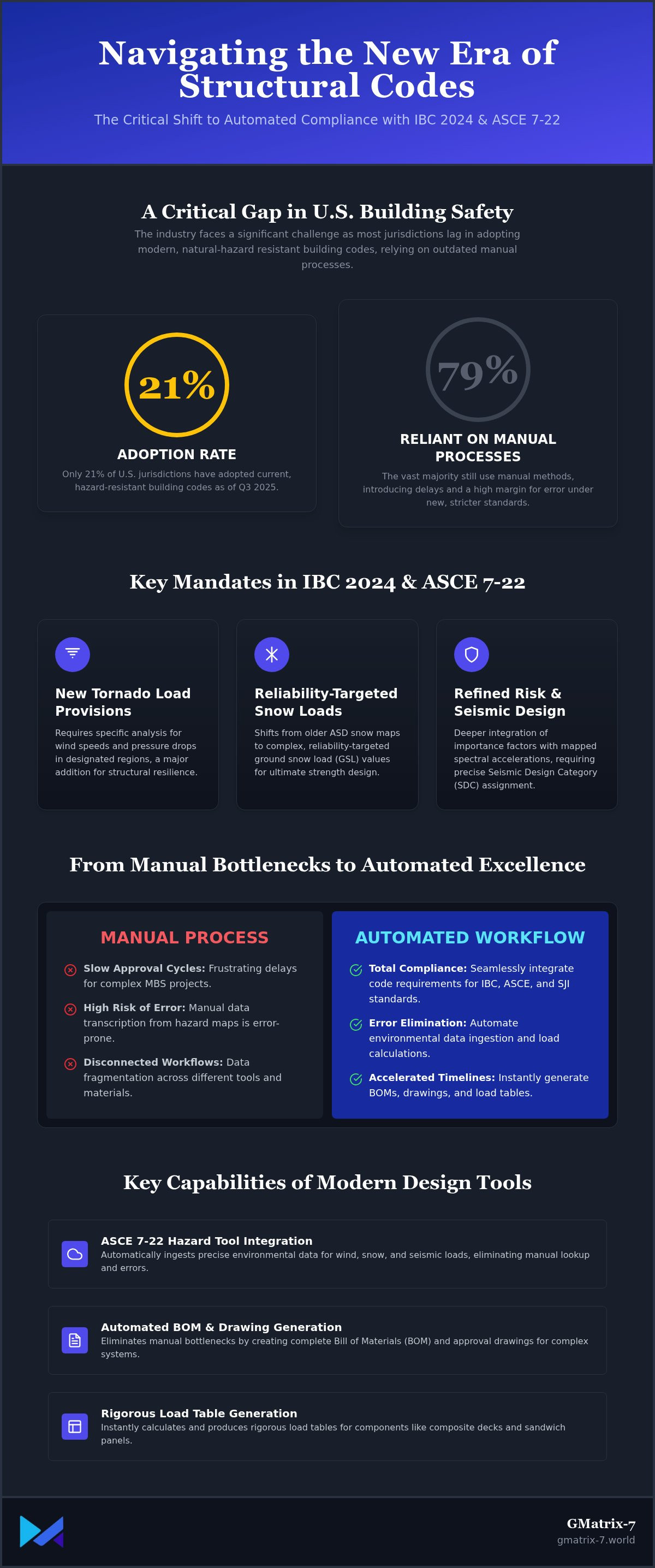
As of the third quarter of 2025, only 21% of U.S. jurisdictions have adopted current, natural-hazard resistant building codes. This statistic reveals a significant gap in the industry, where most firms still rely on manual processes to meet increasingly stringent safety standards. You've likely felt the strain of the new ASCE 7-22 tornado load requirements or the frustration of slow approval drawing cycles for complex MBS projects. These challenges don't just delay timelines; they introduce a margin for error that modern engineering cannot afford.
Mastering the complexities of the IBC 2024 requires a shift toward sophisticated automation. By integrating high-precision IBC 2024 structural design tools into your workflow, you can achieve total compliance while eliminating the manual bottlenecks that stall production. This guide provides a roadmap for automating the generation of bills of materials, load tables, and detailing for bar joists and light gauge steel. We'll explore how to leverage technology to secure your reputation as a premier leader in structural excellence and industrial progress.
Key Takeaways
- Identify the critical shifts in IBC 2024 and ASCE 7-22, specifically focusing on new provisions for tornado loads and reliability-targeted snow loads.
- Learn to select high-performance IBC 2024 structural design tools that integrate seamlessly with the ASCE 7-22 Hazard Tool for precise environmental load calculations.
- Eliminate manual bottlenecks by automating the generation of Bill of Materials (BOM) and approval drawings for complex Metal Building Systems (MBS).
- Secure total compliance with SJI 100-2020 standards through automated detailing for Open Web Steel Joists and light gauge steel components.
- Accelerate project timelines by automatically generating rigorous load tables for composite decks and sandwich panels, ensuring both safety and speed.
Navigating the Structural Evolution of the 2024 International Building Code (IBC)
The 2024 International Building Code (IBC) isn't just a routine update; it's a fundamental shift in how we approach structural resilience. This edition fully adopts the ASCE 7-22 standard, which introduces the most significant changes to environmental load calculations in over a decade. Engineers can no longer rely on simplified, prescriptive methods to ensure safety. Instead, the modern building code demands a rigorous, data-driven approach. Implementing advanced IBC 2024 structural design tools is the only way to navigate these complexities without compromising project velocity or precision.
The Critical IBC-ASCE 7-22 Relationship
IBC Chapter 16 serves as the regulatory framework, but ASCE 7-22 provides the technical engine for seismic, wind, and snow loads. One of the most impactful changes involves Strength-Based Ground Snow Load (GSL) values. Previous versions used allowable stress design (ASD) snow maps, but the 2024 code utilizes reliability-targeted values that align with ultimate strength design. This change forces a complete recalibration of roof design. Manual calculation isn't a viable option for these risk-targeted loads. The sheer volume of data required to calculate localized hazards makes automation a necessity for any firm aiming for world-class excellence.
Risk Categories and Importance Factors in 2024
Precision starts with the correct classification of the structure. Table 1604.5 remains the standard for determining building risk categories, ranging from Category I for low-risk structures to Category IV for essential facilities like hospitals and fire stations. The 2024 code refines how importance factors adjust wind and seismic design criteria. These factors are now more deeply integrated with mapped spectral accelerations, which dictate the Seismic Design Category (SDC) assignment. Relying on outdated spreadsheets leads to critical errors in these assignments. High-precision IBC 2024 structural design tools eliminate this risk by automating the link between geographic data and design requirements.
The introduction of tornado load provisions is perhaps the most striking addition to the structural landscape. For buildings in specific regions and risk categories, you must now account for wind speeds and pressure drops associated with tornadic events. This requires software that can ingest complex hazard maps and output optimized framing solutions. By moving away from manual look-up tables and toward integrated analysis, you secure both the safety of the structure and the peace of mind of your clients. This transition from prescriptive methods to data-driven analysis is the hallmark of a modern, efficient engineering workflow.
Selecting the Right IBC 2024 Structural Design Tools
Choosing the correct IBC 2024 structural design tools requires a focus on end-to-end integration. It's no longer enough for a tool to perform isolated calculations. The modern professional needs a "capability-to-outcome" framework that links rigorous structural analysis directly to precision detailing. This synergy ensures that every design choice remains compliant with the 2024 International Building Code (IBC) while simultaneously streamlining the manufacturing and approval phases.
Seamless integration with the ASCE 7-22 Hazard Tool database is a critical requirement. Your software should automatically ingest environmental data to generate load combinations for both LRFD and ASD methods per §1605. This eliminates the manual transcription of spectral acceleration maps and wind speed data, which are notorious sources of human error. By automating these inputs, you achieve a level of accuracy that manual processes simply can't match. It's about creating a stable, data-driven foundation that supports the entire project lifecycle.
Prioritizing software that supports multi-material design, including Light Gauge Steel (LGS) and Open Web Steel Joists (OWSJ), is paramount. Modern engineering firms often juggle various material types within a single project. A unified platform that handles these diverse inputs prevents data fragmentation and ensures that all components work in harmony. This holistic approach is what separates world-class entities from those still struggling with disconnected workflows.
Automation of Load Table Generation
Precision in load table generation is essential for high-performance building envelopes. Automated tools must calculate composite deck load capacity under the updated standards, accounting for the specific geometries of single skin and sandwich panels. This level of optimization does more than ensure safety; it reduces material waste by providing exact capacities rather than conservative estimates. For firms seeking this level of technical superiority, advanced automation modules offer a clear competitive advantage.
Compliance with Material-Specific Standards
Reliability is built on strict adherence to industry standards. Your chosen software must align with AISC 360 for structural steel and AISI S100 for cold-formed steel. For those specializing in bar joists, SJI 100-2020 compliance is mandatory for detailing and design. The tool should also possess the capability to generate professional approval drawings that satisfy the most rigorous building official requirements. This ensures a smooth transition from the design office to the job site. High-value software doesn't just calculate; it documents and validates every engineering decision according to global standards.
How to Implement an Automated IBC 2024 Compliance Workflow
Standardizing your firm's approach to the IBC 2024 transition is the only way to ensure consistency across complex project portfolios. Manual load transfers often introduce "human-in-the-loop" errors that compromise structural integrity and lead to costly revisions. By deploying IBC 2024 structural design tools, you create a robust, repeatable process that moves seamlessly from site-specific data to finalized engineering outputs. This transition isn't merely about speed; it's about establishing a foundation of reliability that satisfies both internal excellence standards and external regulatory bodies.
Step 1: Environmental Load Determination
The first phase of a high-performance workflow involves importing site-specific data directly from ASCE 7-22 maps into your design environment. Automation modules now allow for the instantaneous calculation of snow, wind, and seismic loads based on the specific risk category of the structure. For projects in tornado-prone regions, the software must account for the new tornado load requirements mandated by the 2024 code. This automated ingestion of hazard data ensures that your starting parameters are accurate and fully compliant with the latest building standards from the very first input.
Step 2: Structural Analysis and Load Combinations
Once environmental loads are established, the system runs automated simulations to evaluate LRFD and ASD load combinations. Identifying the most unfavorable effects on the building frame is a computationally intensive task that manual methods often oversimplify. Automated stress analysis identifies these critical points and optimizes member sizes for Metal Building Systems (MBS) or Light Gauge Steel (LGS) accordingly. This level of precision prevents over-engineering, which saves on material costs without sacrificing safety or performance. It's a data-driven approach that ensures every pound of steel is utilized for maximum efficiency.
Step 3: Automated Detailing and Documentation
The final step transforms analytical data into actionable technical documentation. Professional automation tools generate SJI-compliant bar joist details and comprehensive bills of material (BOM) directly from the structural model. This eliminates the manual entry errors that frequently plague the procurement and fabrication stages. The system also produces technical approval drawings that incorporate all IBC 2024 design criteria, providing building officials with the clear, data-backed evidence they require for rapid project approval. Real-time documentation updates ensure that as design parameters change, every stakeholder remains aligned with the latest project reality, providing the peace of mind that comes from total technical control.
Addressing Complexity in MBS and OWSJ Engineering
Metal Building Systems (MBS) and Open Web Steel Joists (OWSJ) represent some of the most sensitive structural components under the new 2024 building standards. Because these systems often involve large spans and optimized material use, even slight shifts in wind or snow maps can necessitate a complete redesign of the primary frame. Utilizing advanced IBC 2024 structural design tools allows engineers to navigate these sensitivities with surgical precision. Automation serves as a guardian of safety, enforcing code-defined limits in every calculation to ensure that efficiency never comes at the expense of structural integrity.
A common industry objection suggests that automation might diminish professional oversight. In reality, the opposite is true. High-precision software enhances professional engineering judgment by stripping away the burden of repetitive data entry and manual cross-referencing. This frees the engineer to focus on high-level design strategy and complex problem-solving. By automating the "how" of the calculations, you empower your team to focus on the "why" of the design, leading to more innovative and stable structural solutions.
Precision Detailing for Bar Joists
Open Web Steel Joists require rigorous detailing to meet the SJI 100-2020 standards adopted by the current code. Specialized OWSJ software handles complex joist configurations, such as varying depths or special loading conditions, by applying the exact safety factors required for load-bearing capacity. This level of automation streamlines the communication between engineers and fabricators. When the structural model generates data directly for the shop floor, the risk of misinterpretation vanishes. It creates a seamless, error-free pipeline that ensures every bar joist is manufactured to the precise specifications required for IBC 2024 compliance.
Optimizing Metal Building Systems (MBS)
The updated wind and snow maps in ASCE 7-22 create unique challenges for MBS geometries. You must now calculate precise load transfers from roof panels and secondary members to the primary frame with greater granularity. Modern IBC 2024 structural design tools manage these complex geometries by running simultaneous simulations for multiple load paths. This optimization significantly reduces project lead times. By automating the generation of shop drawings and technical documentation, you move projects through the approval cycle faster while maintaining a bold stance on safety and excellence.
To see how these capabilities translate into real-world results for your firm, explore the GMatrix-7 automation suite and secure your position at the forefront of structural engineering innovation.
Elevating Engineering Standards with GMatrix-7
GMatrix-7 offers a sophisticated suite of modules specifically engineered for IBC 2024 compliance. This platform acts as a high-precision bridge between the data-heavy requirements of the new code and the streamlined industrial outputs your projects demand. By implementing these IBC 2024 structural design tools, you achieve world-class precision across Light Gauge Steel (LGS), Open Web Steel Joists (OWSJ), and Metal Building Systems (MBS). This technology is not just a tool; it is a strategic asset that positions your firm as a premier leader in structural engineering productivity and safety.
The transition from complex inputs to optimized outputs happens through a logical, data-driven progression. GMatrix-7 handles the granular technical details of the ASCE 7-22 environmental loads, allowing your team to focus on high-level achievement and innovation. This capability-to-outcome pattern ensures that every design choice is both compliant and commercially viable. You provide your clients with the peace of mind that comes from battle-tested technology and the pride of high-level achievement. By leveraging IBC 2024 structural design tools that integrate directly with your fabrication pipeline, you eliminate the fragmentation that slows down project delivery.
The GMatrix-7 / MBS (IBC) Advantage
The GMatrix-7 / MBS (IBC) module automates the entire engineering lifecycle. It provides integrated load table generation for single skin, sandwich panels, and composite decks, ensuring that your building envelope meets the rigorous standards described in previous sections. This level of automation extends to structural steel detailing and automated bill of material (BOM) generation. You gain total reliability in your procurement and fabrication processes. It eliminates the manual errors that often plague complex industrial projects, ensuring that your final outputs are as accurate as your initial analysis.
Future-Proofing Your Engineering Firm
Adopting GMatrix-7 is a strategic imperative for firms looking to dominate the 2026 engineering landscape. As adoption of the 2024 IBC continues to grow across jurisdictions, the ability to transition from manual detailing to a fully automated, SJI-compliant workflow becomes a critical differentiator. This technology secures your reputation as a visionary developer and a guardian of structural safety. It provides the stability and scalability needed to handle the rigorous data demands of modern construction with professional confidence. Experience the Future of Structural Design with GMatrix-7 and lead the industry with assertive, results-driven engineering excellence.
Securing Your Competitive Edge in the IBC 2024 Era
The evolution of the building code demands a fundamental shift from traditional manual methods to a sophisticated, data-driven framework. By implementing high-precision IBC 2024 structural design tools, you transform regulatory complexity into a streamlined industrial output. This transition doesn't just ensure compliance; it secures your reputation as a premier leader in structural excellence. You've seen how automation eliminates human-in-the-loop errors in MBS engineering and guarantees that bar joist detailing remains strictly SJI 100-2020 compliant.
The path toward world-class precision requires a partner who understands the rigorous demands of modern construction. GMatrix-7 provides the stability and technical superiority needed to future-proof your firm against shifting environmental load standards. Through automated load table generation and industry-leading MBS engineering automation, you achieve the peace of mind that comes from total technical control. This is the hallmark of a battle-tested entity that values excellence above all else.
Take the next step in elevating your engineering standards and reducing detailing bottlenecks. Request a Technical Demo of GMatrix-7 IBC 2024 Design Tools to see how we bridge the gap between complex code and streamlined results. Your commitment to safety and excellence deserves a toolset that matches your professional ambition.
Frequently Asked Questions
What are the most significant structural changes in IBC 2024?
The most significant structural changes in the 2024 International Building Code involve its full alignment with ASCE 7-22. This update introduces reliability-targeted ground snow loads and the first-ever provisions for tornado loads in specific regions. Engineers must also navigate updated wind and seismic maps that utilize multi-period spectral acceleration. These shifts require a transition from simplified prescriptive methods to data-driven analysis to ensure total compliance and structural resilience.
How does ASCE 7-22 affect seismic design in the 2024 IBC?
ASCE 7-22 fundamentally alters seismic design by replacing traditional spectral acceleration maps with multi-period response spectra. This change provides a more accurate representation of ground motion across different soil types and building periods. It requires precise spectral acceleration data to determine the Seismic Design Category (SDC) accurately. Automated IBC 2024 structural design tools are essential for ingesting this high-resolution data and applying it to the structural model without manual transcription errors.
Can I use IBC 2021 software for IBC 2024 projects?
You shouldn't use IBC 2021 software for 2024 projects because the underlying load standards have changed too drastically. ASCE 7-22 introduces new load combinations and hazard maps that aren't present in older software versions. Attempting to force a 2024 project through an outdated platform risks non-compliance and potential structural failure. Professional excellence requires utilizing up-to-date tools that are specifically calibrated for the current regulatory landscape and hazard requirements.
What is the role of the ASCE Hazard Tool in structural design workflows?
The ASCE Hazard Tool serves as the authoritative source for site-specific environmental data required by the 2024 IBC. It provides precise values for wind, snow, seismic, and tornado hazards based on geographic coordinates and building risk categories. Modern workflows integrate this tool directly into the design environment. This seamless data transfer allows engineers to move from hazard determination to structural analysis with high-level achievement and speed, maintaining a bold stance on safety.
How do the new snow load maps in IBC 2024 impact roof design?
The new snow load maps in the 2024 IBC transition from allowable stress design (ASD) values to strength-based Ground Snow Load (GSL) values. This shift reflects a move toward reliability-targeted design, which often results in higher roof design requirements in certain jurisdictions. You must account for these strength-level loads when designing primary frames and secondary members. Automation ensures that these updated values are applied consistently across all roof components to maintain safety and precision.
Why is automated BOM generation critical for IBC 2024 compliance?
Automated Bill of Material (BOM) generation is critical because it eliminates the manual errors that occur during the transfer of complex engineering data to procurement. With the increased complexity of ASCE 7-22 load paths, manual entry is no longer a viable option for high-performance projects. Integrated IBC 2024 structural design tools ensure that every member size and connection detail in the BOM matches the analytical model perfectly. This provides the peace of mind that comes from total technical control.
Does GMatrix-7 support SJI 100-2020 standards for steel joists?
GMatrix-7 provides full support for the SJI 100-2020 standards, which are the mandatory detailing requirements for open web steel joists under the 2024 code. The software automates the generation of compliant joist detailing and load tables, ensuring that every component meets the latest industrial standards. This integration allows firms to produce technical documentation that is both intellectually rigorous and ready for immediate fabrication. It's a world-class solution for bar joist engineering and detailing.
How do tornado loads work in the 2024 International Building Code?
Tornado loads are now a mandatory design consideration for buildings in Risk Category III and IV located within specific high-hazard regions. The 2024 IBC requires engineers to calculate these loads based on the tornado wind speeds and pressure drops defined in ASCE 7-22. This is a significant addition that requires specialized software capable of handling tornadic hazard maps. Implementing these provisions is essential for the safety of essential facilities and high-occupancy structures in tornado-prone areas.


