
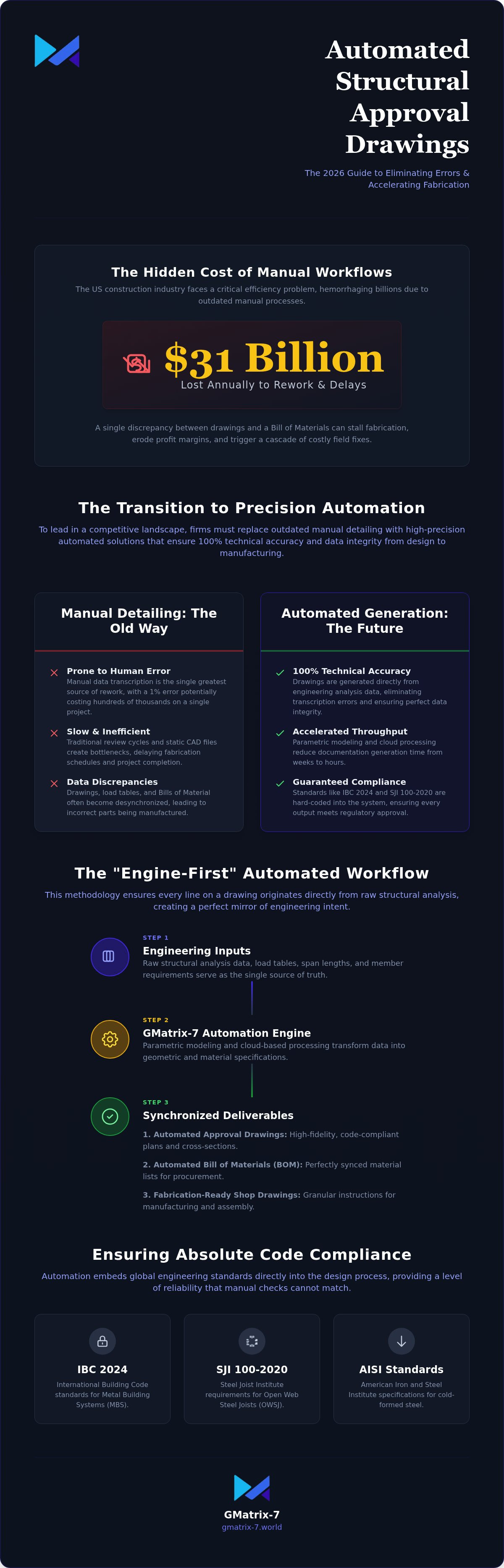
The US construction industry hemorrhages $31 billion annually due to rework, much of which is triggered by manual drafting errors that slip through traditional review cycles. You recognize the high cost of these delays; a single discrepancy between a structural drawing and a Bill of Material can stall fabrication and erode your profit margins. To lead in this competitive landscape, you must replace outdated manual detailing with high-precision automated structural approval drawings. This transition ensures 100% technical accuracy and accelerates project throughput by aligning engineering outputs with real-time manufacturing data.
This 2026 guide provides the roadmap to mastering structural automation, focusing on IBC 2024 compliance and the seamless generation of critical documentation. You'll learn how to leverage sophisticated modules like GMatrix-7 to transform complex inputs into streamlined, error-free deliverables that meet the most rigorous global standards. We'll examine the integration of SJI 100-2020 requirements and the tactical shift toward data-driven engineering that eliminates the need for costly field fixes.
Key Takeaways
- Understand how automated structural approval drawings transform raw engineering data into high-precision, code-compliant documentation.
- Identify the critical transition from manual detailing to parametric modeling to eliminate drafting errors and accelerate fabrication schedules.
- Master a five-step implementation strategy to integrate IBC 2024 and SJI 100-2020 compliance directly into your automated workflow.
- Learn to synchronize technical drawings with automated Bill of Material (BOM) generation to ensure seamless data integrity from design to manufacturing.
The Role of Automated Structural Approval Drawings in 2026
Automated structural approval drawings represent the next evolution in engineering documentation. These are not merely digital sketches; they're high-fidelity technical records generated directly from structural analysis data to verify absolute code compliance. In 2026, the industry has reached a definitive tipping point. With AI-assisted drafting reaching 90% error detection rates, the reliance on manual detailing has become a liability rather than a standard practice. You're no longer just producing drawings; you're deploying data-driven safety protocols that govern the entire project lifecycle.
The transition from static CAD files to dynamic engineering models is fueled by the advancement of Computer-automated design. This technology enables a seamless flow where structural inputs automatically dictate the geometry of every connection and member. It's a move away from "drawing" toward "generating." By linking automated structural approval drawings to real-time engineering engines, firms eliminate the dangerous gap between calculation and visualization. This ensures that what was analyzed is exactly what is presented for approval.
Understanding Approval vs. Shop Drawings
Precision begins with clarity of purpose. Approval drawings serve as the primary validation tool for clients and regulatory authorities, ensuring the design adheres to IBC 2024 and SJI 100-2020 standards. Shop drawings, conversely, provide the granular instructions required for fabrication. Automation bridges these two worlds. When you generate approval documents from a central data model, you ensure that the subsequent shop drawings remain perfectly synchronized. This consistency is vital for maintaining the structural integrity of complex assemblies like Bar Joists or Open Web Steel Joists (OWSJ).
The Cost of Manual Detailing Errors
Manual drafting is the single greatest bottleneck in modern fabrication. The US construction industry loses $31 billion annually to rework, much of which stems from human-induced data entry errors. When a detailer manually transcribes a load table or a connection detail, they introduce a point of failure that can lie dormant until it reaches the field. For a multi-million dollar Metal Building System (MBS) project, a seemingly negligible 1% detailing error can trigger a cascade of field fixes and fabrication delays that strip hundreds of thousands of dollars from the bottom line. Automation isn't just about speed; it's about financial security.
How Automation Technology Generates Precision Documentation
High-level engineering requires more than just custom Python scripts or basic CAD plugins. True precision stems from an "Engine-First" methodology. This approach dictates that every line on a drawing originates directly from raw structural analysis results rather than manual drafting. By utilizing automated structural approval drawings, engineers ensure that member sizes, connection types, and geometry are hard-coded to the design engine. This eliminates the risk of human error during the transcription of data, ensuring that the final output is a perfect mirror of the engineering intent.
Parametric modeling serves as the architectural backbone of this process. It allows for variable inputs, such as span lengths or load requirements, to automatically regenerate standardized outputs. Cloud-based processing facilitates this by offloading heavy structural calculations to high-performance servers. This enables the execution of automated structural design optimization routines that would otherwise overwhelm local hardware. These systems ensure that every output remains compliant with AISI cold-formed steel standards and SJI joist specifications, providing a level of reliability that manual checks cannot match.
From Engineering Inputs to Visual Outputs
The transformation of data into visual clarity is a methodical process. Advanced systems map load tables and member sizes directly to drawing annotations without manual intervention. Title blocks, scales, and viewports are generated automatically, maintaining a professional and consistent presentation across entire project sets. Within the GMatrix-7 ecosystem, modules are specifically tuned to handle the idiosyncratic geometries of Metal Building Systems (MBS) under IBC 2024. Whether managing complex gable frames or intricate lean-to structures, the software automatically generates accurate cross-sections and plan views. This eliminates the "guesswork" often found in generic CAD scripts.
Integration with Automated Bills of Material (BOM)
A primary failure point in traditional workflows is the discrepancy between the drawing and the material list. Automation solves this by creating a "one source of truth" where the drawing and the Bill of Material (BOM) are two views of the same data. If a design change occurs mid-approval, the system updates both the visual documentation and the material data simultaneously. This zero-variance approach is essential for modern fabrication, as it prevents the procurement of incorrect components. To see how these systems function in a live environment, you can explore the automated detailing capabilities of GMatrix-7.
Comparing Manual Workflows vs. Automated Structural Solutions
The legacy of manual drafting is one of inefficiency and inherent risk. In a traditional workflow, a detailer transcribes engineering data into CAD environments, a process that invites human error at every touchpoint. Conversely, automated solutions extract geometry directly from the structural engine. This shift doesn't just improve speed; it fundamentally redefines the reliability of your submittals. Industry leaders increasingly rely on AI-powered structural engineering to bridge the gap between initial concept and final submittal, ensuring that every automated structural approval drawings set is a precise reflection of the underlying math.
Accuracy metrics reveal a stark contrast between these methodologies. While manual reviews typically catch between 60% and 80% of drafting discrepancies, AI-driven plan review platforms now achieve detection rates exceeding 90%. This precision allows firms to scale their operations without a linear increase in drafting headcount. You can handle a tenfold increase in project volume by leveraging systems that automate the repetitive aspects of documentation, leaving your senior engineers to focus on high-value design optimization rather than coordinate checking.
ROI of Engineering Automation
The financial justification for automation extends far beyond simple hour-tracking. While the initial investment in sophisticated software is a consideration, the payback period is often realized within the first few major projects through the total elimination of rework. Indirect savings are even more significant. Faster client sign-offs and reduced field fixes keep projects on schedule and protect your reputation. For instance, manual drafting for a complex OWSJ project often requires multiple days of painstaking technical entry, whereas automated solutions generate the same submittal packages in a fraction of that time, often within a single afternoon. This acceleration directly translates to faster project throughput and improved cash flow.
Standardization and Global Compliance
Maintaining brand and code consistency across global teams is nearly impossible with manual workflows. Automation enforces standardization by hard-coding IBC 2024, SJI, and AISI requirements into the drawing generation process. This ensures that a project detailed in one region meets the exact safety and quality standards of another without manual intervention. GMatrix-7 plays a critical role here, providing the authoritative framework for global fabricator compliance. By using standardized modules for MBS and OWSJ, you ensure that every drawing set is uniform, professional, and strictly adherent to the latest international structural codes.
5 Steps to Implement Automated Approval Drawing Workflows
Transitioning to a high-velocity engineering environment requires more than just a software update. It demands a methodical deployment strategy that aligns your technical outputs with rigorous global safety standards. Implementing automated structural approval drawings isn't a move to replace your engineering team; it's a move to empower them with world-class precision and speed. By following a structured implementation roadmap, you ensure that your automation engine is both battle-tested and compliant from the first project.
- Step 1: Audit detailing bottlenecks. Identify exactly where manual data entry or redundant coordinate checking slows down your fabrication lifecycle. Don't just look for delays; look for points where human error consistently triggers rework.
- Step 2: Define compliance requirements. Anchor your workflow in the latest regulatory frameworks, specifically SJI 100-2020 and IBC 2024. Your automation logic must be hard-coded to these standards to ensure every submittal is legally and technically sound.
- Step 3: Select specialized modules. Choose the specific GMatrix-7 modules that match your core output, whether that's MBS for metal buildings, OWSJ for bar joists, or LGS for light-gauge steel. Specialized tools outperform generic CAD scripts every time.
- Step 4: Configure standardized templates. Sync your automated structural approval drawings with your Bill of Materials (BOM) generation. This creates a "one source of truth" where the visual documentation and the material data are always in perfect alignment.
- Step 5: Execute a pilot project. Select a controlled, real-world project to validate your automation accuracy. This stage is critical for fine-tuning your output and ensuring the data flow from design to fabrication is seamless.
Configuring Your Automation Engine
Precision configurations are the heartbeat of a successful implementation. When setting up your engine, you must define specific design parameters for single skin and sandwich panels to ensure thermal and structural performance are documented correctly. For projects involving composite decks, customize your load table generators to reflect specific material properties and span conditions. This level of granular control extends to SJI-compliant joist detailing rules, which automate web and chord selection based on real-time structural analysis rather than manual lookup tables.
Validation and Quality Assurance
No automated system should operate in a vacuum. A robust 'human-in-the-loop' verification process is essential for maintaining the highest standards of safety. Your senior engineers should cross-reference automated outputs with structural analysis reports to verify that the logic remains sound across complex geometries. This rigorous validation ensures that every document set is accurate, reliable, and ready for the Professional Engineer (PE) seal. Excellence is achieved when technology handles the repetition and experts handle the final validation. Optimize your engineering pipeline today by integrating GMatrix-7 structural modules into your workflow.
GMatrix-7: The Industry Leader in Structural Design Automation
GMatrix-7 stands as the definitive benchmark for structural design automation. While generic CAD tools often fail to address the nuances of terrestrial steel codes, GMatrix-7 provides specialized modules engineered for the specific needs of MBS, OWSJ, and LGS manufacturers. It's a platform built by experts for experts. By integrating automated structural approval drawings directly with your engineering core, you eliminate the friction that typically exists between design and fabrication. This is not just software; it's a world-class engineering engine designed to handle the most rigorous industrial requirements.
The GMatrix-7 / MBS (IBC) module delivers unmatched precision for metal building systems, ensuring every output aligns with IBC 2024 standards. For those specializing in steel joists, the GMatrix-7 / OWSJ (SJI) module automates the detailing of Bar Joists with rigorous SJI 100-2020 compliance. Additionally, the GMatrix-7 / LGS (AISI) module provides advanced tools for cold-formed steel design, allowing for the rapid generation of complex light-gauge assemblies. This comprehensive suite even extends to automated load table generation for composite decks and sandwich panels, providing a level of data depth that manual methods simply cannot replicate.
Why Global Fabricators Choose GMatrix-7
Fabricators across the globe prioritize GMatrix-7 for its proven reliability in high-stakes environments. The system's ability to generate 100% accurate Bills of Material (BOM) alongside professional drawings ensures that your procurement and production teams are never working from outdated or inconsistent data. It's about security. You gain peace of mind knowing that every member, connection, and load table has been validated by an engine led by industry-recognized structural experts. This authoritative approach to automated structural approval drawings transforms your technical documentation from a bottleneck into a competitive advantage.
Streamlining Your Engineering Future
The future of structural engineering belongs to those who embrace data-driven efficiency. By transitioning to GMatrix-7, firms can reduce project lead times by up to 50%, allowing for higher volume without sacrificing technical excellence. You achieve 100% compliance with SJI and IBC standards while setting a new standard for documentation quality. It's time to move beyond the limitations of manual drafting and secure your place at the forefront of industrial progress. Discover how GMatrix-7 automates your structural workflows.
Lead the Future of Structural Engineering
The transition from manual detailing to automated structural approval drawings is no longer optional for firms seeking world-class status. You've seen how data-driven workflows eliminate the industry's massive rework drain while ensuring absolute IBC 2024 and SJI 100-2020 compliance. By integrating specialized MBS, OWSJ, and LGS modules, your team moves from tedious coordinate checking to high-value design optimization. This shift isn't just about software; it's about securing your firm's reputation for precision and reliability in an increasingly demanding global market.
GMatrix-7 provides the rigorous framework necessary to scale your operations without compromising on safety or technical excellence. It's time to replace legacy bottlenecks with a seamless, automated engine that guarantees precision at every stage of the fabrication lifecycle. You'll gain the peace of mind that comes from battle-tested technology and the pride of high-level achievement. Experience the reliability of global standards and the efficiency of modern engineering today.
Request a Demo of GMatrix-7 Structural Automation to transform your technical documentation into a driver of industrial progress. Your path to 100% accuracy and accelerated project throughput starts here. Let's build a more efficient, error-free engineering future together.
Frequently Asked Questions
Can automated structural drawings be customized to my company's standards?
Yes, you can customize automated structural approval drawings to align perfectly with your specific corporate standards. The software utilizes configurable templates that allow your team to define title blocks, scales, and annotation styles while maintaining absolute technical accuracy. This ensures that every submittal reflects your professional brand identity without sacrificing the speed and precision of the automation engine.
Are GMatrix-7 approval drawings compliant with IBC 2024?
Absolutely. GMatrix-7 provides full workflow support for IBC 2024 across its specialized modules, including MBS and LGS. The engineering engine is hard-coded with the latest international building codes to ensure that every generated document meets the most current regulatory requirements for safety and structural integrity. This allows your firm to submit documentation with total confidence in its legal and technical compliance.
How does automation handle changes to the structural model mid-project?
The system manages mid-project changes through parametric modeling and real-time data synchronization. When you update the structural analysis model, the software automatically regenerates the corresponding automated structural approval drawings and Bill of Materials. This "one source of truth" approach eliminates the dangerous risk of discrepancies that frequently occur during manual drafting updates, ensuring your submittals remain perfectly synchronized.
Do I still need a Professional Engineer (PE) if I use automated drawings?
Yes, a Professional Engineer remains essential for the final validation and sealing of all technical documentation. While automation handles the repetitive generation and error-checking of drawings, the PE provides the critical "human-in-the-loop" oversight required by law and safety standards. The software serves as a high-precision tool that empowers the engineer to focus on high-level design optimization rather than manual transcription.
Can GMatrix-7 generate automated Bills of Material (BOM) simultaneously?
Yes, GMatrix-7 simultaneously generates automated Bills of Material (BOM) alongside your approval drawings. This synchronization ensures zero variance between the visual submittal and the material data required for procurement and fabrication. By linking these two critical outputs, you prevent the costly fabrication errors and rework that typically stem from misaligned or manually transcribing documentation.
What file formats are supported for automated structural approval drawings?
The software supports industry-standard file formats to ensure seamless integration with your existing engineering workflow. For official submittals and regulatory approvals, the system generates high-fidelity PDF outputs. Additionally, it provides export capabilities for CAD-compatible formats such as DWG and DXF, facilitating a smooth transition to further detailing or shop drawing preparation in other environments.
Does the software support SJI 100-2020 standards for bar joists?
Yes, the GMatrix-7 / OWSJ module is specifically engineered for SJI 100-2020 compliance. It automates the detailing of bar joists and steel joists according to these rigorous industry standards. This ensures that every joist component and connection selected by the engine adheres to the latest Steel Joist Institute specifications for load, span, and structural safety.
How long does it take to implement automated drawing workflows?
Implementation typically follows a methodical five-step process that can be completed efficiently depending on your firm's complexity. It begins with a thorough audit of your existing bottlenecks and moves through template configuration to a pilot project validation. This structured approach ensures a secure and reliable transition to full engineering automation, providing a rapid return on your technological investment.


