

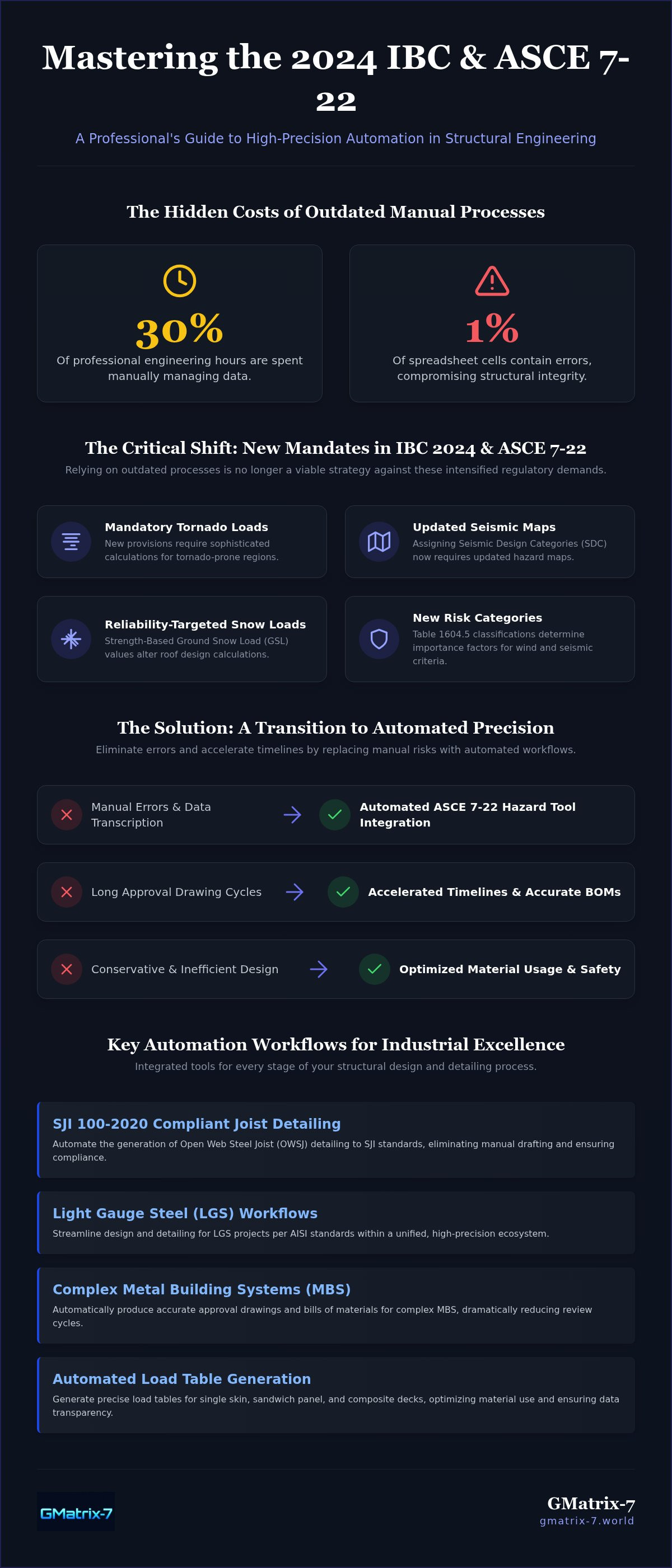
Engineers currently spend up to 30% of their professional hours manually managing data, yet a staggering 1% of all spreadsheet formula cells contain errors that can compromise structural integrity. As the industry shifts toward the 2024 International Building Code, relying on outdated manual processes is no longer a viable strategy. You've likely recognized that the rigorous new ASCE 7-22 provisions, including mandatory tornado load calculations and updated seismic maps, require a more sophisticated approach. Integrating dedicated IBC 2024 structural design tools is the only way to maintain precision while meeting these intensified regulatory demands.
This guide provides the framework to master IBC 2024 and ASCE 7-22 by implementing high-precision automation for structural engineering and detailing. You'll learn how to eliminate manual errors in your bill of materials and slash approval drawing cycles for complex metal building systems. We'll examine the specific workflows for GMatrix-7 modules, showing you how to generate accurate load tables for composite decks and automate SJI 100-2020 compliant joist detailing. By the end of this professional guide, you'll possess the roadmap to achieve total compliance and significantly reduce detailing time for bar joists and light gauge steel.
Key Takeaways
- Master the transition to ASCE 7-22 standards by identifying how IBC 2024 integrates reliability-targeted snow loads and mandatory tornado load provisions.
- Select high-precision IBC 2024 structural design tools that prioritize seamless integration with the ASCE 7-22 Hazard Tool database for unmatched data accuracy.
- Eliminate manual errors and accelerate project timelines by automating the generation of SJI 100-2020 compliant joist detailing and light gauge steel workflows.
- Streamline complex Metal Building Systems (MBS) through the automated production of approval drawings and accurate bills of materials.
- Achieve industrial excellence by utilizing automated generators for single skin, sandwich panel, and composite deck load tables.
Navigating the Structural Evolution of the 2024 International Building Code (IBC)
The 2024 International Building Code (IBC) isn't just a routine update; it's a rigorous recalibration of structural standards. It marks a definitive shift toward the ASCE 7-22 standard for environmental loads, introducing complexities that manual workflows can't reliably manage. This evolution forces a transition from prescriptive design methods to high-precision, data-driven analysis. As the foundational building code for modern construction, the IBC 2024 now mandates new tornado load provisions and reliability-targeted ground snow loads. Implementing advanced IBC 2024 structural design tools is the only way to ensure total compliance while maintaining the speed required in a competitive market.
The Critical IBC-ASCE 7-22 Relationship
Chapter 16 of the IBC serves as the technical bridge to ASCE 7, providing the legal framework for seismic, wind, and snow load requirements. One of the most impactful changes is the adoption of Strength-Based Ground Snow Load (GSL) values. These values now utilize a reliability-targeted approach, which significantly alters roof design calculations. Manual data entry for these risk-targeted loads is no longer a viable strategy. The sheer volume of variables in ASCE 7-22 makes the risk of human-in-the-loop errors too high. Automated tools now handle these complex inputs, ensuring that the final engineering outputs are both safe and optimized for material efficiency.
Risk Categories and Importance Factors in 2024
Engineers must pay close attention to Table 1604.5, which classifies buildings into risk categories I through IV. These classifications are fundamental because they determine the importance factors that scale wind and seismic design criteria. The 2024 code places a heavy emphasis on mapped spectral accelerations for assigning the Seismic Design Category (SDC). This process requires constant cross-referencing with updated hazard maps and risk category adjustments. Modern IBC 2024 structural design tools automate this integration, pulling data directly from the ASCE 7-22 Hazard Tool to eliminate manual transcription errors. This capability-to-outcome pattern provides the peace of mind that every design is fundamentally stable and legally compliant.
Selecting the Right IBC 2024 Structural Design Tools
Selecting a software suite for modern engineering is a high-stakes strategic decision. It directly influences your firm's liability profile and operational profitability. While basic web tools provide raw environmental data, world-class firms require integrated IBC 2024 structural design tools that ingest this data directly into the analysis engine. This integration is vital for maintaining the "capability-to-outcome" workflow that modern projects demand. Your selected platform must automate the increasingly complex load combinations for both LRFD and ASD methods as mandated by §1605 of the 2024 International Building Code. It's about more than just numbers; it's about establishing a dependable, digital source of truth.
Superior tools prioritize a multi-material approach that mirrors the diversity of modern industrial projects. Whether your team is designing Light Gauge Steel (LGS) per AISI standards or Open Web Steel Joists (OWSJ) per SJI requirements, the platform should process these inputs within a unified ecosystem. This holistic approach ensures that structural analysis leads directly to high-precision detailing. It eliminates the fragmentation that often occurs when moving from engineering to fabrication. It's this level of technical sophistication that separates industry leaders from those merely struggling to keep up with code cycles.
Automation of Load Table Generation
Precision is paramount when generating technical documentation for building envelopes. Manual calculation of composite deck load capacity or sandwich panel performance is inherently inefficient and often leads to conservative over-design. High-precision automation tools calculate these capacities under the new ASCE 7-22 standards with surgical accuracy. They produce optimized load tables that reduce material waste while providing the rigorous data transparency that building officials require. This automation transforms a tedious manual task into a rapid, repeatable process that enhances project speed without sacrificing safety.
Compliance with Material-Specific Standards
Professional-grade software must demonstrate strict alignment with AISC 360 for structural steel and AISI S100 for cold-formed steel members. In the specialized niche of bar joists, SJI 100-2020 compliance is a non-negotiable requirement for modern detailing. Your selected tool must be capable of generating professional approval drawings that satisfy the most demanding regulatory bodies. For firms committed to this level of industrial excellence, GMatrix-7 provides specialized modules that bridge the gap between complex code inputs and streamlined, compliant outputs. This ensures that every project meets the highest global standards of accuracy and reliability.
How to Implement an Automated IBC 2024 Compliance Workflow
Standardizing your firm's approach to the IBC 2024 transition ensures every project adheres to the same rigorous safety benchmarks. Manual load transfers between disconnected spreadsheets are a primary source of failure; automation effectively eliminates these "human-in-the-loop" errors. By utilizing integrated IBC 2024 structural design tools, you create a seamless data thread from initial site analysis to the final fabrication bill of material (BOM). This systematic approach transforms a complex regulatory hurdle into a streamlined, repeatable competitive advantage that positions your business as a premier leader in the field.
Step 1: Environmental Load Determination
Precision starts with site-specific data. Advanced design modules import geographical coordinates directly into ASCE 7-22 maps, automating the calculation of snow, wind, and seismic loads based on the building’s assigned risk category. For projects in tornado-prone regions, the software now automatically defines tornado load requirements, which is a mandatory addition to the 2024 code. This automation provides the authoritative accuracy required for modern structural engineering, leaving no room for manual misinterpretation of complex hazard maps or outdated spectral acceleration values.
Step 2: Structural Analysis and Load Combinations
Once environmental loads are established, the system runs automated simulations for LRFD and ASD load combinations per §1605. This process identifies the most unfavorable effects on the building frame, allowing for surgical optimization of member sizes. Whether you are working with GMatrix-7 / MBS (IBC) or GMatrix-7 / LGS (AISI), automated stress analysis ensures every component is sized for peak performance. This rigorous analysis eliminates the guesswork, providing a level of security and material efficiency that manual methods simply cannot match.
Step 3: Automated Detailing and Documentation
The final phase translates engineering data into actionable documentation. Professional platforms generate SJI-compliant bar joist details directly from the structural model, ensuring total alignment between the design intent and the final product. This capability-to-outcome transition produces technical approval drawings and automated bills of material (BOM) simultaneously. Real-time documentation updates ensure that if a design parameter changes, the technical drawings reflect that shift instantly. This maintains project integrity throughout the lifecycle and provides the peace of mind that comes from a world-class, data-driven workflow.
Addressing Complexity in MBS and OWSJ Engineering
Metal Building Systems (MBS) and Open Web Steel Joists (OWSJ) are facing unprecedented technical pressure under the new IBC 2024 standards. The transition to ASCE 7-22 environmental maps isn't a simple update; it's a structural overhaul that demands a higher level of analytical rigor. Specialized IBC 2024 structural design tools provide the necessary framework to navigate these changes without compromising on safety or speed. These systems act as a guardian of safety by enforcing code-defined limits within every calculation, ensuring that no design parameter is overlooked. It's vital to understand that automation doesn't replace professional engineering judgment. Instead, it empowers engineers by removing the burden of manual data management, allowing them to apply their expertise to complex problem-solving.
Precision Detailing for Bar Joists
Open Web Steel Joists require surgical precision to meet the SJI 100-2020 standards. Modern OWSJ software handles intricate joist configurations that would be incredibly time-consuming to detail manually. These tools ensure that every component complies with the latest load-bearing capacity requirements, providing the technical validation building officials demand. By automating the data flow, you streamline the critical communication channel between engineers and fabricators. This ensures that the final product matches the design intent with 100% accuracy, providing the peace of mind that comes from a world-class detailing process.
Optimizing Metal Building Systems (MBS)
Managing the geometric complexity of modern Metal Building Systems requires a sophisticated approach to load path analysis. IBC 2024 design tools enable engineers to calculate precise load transfers from roof panels and secondary members into the primary frame. This is particularly vital when accounting for the new reliability-targeted snow loads and intensified wind provisions. Automation allows for the rapid generation of shop drawings, which significantly reduces project lead times. This efficiency doesn't come at the expense of quality; it's the direct result of a high-precision digital workflow.
Key benefits of automating MBS workflows include:
- Surgical Accuracy: Precise calculation of load transfers across complex geometries.
- Regulatory Compliance: Automated enforcement of IBC 2024 and ASCE 7-22 standards.
- Operational Speed: Rapid generation of technical approval drawings and shop-ready data.
For firms looking to master these complexities, GMatrix-7 / MBS (IBC) provides the specialized modules needed to achieve total compliance and industrial excellence.
Elevating Engineering Standards with GMatrix-7
GMatrix-7 provides the definitive technical response to the intensified demands of the 2024 International Building Code. It isn't merely a software suite; it's a sophisticated "capability-to-outcome" framework designed to bridge the gap between complex regulatory inputs and high-precision industrial outputs. By integrating the rigorous data requirements of ASCE 7-22 directly into its core modules, GMatrix-7 ensures that your firm remains at the cutting edge of structural engineering. Adopting these advanced IBC 2024 structural design tools allows you to achieve world-class precision in LGS, OWSJ, and MBS projects, positioning your business as a premier leader in both productivity and safety.
The GMatrix-7 / MBS (IBC) Advantage
The GMatrix-7 / MBS (IBC) module automates the entire metal building engineering process, transforming a high-liability manual task into a streamlined digital workflow. This module excels in its ability to generate surgical-grade technical documentation, including integrated load table generators for single skin, sandwich panels, and composite decks. These generators account for the latest environmental load standards, ensuring that every panel and deck component is optimized for material efficiency and structural integrity. The platform culminates in the automated generation of error-free bills of material (BOM), providing total reliability from the design phase through to fabrication. This level of technical depth eliminates the data fragmentation that often stalls large-scale industrial projects.
Future-Proofing Your Engineering Firm
Adopting GMatrix-7 is a strategic move for firms looking to dominate the 2026 engineering landscape. The transition from manual detailing to a fully automated, SJI-compliant workflow is no longer optional for firms that value excellence. GMatrix-7 / OWSJ (SJI) ensures that your bar joist detailing meets the rigorous SJI 100-2020 standards without the need for time-consuming manual checks. This automation acts as a guardian of safety, enforcing code-defined limits while accelerating the production of approval drawings. By securing your workflow with a battle-tested, globally minded partner, you gain the peace of mind that comes from unrivaled accuracy and stable, data-driven progress.
The era of manual data management is over. High-performing firms are already leveraging automation to secure their competitive advantage and ensure total compliance with the latest building codes. It's time to elevate your standards and experience the pride of high-level achievement with a world-class structural design partner.
Experience the Future of Structural Design with GMatrix-7
Master the Future of Structural Compliance
The transition to IBC 2024 and ASCE 7-22 represents a definitive shift toward data-intensive engineering. Relying on manual workflows in this environment introduces unacceptable risks to both project timelines and structural reliability. Mastering these complexities requires a move toward a fully integrated, automated ecosystem that handles environmental loads and material-specific detailing with unrivaled precision. Implementing high-precision IBC 2024 structural design tools is no longer a luxury for the modern firm; it's a strategic imperative for those committed to industrial excellence.
GMatrix-7 provides the authoritative solution for this new landscape, offering SJI 100-2020 compliant joist detailing and industry-leading MBS engineering automation. Our platform streamlines the generation of technical documentation, including automated load table generation for composite decks and sandwich panels. This "capability-to-outcome" framework ensures your firm remains a leader in safety and productivity. Take the first step toward securing your competitive advantage today and achieve the peace of mind that comes from world-class structural integrity.
Request a Technical Demo of GMatrix-7 IBC 2024 Design Tools
Frequently Asked Questions
What are the most significant structural changes in IBC 2024?
The most significant shift in IBC 2024 is the mandatory adoption of ASCE 7-22 for environmental loads. This update introduces reliability-targeted ground snow loads and the first-ever provisions for tornado loads in Risk Category III and IV buildings. These changes move the industry away from prescriptive methods toward data-driven analysis. Structural engineers now require sophisticated IBC 2024 structural design tools to manage these complex inputs and ensure total compliance with updated hazard maps.
How does ASCE 7-22 affect seismic design in the 2024 IBC?
ASCE 7-22 fundamentally alters seismic design by replacing traditional two-period response spectra with multi-period response spectra (MPRS). This change provides a more accurate representation of site-specific ground motions, particularly for softer soil sites. The 2024 IBC requires designers to account for these updated spectral acceleration maps and risk category adjustments. Automation is essential here to process the granular data points required for assigning the correct Seismic Design Category without manual calculation errors.
Can I use IBC 2021 software for IBC 2024 projects?
Utilizing IBC 2021 software for 2024 projects isn't a viable strategy because it lacks the ASCE 7-22 integration necessary for compliance. Older tools can't process the new strength-based ground snow loads or the mandatory tornado load provisions. Relying on outdated software creates significant liability risks and potential for non-compliant designs. Modern IBC 2024 structural design tools are built to handle the "capability-to-outcome" workflow required by the latest regulatory benchmarks and updated hazard tool databases.
What is the role of the ASCE Hazard Tool in structural design workflows?
The ASCE Hazard Tool serves as the authoritative source for site-specific environmental data, including wind, snow, and seismic hazards. In a modern workflow, structural design software imports this data directly to automate load determination. This integration eliminates the risk of manual transcription errors during data entry. For firms committed to excellence, this seamless data thread ensures that every design is based on the most current, reliability-targeted hazard information available in the 2024 code cycle.
How do the new snow load maps in IBC 2024 impact roof design?
The 2024 IBC replaces traditional ground snow load maps with reliability-targeted, strength-based values. This change removes the 0.7 factor previously applied when converting ground snow to roof snow loads. Engineers must now design for these higher strength-based values directly, which significantly impacts member sizing and material optimization. Automated load table generators are vital for managing these new calculations, ensuring that roof panels and frames meet the intensified safety requirements without excessive over-design.
Why is automated BOM generation critical for IBC 2024 compliance?
Automated bill of material (BOM) generation is critical because it eliminates the high risk of human-in-the-loop errors during data transfer. With the increased complexity of ASCE 7-22 load combinations, manual data management is no longer a stable strategy. Automation ensures that every structural component identified during analysis is accurately reflected in the final fabrication list. This provides the peace of mind that the physical structure will perfectly match the compliant engineering model, maintaining project integrity.
Does GMatrix-7 support SJI 100-2020 standards for steel joists?
Yes, GMatrix-7 provides specialized modules that fully support SJI 100-2020 standards for open web steel joists. The platform automates the generation of compliant joist detailing and produces technical approval drawings that meet the most rigorous building official requirements. This capability allows firms to transition from manual detailing to a world-class, automated workflow. By enforcing SJI-defined limits in every calculation, GMatrix-7 acts as a guardian of safety for complex bar joist and light gauge steel projects.
How do tornado loads work in the 2024 International Building Code?
Tornado loads are a mandatory design requirement for Risk Category III and IV buildings in specific tornado-prone regions. The 2024 IBC references ASCE 7-22 Chapter 32, which provides the technical framework for calculating these pressures. Designers must compare tornado loads with straight-line wind loads and design for the most unfavorable effect. Automated design tools are essential for performing these comparative analyses quickly, ensuring that essential facilities remain fundamentally stable during extreme weather events.


