
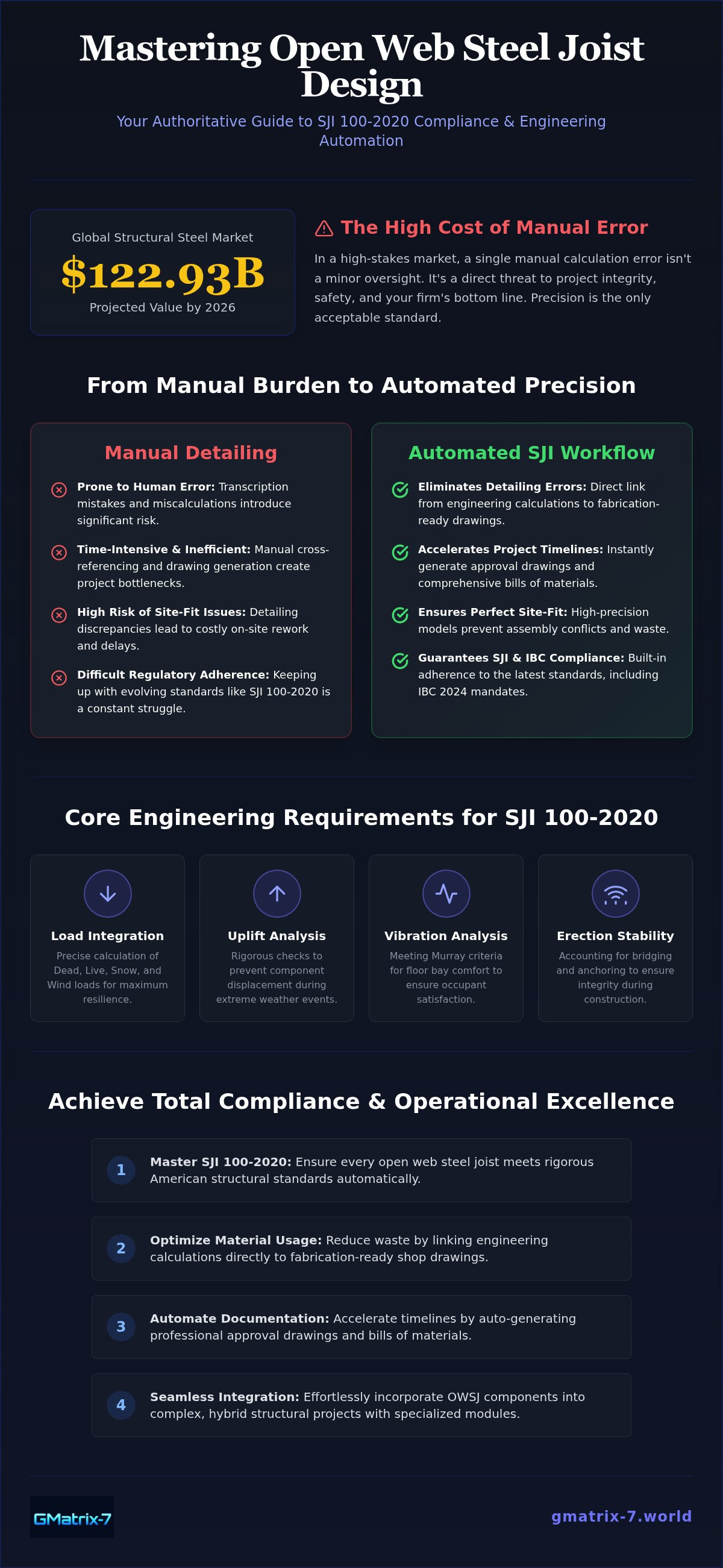
In a global structural steel market projected to reach $122.93 billion in 2026, a single manual calculation error in your joist detailing isn't just a minor oversight; it's a direct threat to your project's integrity and your firm's bottom line. Precision is the only currency that matters when the margin for error is effectively zero.
Engineers often struggle to maintain rigorous SJI compliant joist design while managing the time-intensive demands of generating approval drawings and complex bills of materials. You understand that keeping pace with evolving specifications like SJI 100-2020 requires more than just technical knowledge. It demands a system that removes the burden of manual cross-referencing and site-fit anxieties.
This guide serves as your authoritative resource for mastering open web steel joist design through the power of engineering automation. You'll learn how to eliminate detailing errors and ensure total regulatory adherence while significantly reducing material waste. We will analyze the transition from complex inputs to streamlined technical documentation. This provides a roadmap to achieve total compliance and operational excellence in every project you touch.
Key Takeaways
- Master the core requirements of SJI 100-2020 to ensure every open web steel joist meets rigorous American structural standards.
- Implement SJI compliant joist design through automated detailing to eliminate the "human error tax" and prevent costly site-fit issues.
- Accelerate project timelines by automating the generation of professional approval drawings and comprehensive bills of materials.
- Optimize material usage and reduce waste by linking engineering calculations directly to fabrication-ready shop drawings.
- Leverage specialized software modules to seamlessly integrate OWSJ components into complex, hybrid structural projects.
The Evolution of SJI Compliant Joist Design in 2026
Structural engineering in 2026 demands a decisive shift from static load tables to dynamic, integrated models. Achieving SJI compliant joist design is no longer a simple check-box exercise; it's the foundation of a high-performance, safety-first workflow. The Steel Joist Institute provides the rigorous framework necessary to ensure every Open Web Steel Joist (OWSJ) performs under extreme conditions. While the industry evolves, the SJI 100-2020 standard remains the definitive bedrock for American steel joist design. It ensures that architectural complexity never compromises structural security or regulatory adherence.
Modern engineering standards now require a level of precision that manual methods cannot sustain. The role of the Steel Joist Institute has expanded into active building code enforcement, where digital models must prove compliance before a single beam is fabricated. This evolution moves the industry toward a state where integrated structural integrity is the primary objective, rather than just meeting minimum load requirements. You must adopt a strategy that treats compliance as a continuous, data-driven process.
Understanding the Scope of SJI Standards
The scope of SJI specifications is broad and highly specialized. It covers K-Series for standard spans, LH-Series for long spans, and DLH-Series for deep long spans. Each series demands unique engineering considerations to manage tension and compression forces effectively. Joist Girders require even more precise design parameters because they manage complex, concentrated load paths that support multiple joists. Engineers must distinguish between standard specifications and special load requirements, such as non-uniform loads or specific axial forces. This distinction prevents catastrophic failure in ambitious designs. High-precision detailing in 2026 ensures these components integrate perfectly into the larger structural assembly, leaving no room for site-fit issues.
The Impact of IBC 2024 on Joist Engineering
The International Building Code (IBC) 2024 mandates strict adherence to SJI standards for structural steel applications. This regulatory alignment means that SJI compliant joist design is a legal necessity for project approval. Modern platforms like GMatrix-7 align directly with MBS IBC design software principles, creating a unified engineering environment where data flows seamlessly. This synergy allows for the automated verification of local building code variations, which often differ significantly by state. Whether you're accounting for seismic requirements in California or extreme snow loads in the Northeast, your detailing must reflect these nuances. Automation provides the reliability and peace of mind that manual checks simply cannot match, ensuring your project meets every standard without delay.
Core Engineering Requirements for SJI 100-2020 Compliance
Achieving SJI compliant joist design requires more than a superficial understanding of load tables. It's about navigating a sophisticated matrix of load variables and structural constraints defined by the SJI 100-2020 standard. This framework demands the precise integration of dead, live, snow, and wind loads to ensure structural resilience in any environment. Engineers must also conduct rigorous uplift analysis. This process necessitates meticulous bridge detailing to prevent component displacement or reversal of stress during extreme weather events. The history of SJI Standardization highlights the industry's commitment to these uniform safety protocols, ensuring that every manufactured unit performs as expected.
Vibration analysis is another critical pillar of engineering excellence. Meeting the Murray criteria for floor bay comfort ensures that a structure isn't just safe, but also functional for its occupants. Beyond the finished state, stability during erection remains a primary concern for the engineer of record. You've got to account for bridging and anchoring requirements to maintain integrity before the final deck is secured. These elements don't just happen by accident; they're the result of disciplined engineering logic and a commitment to global safety standards.
Load Table Generation and Verification
The industry is rapidly moving away from static, manual load tables that are prone to transcription errors. Today's projects demand dynamic software generation to handle complex, non-standard joist configurations. Accuracy is vital when using a composite deck load table generator to ensure that every input reflects real-world conditions. Verification protocols must be robust, checking every iteration against SJI specifications to eliminate the risk of structural failure. Automation allows you to simulate these variables in a fraction of the time it takes for manual entry, providing immediate validation of your design assumptions.
Connection Detailing and Weld Specifications
Connection detailing is where theoretical design meets physical reality. SJI compliance requires the algorithmic calculation of weld sizes, ensuring that every joint can withstand the intended stresses without failure. You've got to address end connection requirements for various bearing conditions, whether they're sitting on steel girders or masonry walls. Eccentricity in joist-to-girder connections is a common pitfall that requires careful analysis to avoid unintended moments that could compromise the entire bay. By optimizing your structural detailing through automated platforms, you ensure that these technical nuances are addressed with surgical precision, leaving nothing to chance.
Comparing Manual SJI Tools vs. Automated Detailing Software
Manual calculation is a liability. While free spreadsheets and web-based calculators exist, they impose a heavy "human error tax" on every project. Relying on disconnected tools for SJI compliant joist design creates dangerous data silos where transcription mistakes lead to costly site-fit issues. Automated detailing software eliminates this risk by establishing absolute data continuity. It links your engineering calculations directly to fabrication-ready shop drawings. This ensures that every beam, brace, and weld precisely reflects the design intent without the need for manual re-entry.
Real-time compliance checking represents the pinnacle of modern engineering. Rather than waiting for a post-design review, specialized software identifies potential violations of SJI Standards and Specifications during the design phase. This proactive approach allows you to correct errors before they propagate through the approval process. Speed is another undeniable advantage. GMatrix-7 generates approval drawings in a fraction of the time required by traditional drafting methods, turning weeks of manual labor into hours of automated output.
The Limitations of Traditional CAD Detailing
General-purpose CAD software lacks the structural "intelligence" required for efficient OWSJ detailing. It treats joists as collections of lines and arcs rather than engineered components with specific load-bearing properties. This fundamental gap is a central theme in the CAD vs specialized software for steel detailing debate. In a standard drafting environment, generating a Bill of Materials (BOM) remains a manual bottleneck. This process is not only slow but also introduces a high probability of material count errors that delay fabrication.
Productivity Gains through Structural Design Automation
Specialized modules transform how you handle high-volume projects. By automating repetitive joist profiles, you free your engineering team to focus on complex structural challenges. This integration into professional structural design automation ecosystems ensures that every project component communicates perfectly. Precise, software-validated detailing drastically reduces Request for Information (RFI) counts. When your shop drawings are automatically synchronized with your engineering model, you eliminate the ambiguity that leads to field questions. This level of precision is the only way to maintain a competitive edge in 2026.
Critical Steps for Achieving SJI Compliance in Complex OWSJ Projects
Achieving a world-class SJI compliant joist design requires a methodical approach that eliminates the financial impact of engineering errors. You must start by defining project-specific load criteria and selecting the appropriate SJI series based on span and load requirements. This is not a manual guesswork game. It's a data-driven configuration of software parameters that must account for local building code variations, from seismic zones to extreme wind uplift. Precision at this stage prevents the structural discrepancies that derail project timelines.
Once the parameters are set, you execute automated detailing for joist web and chord members. This process ensures that every component aligns perfectly with the SJI 100-2020 standard. The system then generates SJI-compliant approval drawings for a rigorous review. The final step is the automated generation of the Bill of Materials (BOM). This provides a fabrication-ready list that eliminates the risk of ordering incorrect quantities or specifications, securing your project's bottom line.
Optimizing Joist Geometry for Material Efficiency
Efficiency is the hallmark of professional engineering excellence. You can use GMatrix-7 to identify the optimal joist depth and weight, balancing material costs against fabrication labor with surgical precision. The software automatically selects chord members based on SJI 100-2020 stress limits. This ensures that you don't over-engineer components and waste valuable resources. This level of optimization directly translates to higher profit margins and more competitive bidding in a crowded market. To see how these modules can transform your workflow, explore our OWSJ design solutions.
Streamlining the Approval Process
Speed and reliability are non-negotiable in modern construction. Standardizing your drawing formats allows for a faster engineer-of-record review, significantly reducing the duration from design to fabrication. By utilizing Electronic Data Interchange (EDI), you can communicate directly with joist manufacturers. This ensures that the data used in your SJI compliant joist design remains untainted by manual entry or transcription errors. Maintaining a digital audit trail ensures that every design decision is documented, providing a robust defense for future structural compliance audits and peace of mind for all stakeholders.
GMatrix-7 OWSJ: The Authoritative Platform for SJI-Compliant Detailing
GMatrix-7 represents the pinnacle of structural engineering technology. The GMatrix-7 / OWSJ (SJI) Bar Joist module provides a comprehensive suite for engineers who refuse to compromise on precision. It transforms complex inputs into fabrication-ready outputs with unmatched speed. This isn't just a drafting tool; it's an intelligent engine that ensures every aspect of your SJI compliant joist design meets the most rigorous industrial standards. World-class firms choose this platform because it replaces manual uncertainty with data-driven confidence, securing both structural integrity and project profitability.
Hybrid projects often present significant detailing challenges that slow down production. GMatrix-7 solves this through seamless integration with LGS structural design software. This allows for the simultaneous management of cold-formed steel and open web joists within a single, unified environment. By eliminating data silos, the platform ensures that load paths are traced accurately across different material types. The result is a radical reduction in RFI counts and a significant improvement in overall project velocity.
Fabricators depend on the absolute accuracy of the Bill of Materials (BOM) to manage inventory and production schedules effectively. GMatrix-7 automates this process entirely. By extracting data directly from the engineering model, the software generates comprehensive BOMs that eliminate the risk of material shortages or overages. This precision reduces waste and ensures that the transition from design to fabrication is seamless. It provides the peace of mind that comes from knowing every component is accounted for with surgical accuracy before production begins.
Feature Spotlight: Automated Technical Documentation
Technical documentation often acts as a bottleneck in the engineering workflow. GMatrix-7 eliminates this friction by generating professional approval drawings with a single click. These drawings are not mere sketches; they are intelligent documents that maintain data integrity from the initial design phase through to the shop floor. You can also generate customizable load tables for specialized joist applications, ensuring that even the most unique project requirements are met with total compliance. This automation allows your team to focus on high-value engineering rather than repetitive drafting tasks, maximizing your firm's billable efficiency.
Future-Proofing Your Engineering Workflow
The structural steel landscape is constantly shifting. Your tools must be as scalable as your ambitions. Whether you're designing small retail bays or massive distribution centers, GMatrix-7 provides the scalability required to handle any project volume. The platform receives continuous updates to reflect evolving standards, including the latest SJI and AISI specifications. This commitment to excellence ensures that your firm remains at the cutting edge of the industry. Don't let manual errors or outdated tools limit your growth. Join the leaders in SJI compliant joist design by integrating GMatrix-7 into your structural workflow today.
Securing Structural Excellence in a Digital-First Era
The transition from manual calculation to automated detailing is no longer optional for firms seeking to lead the industry. Mastering SJI compliant joist design through specialized software eliminates the "human error tax" that plagues traditional workflows. By prioritizing data continuity and surgical precision in your bills of materials, you ensure every project moves seamlessly from the engineering model to the fabrication floor without costly delays. GMatrix-7, the 2024 Structural Engineering Innovation Award winner, provides the definitive platform to achieve this level of optimization.
Global fabricators trust our industry-leading OWSJ (SJI) detailing module for its unmatched BOM accuracy and total regulatory adherence. You can now replace site-fit anxieties with the peace of mind that comes from world-class structural automation. It's time to elevate your engineering standards and reclaim your competitive edge. Experience the Future of Structural Automation with GMatrix-7 and discover how our technology empowers your team to deliver excellence in every span. Your journey toward total structural integrity starts here.
Frequently Asked Questions
What are the main changes in SJI 100-2020 compared to previous versions?
SJI 100-2020 consolidated the K, LH, and DLH-Series into a single comprehensive specification. It introduced revised design parameters for compression members and refined the requirements for bridging and anchoring. This update ensures a more uniform approach to safety and structural integrity across all series. By adhering to these consolidated rules, you maintain a rigorous standard of SJI compliant joist design that reflects the most current engineering consensus.
How does GMatrix-7 ensure compliance with SJI uplift requirements?
GMatrix-7 automates the rigorous analysis of net uplift forces to prevent component displacement. The software calculates the necessary bridging and anchoring required by SJI specifications based on the specific wind load inputs for your project. This eliminates the risk of manual miscalculation in stress reversal scenarios. You get a precise, software-validated detailing plan that ensures every joist remains secure under extreme weather conditions, providing absolute structural reliability.
Can I use GMatrix-7 for custom joist configurations not found in standard load tables?
Yes, GMatrix-7 is engineered to handle complex, project-specific configurations that fall outside standard manufacturer load tables. The platform uses dynamic software logic to verify non-standard spans, unique depths, and specialized loading conditions against SJI 100-2020 limits. This flexibility allows you to push architectural boundaries without compromising safety. You can confidently design custom OWSJ components while the system automatically handles the underlying structural verification and compliance checks.
Does the software support the design of Joist Girders under non-uniform loads?
The software provides specialized design logic for Joist Girders subjected to non-uniform or concentrated load paths. It calculates the exact forces at every panel point, ensuring the girder can support multiple joists or heavy equipment loads with surgical precision. This capability is essential for modern distribution centers and industrial facilities. By automating these complex load path analyses, GMatrix-7 ensures that even the most intricate girder designs meet every safety requirement.
How much time can be saved using automated BOM generation for steel joists?
Automated Bill of Material generation typically reduces the time spent on manual documentation by approximately 50%. By extracting data directly from the engineering model, the software eliminates the need for manual material counts and transcription. This speed doesn't come at the cost of accuracy; it actually increases it by removing human intervention from the counting process. You'll generate fabrication-ready lists in minutes, allowing your team to focus on high-value engineering tasks.
Is GMatrix-7 compliant with the latest IBC 2024 structural requirements?
GMatrix-7 is fully aligned with the structural requirements of IBC 2024. The software modules are updated to reflect the latest International Building Code standards, ensuring that your projects meet all legal and regulatory benchmarks for structural steel. This alignment is critical for passing engineer-of-record reviews and obtaining building permits without delays. You can trust that your designs are compliant with both national codes and specific SJI compliant joist design specifications.
Can the software generate load tables for composite floor decks alongside joists?
Yes, the platform features a dedicated module for generating load tables for composite floor decks, single skin panels, and sandwich panels. This allows you to design the entire floor or roof system within a single, integrated environment. By coordinating the joist design with the deck load tables, you ensure perfect structural synergy. This integrated approach reduces the risk of coordination errors between different structural components, leading to a more stable and efficient building.
What output formats are available for approval drawings and material lists?
The software generates professional approval drawings and material lists in standard industry formats, including PDF and CAD-compatible files. It also supports Electronic Data Interchange (EDI) for direct communication with joist manufacturers. These formats ensure that your technical documentation is easily reviewed by engineers-of-record and seamlessly integrated into fabrication workflows. This versatility maintains data integrity from the design phase all the way to the final shop floor production.


