

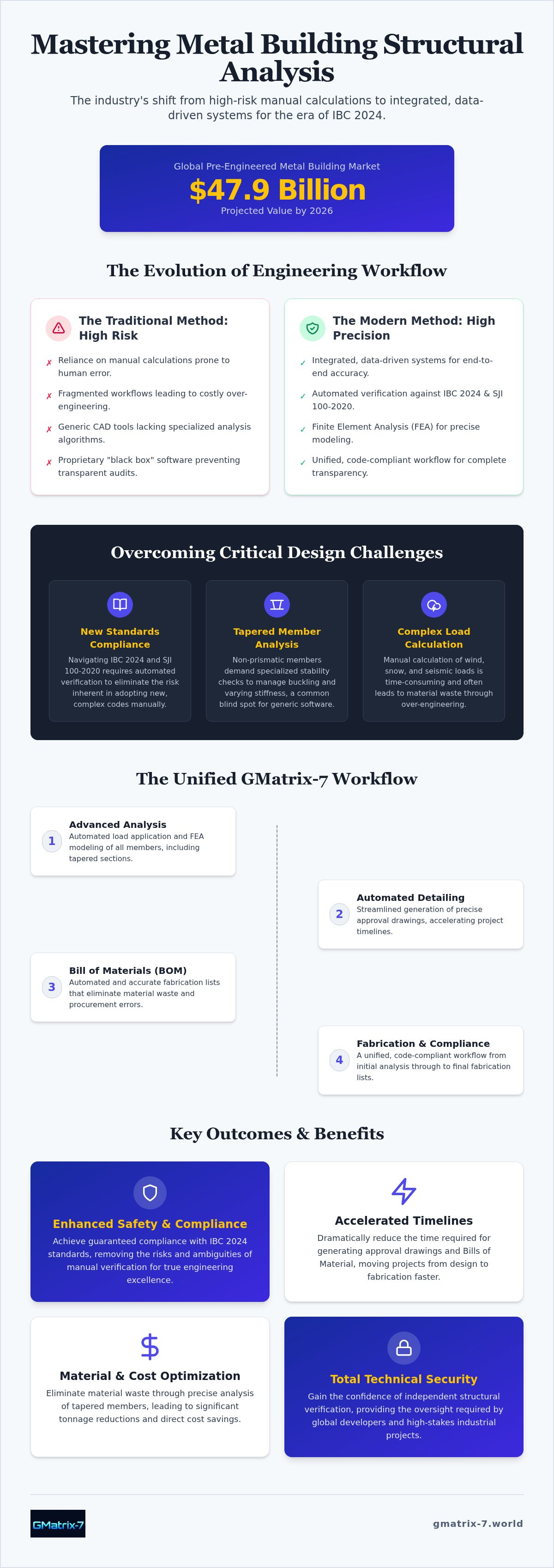
The global pre-engineered metal building market is projected to reach $47.9 billion in 2026, yet the margin for error in manual structural verification has never been thinner. You likely recognize that relying on manual calculations for complex tapered members is a significant risk, especially as jurisdictions begin adopting the IBC 2024 and SJI 100-2020 standards. Maintaining precision in metal building structural analysis is no longer just a goal. It's a rigorous requirement for firms that intend to lead the industry rather than fall behind. Achieving this level of accuracy requires a shift from fragmented manual workflows to integrated, data-driven systems that prioritize both safety and speed.
This article provides the definitive roadmap to mastering these complexities through high-level automation and engineering excellence. You'll learn how to leverage advanced modules like GMatrix-7 / MBS (IBC) to ensure seamless transitions from analysis to detailing while generating automated bills of material. We examine the processes that eliminate material waste, accelerate approval drawing generation, and provide the technical security needed for modern storage and logistics projects. By the end of this guide, you'll understand how to transform complex inputs into optimized, code-compliant structural outcomes that define the gold standard of 2026 engineering.
Key Takeaways
- Master the transition to IBC 2024 and SJI 100-2020 standards by utilizing automated verification tools that eliminate the risks inherent in manual calculations.
- Understand how advanced metal building structural analysis optimizes tapered built-up members, ensuring structural stability while significantly reducing total material tonnage.
- Evaluate the ROI of moving from manual drafting to automated detailing, which streamlines the generation of approval drawings and precise Bills of Material (BOM).
- Leverage automated load table generation for single skin panels, sandwich panels, and composite decks to ensure superior floor and cladding performance.
- Integrate the GMatrix-7 suite, including MBS (IBC) and OWSJ (SJI) modules, to create a unified, code-compliant workflow from initial analysis to final fabrication lists.
The Evolution of Metal Building Structural Analysis
The discipline of metal building structural analysis has transitioned from a manual, component-based practice into a sophisticated, system-wide optimization process. Historically, engineers relied on simplified 2D moment frame "bents" to approximate load paths. Today, the demand for material efficiency and complex geometries requires a more rigorous approach. Modern analysis integrates Finite Element Analysis (FEA) to model every connection and member interaction with absolute precision. This shift ensures that high-stakes industrial projects meet the safety demands of 2026 while minimizing unnecessary steel tonnage.
Independent structural verification is now a prerequisite for world-class projects. Relying solely on manufacturer data is no longer sufficient for projects with complex loading or unusual footprints. By utilizing advanced computational models, engineers can validate the integrity of a structure before a single bolt is tightened. This level of oversight provides the technical security that global developers and logistics giants require. It's about moving beyond basic stability to achieve true engineering excellence.
Understanding the MBS (IBC) Framework
The International Building Code (IBC) 2024 provides the regulatory foundation for modern metal building systems. This framework dictates how primary and secondary structural members must perform under extreme conditions. While primary frames provide the main lateral stability, secondary members like purlins and girts are equally critical for load distribution. Engineers must navigate localized load parameters, including specific wind and seismic data, to ensure global compliance. A deep understanding of structural steel properties allows designers to apply these code requirements while maintaining the economic advantages of pre-engineered systems.
The Critical Need for Design Verification
Generic CAD tools lack the specialized algorithms needed to perform accurate metal building structural analysis on tapered built-up members. These non-prismatic sections require specific stability checks that standard software often overlooks. Specialized modules, such as GMatrix-7 / MBS (IBC), provide the precision necessary to model these varying depths accurately. Without this specialized focus, engineers risk over-designing the structure or, worse, missing critical failure points in the tapered geometry. Proprietary supplier software often functions as a "black box" where internal logic remains hidden, preventing engineers from conducting the transparent, independent audits required for modern safety standards.
Analyzing Tapered Members and IBC 2024 Compliance
Tapered built-up members represent the pinnacle of material optimization in modern pre-engineered buildings. By varying the depth of the web to match the bending moment diagram, engineers strategically place steel only where it's required. This results in significant tonnage reductions and cost savings. However, this non-prismatic geometry introduces significant challenges in metal building structural analysis, particularly regarding stability under complex load combinations. Engineers must account for the shifting neutral axis and varying stiffness along the member length to prevent premature failure during extreme events.
Managing lateral-torsional buckling in these thin-walled sections is essential for structural longevity. These members don't behave like standard hot-rolled beams; their varying cross-sections require specialized integration with AISC steel construction standards to ensure code compliance. Automating these IBC 2024 checks within the analysis workflow ensures that every flange and web thickness is verified against the latest safety benchmarks. This data-driven approach removes the ambiguity often associated with manual stability checks in non-standard sections, providing peace of mind for both the engineer and the end-user.
Advanced Load Path Analysis
Large-scale metal building systems face extreme environmental stressors that demand rigorous calculation. Calculating wind, snow, and seismic loads manually is prone to error and often leads to costly over-engineering. GMatrix-7 / MBS (IBC) automates this load application across the entire building envelope, ensuring that forces are distributed correctly through the rigid frame connections. This precision allows for a more streamlined structural design that remains resilient under peak demand. It ensures the building operates as a single, cohesive unit rather than a collection of isolated parts. For firms seeking to eliminate these manual risks, exploring the capabilities of GMatrix-7 provides a clear path to engineering certainty.
Cold-Formed Steel and AISI S100 Standards
Secondary structural support relies heavily on cold-formed steel components like purlins and girts. Integrating GMatrix-7 / LGS (AISI) design into the primary structural analysis ensures these elements work in harmony with the main frames. Analyzing these members according to AISI S100 standards is crucial for preventing local buckling and ensuring the integrity of the cladding support system. Precise detailing for fabricators minimizes on-site assembly issues, moving the project from the screen to the field with world-class accuracy. This holistic view of both primary and secondary steel is what defines modern engineering excellence in 2026.
Manual vs. Automated Structural Detailing: An ROI Comparison
The transition from manual drafting to automated detailing represents a fundamental shift in project profitability. Manual workflows are inherently fragmented. An engineer performs the metal building structural analysis, then passes results to a detailer who manually interprets those values to create shop drawings. This gap is where human error flourishes. Automation eliminates this interpretation layer. By 2026, firms using integrated systems report that 100% prefabricated steel kits, derived from automated detailing, can reduce on-site construction time by more than 40% compared to traditional methods.
Precision in the initial analysis phase dictates the reliability of every subsequent output. If the analysis is flawed, the Bill of Materials (BOM) becomes a list of expensive mistakes. High-fidelity automation ensures that the calculated member sizes flow directly into the material list without manual reentry. This level of synchronization is supported by Metal Building Manufacturers Association research, which emphasizes the critical nature of integrated design in maintaining system performance and cost-efficiency. It's about moving from a series of disconnected tasks to a unified engineering pipeline.
The Impact of Automated BOM Generation
Material procurement is the largest variable cost in metal building construction. Automated BOM generation utilizes the exact data from the structural analysis to produce comprehensive material lists instantly. This process ensures that structural member sizing is optimized to the millimeter, which significantly reduces material waste on the shop floor. Procurement teams gain immediate visibility into tonnage requirements. This allows for more aggressive purchasing strategies and better cash flow management. Linking analysis data directly to fabrication outputs ensures that what's designed is exactly what's ordered, with no room for ambiguity.
Streamlining Approval Workflows
Approval cycles often stall project momentum and inflate overhead costs. Generating professional approval drawings that adhere to SJI and AISI standards manually takes days; automation completes the task in minutes. This speed reduces the revision cycle between engineers and fabricators, keeping projects on schedule. For a deeper dive into why general drafting tools fall short of industry requirements, CAD vs specialized software for steel detailing provides a comprehensive 2026 comparison. By automating these workflows, firms move from engineering to fabrication with unparalleled speed and technical security.
Optimizing Cladding with Automated Load Table Generation
Cladding systems are the first line of defense against environmental stressors. In the context of metal building structural analysis, these components must be treated as integral load-bearing elements rather than mere aesthetic finishes. High-performance analysis ensures that every panel profile can withstand localized wind pressures and snow accumulations without compromising the secondary framing. Precision in this area prevents catastrophic failures during extreme weather events, which are becoming increasingly frequent and severe as we move into 2026. It's about ensuring that the building's skin performs as reliably as its skeleton.
The generation of load tables involves complex algorithms that simulate the interaction between profile geometry, material thickness, and span conditions. Manual calculation of these tables is notoriously slow and prone to transcription errors. Automation provides a seamless transition from raw engineering data to verified performance benchmarks. This ensures that every component, from the smallest fastener to the largest wall panel, is optimized for safety and material efficiency. It's a level of technical security that general-purpose tools simply cannot provide.
Composite Deck Load Capacity
Analyzing the interaction between steel decks and concrete fill is essential for floor system safety. The composite action between these materials creates a rigid diaphragm that must be accounted for in the global structural model. GMatrix-7 automates the generation of these precise composite floor deck load tables, ensuring that deflection and shear limits are strictly maintained. Meeting the rigorous requirements of 2026 building codes demands this level of granular detail. For those looking to streamline this process, you can explore our guide on composite deck load table generators to see how automation transforms floor design.
Sandwich Panel and Single Skin Analysis
Insulated sandwich panels introduce unique engineering challenges, specifically regarding thermal expansion and structural load distribution. Unlike single skin profiles, these panels must be analyzed for their composite stiffness and the thermal gradients between internal and external faces. Generating automated load tables for various cladding profiles allows engineers to select the most efficient material for the specific project climate. This data-driven approach eliminates guesswork and ensures long-term durability. To ensure your cladding systems meet the highest global standards, integrate GMatrix-7 into your structural workflow and achieve total engineering certainty.
Implementing GMatrix-7 for Global Structural Excellence
Achieving engineering excellence in 2026 requires more than just isolated software tools; it demands a unified ecosystem. GMatrix-7 provides this through specialized modules that transform the entire metal building structural analysis workflow. By integrating GMatrix-7 / MBS (IBC) for primary frame design, firms establish a foundation of total technical security. This isn't just about meeting codes. It's about dominating the market through superior precision and efficiency. When every calculation is verified against the most rigorous global standards, you gain the confidence to take on high-stakes industrial projects that others find too complex.
Uncompromising reliability is the hallmark of the GMatrix-7 suite. Whether you're designing a massive warehouse or a specialized storage facility, the ability to transition seamlessly from analysis to fabrication is a significant competitive advantage. This system doesn't just calculate loads; it manages the entire engineering lifecycle. You're not just providing a building; you're delivering a battle-tested structural solution that prioritizes safety and material optimization at every stage. This is how world-class engineering firms future-proof their operations against rising labor costs and evolving regulatory demands.
Total Compliance with SJI and AISI Standards
Compliance with SJI 100-2020 isn't optional for serious manufacturers. GMatrix-7 / OWSJ (SJI) automates the detailing of complex open web steel joists, ensuring every web member and chord meets rigorous safety standards. This precision extends to light gauge steel through GMatrix-7 / LGS (AISI), which handles thin-walled framing with unrivaled accuracy. These modules eliminate the friction between design and fabrication, providing the data needed for automated Bill of Material generation. You'll achieve AISI S100 standards without the manual bottlenecks that traditionally slow down cold-formed steel projects.
The Future of Structural Engineering Productivity
The future of the industry belongs to firms that scale through automation. Providing world-class structural analysis to global fabricators is only possible when you've removed manual bottlenecks from your documentation process. Scaling isn't just about doing more; it's about doing better while maintaining uncompromising safety standards. For a strategic perspective on these shifts, consult the 2026 professional structural design automation outlook. By adopting these automated workflows, your firm can deliver faster approval drawings and more accurate material lists, positioning you as a premier partner in the global construction market.
Securing Your Lead in Modern Structural Engineering
The engineering landscape of 2026 demands a definitive departure from antiquated manual methods. Firms that prioritize high-level automation don't just survive; they secure their place at the forefront of global industry standards. By integrating automated IBC 2024 compliance and precise load table generation, your team can eliminate the "black box" risks often associated with supplier-led software. A unified workflow ensures that your metal building structural analysis leads directly to accurate Bills of Material and streamlined approval drawings. It's about transforming technical complexity into a repeatable, high-value outcome.
GMatrix-7 provides the industry-leading modules needed to maintain global SJI and AISI standards while maximizing material optimization. Our technology empowers you to deliver battle-tested structural solutions that prioritize both safety and commercial speed. You're invited to Request a Professional Consultation with GMatrix-7 to discover how our automated BOM and compliance tools can revolutionize your current operations. Achieving structural excellence is a deliberate choice. Take the next step toward engineering certainty today.
Frequently Asked Questions
What is the most accurate method for metal building structural analysis?
The most precise approach involves integrated Finite Element Analysis (FEA) combined with specialized code-check algorithms for non-prismatic members. This method ensures every member interaction is modeled accurately under complex load combinations. By using tools like GMatrix-7 / MBS (IBC), engineers perform independent verification that transcends supplier "black box" calculations. This provides the highest level of technical security for large-scale projects where material optimization and safety are paramount.
How does IBC 2024 affect the design of tapered steel members?
The IBC 2024 increases the focus on non-prismatic member stability and lateral-torsional buckling under extreme environmental loads. These updates require more rigorous verification of thin-walled sections used in metal building structural analysis. Designers must ensure tapered geometry adheres to the latest AISC standards for stability. Automated modules simplify this by integrating localized wind and seismic parameters directly into stability checks, preventing over-design while maintaining strict code compliance.
Can structural analysis software automate the generation of a Bill of Materials?
Yes, advanced platforms like GMatrix-7 include built-in modules for Automated Bill of Material Generation. This feature links the final design data directly to the procurement list, ensuring every structural member size is captured accurately. By eliminating manual data entry between the engineering and fabrication phases, firms significantly reduce the risk of material waste. This synchronization provides immediate visibility into tonnage requirements and improves overall project cash flow management.
What are the benefits of using specialized OWSJ detailing software?
Specialized OWSJ software, such as GMatrix-7 / OWSJ (SJI), automates the complex detailing of open web steel joists to ensure total precision. These tools provide several high-value advantages:
- Instant generation of shop drawings that adhere to SJI standards.
- Automated chord and web member sizing based on structural loads.
- Reduction in revision cycles between the engineer and the joist manufacturer.
How are load tables generated for composite decks and sandwich panels?
Load tables are generated through automated algorithms that simulate the interaction between profile geometry, material thickness, and span conditions. GMatrix-7 features specialized tools for Generating Single Skin, Sandwich panels, and Composite Deck Load Tables. These generators account for thermal expansion in insulated panels and composite action in floor decks. This data-driven approach ensures that cladding and floor systems meet the performance benchmarks required by 2026 building codes without manual calculation errors.
What is the difference between generic FEA and specialized MBS design software?
Generic FEA tools lack the specific algorithms required to analyze the unique stability challenges of tapered built-up members and cold-formed sections. Specialized MBS software, like GMatrix-7 / MBS (IBC), is purpose-built to handle non-prismatic geometry and secondary structural interactions. While generic tools are versatile, they often require extensive manual workarounds for code compliance. Specialized platforms streamline the transition from analysis to detailing, providing a more efficient and technically secure workflow for complex metal building projects.
How does GMatrix-7 ensure compliance with SJI 100-2020 standards?
GMatrix-7 ensures total compliance by integrating SJI 100-2020 standards directly into the GMatrix-7 / OWSJ (SJI) module. The software automates the structural verification of bar joists, checking every component against the latest industry benchmarks for load-carrying capacity and stability. This rigorous approach provides manufacturers with the technical security needed for global project delivery. By automating these checks, the software eliminates the inconsistencies found in manual verification and ensures every joist is fabrication-ready.
Is automated detailing compatible with modern BIM workflows?
Automated detailing is fully compatible with modern BIM workflows, serving as a critical bridge between design and construction. By 2026, the industry has shifted toward 3D modeling environments where automated outputs like Approval Drawing Generation integrate seamlessly with global project data. This compatibility allows for real-time collaboration among stakeholders and reduces on-site assembly issues. Automated systems provide the high-fidelity data needed to populate BIM models with accurate material specs and structural geometry.


