
The most profitable structural steel detailing solutions for 2026 aren't external firms you hire. They are automated engineering modules you own. You've likely felt the frustration of waiting weeks for external detailing firms only to receive a Bill of Materials riddled with manual entry errors. These inconsistencies with SJI and IBC standards don't just delay your timeline; they directly impact your bottom line.
This guide demonstrates how transitioning to automated workflows eliminates these high error rates and maximizes project profitability through precision engineering. You'll discover how to generate instant approval drawings and error-free material lists while maintaining full compliance with AISI and SJI standards. We'll examine why the shift from manual services to integrated technology is the only way to secure a competitive edge in an increasingly demanding market. By replacing traditional bottlenecks with data-driven automation, you ensure your operations remain both agile and fundamentally stable.
Key Takeaways
- Understand why the shift from manual drafting to automated engineering modules is the new industry standard for 2026.
- Compare the long-term ROI of software licensing against recurring service fees to maximize your firm's total profitability.
- Evaluate specialized structural steel detailing solutions that ensure full compliance with SJI 100-2020 and IBC standards.
- Learn how to eliminate the "manual check" phase by generating instant, error-free Bills of Material and approval drawings.
- Discover how GMatrix-7 modules bridge the gap between complex engineering inputs and streamlined fabrication outputs.
The Evolution of Structural Steel Detailing Solutions
Structural steel detailing is the technical process of translating high-level engineering intent into the granular, actionable data required for fabrication. It serves as the final checkpoint before steel hits the shop floor, ensuring that every connection and member aligns with the overall structural integrity of the building. For decades, this critical task relied on the expertise of a Steel detailer using manual drafting techniques or basic 2D CAD. However, as we move through 2026, the definition of structural steel detailing solutions has fundamentally shifted. It no longer describes a service based on human drafting hours. It now signifies an integrated, software-driven ecosystem that automates the generation of shop drawings, bills of material, and CNC data.
Modern global markets demand a move away from isolated drafting labor toward integrated BIM workflows. This transition allows for real-time synchronization between design and fabrication, reducing the friction that typically occurs during the handoff between engineers and detailers. By adopting automated engineering modules, firms can achieve a level of precision that manual processes simply cannot match. This shift is not just about speed; it's about establishing a single source of truth for the entire project lifecycle.
From Manual Drafting to Digital Twins
The industry's trajectory has moved from static 2D lines to dynamic, parametric 3D modeling. Modern detailing creates a "Digital Twin" of the structure, providing a virtual replica that contains every bolt, weld, and plate. This allows for exhaustive clash detection before a single beam is cut, ensuring that the physical assembly mirrors the digital design perfectly. Data-driven detailing ensures that what works in the software works on the job site. This evolution minimizes the risk of on-site erection issues, which are often the most expensive failures in a construction project. By utilizing automated engineering modules, firms move from reactive problem-solving to proactive precision.
The Cost of Inefficiency in Traditional Workflows
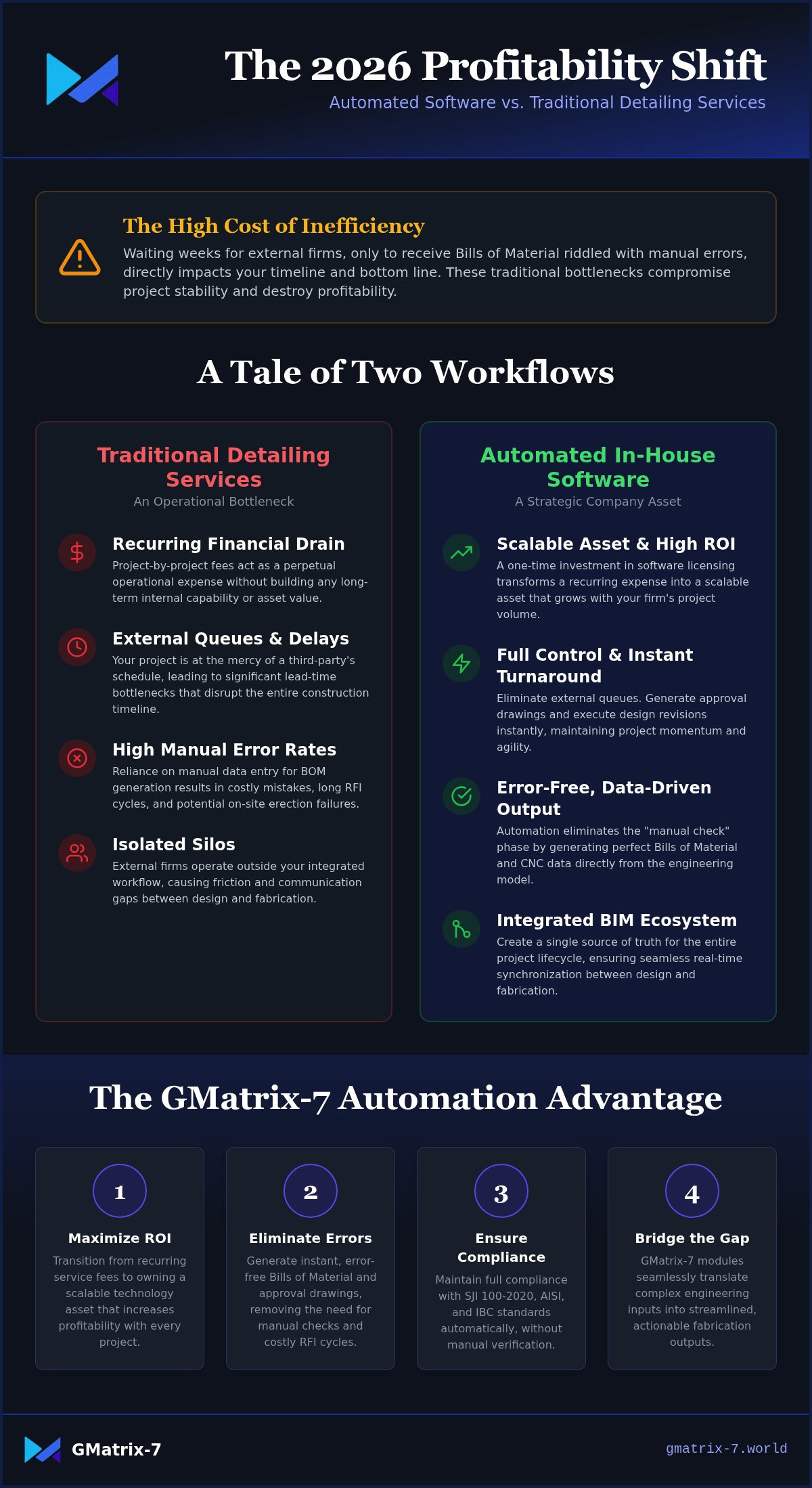
Traditional workflows often rely on external firms that operate in isolated silos, leading to high error rates during manual Bill of Material (BOM) generation. These errors result in agonizingly long Request for Information (RFI) cycles that kill project momentum. Every hour spent waiting for a clarification from an external detailer is an hour of lost production. Manual entry errors don't just waste material; they compromise project timelines and destroy profitability. Detailing efficiency is the ratio of engineering hours to error-free outputs. When you replace manual labor with automated structural steel detailing solutions, you eliminate the "manual check" phase and secure your margins against human error.
Automated Software vs. Detailing Services: A Comparison
The choice between investing in in-house structural steel detailing solutions and hiring external services defines a firm's operational trajectory. Traditional detailing services operate on a project-by-project fee structure, which acts as a recurring financial drain without building internal equity. In contrast, specialized software licensing transforms detailing from a variable expense into a scalable asset. While organizations like the National Institute of Steel Detailing (NISD) provide essential industry advocacy for service providers, the 2026 market increasingly favors the autonomy provided by automated engineering modules.
Owning the technology allows for the seamless integration of engineering and detailing within a single environment. This is particularly critical for Metal Building Systems (MBS), where scalability is essential for maintaining profitability. Automated modules like GMatrix-7 / MBS (IBC) allow users to handle high-volume projects without the proportional increase in overhead associated with external firms. You don't just buy software; you acquire the capability to produce sophisticated outputs with minimal manual intervention. This shift ensures that your firm's growth is no longer limited by the capacity of a third-party partner's drafting team.
Project Control and Turnaround Times
Outsourcing detailing often places your project in an external queue, creating significant lead-time bottlenecks that disrupt the entire construction schedule. In-house automation eliminates these delays by allowing for the instant generation of approval drawings. When design parameters shift mid-project, internal teams can execute revisions immediately rather than waiting days for a submittal from a third party. This agility is vital for complex Open Web Steel Joist (OWSJ) or Light Gauge Steel (LGS) projects where precision is non-negotiable. By leveraging automated engineering modules, you regain total authority over your project timelines and deliver results with commercial urgency.
Quality Assurance and Standards Compliance
External detailing services carry an inherent risk of interpretation errors where third-party drafters may misread engineering intent. Automated software removes this ambiguity by hard-coding SJI 100-2020 and IBC compliance directly into the workflow. This ensures that every generated member meets rigorous safety and global standards without the need for exhaustive manual oversight. Maintaining a single source of truth from the initial design to the final Bill of Materials (BOM) provides a level of reliability that human drafting teams cannot consistently replicate. This data-driven approach secures your reputation for excellence and protects your project margins from the costs of rework.
Specialized Detailing for MBS, OWSJ, and LGS Structures
Generic structural steel detailing solutions often fail when confronted with the highly specialized engineering requirements of complex framing systems. While standard drafting tools might handle basic beams and columns, systems like Metal Building Systems (MBS) demand a deep integration between design intent and fabrication output. As the American Institute of Steel Construction (AISC) establishes the foundational standards for structural safety, modern software must translate these complex regulations into granular, actionable data. GMatrix-7 / MBS (IBC) provides this exact capability, optimizing the detailing process within the International Building Code framework to ensure every tapered member and connection is engineered for maximum material efficiency.
Beyond primary framing, the automation of secondary components like single skin, sandwich panels, and composite decks represents a significant leap in project speed. Traditionally, generating load tables for these elements required exhaustive manual calculation and data entry. Advanced engineering modules now automate this entire process, producing accurate performance data and material lists instantly. This level of specialization ensures that your workflow remains compliant with global standards while drastically reducing the time spent on repetitive technical documentation.
Mastering Open Web Steel Joists (OWSJ)
Precision in bar joist detailing is governed by SJI 100-2020 compliance, a standard that leaves no room for manual interpretation errors. Automated detailing for OWSJ eliminates the tedious task of sizing chords and webs manually. By utilizing GMatrix-7 / OWSJ (SJI), firms can generate precise material lists for manufacturers that reflect the exact engineering requirements of the project. This data-driven approach utilizes optimized joist design algorithms to reduce material waste, ensuring that every ton of steel is used effectively. You gain the ability to move from engineering inputs to fabrication-ready joist drawings with absolute confidence in the output's accuracy.
LGS and Cold-Formed Steel Precision
Cold-formed steel design presents unique challenges due to the complex buckling behavior of thin-walled profiles. Leveraging AISI S100 standards, specialized LGS design tools handle these intricacies by automating the creation of shop drawings for framing and trusses. GMatrix-7 / LGS (AISI) ensures structural integrity in high-load light gauge applications by hard-coding the necessary engineering constraints directly into the detailing workflow. This automation allows internal teams to produce complex truss layouts and wall panel drawings without the risk of "interpretation errors" common in third-party services. The result is a seamless transition from architectural intent to a stable, compliant cold-formed structure.
Maximizing ROI with Automated BOM and Documentation
Project profitability in 2026 hinges on the absolute accuracy of the final material procurement list. In traditional service models, the Bill of Materials (BOM) is often a semi-manual byproduct that requires exhaustive human verification and cross-referencing. Modern structural steel detailing solutions redefine this process by making the BOM an automated, live extension of the engineering model. This eliminates the "manual check" phase entirely, as the software extracts data directly from the verified design parameters. By integrating specialized load tables for composite decks and sandwich panels directly into the documentation package, firms provide a comprehensive technical dossier that leaves no room for field-side guesswork or procurement delays.
The transition from manual drafting to automated outputs allows engineering firms to capture higher margins by reducing the labor hours traditionally dedicated to technical clerical work. When the documentation process is handled by a specialized engine, the risk of data fragmentation vanishes. You ensure that every stakeholder, from the purchasing department to the shop floor foreman, is working from an identical, synchronized dataset. This level of coordination is the foundation of a high-performance structural workflow that prioritizes speed without sacrificing the rigorous standards of excellence your clients expect.
The Anatomy of an Automated BOM
An automated BOM must provide a granular level of detail to support lean fabrication and precise cost control. This includes exact cut lengths, precise weights, material grades, and assembly marks that correlate directly to the 3D model. GMatrix-7 ensures these data points remain synchronized with real-time design changes. If a joist depth or a building span is adjusted, the BOM updates instantly to reflect the new requirements. A Zero-Error BOM is the ultimate goal of structural automation, serving as the definitive, unassailable guide for procurement and shop-floor execution. This precision prevents the over-ordering of materials and eliminates the costly "re-work" cycles triggered by manual entry discrepancies common in traditional services.
Accelerating Approval Drawing Workflows
Standardizing the approval process is essential for maintaining project momentum and securing client trust. Software-generated approval drawings ensure full compliance with IBC and local building codes by utilizing pre-validated engineering rules. This professional documentation reduces the RFI burden by providing clear, unambiguous technical communication to architects and general contractors. When stakeholders receive a cohesive, data-backed drawing package, the approval cycle accelerates, allowing fabrication to commence sooner. High-quality documentation functions as a driver of project speed, moving the structure from the digital environment to the physical site with commercial urgency. To secure these efficiencies for your next project, explore the GMatrix-7 automated documentation modules.
Choosing GMatrix-7 for Your Structural Detailing Workflow
Selecting a long-term partner for your technical workflow is a strategic decision that dictates your firm's future scalability and precision. GMatrix-7 represents the pinnacle of structural steel detailing solutions by consolidating fragmented engineering tasks into a unified, automated engine. It bridges the gap between sophisticated engineering inputs and the simple, error-free outputs required for rapid fabrication. This technology moves your organization away from the inherent limitations of external drafting firms and toward a model of absolute self-sufficiency. By owning the engineering modules, you secure a stable foundation for growth that is no longer tethered to third-party project queues or manual entry errors.
Global fabricators require a platform that understands the nuances of international building codes while providing a battle-tested environment for complex projects. GMatrix-7 delivers this reliability through its specialized modules, ensuring that your data remains compliant across diverse jurisdictions. Automating the most labor-intensive aspects of the detailing process empowers your team to focus on high-value innovation rather than repetitive clerical verification. This shift ensures your operations remain both technologically advanced and fundamentally stable in an increasingly competitive global market.
A Suite of Specialized Engineering Modules
The strength of GMatrix-7 lies in its integrated architecture, offering MBS, OWSJ, and LGS modules as a cohesive ecosystem. This unified approach allows you to manage design, detailing, and the generation of composite deck load tables within a single, secure environment. You won't have to juggle multiple software licenses or risk data loss during file transfers between disparate tools. Continuous updates ensure your workflow remains aligned with the latest SJI 100-2020 and AISI standards, providing the peace of mind that comes with world-class compliance. Utilizing one platform for all structural steel detailing solutions creates a streamlined path from engineering intent to fabrication reality.
Implementation and Global Support
Transitioning your team to automated detailing requires a partner that prioritizes both technical depth and operational simplicity. GMatrix-7 supports worldwide structural engineering compliance by hard-coding rigorous standards into its automated routines. Our training resources are designed to help your design office achieve a seamless transition, moving from traditional drafting to automated workflows without disrupting ongoing project timelines. This data-driven foundation is what allows international fabricators to maintain their competitive edge and maximize profitability. To see these modules in action and evaluate the impact on your bottom line, request a demo of GMatrix-7 structural detailing solutions and secure your path to engineering excellence.
Securing the Future of Structural Engineering Excellence
The transition from manual drafting to automated structural steel detailing solutions is no longer a luxury; it's a commercial necessity for firms aiming to lead in 2026. By internalizing specialized engineering modules, you eliminate the high error rates and long lead times inherent in traditional service models. You gain absolute control over your project timelines while ensuring every output meets the rigorous demands of SJI and IBC standards. This shift toward data-driven precision protects your margins and secures your reputation as a premier provider of structural excellence.
GMatrix-7 provides the specialized tools needed to bridge the gap between complex engineering intent and fabrication-ready reality. With automated BOM and Load Table generation, you can streamline your documentation process and move from design to the shop floor with unprecedented speed. Our 2024 industry awards validate our commitment to safety and innovation. It's time to take command of your technical outputs and eliminate the friction of outsourced detailing. Optimize your engineering workflow with GMatrix-7 detailing solutions and drive your business toward a more profitable, secure future.
Frequently Asked Questions
What is the difference between structural steel detailing software and general CAD?
General CAD functions as a generic drafting tool for creating lines and circles, whereas specialized detailing software operates as an engineering-driven engine. Specialized structural steel detailing solutions utilize parametric intelligence to understand structural members, connections, and material properties. This allows for the automated generation of shop drawings and data that are synchronized with the physical requirements of the project rather than just visual representations.
How does GMatrix-7 ensure compliance with SJI 100-2020 standards?
GMatrix-7 hard-codes the rigorous Steel Joist Institute specifications directly into its engineering modules. The software automates the sizing of chords and webs based on these pre-validated rules, which removes the risk of human interpretation errors. This ensures that every bar joist produced within the system meets the latest SJI 100-2020 safety and performance requirements without needing exhaustive manual oversight.
Can GMatrix-7 generate load tables for composite decks automatically?
Yes, GMatrix-7 provides specialized modules that generate load tables for composite decks, single skin, and sandwich panels instantly. By inputting the specific design parameters, the software calculates the necessary performance data and formats it into professional technical documentation. This automation eliminates the tedious manual calculation phase and provides fabricators with accurate, project-specific data in a fraction of the time.
Is automated BOM generation more accurate than manual material lists?
Automated Bill of Material (BOM) generation is significantly more reliable because it extracts data directly from the 3D engineering model. This process eliminates the data entry discrepancies and clerical errors common in manual lists produced by external services. Every cut length, weight, and material grade remains perfectly synchronized with the approval drawings, ensuring that procurement and fabrication are based on a single source of truth.
Does GMatrix-7 support IBC 2024 and AISI S100 design codes?
GMatrix-7 is fully updated to support the 2024 International Building Code (IBC) and AISI S100 standards for cold-formed steel design. These structural steel detailing solutions are continuously refined to reflect evolving global standards, providing users with the peace of mind that their projects remain compliant with the latest regulatory requirements. This focus on current codes ensures structural integrity and safety in high-load applications.
What types of structures are best suited for GMatrix-7 detailing solutions?
GMatrix-7 is engineered specifically for high-performance structures, including Metal Building Systems (MBS), Open Web Steel Joist (OWSJ) applications, and Light Gauge Steel (LGS) framing. It excels in projects where material optimization and precise engineering are critical for profitability. Whether you're detailing complex bar joists or large-scale metal buildings, the software provides the specialized depth required for these specific industrial and commercial structural types.
How does automated detailing reduce project lead times for fabricators?
Automation reduces lead times by allowing for the instant generation of approval drawings and material lists, bypassing the queues of external detailing firms. In-house control means design revisions are updated across all documentation immediately, which slashes the typical RFI cycle. This commercial urgency allows fabricators to move from the design phase to the shop floor much faster, securing project timelines and maximizing production capacity.
Can GMatrix-7 handle both single skin and sandwich panel load tables?
The software includes dedicated modules for generating comprehensive load tables for both single skin and sandwich panel systems. These tools automate the complex engineering calculations required for different cladding types, ensuring that the documentation package is complete and technically sound. By consolidating these tasks within one platform, you simplify your workflow and ensure that all secondary components are as precisely engineered as the primary framing.


