

The lightest member isn’t always the most efficient design. Minimizing material waste in structural design means looking beyond section sizes: each decision must preserve structural performance, meet applicable codes, and carry through accurately to detailing and material planning.
Overdesign and inefficient layouts can build avoidable material use into a project. Late design changes can add to the problem when drawings and material lists fall out of sync. The challenge is to use less material without compromising safety or creating costly rework. A disciplined process helps teams compare alternatives and keep engineering decisions consistent across project documents.
This guide explains how design choices can create preventable waste and how to compare efficient, code-compliant options. It also covers coordination between engineering outputs, approval drawings, and bills of material. Automated documentation can support review, but qualified engineers must retain oversight. The goal is a repeatable workflow that connects sound structural decisions to clear, coordinated project information.
Key Takeaways
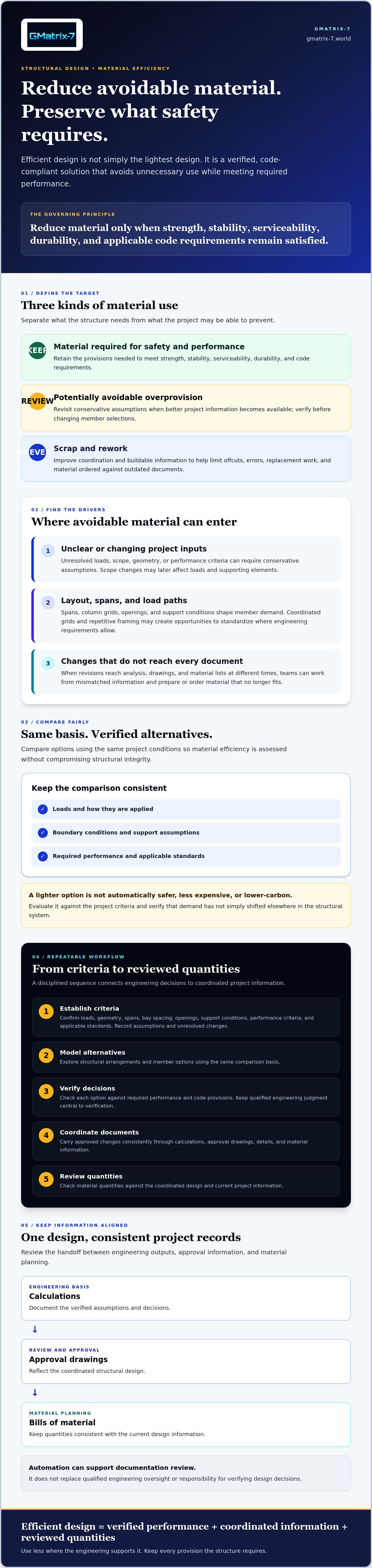
- Separate avoidable material use, scrap, and rework from material required for safety. Efficient design means meeting performance and code requirements, not simply choosing the lightest members.
- Check how incomplete project criteria, scope changes, and layout decisions can drive conservative assumptions or redesign. Coordinated grids may create opportunities to standardize framing where engineering requirements allow.
- Compare design alternatives using the same loads, boundary conditions, performance requirements, and applicable standards. This helps assess efficiency without compromising structural integrity.
- Use a repeatable process for minimizing material waste in structural design: establish criteria, model alternatives, verify decisions, coordinate documents, and review quantities.
- Keep calculations, approval drawings, and bills of material consistent to support review across design stages, with qualified engineering judgment central to verification.
What minimizing material waste in structural design actually means
Minimizing material waste in structural design means reducing material a project can avoidably use, discard, or replace through rework while preserving the structure’s required performance. It does not mean removing material needed for strength, stability, serviceability, durability, or code compliance. The broader idea of material efficiency helps frame the goal: use resources effectively over a product’s life, rather than treating weight reduction as an end in itself.
Waste can arise at several connected stages. Design decisions establish the structural arrangement and member quantities. Detailing translates those decisions into buildable information, procurement determines what materials are ordered, and fabrication and construction can generate offcuts, errors, or replacement work. Structural engineers may not control every source, but they can influence the conditions that create avoidable use and improve coordination before decisions become difficult to revise.
Which material waste can structural engineers influence?
Design-stage overprovision can occur when members are selected using conservative assumptions that remain in place after better information becomes available. Inefficient spans or load paths can also increase material use. Fabrication offcuts and construction-stage losses arise during processing or installation, but design choices such as member lengths, connection details, and repetition can affect how practical the work is to execute.
Consider a project where column locations, framing spans, or loads change after design coordination. If revisions reach analysis, drawings, and material lists at different times, teams may work from mismatched information and order or prepare material that no longer fits. Coordinating grids, structural assumptions, and design documents early helps limit this revision chain and makes quantities easier to review.
Why lower material quantities must not become the only target
A smaller quantity is not automatically a better design. Every alternative must meet the project’s requirements for strength, stability, serviceability, and durability, as well as applicable code provisions. Reducing a member without checking all governing conditions can compromise performance or shift demand to other parts of the system.
The responsible engineer evaluates options against the same project criteria, including loads, boundary conditions, and required performance. A lighter alternative may be worth assessing, but it is not automatically safer, less expensive, or lower-carbon. The objective is a verified, compliant design that avoids unnecessary material while retaining every provision needed for reliable performance. That distinction is central to disciplined material efficiency.
How structural design decisions create avoidable material use
Material quantities can drift upward before a member is sized. If loads, project criteria, or scope remain unclear, engineers may need to use conservative assumptions. Those assumptions can be appropriate until verified, but if they remain after better information becomes available, they may lead to heavier selections or redesign. A late change to equipment, openings, or building use can also affect load paths and supporting elements. Revisions must then carry through calculations, details, drawings, and quantity schedules.
Project inputs, load paths, and structural layout
Before comparing alternatives, confirm the project information that governs the analysis:
- Required loads and how they are applied
- Building geometry, spans, bay spacing, and openings
- Structural system, support conditions, and interfaces with other systems
- Performance criteria, material assumptions, and applicable design standards
- Known scope changes and unresolved assumptions
These inputs shape member demand. A long span, for example, may change the depth or configuration of framing, while a revised column grid can redistribute forces across the system. Coordinated grids and repetitive framing may create opportunities to standardize member types, but repetition should follow verified engineering requirements, not convenience alone. Record assumptions and review changes explicitly so outdated inputs don’t carry into later calculations.
Member selection, connections, and material coordination
Compare feasible member options against the same project criteria, including applicable strength and serviceability requirements. Don’t optimize a beam or column in isolation: its connections, supporting members, and load-transfer path must also work as designed. A change to one component can shift demand elsewhere, so assess the structural system as a whole.
Design coordination also connects structural choices to material planning. The U.S. Environmental Protection Agency describes source reduction as part of sustainable materials management, including design approaches that can support adaptability and disassembly. For a project, early agreement on geometry, loads, interfaces, and revisions helps teams keep calculations, drawings, and material lists aligned. This can reduce quantity discrepancies caused by inconsistent information.
Before releasing documents, review drawings and bills of material together. Check that member marks, quantities, and revisions correspond, and resolve mismatches before they reach procurement or fabrication planning. For metal building system, open-web steel joist, or light-gauge steel workflows, GMatrix-7 structural design software provides system-specific design and documentation workflows. Automated outputs still require qualified engineering review. They don’t establish that a design is correct or that it uses less material.
Material efficiency versus safety: how to compare structural design options
Minimizing material waste in structural design doesn’t mean weakening a structure. It means testing whether different layouts or member selections can meet the same project requirements with less avoidable material. Code compliance and engineering approval are constraints, not benefits to trade away for a lower quantity.
A fair comparison holds the design basis constant: loads, boundary conditions, performance requirements, and applicable standards. If those inputs change between options, the results aren’t directly comparable. Evaluate the structural system as a whole, since reducing material in one member can increase demand on connections, supports, or other components.
A consistent framework for evaluating design alternatives
Use a common review record for each candidate. Document quantities, assumptions, governing checks, and unresolved coordination issues. Separate calculated or measured results from engineering judgment, and identify the qualified reviewer responsible for accepting the analysis. This makes the comparison traceable and shows why an alternative was selected, not just how much material it appears to use.
| Comparison area | What to assess | What to record |
|---|---|---|
| Material quantity | Member and supporting-component quantities across the full system | Basis of comparison, included components, and any exclusions |
| Structural checks | Strength, stability, serviceability, and other project criteria | Governing checks, assumptions, and review status |
| Constructability | Connection demands, interfaces, and practical coordination needs | Open detailing questions and impacts on related elements |
| Documentation | Consistency between calculations, drawings, and quantity records | Revision identifiers, discrepancies, and required updates |
When a lighter option may not be the better option
A lighter member can require a more demanding connection, affect stability, or produce deflection that doesn’t meet project criteria. Durability and constructability also matter. If a local reduction shifts material demand elsewhere, compare the net system requirements rather than judging the isolated component. The apparent gain may disappear once supporting elements and connections are included.
Apply the same checks to every alternative, then resolve coordination questions before adopting a change. A design that meets a quantity target but fails a governing requirement is not an efficient solution. Any proposed structural change requires qualified engineering review and approval against the project’s criteria. This disciplined approach keeps material comparisons consistent and grounded in verified performance.
How to minimize material waste in structural design: a practical workflow
A repeatable process makes minimizing material waste in structural design traceable rather than guesswork. Carry project assumptions through analysis, review, and documentation so each quantity can be tied to a defined design revision.
From project criteria to verified design alternatives
Start by confirming the project basis, then compare feasible alternatives using consistent assumptions. Record what was evaluated, which checks governed, and who reviewed the engineering. This creates a clear decision trail and prevents an option from being selected on quantity alone.
- 1. Establish criteria. Record loads, geometry, structural system constraints, applicable standards, performance targets, and project-specific requirements. Note the source and revision of key inputs.
- 2. Model alternatives. Identify feasible layouts or member options. Log the assumptions used for each model so differences in results can be traced to design choices, not inconsistent inputs.
- 3. Verify. Complete the required structural checks for each candidate. Document governing results, unresolved questions, and the qualified reviewer’s decision before selecting a preferred option.
Coordinate drawings and bills of material before release
Once an option is verified, carry the same revision into engineering outputs and material documentation. Before release, confirm that drawings and bills of material describe the same design. Resolve discrepancies rather than allowing them to carry into downstream planning.
- 4. Coordinate. Track design changes and confirm their impacts appear across the relevant structural documents.
- 5. Document. Maintain revision identifiers, approved assumptions, design decisions, and review status alongside the applicable drawings and quantity records.
- 6. Review quantities. Check for duplicated, missing, or inconsistent line items. Reconcile each item with the current drawing revision and document how discrepancies were resolved.
Make this a formal checkpoint before approval drawings and material lists are issued. Automated approval drawing and bill-of-material generation can help organize consistent documentation, but outputs still require qualified engineering review. For projects that fit its supported workflows, GMatrix-7 structural design software can connect design documentation and material review.
How structural design software supports material review and next steps
Software can make design information easier to trace across analysis and documentation. When calculations, approval drawings, and material lists reflect the same project inputs and revisions, engineers can review quantities against the current design instead of reconciling disconnected records. That consistency supports minimizing material waste in structural design by making discrepancies easier to identify. It does not, by itself, establish that a design is correct or that it uses less material.
What to evaluate in a structural design workflow
Assess whether a workflow fits the structural system and project requirements, then verify how information moves from calculations to drawings and bills of material. Check revision controls, required outputs, and who is responsible for engineering review. Confirm the applicable code and standard editions for the project rather than assuming software support matches current requirements. Automation organizes repeatable tasks; qualified professionals must still verify inputs, assumptions, and results.
For each issue or revision, teams should be able to identify what design information changed and where that change appears in related documents. Before releasing outputs, compare drawing revisions with material-list revisions and resolve mismatches. This gives reviewers a practical basis for checking quantities without treating an automated schedule as proof of savings.
Apply the process to MBS, OWSJ, and LGS projects
The right tools depend on the system being designed. GMatrix-7 provides workflows for metal building systems (MBS) using IBC, open-web steel joists (OWSJ) using SJI, and light-gauge steel (LGS) using AISI. Where a project fits, automated approval drawing and bill-of-material generation can help keep design documentation organized for review. Outputs still require qualified engineering judgment, and project-specific material comparisons must be verified.
The practical next step is to examine how well a design workflow connects project criteria, engineering outputs, drawing revisions, and material quantities. GMatrix-7 design workflows include system-specific capabilities for MBS, OWSJ, and LGS projects.
Make material efficiency part of every design decision
Reliable material efficiency starts with a clear project basis and a consistent comparison of design alternatives. Keep loads, performance requirements, and applicable standards fixed when evaluating options, then verify that the preferred design works as a complete system. This is the discipline behind minimizing material waste in structural design: eliminate avoidable use and rework without compromising safety or compliance.
Carry those decisions through coordinated calculations, drawings, and material lists. A documented review before release helps teams catch quantity mismatches while keeping engineering judgment central. For projects using metal building systems, open-web steel joists, or light-gauge steel, GMatrix-7 provides workflows for MBS (IBC), OWSJ (SJI), and LGS (AISI), with automated approval drawings and bills of material to support coordinated documentation. These tools organize work; qualified professionals must still review outputs and confirm project requirements.
Put a more connected design workflow into practice. Explore GMatrix-7 structural design software to review the system-specific workflows available for your projects. Clear criteria, traceable decisions, and coordinated documentation help your team pursue material efficiency with confidence.
Frequently Asked Questions
What does minimizing material waste in structural design mean?
Minimizing material waste in structural design means identifying avoidable material use, scrap, and rework while meeting structural, serviceability, durability, and applicable code requirements. It isn’t a mandate to select the lightest possible members. Engineers compare feasible options using consistent project assumptions, document the governing checks, and coordinate approved design information with drawings and material lists so teams can review quantities against the intended design.
Can structural engineers reduce material use without compromising safety?
Yes, potentially, when qualified engineers evaluate alternatives against the same project criteria and complete the required structural checks. Safety, serviceability, durability, and applicable requirements constrain material-efficiency decisions. A lighter component isn’t automatically a better solution: it may increase connection demands, affect supporting elements or stability, or shift material requirements elsewhere. The responsible engineer must review the complete structural system before approving a design change.
How can structural design software help reduce material waste?
Structural design software can support repeatable calculations, coordinated documentation, and material-list generation. When drawings and quantity records track the same design revisions, teams can more readily identify inconsistencies before release. Software doesn’t prove a design is correct or establish a particular amount of waste reduction. Qualified professionals must validate project inputs, assumptions, outputs, and revisions, then determine whether the design satisfies its engineering requirements.
What design decisions have the greatest influence on structural material quantities?
The most influential decisions depend on the project, but engineers can examine the structural layout, spans, bay spacing, load paths, member selection, and connection design. Project constraints and later design changes can also affect supporting elements and material schedules. Evaluate these choices as parts of one system. Comparing alternatives using consistent loads and criteria helps reveal trade-offs without optimizing a single member in isolation.
How do engineers compare structural design alternatives fairly?
Set the same loads, geometry, boundary conditions, performance requirements, and applicable design criteria for every alternative. Record material quantities alongside governing checks, connection demands, constructability considerations, and key assumptions. Separate calculated results from professional judgment, and identify the responsible reviewer. This consistent method makes trade-offs traceable and supports a sound decision without treating minimum weight as the sole measure of design quality.
What is the difference between design waste and fabrication waste?
Design waste refers to material made avoidable by inefficient design choices, revisions, or coordination problems. Fabrication waste includes losses such as offcuts generated during manufacturing, while construction-stage waste occurs during later project work. These categories are distinct, even though design decisions can influence downstream processes. Engineering workflows can address design choices and documentation coordination; fabrication and site losses require controls suited to those stages.
How can a bill of material help identify potential waste?
A bill of material organizes items and quantities associated with a design, giving teams a basis for comparison with approved drawings and revisions. Reviewers can investigate missing, duplicated, or inconsistent entries before documents are released. The list is a review aid, not proof of efficiency or correctness. Its usefulness depends on current design information, accurate documentation, and appropriate checks by qualified professionals.


