

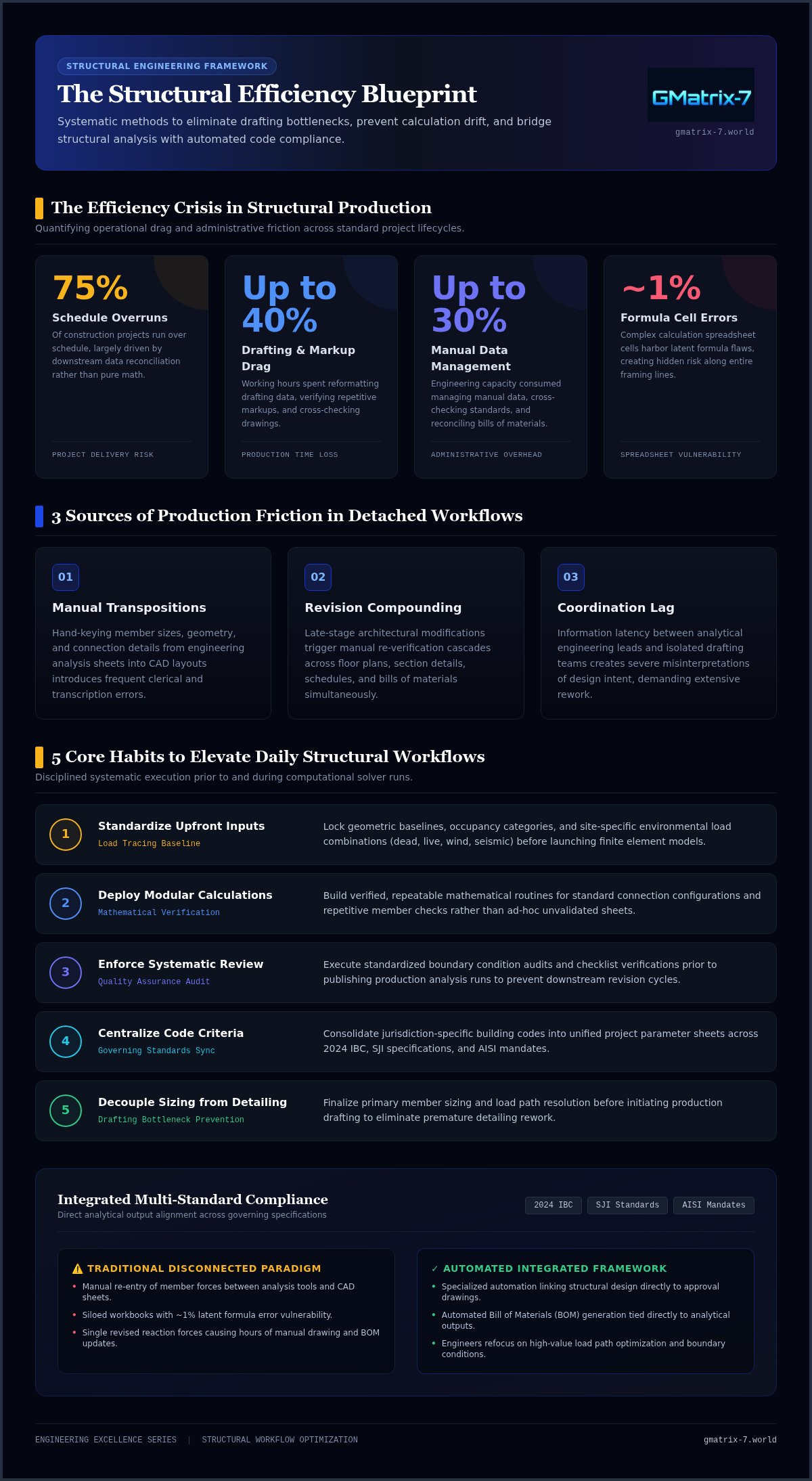
Rushing your calculations will never fix a broken detailing pipeline. Learning how to become a more efficient structural engineer isn't about running finite element models faster; it's about eliminating manual production friction. When an estimated 75% of construction projects run over schedule, the drag rarely stems from complex mathematics. Instead, it comes from engineers spending up to 30% of their time managing data manually, cross-checking design standards, and reconciling bills of materials across shifting IBC, SJI, and AISI requirements.
You already know the frustration of burning prime analytical hours on repetitive drafting updates and spreadsheet verification. True professional efficiency requires an integrated framework that directly bridges structural design with automated documentation. In this guide, you'll learn how to master systematic workflows, robust calculation frameworks, and automated detailing methods to slash project turnaround times without compromising code compliance. Here is your definitive blueprint to eradicate clerical errors, eliminate detailing bottlenecks, and refocus on high-value structural problem solving.
Key Takeaways
- Eliminate the traditional drafting bottleneck by deploying specialized automation that links structural design models directly to approval drawings.
- Discover how to become a more efficient structural engineer by standardizing design criteria and utilizing modular calculation frameworks before modeling.
- Eradicate clerical errors and material mismatches through automated bill of materials generation tied directly to analytical outputs.
- Maintain uncompromising code compliance across complex IBC, SJI, and AISI mandates by utilizing typology-specific software engines.
- Scale firm-wide production capacity by shifting engineering hours away from repetitive CAD modifications toward high-level analytical problem solving.
The Efficiency Crisis in Modern Structural Engineering
True efficiency in structural engineering is not about cutting analysis corners or accelerating manual calculations. It means maximizing high-value decision-making while eliminating non-analytical production friction. Understanding how to become a more efficient structural engineer begins with identifying where hours vanish. Too often, engineering talent is consumed by administrative coordination rather than optimizing load paths, resolving complex boundary conditions, or refining framing efficiency.
Diagnosing the Administrative and Drafting Drag
Manual friction dominates the standard production cycle. Design practitioners frequently spend up to 40% of their working hours reformatting drafting data, verifying repetitive markups, and cross-checking drawing sets against updated calculations. Detached workflows between design analysis and detailing create a compounding drag on project momentum:
- Manual transpositions: Hand-keying member sizes and connection details from analysis sheets into CAD layouts introduces frequent transcription errors.
- Revision compounding: Late-stage architectural adjustments force manual updates across floor plans, section details, schedules, and bills of materials.
- Coordination lag: Traditional handoffs between engineers and separate drafting teams create informational latency, driving up rework when design intent is misunderstood.
A single revised reaction force can trigger hours of manual drawing corrections and updated material callouts across disconnected production files.
The Limits of Manual Spreadsheets and Generic Tools
Many firms still depend on home-grown spreadsheets for daily member design and connection checks. These tools provide quick math, but they create institutional risk. Industry research indicates that roughly 1% of all formula cells in complex spreadsheets harbor latent mathematical errors. When calculations live in siloed workbooks without automated validation checks, a single broken cell can compromise an entire framing line.
Generic office tools also fail at scale. They cannot maintain version control when governing codes like the 2024 IBC, SJI standards, or AISI specifications update across simultaneous projects. To master how to become a more efficient structural engineer, firms must abandon fragmented tools and establish unified digital workflows that directly link analytical design engines to automated drafting generation.
5 Core Habits to Elevate Your Daily Structural Workflow
Establishing systematic operating procedures separates reactive engineers from high-performing project leads. Mastering how to become a more efficient structural engineer requires disciplined execution long before launching computational solvers. Integrating structured habits across your daily analytical routine prevents downstream revisions and protects your project timeline.
Standardizing Design Inputs and Loading Assumptions
Standardized load tracing is the methodical pre-calculation and mapping of gravity and lateral force paths through defined environmental criteria and governing load combinations before initiating finite element modeling. Pre-calculating dead, live, wind, and seismic combinations establishes a solid analytical baseline, stopping mid-design parameter changes from invalidating downstream analysis.
Apply rigid project setup templates across your engineering team. Define site-specific environmental criteria, occupancy categories, and serviceability limits in a single centralized design brief. This eliminates the friction of re-entering basic design assumptions and guarantees that every calculation relies on synchronized inputs.
Beyond loading parameters, structure your daily execution around five repeatable habits:
- Standardize upfront inputs: Lock geometric baselines and loading combinations prior to analytical modeling.
- Deploy modular calculations: Build verified mathematical routines for common connection configurations and repetitive member checks.
- Enforce systematic review checklists: Execute boundary condition audits before publishing production analysis runs.
- Centralize code criteria: Consolidate jurisdiction-specific building codes into clear project parameter sheets.
- Decouple sizing from detailing: Finalize primary member selections before triggering drafting workflows to eliminate premature detailing rework.
Eliminating Rework Through Upfront Quality Checklists
Rigorous sanity checks protect engineering hours from late-stage model failure. Verify member end-releases, nodal connectivity, and foundation stiffness assumptions before reviewing stress ratios. Auditing deflection limits before initiating member optimization ensures framing sections meet drift criteria without triggering multiple redesign iterations. Implementing formal peer-review checkpoints at thirty and sixty percent design stages catches geometry discrepancies early, when adjustments require minutes instead of days.
Adopting these procedural baselines creates the operational stability required for continuous project delivery. Engineering teams aiming to maximize throughput often connect these standardized practices to dedicated platforms like GMatrix-7 structural software to translate verified calculation rules directly into automated engineering models.
Overcoming Detailing Bottlenecks: CAD vs. Specialized Automation
The traditional wall between structural engineering and production drafting remains the most expensive friction point in commercial construction. When an analytical model finishes solving, conventional delivery methods require an engineer to translate member profiles, reaction forces, and stiffener configurations into manual markups. A drafting department then manually re-draws those elements into disconnected 2D CAD files. Comparing CAD vs specialized software for steel detailing reveals why general drafting tools continually erode design margins and inflate delivery cycles.
The True Cost of Manual Drafting Handoffs
Manual drafting interfaces create an unnecessary multi-week revision loop. The handoff process forces drafters to re-interpret technical sketches, causing coordination mismatches across anchor bolt plans, column schedules, and connection details. When structural coordination conflicts contribute to an estimated 12% of total rework costs on commercial projects, detached drafting practices become an unviable liability. Misaligned callouts inevitably lead to rejected shop drawing submittals, halting fabrication and stalling project velocity.
Accelerating Deliverables with Automated Drawing Generation
Specialized automation eliminates this translation barrier by generating structural approval drawings directly from analytical geometry. Instead of manually coordinating lines, text, and dimensions in general drafting tools, specialized systems automatically draft:
- Anchor bolt layouts: Exact foundation coordinates and base plate orientations linked to load combinations.
- Framing elevations: Primary member profiles, bracing work points, and clearances generated instantly from model nodes.
- Connection schedules: Synchronized moment and shear connection tables that automatically populate without clerical data entry.
Eliminating drafting handoffs represents the most impactful strategy for anyone exploring how to become a more efficient structural engineer. When design revisions occur, synchronized platforms re-draw affected sections automatically, preserving drawing integrity without manual drafting labor.
Direct-to-Fabrication Bill of Materials Automation
Manual quantity takeoffs are slow and error-prone. Specialized structural engineering systems generate comprehensive bills of materials automatically upon calculation sign-off. The platform computes linear footage, plate thickness, bolt counts, and precise steel tonnage directly from modeled members. This direct data link protects project budgets by preventing purchasing discrepancies and eliminating the clerical mismatches common in manual procurement schedules. By connecting analysis directly to production deliverables, engineers bypass manual drafting bottlenecks entirely.
Mastering Standards-Based Efficiency: IBC, SJI, and AISI Workflows
Managing disparate building standards across regional jurisdictions creates a relentless operational drag. An engineer designing light industrial facilities must frequently balance 2024 IBC load provisions, SJI specifications for roof systems, and AISI cold-formed steel requirements on a single building envelope. Relying on generic FEA packages forces practitioners to interpret and apply these disparate code mandates through manual workarounds. Reviewing professional structural design automation illustrates how purpose-built software engines absorb jurisdictional complexity, maintaining strict code compliance while accelerating throughput.
Metal Building Systems Under IBC Criteria
Metal building systems (MBS) demand specialized optimization that generic frame analysis packages cannot deliver efficiently. Designing web-tapered rigid frames requires rigorous evaluation of lateral-torsional buckling across non-prismatic members. Applying the updated wind, snow, and tornado loading combinations of the 2024 IBC through manual spreadsheets consumes valuable production hours. Purpose-built MBS design engines automate these multi-load configurations, instantly sizing web plates, flanges, and stiffeners to deliver code-compliant portal frames with minimal calculation friction.
Open Web Steel Joist Design to SJI Standards
Bar joist specification often devolves into tedious manual cross-referencing against standard catalog capacities. Implementing dedicated SJI compliant joist design tools automates the sizing of K, LH, and DLH-Series components directly against SJI 100-2025 and composite SJI 200-2025 criteria:
- Bridging automation: Sizing diagonal and horizontal bridging lines instantly based on joist span, spacing, and chord axial forces.
- Seat and bearing checks: Generating verified end-bearing dimensions and weld requirements across masonry and structural steel supports.
- Net uplift combinations: Resolving critical chord stress reversals under severe uplift wind loading without manual spreadsheet recalculations.
This automated approach produces coordinated joist schedules immediately, eliminating clarification requests from fabricators and building officials.
Cold-Formed Steel and Panel Capacity Calculations
Evaluating cold-formed steel introduces the mathematical burden of iterative effective width and direct strength method (DSM) calculations. Thin-walled members undergo local, distortional, and global buckling modes under flexure and axial compression. Utilizing dedicated LGS structural design software streamlines compliance with AISI S100-16 (2020), calculating complex section properties in seconds. These specialized systems also generate reliable capacity tables for single skin panels, sandwich panels, and composite deck assemblies.
Standardizing these code checks across specialized modules is fundamental to mastering how to become a more efficient structural engineer. To accelerate project delivery across industrial and commercial facilities, explore the specialized design modules available at GMatrix-7 structural software solutions to streamline your firm's compliance pipelines.
Scaling Engineering Capacity: Toolchains, Culture, and Software Integration
Individual discipline eventually hits an operational ceiling. You can refine load-tracing habits and master keyboard shortcuts, but manual handoffs between design tools and detached drafting environments will inevitably stall your output. Real gains in engineering throughput require an institutional pivot. Understanding how to become a more efficient structural engineer on an organizational level means replacing fragmented drafting handoffs with an end-to-end design automation toolchain.
Evaluating Specialized Software Modules vs. Monolithic Suites
Monolithic structural software suites promise complete universality, yet they routinely create operational drag. These bloated platforms force engineers through cumbersome modeling steps designed for arbitrary structures, slowing down standard production. General tools also stop short of final deliverables, outputting raw member capacities while leaving drawings and schedules to disconnected CAD applications. Specialized modules tailored to specific framing systems bypass this friction, moving from input geometry to production documentation in a single environment.
Building an Error-Resistant Engineering Production Engine
Scaling capacity safely requires structural safeguards embedded directly into the software interface. An automated production engine must bridge the gap between initial analysis and commercial documentation through synchronized verification:
- Automated overstress validation: Built-in checks flag code violations, deflection exceedances, or unbraced lengths before drawing generation can proceed.
- Synchronized material scheduling: Analytical adjustments instantly update member schedules, eliminating discrepancies between drawing marks and procurement tallies.
- Delegated production with senior oversight: Standardized software parameters allow junior staff to generate verified, high-volume framing models safely within established engineering rules.
This closed-loop methodology transforms engineering offices from reactive drafting mills into scalable design engines. Rather than absorbing administrative overhead or adding drafting shifts, leading practices deploy purpose-built software engines to handle documentation production. The dedicated engineering modules from GMatrix-7 automate structural design, approval drawings, and bills of materials across Metal Building Systems, Open Web Steel Joists, and Light Gauge Steel. Adopting this integrated approach allows your practice to expand deliverable volume while safeguarding code compliance.
Transform Your Structural Engineering Throughput
Engineering excellence is no longer measured by how many hours you spend managing manual drafting markups. Mastering how to become a more efficient structural engineer requires eliminating clerical bottlenecks, standardizing load inputs upfront, and deploying dedicated automation toolchains. When you systematically bridge analytical models directly to production deliverables, your firm protects its design margins while achieving faster turnaround times.
Purpose-built software platforms eliminate disconnected CAD handoffs entirely. Instead of struggling with fragmented spreadsheets and disjointed drafting teams, modern structural practices deploy specialized automation engines for MBS, OWSJ, and LGS structural systems. These integrated solutions automate approval drawing generation, compile exact bills of materials, and ensure rigid compliance with IBC, SJI, and AISI requirements right out of the box.
Reclaim your analytical focus and lead the industry with faster, error-free deliverables. Accelerate your structural engineering workflows with GMatrix-7 software and transform your practice into a high-capacity engineering leader.
Frequently Asked Questions
What is the single biggest factor that slows down structural engineers?
Manual drafting handoffs represent the largest bottleneck in commercial engineering workflows. Translating analytical member sizes and reaction forces into disconnected 2D CAD layouts requires tedious markups and repetitive redlines. This communication gap between design engineers and drafting departments introduces translation errors, inflates drawing revision cycles, and causes costly detailing rework that pulls engineering talent away from core analytical problem-solving.
How can structural engineers ensure safety while working significantly faster?
Engineers preserve structural safety while accelerating delivery by adopting verified, rule-based automation instead of rushing manual tasks. When code algorithms directly drive member checks and drawing outputs, human transcription errors disappear. Mastering how to become a more efficient structural engineer relies on embedding strict boundary condition checks and automated overstress warnings directly into your digital workflow before releasing production models.
Can structural design automation replace professional engineering judgment?
No, automation cannot replace engineering judgment; it serves as a force multiplier for technical decision-making. Software engines execute mathematical iterations, member capacity checks, and detailing generation at scale. The engineer still establishes structural framing concepts, defines boundary conditions, evaluates load paths, and verifies constructability. Automation simply removes non-analytical clerical chores, giving engineers more time to scrutinize critical design parameters.
How does automated drawing generation differ from traditional CAD drafting?
Automated drawing generation derives sheet geometry, section elevations, and schedules directly from analytical model nodes rather than manual line drafting. In traditional CAD workflows, drafters manually draw lines, place dimensions, and coordinate schedules from engineer markups. Automated systems generate synchronized anchor bolt layouts, framing elevations, and connection tables programmatically, updating all sheets simultaneously whenever member sizes change.
What are the most time-consuming code checks in steel framing design?
Iterative buckling evaluations in cold-formed steel and non-prismatic member verifications consume the most analytical time. Calculating effective widths under AISI S100 specifications requires extensive iterative math for every thin-walled profile. Similarly, checking lateral-torsional buckling across web-tapered metal building frames under multi-directional wind and seismic combinations demands intensive calculation cycles without dedicated typology engines.
How do automated bills of material reduce project delivery timelines?
Automated material lists eliminate manual quantity takeoffs by extracting exact linear footage, steel tonnage, and hardware counts directly from approved analytical geometry. Generating procurement data instantly upon design completion stops discrepancies between engineering drawings and ordering lists. This immediate synchronization avoids costly field change orders, prevents material waste, and allows steel procurement to proceed without multi-week clerical audits.
Is specialized software necessary for cold-formed steel and open web joists?
Specialized software is critical because general FEA tools lack the dedicated logic required for non-standard steel geometries. Thin-walled cold-formed members require complex local, distortional, and global buckling checks under AISI standards, while bar joists require strict adherence to SJI bridging and bearing criteria. Typology-specific modules like GMatrix-7 automate these unique parameters, ensuring full compliance without manual post-processing.


