

If your engineering team is still manually cross-referencing IBC standards with material lists, you're essentially subsidizing inefficiency. You've likely experienced the frustration of a single manual error in a Bill of Materials cascading into a costly site-wide delay, or the grueling hours spent updating load tables for composite decks to meet SJI 100-2020 requirements. It's a high-stakes environment where traditional workflows simply can't keep pace with the rigorous demands of modern steel construction.
This article explores how professional structural design automation has evolved into a sophisticated, algorithmic necessity for firms demanding 100% accuracy and accelerated approval drawings. You'll discover how advanced modules like GMatrix-7 redefine structural engineering productivity by integrating code compliance directly into the detailing process. We'll examine the seamless transition from complex inputs to streamlined outputs, focusing on precision load table generation for sandwich panels and the automated generation of technical documentation that meets the latest AISI and SJI standards. By the end of this outlook, you'll understand how to leverage these world-class tools to secure your firm's position as a leader in industrial progress.
Key Takeaways
- Understand the transition from geometric drafting to data-centric workflows that prioritize algorithmic code compliance over traditional CAD methods.
- Learn how specialized modules for MBS, OWSJ, and LGS ensure seamless adherence to IBC, SJI 100-2020, and AISI standards.
- Discover how professional structural design automation eliminates manual errors in Bills of Material and generates high-fidelity load tables for sandwich panels and composite decks.
- Explore strategies for maintaining technical transparency in automated design while integrating these tools into existing workflows to accelerate approval drawing generation.
- Identify the specific advantages of GMatrix-7 in combining advanced structural analysis with automated documentation for superior project outcomes.
The Paradigm Shift in Structural Engineering: From CAD to Intelligent Automation
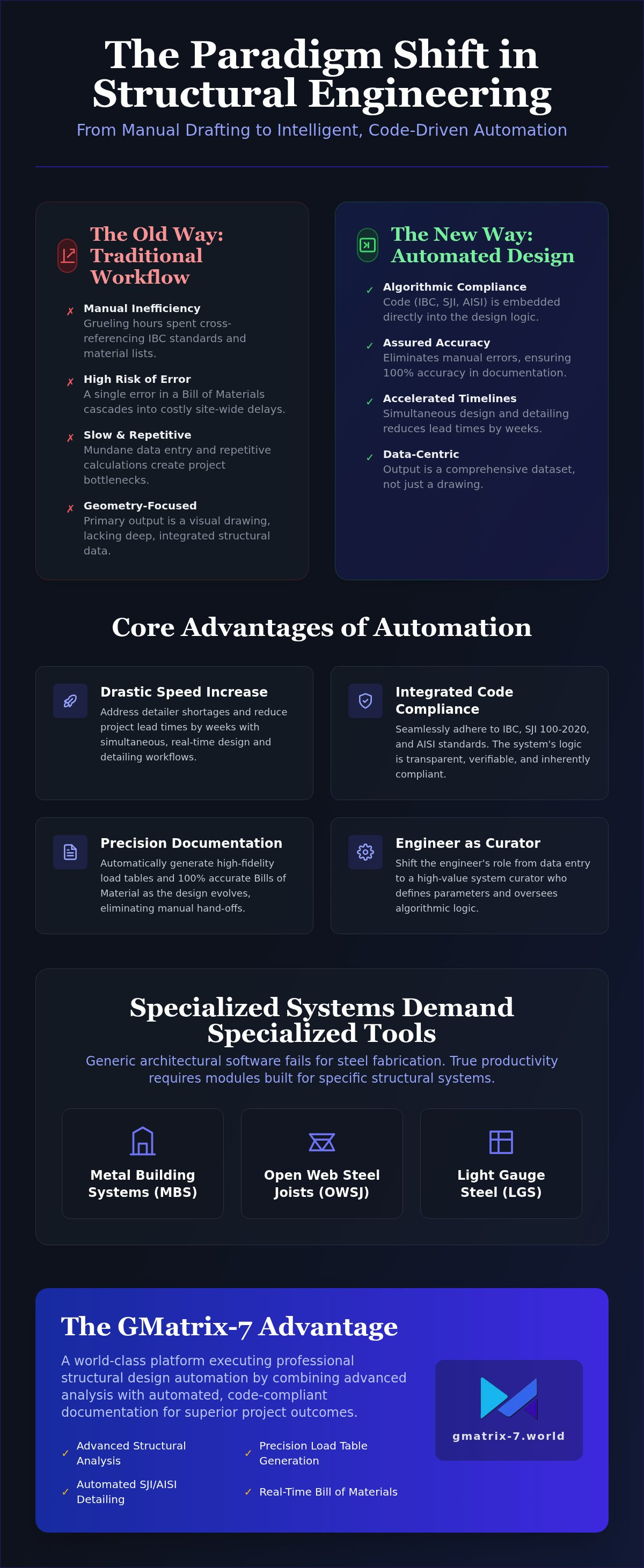
The transition from Computer-Aided Drafting to intelligent, data-driven systems is no longer a future projection. It's a current reality. By 2026, professional structural design automation has moved far beyond simple geometry. It represents a fundamental shift where the primary output isn't just a drawing, but a comprehensive dataset containing every structural nuance required for fabrication and compliance. Traditional drafting focused on visual representation; modern automation focuses on the algorithmic relationships between load, material, and code. This evolution into Computer-automated design allows engineers to move away from the repetitive labor of manual calculation. Instead, they act as system curators. They define the structural parameters, oversee the underlying logic, and ensure the final output aligns with the project's high-level objectives. This shift ensures that the engineer's time is spent on high-value optimization rather than mundane data entry.
Bridging Building Codes and Computer Code
Modern engineering requires the precise translation of the International Building Code (IBC) and Steel Joist Institute (SJI) standards into executable logic. While building codes often provide ranges or margins for human judgment, computer code requires absolute precision to ensure safety and structural integrity. This isn't about replacing the engineer's expertise. It's about augmenting it. By embedding SJI 100-2020 or AISI S100 standards directly into the software, automation ensures that every design iteration is inherently compliant. This rigorous, data-driven approach eliminates the "black box" concern by making the underlying logic transparent and verifiable. Engineers maintain absolute oversight, validating the system's logic against jurisdictional requirements while the automation handles the complex, multi-clause compliance checks. It creates a seamless path from abstract building codes to the concrete requirements of the fabrication floor.
The Demand for Speed in Global Fabrication
Speed is the new currency in global steel construction. The industry faces a persistent shortage of skilled structural detailers, which often creates critical bottlenecks in project timelines. Automation addresses this by enabling simultaneous design and detailing workflows. When the engineering logic is automated, approval drawings and Bills of Material are generated in real-time as the design evolves. This synchronization reduces project lead times by weeks, not just days. Multi-national workflows benefit from this immediate feedback loop, ensuring that a design modification in one region is instantly reflected in the fabrication requirements of another. It facilitates a seamless flow from complex engineering inputs to optimized, fabricator-ready outputs. By removing the manual hand-off between design and detailing, firms can achieve a level of productivity that was previously impossible, solidifying the role of professional structural design automation as the industry standard for 2026.
Specialized Automation for MBS, OWSJ, and LGS Systems
Generic architectural software often fails when it meets the rigorous demands of steel fabrication. While standard BIM tools handle basic geometry, they lack the algorithmic depth required for professional structural design automation in specialized systems. To achieve true productivity, firms must deploy modules designed specifically for Metal Building Systems (MBS), Open Web Steel Joists (OWSJ), and Light Gauge Steel (LGS). These systems don't just draft; they calculate, optimize, and document simultaneously within the boundaries of international building codes. This focused approach ensures that every structural element is optimized for its specific load case and manufacturing constraints, rather than being a generic placeholder in a 3D model.
Engineering OWSJ and Bar Joists with Precision
Automating the complex geometry of bar joists requires more than visual accuracy. It demands a direct integration of SJI 100-2020 standards into the detailing workflow. High-volume manufacturing environments can't afford manual verification cycles that slow down production or introduce risk. By utilizing SJI compliant joist design, engineers ensure every weld, web member, and chord section meets rigorous safety thresholds automatically. This reflects broader advancements in automation, robotics, manufacturing and artificial intelligence that are currently reshaping how civil infrastructure is conceived and built. The result is a seamless transition from engineering intent to shop-floor execution without the risk of human calculation error. It provides the peace of mind that comes from knowing every joist is battle-tested against the latest industry standards.
Cold-Formed Steel and LGS Structural Design
Light Gauge Steel (LGS) presents unique challenges due to the complex buckling modes of thin-walled, cold-formed members. Relying on generic tools often leads to over-engineered structures or, worse, non-compliant designs that fail under load. Specialized LGS structural design software solves this by applying AISI S100 standards at the point of creation. These tools generate precise detailing for complex assemblies, managing everything from screw patterns to local buckling checks with absolute precision. It's about achieving 100% material accuracy while accelerating the generation of approval drawings. When you integrate these specialized modules, you're not just drafting; you're leveraging a world-class system that values excellence and safety above all else. For those looking to optimize their workflow, exploring the GMatrix-7 / LGS (AISI) module offers a direct path to superior engineering precision and reduced material waste.
Beyond Geometry: Automating Load Tables and Bills of Material
True engineering excellence isn't found in the lines of a CAD drawing. It lives in the accuracy of the data that follows. By 2026, professional structural design automation has moved into the critical territory of material procurement and technical documentation. It's no longer enough to have a compliant design; you need a system that translates that design into actionable, error-free outputs for the fabricator. This integration bridges the gap between structural analysis and the commercial reality of a project. It ensures that every pound of steel and every square foot of decking is accounted for before the first beam is cut. Accuracy is the only standard that matters here.
High-Fidelity Load Tables for Composite Decks
Calculating load capacities for composite decks and sandwich panels used to be a significant bottleneck. The variables are immense. You're balancing concrete strength, steel gauge, and span lengths against evolving IBC and SJI standards. Automation has simplified this complexity. Advanced software now generates high-fidelity load tables that account for these variables in real-time. This precision is vital for single skin and sandwich panels where thermal performance and structural integrity must coexist. Utilizing a specialized composite deck load table generator allows engineers to move from complex inputs to optimized outputs with total confidence. It eliminates the conservative guesswork that often leads to over-designed, over-budget structures. You get exactly what the design requires.
Eliminating Manual Error in Material Procurement
Project profitability is often lost in the translation from drawing to delivery. A single manual entry error in a Bill of Materials (BOM) can derail a multi-million dollar schedule. Automated detailing solves this by linking the structural model directly to the material list. This ensures that the quantity, length, and specification of every member are 100% accurate. An Automated BOM is the digital thread connecting design to the shop floor. By integrating these lists directly with fabrication software, you remove the human factor from the procurement cycle. This results in a massive reduction in RFIs and a streamlined approval process.
- Eliminate waste through precise material counting.
- Accelerate approval drawing generation for faster fabrication.
- Reduce the RFI cycle between the engineer and the shop.
- Ensure 100% material list accuracy for complex assemblies.
You aren't just designing a building; you're orchestrating a precision-engineered supply chain. This level of professional structural design automation provides the peace of mind that comes from a battle-tested workflow. It positions your firm as a driver of industrial progress, moving away from manual calculation toward a future of data-driven excellence.
Strategic Implementation: Overcoming the Objections to Automation
Adopting professional structural design automation often triggers a defensive response from seasoned engineering teams. The primary concern is the "black box" effect—the fear that software will make critical safety decisions without transparent, verifiable logic. This skepticism is healthy but misplaced. Modern automation doesn't hide logic; it codifies it. By 2026, the most successful firms are those that treat automation as a high-fidelity extension of their own expertise. They don't just use software; they curate the algorithmic inputs to ensure every output meets their internal standards for excellence and safety. Transparency is maintained through rigorous reporting and the ability to audit every calculation against IBC or SJI standards.
Integrating Automated Detailing Workflows
The transition from manual drafting to an automated environment requires a methodical progression. It isn't an overnight replacement of legacy systems. Instead, it's a strategic integration that starts with identifying the most repetitive, error-prone tasks in your current pipeline. Utilizing structural engineering workflow software provides a framework for this shift. Consider this three-step implementation strategy:
- Audit and Identify: Pinpoint where manual errors occur most frequently, typically in BOM generation or load table updates.
- Module Deployment: Implement specialized modules for MBS, OWSJ, or LGS to handle these specific bottlenecks.
- Staff Evolution: Train your engineers to act as system curators who validate automated outputs rather than manual calculators who draw lines.
This approach ensures that your team remains the final barrier to error while the software handles the data-heavy lifting. It creates a workflow that is both intellectually rigorous and commercially urgent.
The ROI of Engineering Productivity
Quantifying the return on investment for automation goes far beyond simple time-tracking. You must account for the massive reduction in material waste and the total elimination of site-side delays caused by manual Bill of Material errors. The ROI of automation is the measurable reduction in both time-to-market and project error-rate. When approval drawings are generated in a fraction of the traditional time, the entire project lifecycle moves faster. This speed allows your firm to take on more complex projects without increasing headcount. It provides the peace of mind that comes from knowing your material lists are 100% accurate before they reach the fabrication floor. To see how these efficiencies can transform your bottom line, explore the GMatrix-7 engineering modules and start optimizing your productivity today.
Looking toward the 2026 horizon, the rise of cloud scalability will allow for even greater collaboration. Real-time updates across multi-national teams will become the standard. AI-driven structural optimization will soon move from a visionary concept to a practical tool, identifying the most efficient material use-cases in seconds. Firms that implement these foundational automated detailing workflows now will be the ones leading the industry into this next era of innovation.
GMatrix-7: Executing Professional Structural Design Automation
GMatrix-7 isn't just another software suite. It's a comprehensive engineering ecosystem designed for firms that refuse to settle for generic drafting tools. By integrating specialized modules for Metal Building Systems (MBS), Open Web Steel Joists (OWSJ), and Light Gauge Steel (LGS), GMatrix-7 provides a level of precision that standard AEC platforms simply can't match. Executing professional structural design automation requires a platform that understands the granular details of fabrication as well as the high-level requirements of global building codes. GMatrix-7 delivers this by combining advanced structural analysis with the immediate generation of technical documentation, ensuring that your engineering intent is never lost in translation.
Global Structural Compliance and Detailing
Managing multi-national projects requires a platform that can pivot between different jurisdictional standards without missing a beat. GMatrix-7 ensures global compliance by embedding IBC, SJI, and AISI logic directly into its core modules. This isn't about checking for errors after the design is finished; it's about designing within a compliant environment from the very first input. The platform excels at generating professional approval drawings that are both technically rigorous and ready for the fabrication floor. For those specializing in metal buildings, utilizing high-performance MBS IBC design software is the only way to guarantee that your structures meet the most stringent safety requirements while maintaining maximum material efficiency. It provides the reliable foundation needed for world-class engineering achievement.
Transitioning to Automated Excellence
GMatrix-7 is the gold standard for structural design automation in 2026 because it addresses the entire project lifecycle. It bridges the gap between the engineer's desk and the fabricator's shop floor, providing a seamless flow of data that eliminates manual intervention. Whether you're generating precise load tables for sandwich panels or 100% accurate Bills of Material, the system is built to protect your project's profitability and safety. The transition to this level of excellence is a strategic move that positions your firm as a leader in industrial progress. It's time to move away from the limitations of legacy workflows and embrace a future defined by data-driven precision.
- Deploy specialized modules for OWSJ and LGS to eliminate detailing bottlenecks.
- Ensure 100% material accuracy through automated BOM generation.
- Accelerate project timelines with real-time approval drawing updates.
- Maintain absolute compliance with SJI 100-2020 and AISI S100 standards.
The path to future-proof structural engineering excellence begins with a commitment to the best available technology. GMatrix-7 offers the tools, the logic, and the reliability that modern fabricators and engineers demand. Don't let manual processes hold your firm back from its full potential. Contact us today for a professional consultation and discover how our world-class engineering modules can redefine your productivity and secure your place at the forefront of the industry.
Leading the Future of Structural Engineering Excellence
The transition toward data-centric engineering is irreversible. Firms that continue to rely on manual drafting and disconnected spreadsheets risk obsolescence in an industry that now demands absolute precision and rapid turnaround. By embracing professional structural design automation, you're securing a competitive advantage that ensures every project is optimized for both safety and profitability. This evolution moves your team away from repetitive manual labor and toward high-level system curation.
GMatrix-7 stands at the forefront of this industrial shift. Our world-class modules are battle-tested by global steel fabricators and remain strictly SJI 100-2020 and AISI S100 compliant. Whether you're generating automated load tables or 100% accurate Bills of Material, the path to superior engineering productivity is now accessible. It's time to eliminate the bottlenecks of the past and drive your firm into a new era of innovation. Scale your engineering productivity with GMatrix-7 structural automation modules today.
The horizon of 2026 belongs to the bold and the technologically advanced. We're ready to help you achieve the peace of mind that comes from total structural accuracy and world-class documentation. Your journey toward engineering excellence starts now.
Frequently Asked Questions
What is professional structural design automation?
Professional structural design automation is the algorithmic integration of code compliance, detailing, and material procurement into a singular, unified workflow. It represents a paradigm shift where data centric logic replaces traditional manual drafting. This technology allows engineering firms to automate repetitive calculations and documentation while maintaining absolute precision across complex systems like MBS and OWSJ.
How does automation ensure compliance with SJI 100-2020 standards?
Advanced platforms like GMatrix-7 embed SJI 100-2020 standards directly into the design engine. This integration ensures that every joist and bar joist configuration is automatically validated against the latest industry requirements during the detailing phase. It eliminates the risk of human error during manual verification cycles and provides a transparent, auditable path to structural safety.
Can automated structural design software generate accurate load tables for composite decks?
Yes, specialized modules are engineered to generate high-fidelity load tables for composite decks, single skin, and sandwich panels. These tools process complex variables such as material gauge, span lengths, and concrete strength in real-time. The result is a precise, data-driven output that optimizes material use and ensures the structure meets specific load capacity requirements without conservative guesswork.
Will structural design automation replace the need for licensed engineers?
Automation doesn't replace engineers; it redefines them as system curators. While the software handles the data-heavy lifting and complex compliance checks, the licensed engineer provides the essential oversight and final validation. This shift allows professionals to focus on high-level structural optimization and safety rather than the mundane labor of manual data entry.
How does an automated Bill of Material (BOM) reduce project costs?
An automated Bill of Material eliminates the manual entry errors that frequently lead to material waste and expensive site-side delays. By linking the structural model directly to the procurement list, firms achieve 100% accuracy in material counts. This digital thread protects project profitability by ensuring that only the necessary components are ordered and fabricated.
Is GMatrix-7 software compatible with IBC 2024 and 2026 standards?
GMatrix-7 is designed to evolve alongside global regulatory changes, including IBC 2024 and the anticipated 2026 standards. The platform's modular architecture allows for seamless updates to its internal logic. This ensures that your professional structural design automation remains current and compliant with jurisdictional building codes across all project phases.
What are the benefits of automated detailing for light gauge steel (LGS)?
Automated detailing for LGS manages the complex buckling modes of cold-formed members with absolute precision. By applying AISI S100 standards at the point of creation, these tools generate accurate screw patterns and detailing for complex assemblies. This level of automation accelerates the generation of approval drawings while ensuring the structural integrity of thin-walled steel systems.
How long does it take to implement structural design automation in a fabrication firm?
The implementation timeline follows a methodical progression that respects your firm's existing professional workflow. While GMatrix-7 modules are designed for rapid deployment, the total transition depends on your team's specific requirements and training needs. Most firms see an immediate improvement in productivity as soon as the first specialized module is integrated into their detailing pipeline.


