

Relying on manual spreadsheets for structural calculations in 2026 is no longer a viable strategy; it's a liability that threatens both project integrity and firm profitability. You've likely experienced the frustration of navigating the intricate IBC 2024 provisions and SJI 100-2020 standards while battling the inevitable formula errors inherent in manual data entry. These bottlenecks in generating approval drawings and accurate material lists do more than cause delays. They compromise your ability to compete in a global market that demands absolute precision and rapid delivery.
Transitioning to a sophisticated structural engineering compliance software platform allows you to master these modern building codes through automated, high-precision workflows. We provide the roadmap to total compliance while helping you realize a 2-3x increase in engineering productivity. This guide details the seamless generation of Bills of Materials (BOMs) and load tables for single skin, sandwich panels, and composite decks. You'll discover how to bridge the gap between complex engineering analysis and fabrication-ready documentation using the industry's most advanced compliance tools.
Key Takeaways
- Discover how generative, code-aware design shifts your workflow from retrospective checking to real-time validation of structural integrity.
- Learn to integrate structural engineering compliance software with existing BIM environments to eliminate manual data entry and inconsistent spreadsheet formulas.
- Master the intricacies of IBC 2024 and SJI 100-2020 standards through automated modules designed for complex metal building systems and steel joists.
- Unlock significant productivity gains by automating the transition from engineering inputs to fabrication-ready Bills of Materials and approval drawings.
- Streamline the generation of accurate load tables for composite decks and sandwich panels to ensure total compliance across diverse material specifications.
The Evolution of Structural Engineering Compliance in 2026
Structural compliance has transitioned from a final design hurdle into an active, real-time participant in the engineering process. Modern structural engineering compliance software functions as a digital validator that operates concurrently with the modeling phase. It ensures every structural member adheres to rigorous building codes before a single drawing is generated. This shift from retrospective checking to generative, code-aware design represents a fundamental change in how we approach structural integrity. We no longer wait for a post-analysis report to identify failures. Instead, we utilize technology that treats regulatory requirements as primary design parameters.
Semantic code interpretation now allows systems to parse complex regulations and translate them into actionable engineering logic. This advancement integrates traditional structural analysis and design software into a broader, more intelligent ecosystem of automated verification. Relying on manual verification in the 2026 high-speed construction market is a significant liability. The speed of modern project cycles demands a level of precision that human oversight alone cannot consistently provide. Integrated compliance is the only way to maintain the pace of global industrial progress without sacrificing safety.
From Spreadsheet Stress to Automated Precision
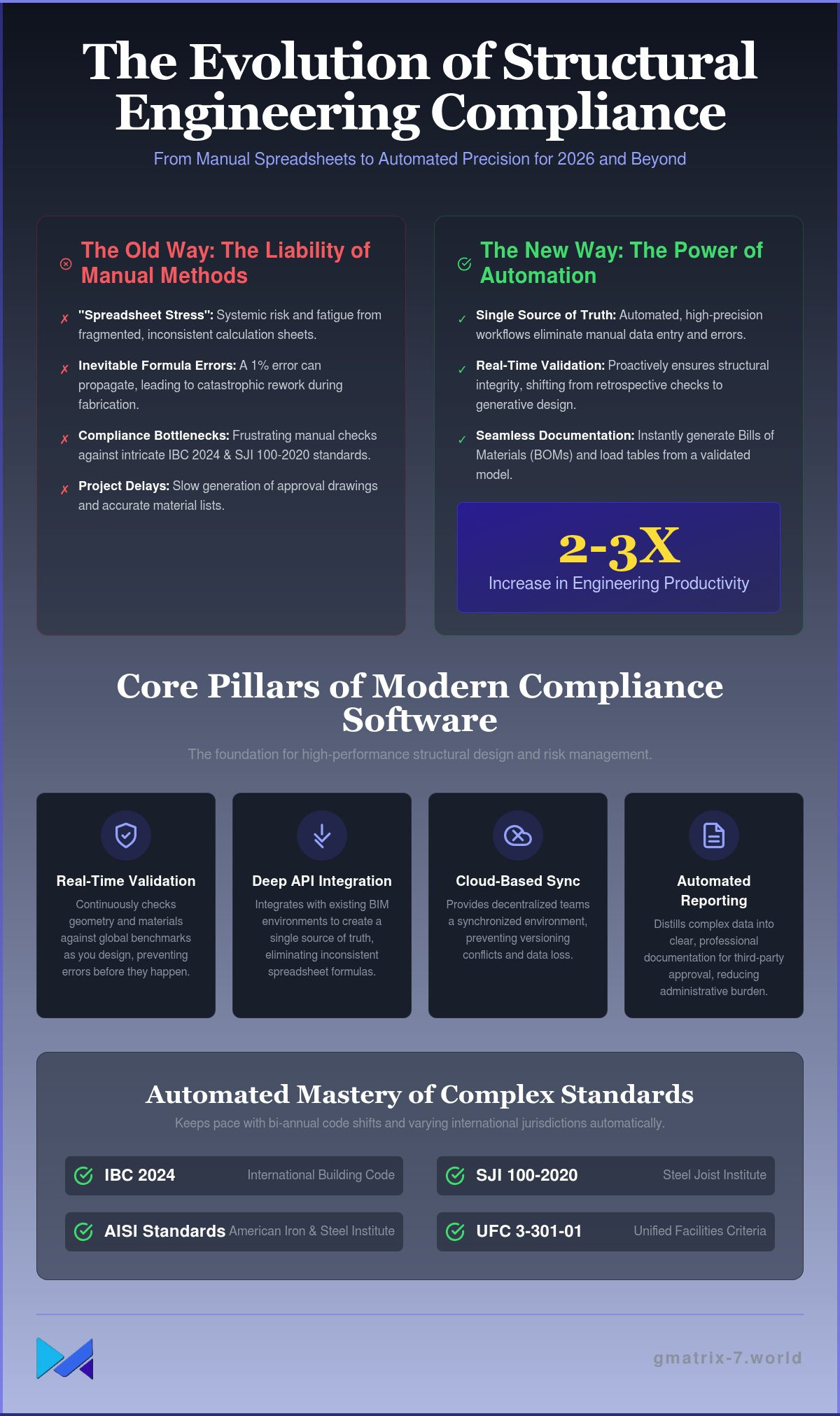
Engineers frequently suffer from "spreadsheet stress," which is the systemic operational risk and psychological fatigue caused by managing fragmented data across inconsistent manual calculation sheets. Even a 1% formula error in a legacy Excel file can propagate through a multi-story project, leading to catastrophic rework during the fabrication stage. Adopting a "single source of truth" engineering model eliminates these vulnerabilities. Automated precision replaces manual data entry, ensuring that your Bill of Materials (BOM) and load tables are derived directly from a validated, code-compliant model. This transition moves your firm from a defensive posture of error-correction to an offensive strategy of high-value output.
2026 Regulatory Landscape: IBC and Beyond
The IBC 2024 remains the foundational benchmark for metal building systems, yet regional supplements and rapid updates create a moving target for engineering firms. Global fabrication projects require a sophisticated approach to compliance that accounts for varying standards across international jurisdictions. Modern software keeps pace with these bi-annual shifts automatically. It ensures that MBS (IBC) and OWSJ (SJI) designs remain compliant without requiring constant manual research. This automated alignment is essential for fabricators who operate across borders, where failing to meet a specific regional standard can halt a project instantly and result in massive financial penalties.
Core Pillars of Modern Compliance Software
Excellence in structural design requires more than just raw calculation power. High-performance structural engineering compliance software in 2026 rests on four foundational pillars: real-time validation, deep API integration, cloud-based synchronization, and automated reporting. These elements transform a standard calculation tool into a comprehensive risk-management platform. Real-time validation ensures that as you manipulate a model, the software continuously checks geometry and material properties against global benchmarks. This proactive approach identifies non-compliant member sizes or insufficient bracing long before the peer review stage. It's about building security into the model from the first click.
Modern systems must rigorously adhere to the Unified Facilities Criteria (UFC) for structural engineering to ensure that complex load combinations meet the highest safety thresholds. This alignment isn't just a convenience; it's a prerequisite for high-stakes projects. Cloud-based collaboration further enhances this by providing a decentralized team with a synchronized environment. It allows engineers across different time zones to work on the same model without versioning conflicts or data loss. Every stakeholder operates from the same validated data set, which is critical for maintaining integrity in distributed workflows. Automated report generation then distills this complex data into clear, professional documentation for third-party approval, significantly reducing the administrative burden on your senior staff.
Integrated Analysis and Design (A&D) Engines
Eliminating the silos between structural analysis and final detailing is the primary goal of any advanced A&D engine. In legacy workflows, data transfer between these stages often introduced transcription errors or lost load path continuity. Modern structural engineering workflow software solves this by maintaining a persistent connection between the mathematical model and the physical geometry. This automation ensures that every connection and member is verified for the specific forces it will encounter in the field. It's a level of precision that maximizes productivity by reducing the need for manual cross-referencing and redundant checks. When your analysis engine speaks directly to your detailing tools, the risk of misinterpretation vanishes.
API and Customization Capabilities
While standard building codes cover the majority of scenarios, bespoke projects often demand specialized compliance checks. Access to robust API environments, particularly those supporting Python, allows engineering firms to script custom routines for unique constraints. You can automate repetitive post-processing tasks like seismic drift calculations or P-Delta sensitivity analysis with incredible speed. This flexibility bridges the gap between rigid software limitations and the creative requirements of complex architecture. Firms that leverage these customization tools often see a significant reduction in time-to-approval for non-standard structures. To experience this level of technical optimization firsthand, consider evaluating how GMatrix-7 can redefine your documentation accuracy.
Automating Specialized Standards: IBC, SJI, and AISI
General-purpose Finite Element Analysis (FEA) tools often reach their functional limits when confronted with the intricate detailing requirements of specialized structural systems. While these tools calculate global forces effectively, they frequently lack the granular logic needed for specific industry certifications. High-performance structural engineering compliance software bridges this gap by embedding the actual logic of the code directly into the design environment. This specialized approach ensures that every purlin, joist, and stud meets the exact criteria defined by the International Building Code (IBC) and the Steel Joist Institute (SJI). It's a shift from general math to specific, actionable compliance.
Specialized modules outperform general software by accounting for the nuanced behavior of niche systems. For example, the interaction between primary frames and secondary members in metal buildings requires specific buckling and load-sharing analysis that general FEA often overlooks. By utilizing technology that understands these specific structural languages, you eliminate the need for manual "workarounds" or external verification steps. This creates a direct, high-speed pipeline from initial concept to a code-compliant structural model.
MBS and IBC: The Gold Standard for Metal Buildings
Large-scale metal building systems demand a level of coordination that general software cannot provide. Automating IBC design for primary frames and secondary members requires a system that understands these components' interdependent behavior. Using a dedicated MBS IBC design software environment allows engineers to generate professional approval drawings that are pre-validated against the latest 2024 provisions. This streamlines the path to fabrication by ensuring that every structural connection is optimized for both safety and material efficiency. It effectively removes the risk of rejection during the permitting phase.
OWSJ and AISI: Joists and Cold-Formed Steel
Open Web Steel Joists (OWSJ) represent one of the most technical segments of the steel industry. Achieving total SJI compliant joist design requires strict adherence to SJI 100-2020 standards, which govern everything from web configuration to seat detailing. Generic tools simply don't offer the automated verification necessary for high-volume bar joist manufacturing. Precision is non-negotiable here.
Similarly, precision engineering for LGS structural design software relies on the AISI S100 standard for cold-formed steel. These structures are susceptible to complex buckling modes, including distortional and local buckling, which demand rigorous mathematical modeling. Specialized modules automate the detailing for cold-formed steel framing and trusses. This ensures every light-gauge member is utilized to its maximum structural capacity. By adopting standards-specific automation, firms deliver projects that are both globally compliant and commercially superior.
Beyond Analysis: Compliance in Documentation and BOMs
True structural integrity isn't confined to the digital model; it must manifest in the physical materials delivered to the site. Many engineers view compliance as a binary pass-fail check performed during the analysis phase. This narrow perspective ignores the critical "compliance-to-fabrication" gap where errors often occur. High-performance structural engineering compliance software ensures that the final documentation, including shop drawings and material lists, remains perfectly synchronized with the validated engineering logic. When your documentation is an automated output of your analysis, the risk of transcription error disappears entirely.
Reducing material waste is a direct byproduct of this integrated approach. By linking structural design directly to material lists, firms eliminate the over-ordering typically used as a buffer for manual inaccuracies. This level of precision is essential for maintaining profitability in a market defined by fluctuating material costs. It transforms your engineering office from a cost center into a driver of operational efficiency. Every structural member is accounted for, and every connection is verified against the approved model before procurement begins.
Automated Bill of Materials (BOM) Generation
Manual data entry remains the single greatest threat to project accuracy in 2026. Industry data suggests that manual BOM generation often carries a 1-2% error rate, which translates to thousands of dollars in lost time and wasted steel. Automated BOM generation removes this vulnerability by extracting data directly from the compliance-checked model. This ensures that every bolt, plate, and structural member matches the approved engineering specifications perfectly. Integrating these material lists with structural compliance data allows procurement teams to order with absolute confidence, knowing that the physical components will meet the rigorous demands of the design.
Load Table Generators for Panels and Decks
Generating accurate performance data for specialized components requires a deep understanding of material science and building code requirements. The science behind composite deck load table generators has advanced significantly, allowing for the rapid validation of structural deck load capacity under 2026 building codes. Creating precise load tables for single skin and sandwich panels is no longer a manual exercise in interpolation. It is a data-driven process that ensures safety across diverse spans and loading conditions.
To secure this level of precision across your entire documentation workflow, you need a partner that understands the intricacies of the fabrication cycle. We invite you to explore our automated BOM and load table modules to see how we bridge the gap between analysis and the job site. This integration is the final step in achieving a truly optimized, code-compliant structural project.
Implementing Professional Structural Design Automation
Scaling a structural engineering firm in 2026 requires more than just hiring additional staff; it necessitates a strategic shift toward high-level automation. Evaluating structural engineering compliance software based on regional relevance and material support is the first step in this transformation. A world-class platform must handle the complexities of MBS (IBC), OWSJ (SJI), and LGS (AISI) without requiring manual intervention or external spreadsheets. Moving from manual detailing to automated solutions provides a massive Return on Investment (ROI) by slashing the time required for drawing generation and BOM extraction. This efficiency allows your team to focus on high-value engineering decisions rather than administrative data management.
GMatrix-7 provides the modular platform necessary to scale compliance across global projects. Whether you are designing for a local jurisdiction or an international industrial complex, the software ensures that your outputs meet the highest standards of safety and excellence. This reliability is the foundation of industrial progress. It allows fabricators and engineers to operate with absolute peace of mind. By integrating advanced compliance tools, you aren't just buying software. You're adopting a guardian of safety that drives your business toward a future of automated structural excellence.
Choosing the Right Compliance Partner
Selecting a partner for your digital transformation involves looking beyond basic features. Accuracy, speed, and adherence to global standards are the primary criteria for any professional firm. World-class support and the technical leadership of Dr. Simon B. ensure that your team isn't just using a tool but is participating in an industry-leading ecosystem. Transitioning from 20th-century manual methods to 2026 automation requires a partner who understands the intricacies of the fabrication cycle. This expertise ensures that your implementation is seamless and that your team achieves peak productivity within weeks, not months.
The Future: Digital Twins and Continuous Compliance
Structural compliance will soon evolve toward real-time monitoring through digital twins and persistent data synchronization. This shift means that compliance isn't a snapshot in time but a continuous state of the structural model throughout its lifecycle. GMatrix-7 remains at the forefront of this evolution, developing the tools that will define the next decade of automated structural excellence. We provide the technical infrastructure needed to bridge the gap between visionary design and practical, safe execution. Discover GMatrix-7’s high-value structural modules today and position your firm as a leader in the new era of engineering precision.
Mastering the Future of Structural Integrity
The transition from manual verification to generative, code-aware design is no longer an option for firms aiming for market leadership. You've seen how integrating specialized modules for MBS, OWSJ, and LGS eliminates the operational risks associated with legacy spreadsheets and manual data entry. By automating the critical link between engineering calculations and fabrication-ready documentation, your firm achieves a level of precision that guarantees project safety and commercial success. This shift ensures that compliance is an integrated output of your workflow rather than a final design hurdle.
Adopting a world-class structural engineering compliance software platform is the most direct path to scaling your operations across global jurisdictions. GMatrix-7 provides the technical infrastructure to master IBC and SJI standards while delivering automated approval drawings and Bills of Materials. This technology doesn't just check for compliance; it drives industrial progress by ensuring every structural member is optimized for its real-world application. It's time to replace fragmented workflows with a unified, high-performance engineering ecosystem.
Streamline Your Engineering Workflow with GMatrix-7 and secure your position at the forefront of automated structural excellence. Your path to total compliance and increased productivity starts here.
Frequently Asked Questions
What is structural engineering compliance software?
Structural engineering compliance software is a high-performance validator that operates concurrently with the modeling phase to ensure designs adhere to global building codes. It translates complex legal provisions into actionable engineering logic, allowing for the real-time verification of structural integrity. This technology moves beyond simple math to act as a guardian of safety throughout the project lifecycle.
How does automated BOM generation improve project profitability?
Automated Bill of Materials (BOM) generation directly increases profitability by eliminating the 1-2% manual transcription error rate common in legacy workflows. By extracting data directly from a validated engineering model, firms prevent costly over-ordering and material waste. This precision ensures that every bolt and member delivered to the site matches the approved design, protecting margins on high-stakes projects.
Is software compliance enough to meet SJI 100-2020 standards?
Meeting SJI 100-2020 standards requires specialized logic that general FEA tools often lack. While general software calculates forces, dedicated compliance modules automate the specific seat detailing and web configurations mandated by the Steel Joist Institute. Utilizing these targeted tools provides the technical assurance that your bar joist designs are globally compliant and fabrication-ready.
Can structural compliance software integrate with existing BIM tools?
Modern compliance platforms utilize API-driven integration to sync seamlessly with existing BIM and CAD environments. This connectivity eliminates data silos between structural analysis and the final documentation stage. Cloud-based synchronization allows distributed teams to work on a single, validated model, ensuring that compliance checks are consistent across the entire project.
What are the benefits of using specialized AISI design tools for LGS?
Specialized AISI design tools provide the mathematical rigor needed to analyze complex buckling modes in Light Gauge Steel (LGS) structures. These tools automate the verification of local and distortional buckling, which general software frequently overlooks. By applying precise AISI S100 standards, engineers can optimize member sizes to maximize structural capacity without compromising safety.
How does GMatrix-7 handle updates to the International Building Code (IBC)?
GMatrix-7 maintains a proactive update cycle to incorporate the latest International Building Code (IBC) provisions and regional supplements. This automated alignment ensures that MBS (IBC) designs remain compliant without requiring engineering teams to perform manual code research. It provides a stable, up-to-date platform for international projects where regulatory requirements shift rapidly.
What is the difference between general analysis software and specialized compliance modules?
General analysis software focuses on solving mathematical load paths, whereas specialized compliance modules apply specific code logic to generate fabrication-ready outputs. While general tools provide raw data, compliance modules automate the generation of approval drawings, load tables, and BOMs. This specialization transforms a pass-fail check into a comprehensive documentation workflow.
How much time can engineers save by automating building code checks?
Firms using structural engineering compliance software often realize a 2-3x increase in engineering productivity. This shift allows senior staff to move away from tedious manual verification and focus on high-value design decisions. By reducing the time spent on administrative data entry, firms can accelerate project delivery and scale their operations effectively.


