

Can your structural designs survive a 50% tariff on imported steel and the rigorous demands of IBC 2024 without sacrificing your profit margins? In a market where structural steel averages $2,519 per ton, over-engineering is no longer a safety margin; it's a direct financial liability. Achieving structural excellence now requires a shift from manual estimation to high-velocity, algorithmic precision. Integrating advanced MBS design optimization software allows engineers to move beyond traditional calculation, ensuring every pound of steel serves a definitive purpose while maintaining total code compliance.
You've likely felt the pressure of tightening building codes and the frustration of manual errors in a Bill of Materials that delay fabrication. It's a constant challenge to balance the mandatory tornado load provisions of ASCE 7-22 with the need for lean, profitable project delivery. This article demonstrates how GMatrix-7 transforms these complex regulatory hurdles into a streamlined competitive advantage. We'll explore how automated compliance documentation and precision analysis reduce material waste, accelerate approval cycles, and secure your standing as a leader in the metal building industry.
Key Takeaways
- Master the transition from traditional 2D drafting to data-driven structural optimization to meet the rigorous demands of IBC 2024 and ASCE 7-22 standards.
- Understand how advanced MBS design optimization software utilizes iterative algorithms to pinpoint the most efficient structural configurations while significantly reducing material waste.
- Discover how to compress approval drawing cycles from weeks into hours by replacing manual calculations with automated, error-free documentation workflows.
- Implement a systematic audit of your structural detailing processes to identify immediate "low-hanging fruit" for material reduction in rigid frame designs.
- Explore the competitive advantage of integrating specialized engineering modules that automate compliance across IBC, SJI, and AISI requirements.
The Evolution of Metal Building Structural Analysis in 2026
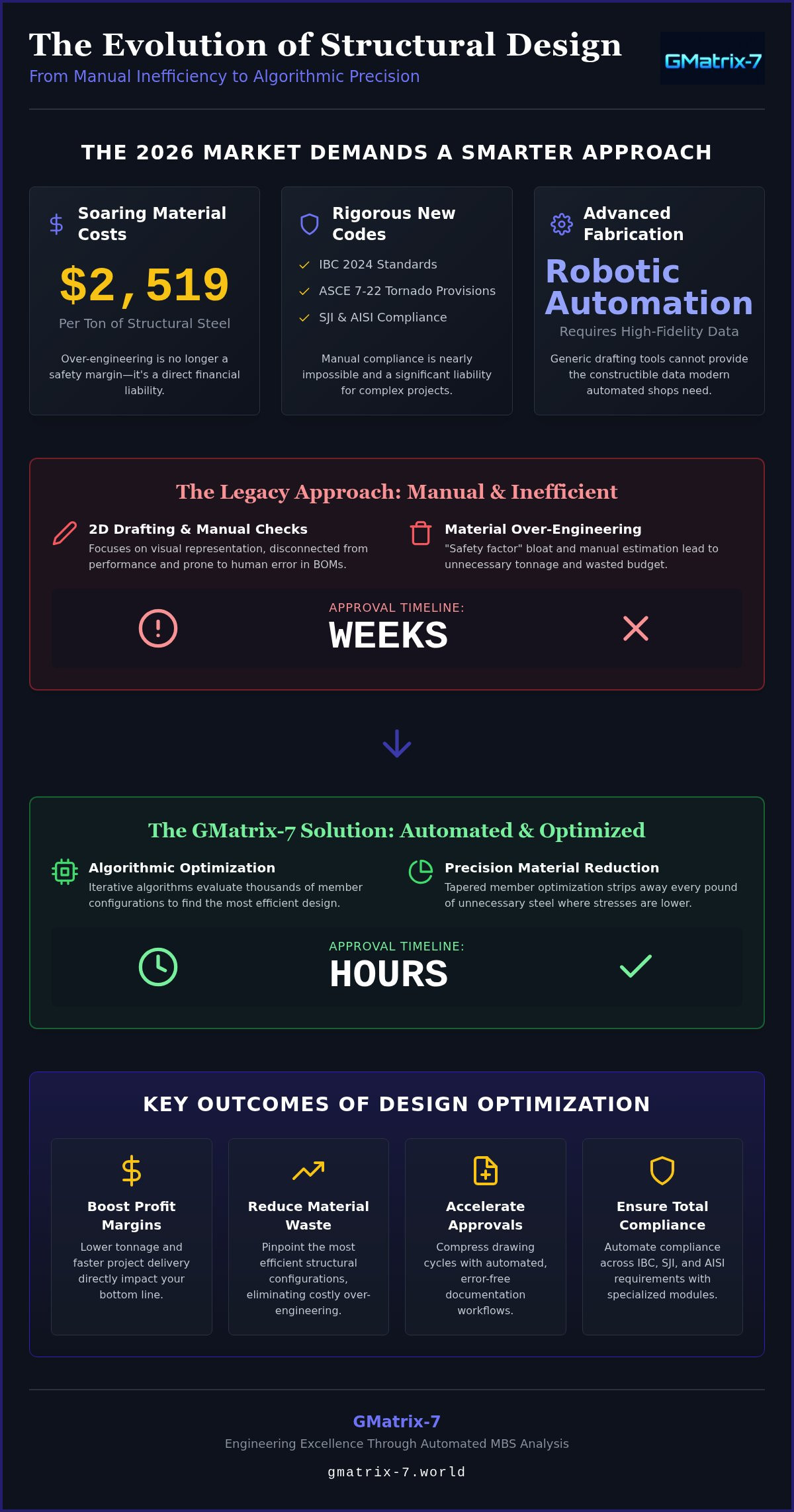
The landscape of structural engineering is undergoing a fundamental transformation. For decades, the industry relied on 2D drafting and manual checks to ensure safety. However, the 2026 market climate demands a more rigorous approach. Modern structural analysis has evolved into a data-centric discipline where every beam and column is optimized for maximum efficiency. High steel prices, which averaged $2,519 per ton in early 2026, have forced a shift in design philosophy. Engineers can't afford the "safety factor" bloat of the past. Precision is the only path to project profitability.
The Shift from Drafting to Engineering Automation
Legacy CAD-based detailing focuses on the visual representation of a building. While necessary, it often creates a disconnect between the drawing board and the actual performance of the steel. Transitioning to calculation-led design ensures that the engineering drives the geometry, not the other way around. Manual entry is now a significant liability for large-scale fabricators. One miscalculation in a Bill of Materials (BOM) can stall a project for weeks. By utilizing specialized MBS design optimization software, firms eliminate these human-centric bottlenecks. This technology synchronizes complex inputs with streamlined outputs. It ensures that the final structure adheres to the architectural vision while meeting strict engineering limits.
Key Drivers for MBS Optimization in 2026
Regulatory compliance is the primary catalyst for this technological surge. Navigating the complexities of IBC 2024 structural design tools is mandatory for any project breaking ground this year. The introduction of ASCE 7-22 standards, including new mandatory tornado load provisions for specific building categories, has made manual compliance nearly impossible for complex geometries. Beyond regulation, several pressures accelerate the need for advanced MBS design optimization software:
- Economic Necessity: Reducing tonnage is vital when structural steel costs remain high. Optimization algorithms find the "sweet spot" where safety meets material minimalism, directly impacting the bottom line.
- Robotic Fabrication: Modern shops use automated cutters and welders. These machines require high-fidelity, constructible data that generic drafting tools simply cannot provide.
- Precision Standards: The shift toward sophisticated metal building structural analysis ensures that every component is SJI or AISI compliant from the initial design phase.
GMatrix-7 stands at the forefront of this evolution. It provides the specialized modules necessary to bridge the gap between high-level engineering and practical fabrication. By automating the most labor-intensive aspects of structural analysis, it allows engineers to focus on excellence rather than data entry.
Core Components of MBS Design Optimization Software
MBS design optimization software is a precision tool that utilizes iterative algorithms to identify the most efficient structural configuration for any given set of parameters. Unlike standalone detailing tools that focus primarily on the 3D representation of a building, integrated analysis engines perform rigorous calculations before a single line is drawn. This distinction is critical for engineers who must balance cost and safety. By utilizing automated MBS IBC design software, firms ensure that every design iteration remains compliant with multi-standard requirements without manual re-entry. Real-time feedback loops create a seamless connection between structural adjustments and the Bill of Materials (BOM), providing immediate clarity on how a design change impacts total tonnage.
Algorithmic Material Reduction
Optimization engines achieve structural excellence by evaluating thousands of member configurations in seconds. This capability far exceeds human capacity for manual iteration. In the context of rigid frames, the science of tapered member optimization is particularly impactful. The software calculates the exact depth and thickness required at every point along a rafter or column, stripping away unnecessary steel where stresses are lower. This process requires a sophisticated balance between structural weight and fabrication complexity. A design that is technically the lightest might be too complex to weld efficiently; therefore, modern engines prioritize a "constructible optimum" that maximizes project profitability without increasing labor costs.
Integrated Load Table Generation
A truly comprehensive engineering solution must extend beyond the primary frame. GMatrix-7 leads the industry by automating load table generation for single skin, sandwich panels, and composite decks. This integration is vital because cladding selection directly influences the overall frame optimization. When load data is generated with AISI-compliant precision, engineers can trust that the secondary members and panels are perfectly matched to the building's environmental demands. This level of detail is a key differentiator from generic CAD tools that often treat cladding as a secondary architectural concern. To see how these specialized modules can enhance your structural output, consider reviewing the latest GMatrix-7 engineering modules.
The synergy between these components ensures that the final output is not just a building, but an engineered system. By automating the calculation of composite deck load tables and sandwich panel performance, the software provides a holistic view of the structure's integrity. This precision prevents the common pitfall of over-engineering the primary frame while under-specifying the secondary components, leading to a more balanced and cost-effective result.
Automated Compliance vs. Manual Calculation: A Performance Analysis
Manual calculation is a relic of a slower era. Today, manual entry remains the leading cause of project delays, often resulting from transcription errors that ripple through the fabrication process. When an engineer relies on manual spreadsheets, the risk of a misaligned Bill of Materials (BOM) increases exponentially. In contrast, MBS design optimization software creates a direct, digital link between the analysis engine and the final documentation. This automation compresses approval drawing cycles from weeks into hours, allowing fabricators to meet aggressive 2026 timelines despite the 499,000 unfilled jobs currently plaguing the U.S. construction industry.
The ROI of advanced software licensing is clear when measured against extended engineering man-hours. In a market where labor costs add $5 to $15 per square foot to a metal building project, efficiency is the only way to protect margins. Investing in automation isn't just about speed; it's about the precision required to stay current with SJI 100-2020 and AISI S100 standards without constant manual oversight. This transition ensures that structural excellence is a repeatable outcome rather than a variable dependent on individual engineer fatigue.
Risk Mitigation through Engineering Automation
Engineering automation eliminates the dangerous gap between design intent and the Bill of Materials. By using a specialized metal building system design tool, firms ensure that safety factors remain uniform across every member of the structure. This consistency is vital for professional liability reduction. When the software handles the complex load paths and code-specific checks, the engineer of record can focus on high-level validation rather than repetitive data entry. This shift drastically reduces the likelihood of errors that occur when engineers are rushed by tight deadlines.
Standardization Across Global Projects
Maintaining quality across international jurisdictions is a significant hurdle for global fabricators. Automation enables these firms to maintain consistent standards regardless of the project's location. By hard-coding IBC compliance and local requirements into the workflow, the software ensures that every output meets the same high-precision criteria. Standardized calculation reports also streamline the peer review process, providing third-party engineers with clear, logical documentation that accelerates the approval phase. This methodical approach transforms structural analysis from a potential bottleneck into a predictable, world-class standard of excellence.
Implementing Material Optimization Strategies in Large-Scale Projects
Successful implementation of lean engineering begins with a thorough audit of your current structural steel detailing solutions. Many firms continue to rely on generic CAD tools that lack the algorithmic depth required for high-stakes optimization. Transitioning to MBS design optimization software allows your team to identify "low-hanging fruit" for material reduction immediately. Rigid frame designs often contain hidden redundancies that add unnecessary weight. By refining the web and flange thicknesses of tapered members through iterative analysis, you can slash tonnage without compromising structural integrity or safety.
Automated material lists play a critical role in procurement optimization. In a market where structural steel is averaging $2,519.61 per ton, precision is a financial necessity. Automated Bill of Material (BOM) generation ensures you order exactly what is required, eliminating the wasteful overages common in manual estimations. This data-driven approach also simplifies training for the next generation of engineers. Instead of teaching them to rely on conservative intuition, you train them on optimization workflows that prioritize rigorous data and algorithmic validation.
Maximizing Tonnage Efficiency
Tonnage efficiency extends beyond the primary rigid frames into the secondary framing systems. Engineers can significantly reduce weight by optimizing purlin and girt spacing based on the specific load requirements of the cladding. Leveraging GMatrix-7 / LGS (AISI) modules for non-primary structural elements ensures that the entire building system is lean. The impact of professional structural design automation on large-span structures is profound. It enables the creation of expansive, clear-span environments that were previously considered cost-prohibitive by distributing loads with mathematical precision across every component.
Streamlining the Shop Drawing Pipeline
The transition from optimized analysis directly to automated shop drawings is where the most significant time recovery occurs. Precise initial detailing reduces the Request for Information (RFI) cycle by anticipating fabrication constraints during the design phase. High-precision MBS design optimization software allows you to bake fabricator-specific standards directly into the optimization logic. This ensures that the output is not just a theoretical optimum, but a practical, constructible reality ready for the shop floor. To see how these specialized modules can enhance your structural output, explore GMatrix-7 structural analysis solutions and witness the power of engineering-first automation.
GMatrix-7: Engineering Excellence Through Automated MBS Analysis
GMatrix-7 represents the pinnacle of engineering-first automation. It's the preferred choice for high-precision MBS engineering because it refuses to compromise on the depth of analysis. While other platforms focus on visualization, GMatrix-7 prioritizes the rigorous calculations that define structural integrity. The power of our specialized modules, including GMatrix-7 / MBS (IBC), GMatrix-7 / OWSJ (SJI), and GMatrix-7 / LGS (AISI), allows engineers to navigate the complexities of 2026 standards with confidence. Whether you're designing bar joists or light gauge steel frames, the software ensures total compliance with SJI 100-2020 and AISI standards from the first iteration.
A unique value proposition of GMatrix-7 is its ability to generate automated load tables for single skin, sandwich panels, and composite decks. This feature is often a blind spot in generic MBS design optimization software. By integrating cladding performance directly into the structural workflow, the software provides a holistic view of the building's capacity. This level of detail ensures that the transition from architectural vision to structural reality is seamless and data-driven. It eliminates the guesswork that often leads to over-engineered cladding or under-specified secondary members.
Precision Detailing and BOM Automation
GMatrix-7 eliminates the traditional friction between design and material procurement. It generates an automated Bill of Materials (BOM) that mirrors the structural analysis, ensuring that what's ordered is exactly what's needed for the project. This accuracy is essential for reducing material waste in large-scale buildings where tonnage costs are a primary concern. Automated approval drawings for complex metal buildings are generated with high-precision, allowing for faster sign-offs and significantly fewer revisions. When you rely on software-generated material lists, you're not just saving time; you're protecting your project's profitability from the hidden costs of manual error.
A Partner in Structural Innovation
Accessing GMatrix-7 provides more than just software; it offers a direct line to world-class engineering expertise. Led by industry expert Dr. Simon B., our development team ensures that the software is always ahead of the curve. Future-proofing your firm against evolving structural standards is a core component of our mission. We take a serious, focused approach to our craft, serving as both a visionary developer and a practical problem-solver for the global steel industry. We are committed to safety, compliance, and your long-term industrial progress. Experience the power of GMatrix-7 MBS optimization today.
The Future of Precision Engineering Starts with Algorithmic Excellence
The transition toward engineering-first automation is no longer optional for firms seeking to maintain a competitive edge in a high-cost steel market. Structural excellence in 2026 demands a departure from conservative manual estimations in favor of data-driven precision. By integrating advanced MBS design optimization software, you eliminate the transcription errors that lead to project delays and material overages. This shift ensures that every structural member is perfectly calibrated for both safety and profitability, allowing your team to focus on high-level innovation rather than repetitive data entry.
GMatrix-7 serves as the gold standard for this technological evolution. Our platform provides automated IBC 2024 engineering documentation and industry-leading load table generation, ensuring your projects remain SJI 100-2020 compliant while driving significant material waste reduction. You don't have to choose between speed and accuracy when you possess the right tools. Secure your position as an industry leader and elevate your engineering standards to a world-class level. Optimize Your Structural Workflow with GMatrix-7 Licensing and lead the charge toward a more efficient, profitable future.
Frequently Asked Questions
How does MBS design optimization software reduce material waste?
MBS design optimization software reduces material waste by executing thousands of iterative calculations to identify the lightest possible structural configuration that meets safety codes. This process eliminates the "safety padding" often added during manual design, ensuring that every pound of steel serves a specific structural purpose. By refining tapered members and secondary framing spacing, engineers achieve significant tonnage reductions without compromising structural integrity.
Is GMatrix-7 software compliant with the latest IBC 2024 and 2026 standards?
Yes, GMatrix-7 is fully compliant with IBC 2024 standards and current ASCE 7-22 requirements. The software's analysis engine is updated to handle the latest mandatory tornado load provisions and updated wind or snow load criteria. This automated compliance ensures that your structural designs meet the most rigorous regulatory demands of 2026, providing peace of mind and protecting your firm from liability issues related to outdated code application.
Can this software generate load tables for composite floor decks and sandwich panels?
GMatrix-7 provides specialized modules that automatically generate load tables for single skin, sandwich panels, and composite floor decks. This unique integration allows engineers to evaluate cladding and decking performance alongside the primary structural frame. By automating these tables, the software ensures that AISI compliance is maintained across all building components, creating a more cohesive and accurately engineered system than generic CAD tools allow.
What is the difference between 3D BIM modeling and structural design optimization?
3D BIM modeling focuses on the visual representation and spatial coordination of building elements, whereas structural design optimization focuses on the algorithmic analysis of those elements. While BIM tells you where a beam is located, optimization software determines the exact dimensions and material grade required for maximum efficiency. GMatrix-7 bridges this gap by providing the engineering data necessary to drive high-fidelity BIM outputs and robotic fabrication.
How does automated Bill of Materials (BOM) generation improve project profitability?
Automated Bill of Materials generation improves profitability by eliminating transcription errors and reducing procurement waste. When the BOM is linked directly to the structural analysis, the risk of ordering incorrect quantities or dimensions is removed. This precision prevents costly shop-floor delays and site-work interruptions. In a market where steel prices are volatile, having an exact material count ensures that your bidding remains competitive and your margins stay protected.
Does GMatrix-7 support both rigid frame and cold-formed steel (LGS) design?
GMatrix-7 supports both rigid frame Metal Building Systems (IBC) and cold-formed light gauge steel (LGS) design through specialized modules. This versatility allows engineering firms to handle diverse project types within a single, unified environment. The software applies the specific AISI S100 and IBC criteria required for each material type, ensuring that both primary and secondary structural elements are optimized for their unique load-bearing characteristics.
What are the hardware requirements for modern structural engineering automation software?
Modern structural engineering automation software like GMatrix-7 is designed for Windows 10 and 11 environments. It requires a stable internet connection for license key activation and a processor capable of handling complex iterative calculations. While specific RAM requirements depend on project scale, a professional-grade workstation is recommended to ensure the analysis engine operates at peak velocity. This setup allows the software to execute thousands of member checks without performance bottlenecks.
How does automated detailing reduce errors in large-scale metal building projects?
Automated detailing reduces errors by generating approval and shop drawings directly from the optimized engineering data. This removes the human element from the drafting process, where most transcription mistakes occur. By baking fabricator-specific standards into the software logic, the resulting drawings are highly accurate and constructible. This precision drastically reduces the RFI cycle and ensures a seamless transition from the design phase to the fabrication shop floor.


