

Relying on static PDF load tables in 2026 is no longer a viable engineering strategy; it's a structural liability that compromises both safety and profitability. As the industry transitions to the rigorous AISI S100-2024 standards, the margin for error in manual span calculations has effectively vanished. You understand the pressure of ensuring that every specification for metal cladding load tables is accurate, yet the traditional process remains agonizingly slow and prone to human slip-ups. It's a common pain point where the risk of liability from outdated data clashes with the urgent need for faster project turnaround.
This article provides the roadmap to master these technical intricacies by leveraging automated structural modules that eliminate manual calculation errors in metal building design. You'll discover how tools like GMatrix-7 / MBS (IBC) and GMatrix-7 / LGS (AISI) facilitate the instant generation of precise load data. We'll examine the transition from manual entry to seamless compliance with 2026 standards, demonstrating how to integrate this data directly into Bills of Material to optimize material use and secure your professional reputation.
Key Takeaways
- Learn how to apply specific deflection criteria and span conditions to guarantee the structural integrity of every cladding installation.
- Master the transition to IBC 2024 and AISI S100 standards to maintain seamless compliance across complex global projects.
- Discover why automated metal cladding load tables outperform static PDF charts by providing real-time accuracy for unique material gauges and ksi values.
- Leverage GMatrix-7 modules to generate specialized tables for sandwich panels and composite decks, ensuring your engineering data flows directly into professional approval drawings.
- Optimize material usage and eliminate manual calculation errors to reduce project liability while increasing overall design speed.
The Critical Role of Metal Cladding Load Tables in Structural Integrity
In the engineering of modern metal buildings, metal cladding load tables serve as the foundational blueprint for structural safety. These documents aren't merely suggestions; they're rigorous technical datasets that define the maximum allowable span for a specific profile under defined environmental pressures. As we look toward the 2026 regulatory environment, the reliance on generic, legacy charts has become a significant liability. Precision is mandatory. High-level structural achievement depends on understanding how sectional properties, such as the moment of inertia and section modulus, interact with the specific geometry of the panel to resist bending and shear forces.
Modern engineering demands a move away from "one size fits all" calculations. Every gauge, yield strength, and profile shape reacts differently under stress. Accurate load tables provide the specific limits that prevent catastrophic failure, ensuring that the Cladding (construction) remains securely attached to the primary structure. By correlating wind pressure (PSF) directly with support spacing, engineers can determine the exact point where material efficiency meets structural necessity.
Understanding PSF and Lateral Deformation
Calculating wind pressure in pounds per square foot (PSF) is a multi-variable process that differs significantly between wall and roof applications. Roofs often face extreme uplift pressures at corners and eaves, while walls must withstand direct lateral force. Beyond total failure, engineers must account for lateral deformation. If a panel deflects too much, it compromises the aesthetic integrity and the weather-tight seal of the system. Achieving true peace of mind requires a data-driven approach where support spacing is optimized based on these exact deformation limits. This ensures the building remains both functional and visually pristine under peak loads.
The Difference Between Positive and Negative Bending
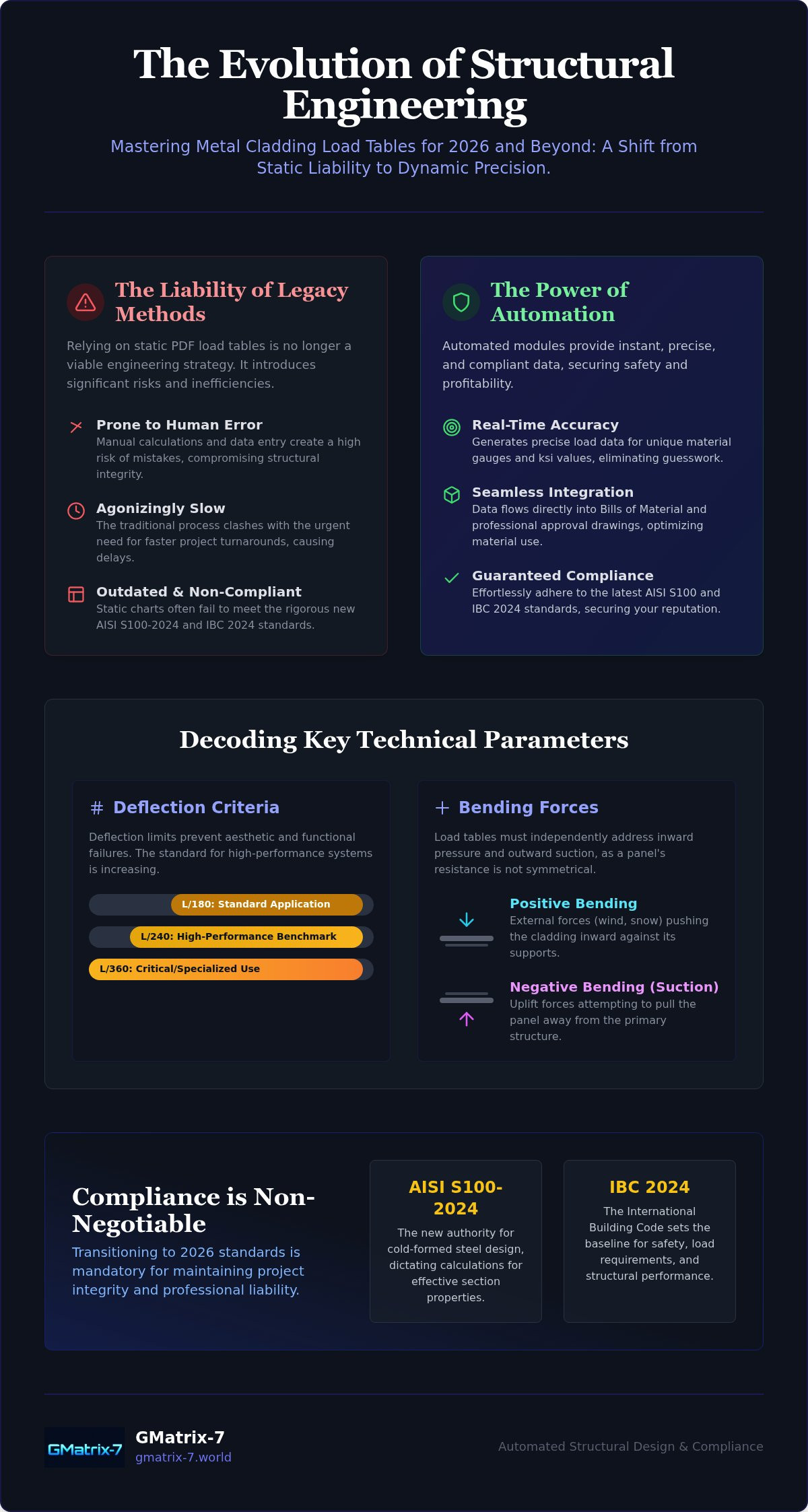
Professional metal cladding load tables must independently address two distinct force vectors: positive and negative bending. Positive bending occurs when external forces, like wind or snow, push the cladding inward against its supports. Conversely, negative bending, or suction, creates an uplift force that attempts to pull the panel away from the structure. These conditions aren't symmetrical. The profile's resistance changes depending on which side of the metal is in compression. Accurate tables account for these variations by calculating the effective width of the panel's elements for each scenario independently. This level of detail is essential for generating professional approval drawings and ensuring that insurance requirements are met with battle-tested data.
Technical Parameters: Decoding Deflection Criteria and Span Conditions
Structural reliability hinges on the precise calibration of technical variables within metal cladding load tables. You cannot simply rely on nominal values when the integrity of a multi-million dollar project is at stake. Material thickness, or gauge, and yield strength, measured in ksi, are the primary drivers of performance. For instance, a 24-gauge panel with a 50 ksi yield strength behaves fundamentally differently than an 80 ksi variant under the same pressure. Adhering to the latest AISI S100 Requirements is non-negotiable when calculating effective section properties for cold-formed steel. This process accounts for local buckling and the reduction in effective width, ensuring that the safety factors applied are both accurate and compliant with 2026 standards.
Calculating Allowed Deflection for Large-Scale Projects
Deflection limits are expressed as a ratio of the span length (L), such as L/180, L/240, or L/360. To calculate the allowed deflection, you divide the total span in inches by the divisor. While L/180 is often acceptable for standard wall applications, L/240 is rapidly becoming the benchmark for high-performance metal building systems to ensure superior weather-tightness and aesthetic stability. This rigorous approach is central to professional structural design automation, where precision exceeds the capabilities of manual estimation. Higher divisors result in stiffer requirements, which directly impacts the maximum allowable span distance and overall material requirements.
Multi-Span Condition vs. Simple Span Analysis
The efficiency of a cladding system changes dramatically based on its span condition. A simple span, supported at only two points, is the most conservative and least efficient configuration. In contrast, double and triple span conditions introduce continuity over internal supports, which significantly redistributes the bending moment. This redistribution allows for higher load capacities or longer spans for the same material thickness. However, calculating these distributions manually is complex and prone to error. You must account for the specific moment and shear values at every support point to avoid over-stressing the material. Transitioning to automated systems ensures these complex variables are captured instantly in your metal cladding load tables. You can explore precision engineering modules to streamline this workflow and eliminate the risks associated with manual span analysis.
The Shift from Static PDF Charts to Automated Load Table Generation
Static PDF directories represent an outdated engineering paradigm. Relying on these generic charts often leads to significant material waste through over-engineering or, worse, introduces safety risks by using data that doesn't perfectly match the project's specific material properties. In the high-stakes environment of 2026 construction, "close enough" is no longer an acceptable standard. Dynamic generation of metal cladding load tables allows for the input of specific ksi values and exact material gauges, ensuring that every calculation is optimized for the actual product being installed. This level of precision is a competitive necessity for fabricators who must deliver excellence without the bloat of unnecessary material costs.
Automation closes the gap between design capability and final outcome. By moving away from static charts, engineers gain the ability to validate structural performance in real-time. This shift isn't just about convenience; it's about establishing a rigorous, data-driven foundation for every building system. Speed without compromise becomes the new baseline, allowing firms to respond to complex project requirements with assertive confidence. When you eliminate the manual entry of span data, you simultaneously eliminate the liability associated with human error.
Why Custom Profiles Demand Dynamic Calculation
Manufacturer-provided charts are inherently limited to standard, proprietary shapes. When a project requires a custom profile or a non-standard gauge, static tables fail to provide the necessary data. Utilizing specialized LGS structural design software enables engineers to perform rigorous analysis on unique geometries. This capability eliminates the need for manual interpolation, which is a common source of calculation errors. By automating the detailing process, you ensure that the load resistance of a custom profile is validated against global standards before the first sheet is ever rolled. This transition from complexity to simplicity is essential for maintaining a world-class standard of excellence.
Integrating Load Tables into the Engineering Workflow
The true power of automation lies in its ability to bridge the gap between structural analysis and material procurement. Once the load tables are generated, the data flows seamlessly into automated bill of materials software. This integration removes the friction of manual data entry, which often causes discrepancies between engineering intent and the final material list. Automated tables also accelerate the creation of professional approval drawings, allowing for faster client sign-off and reduced lead times. When compared to traditional CAD methods, the ROI of specialized structural modules is clear: you achieve superior precision in a fraction of the time. This methodical progression from technical input to streamlined output ensures that your projects remain both intellectually rigorous and commercially urgent.
Compliance Standards: Navigating IBC 2024 and AISI S100 Requirements
The adoption of the 2024 International Building Code (IBC) has redefined technical expectations for metal building systems. While many local authorities are still enforcing 2021 editions, elite engineering firms already align their metal cladding load tables with the newest standards to ensure global portability. This proactive approach eliminates the risk of regulatory rejection. It establishes a foundation of absolute reliability. Achieving compliance requires a deep understanding of the Steel Deck Institute's (SDI) assumption of the S100-2024 standard. This new edition, published in March 2025, replaces the 2016 version and introduces more rigorous requirements for cold-formed steel design. Operating across multiple jurisdictions requires a globally minded strategy. Recent updates, such as the New Zealand Metal Roof and Wall Cladding Code of Practice from June 2026, highlight the international trend toward more stringent safety protocols.
AISI S100: The Benchmark for Cold-Formed Steel Cladding
Calculating member strength and stiffness under the current AISI S100 demands a level of precision that manual spreadsheets cannot replicate. The standard mandates rigorous assessment of safety factors (Omega) and resistance factors (Phi) to account for material variability and load uncertainties. Utilizing AISI structural design tools automates these complex iterations. It ensures every span calculation respects the boundaries of local buckling and torsional-flexural behavior. This automation transforms a high-risk technical burden into a streamlined, error-free workflow. It allows engineers to focus on structural optimization rather than just survival. The transition of responsibility to the SDI is a significant industry shift. Professionals must navigate this change to ensure their deflection and shear analysis remains accurate for thin-walled sections.
Achieving Total Compliance in Approval Drawings
In 2026, structural approval drawings must contain comprehensive documentation of yield strength, deflection limits, and specific span conditions. When cladding is supported by open web steel joists, the integration of SJI compliant joist design becomes critical. The metal cladding load tables must sync perfectly with the joist spacing and load-bearing capacity defined by the SJI 100-2020 standard. Automated documentation ensures that every table and drawing meets local building codes instantly. This total transparency provides peace of mind to inspectors and clients alike. You can automate your compliance documentation today to secure your projects against shifting regulatory standards and ensure seamless integration with your bills of material.
Optimizing Structural Precision with GMatrix-7 Load Table Modules
GMatrix-7 represents the pinnacle of structural engineering software, offering a comprehensive suite for generating metal cladding load tables that are as precise as they are reliable. This platform isn't just a calculator; it's a world-class engine designed to move fabricators from complexity to simplicity. By generating tables for single skin, sandwich panels, and composite decks, the software ensures every structural element is optimized for its specific role. This capability is deeply integrated with GMatrix-7 / MBS (IBC) and GMatrix-7 / OWSJ (SJI) bar joist modules, creating a unified ecosystem where data flows without friction. You gain the ability to specify profiles with assertive confidence, knowing the underlying logic is battle-tested against the most demanding global standards.
The reliability of these outputs provides the security necessary for high-level achievement. In an industry where a single manual error can lead to significant liability, GMatrix-7 provides the peace of mind that comes from automated precision. It translates complex engineering inputs into streamlined, high-value results that meet the rigorous 2026 standards discussed previously. This methodical approach ensures that your firm remains a leader in structural integrity while maximizing operational efficiency.
Single Skin and Sandwich Panel Optimization
Sandwich panels present unique engineering challenges, particularly regarding thermal effects and core shear capacity. GMatrix-7 modules account for these variables with surgical accuracy, calculating how temperature differentials impact load capacity over time. This level of detail allows for precise span data that significantly reduces material waste. Instead of over-specifying to compensate for uncertainty, you can rely on data-driven optimization to lower costs while maintaining safety. For floor applications, the composite deck load table generator provides the same level of rigorous analysis, ensuring that horizontal surfaces meet the same excellence as vertical cladding. This focus on optimization ensures that every pound of steel is utilized to its maximum potential.
The Future: Automated BOM and Material Lists
The final stage of the engineering workflow is the seamless transition from load table generation to a comprehensive Bill of Material (BOM). GMatrix-7 automates this process, ensuring that every span, gauge, and fastener count is reflected accurately in the material list. This integration eliminates the disconnect between the design phase and procurement, streamlining the entire project lifecycle. You don't have to worry about manual transcription errors or material shortages that stall construction. The result is a more efficient, profitable, and secure operation that scales with your business needs. To see these capabilities in action and secure your engineering workflow, Explore GMatrix-7 Structural Design Modules and elevate your precision to the next level.
Securing the Future of Metal Building Design
The transition to automated engineering is no longer optional for firms aiming to lead the industry in 2026. By moving beyond static PDF charts, you eliminate the liability of manual calculation errors and ensure seamless compliance with IBC 2024 and AISI S100 standards. Generating precise metal cladding load tables allows for significant material optimization, reducing waste while maintaining the highest safety factors for single skin and sandwich panels. This rigorous, data-driven approach transforms complex span analysis into a streamlined asset for your entire structural workflow.
Global fabricators already rely on our technology to automate complex calculations and reduce detailing time by up to 60%. It's time to replace outdated methods with a battle-tested solution that integrates directly with your bills of material and approval drawings. Take the first step toward world-class structural precision and total peace of mind. Request a Demo of GMatrix-7 Load Table Generation Modules today and elevate your engineering standards to the next level of excellence.
Frequently Asked Questions
What is the difference between a load table and a span chart?
Load tables specify the pressure in pounds per square foot (PSF) that a material can withstand over specific distances. Span charts focus primarily on the maximum distance between supports for a given load. While professionals often use these terms interchangeably, a load table is the more comprehensive engineering document. It includes critical deflection limits and safety factors. Using these tables ensures your structural design remains within the boundaries of safe operation.
How often should metal cladding load tables be updated for code compliance?
You must update your tables whenever a new building code is adopted or material standards change. With the industry moving toward IBC 2024 and the SDI-published AISI S100-2024, static data from previous cycles is now obsolete. Regular updates ensure your designs meet current safety and insurance requirements. Automated systems provide the most reliable way to stay current. This eliminates the need for manual recalculation every time a jurisdiction adopts new regulations.
Can I use generic load tables for custom-profiled sandwich panels?
Using generic tables for proprietary or custom sandwich panels is a significant engineering risk. These panels possess unique core properties and thermal behaviors that fundamentally impact structural capacity. Static charts cannot account for custom profiles or varying material grades. GMatrix-7 allows you to input specific material data to generate accurate, custom metal cladding load tables for any configuration. This ensures your project remains safe and optimized for its specific material properties.
What deflection limit should I use for metal wall panels vs. roofing?
Wall panels typically utilize L/180 or L/240 to maintain aesthetic integrity and prevent seal failure. Roofing often requires stricter limits, such as L/240 or L/360, to support snow loads or maintenance traffic. The specific divisor depends on the building's occupancy category and local environmental conditions. Always verify the jurisdiction's requirements before finalizing your span analysis. Precise calculations prevent excessive deformation that could compromise the weather-tightness of the building envelope.
How does GMatrix-7 handle AISI S100-24 compliance in its load tables?
GMatrix-7 / LGS (AISI) automates the rigorous calculations required by the S100-2024 standard. It accounts for effective width, local buckling, and torsional-flexural behavior instantly. The software applies the correct safety and resistance factors for cold-formed steel members. This ensures every output is compliant with the latest SDI-published standards for 2026. You gain the peace of mind that comes from using battle-tested logic that has been verified against global engineering requirements.
Is automated load table generation faster than using manufacturer PDFs?
Automated generation is significantly faster, reducing detailing and calculation time by up to 60%. Manufacturer PDFs require manual interpolation and data entry, which is both slow and prone to human error. Automation provides instant results for any gauge, yield strength, or span condition. It allows engineers to move from complex inputs to professional approval drawings with surgical speed. This efficiency is a competitive necessity for firms operating in the fast-paced 2026 construction market.
What data is required to generate a custom metal cladding load table?
Generating a custom table requires the panel profile geometry, material thickness, and yield strength. You must also define the deflection criteria and the span conditions, such as single, double, or triple spans. Providing accurate sectional properties ensures the software calculates the moment of inertia correctly for both positive and negative bending. This data-driven approach ensures that your metal cladding load tables are optimized for the actual materials being used on the job site.
How do load tables integrate with a Bill of Materials (BOM)?
Load tables define the support spacing and material specifications that feed directly into the material list. GMatrix-7 automates this transition, ensuring the Bill of Materials reflects the exact quantities and gauges validated during the engineering phase. This integration eliminates transcription errors and streamlines the entire procurement process. It bridges the gap between design intent and final construction delivery. This methodical progression ensures that your projects remain both intellectually rigorous and commercially urgent.


