

In 2026, relying on manual calculations for IBC or SJI compliance isn't just inefficient; it's a liability that threatens the structural integrity and profitability of every project you touch. You've likely felt the frustration of losing hours to manual checks or the sting of material waste caused by inaccurate bills of materials. It's a common struggle for firms aiming to maintain excellence while navigating the rigorous demands of ASCE 7-22. Mastering these complexities requires a shift toward advanced structural engineering compliance software that replaces manual verification with automated excellence.
This guide demonstrates how to eliminate manual errors and secure your status as an industry leader. You'll learn to transform technical inputs into streamlined, fabrication-ready documentation with total confidence. We'll examine how automated approval drawings and precise load tables for composite decks ensure instant compliance with global engineering standards. This methodology allows you to optimize every ton of steel in your design while maintaining the highest levels of safety and precision. By the end of this guide, you'll have a clear roadmap for integrating automation into your MBS, OWSJ, and LGS workflows.
Key Takeaways
- Learn how modern structural engineering compliance software automates complex analysis against IBC and SJI standards to eliminate manual calculation errors.
- Discover the efficiency of real-time code checking for MBS, OWSJ, and LGS components within a unified, high-accuracy digital environment.
- Master the transition to automated documentation by generating fabrication-ready approval drawings and precise bills of materials instantly.
- Unlock the capability to generate sophisticated load tables for sandwich panels and composite decks, ensuring rigorous data-driven compliance for building envelopes.
- Adopt authoritative engineering solutions that secure your firm's reputation as a visionary leader in safety and industrial excellence.
What is Structural Engineering Compliance Software?
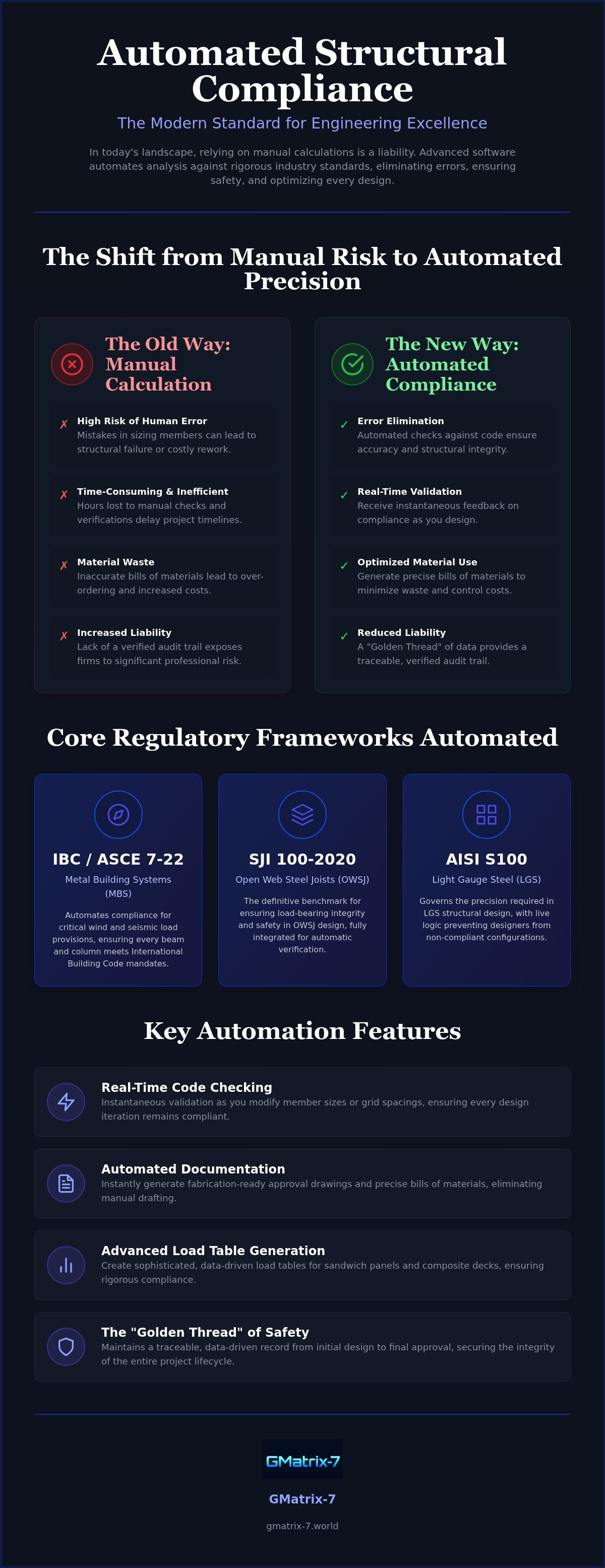
Structural engineering compliance software represents a specialized category of digital tools engineered to automate structural analysis against rigorous local and international building codes. It functions as an integrated ecosystem where design inputs automatically trigger compliance checks. This ensures that every beam, column, and joist meets the specific safety mandates of the project's jurisdiction. Transitioning from "Spreadsheet Stress" to these high-accuracy environments eliminates the vulnerability of disconnected data and fragmented calculations. While traditional structural engineering software focuses on general analysis, compliance-centric platforms like GMatrix-7 prioritize the "Golden Thread" of safety.
This digital thread provides a traceable, data-driven record from initial design to final approval, securing the integrity of the entire project lifecycle. In 2026, the industry has moved past the era of static 2D drafting. Modern standards require dynamic models that reflect real-time changes in code requirements, such as the new tornado load provisions in ASCE 7-22. Firms that fail to adopt these automated environments risk falling behind as jurisdictions increasingly demand BIM-integrated compliance data for project certification.
The Core Regulatory Frameworks of 2026
Project approvals in 2026 demand strict adherence to updated mandates that go beyond basic 2D drafting. The International Building Code (IBC) now requires granular data for Metal Building Systems (MBS), specifically concerning wind and seismic loads under ASCE 7-22. For those specializing in Open Web Steel Joists, SJI 100-2020 remains the definitive benchmark for ensuring load-bearing integrity. Similarly, AISI S100 governs the precision required in Light Gauge Steel (LGS) structural design. Modern software modules must incorporate these frameworks as live logic. This prevents designers from drifting into non-compliant territory during the iterative design phase.
Why Manual Calculations are No Longer Sufficient
Relying on manual calculation for complex structural member sizing is a high-risk strategy that often leads to catastrophic material waste or structural failure. Human error in sizing just a few members can balloon project costs and delay approvals by weeks. Automated compliance serves as a critical shield, significantly reducing insurance liability for engineering firms by providing a verified audit trail of every design decision.
Precision in 2026 isn't optional; it's the foundation of professional liability management. Structural engineering compliance software is the bridge between engineering theory and regulatory reality. By automating these checks, firms protect their reputation and their bottom line simultaneously. This transition allows engineers to focus on innovation rather than the tedious verification of static code tables.
Key Features of Professional Structural Design Automation
Automation in 2026 isn't just about speed; it's about shifting the compliance burden from a post-design audit to a live, proactive feedback loop. Modern structural engineering compliance software embeds regulatory logic directly into the modeling environment. This allows engineers to receive instantaneous validation as they modify member sizes or grid spacings. This real-time interaction ensures that every design iteration remains within the safe boundaries of the law. Integrating these capabilities into professional structural design automation workflows transforms the engineer from a manual calculator into a high-level systems orchestrator.
Professional platforms must also solve the "black box" problem. For years, engineers were forced to trust results they couldn't easily verify, creating significant risk during third-party reviews. Today's elite solutions prioritize calculation transparency, providing granular, step-by-step reports that show exactly how a result was derived from the code. This level of detail is essential for maintaining professional standards and securing project approvals in an increasingly scrutinized regulatory environment.
Specialized Modules for Steel Structures
Generic analysis tools often fall short when dealing with the nuances of specialized steel detailing. GMatrix-7 addresses this gap with dedicated modules designed for specific structural categories. The GMatrix-7 / MBS (IBC) module automates the intricate design requirements of metal building systems, ensuring every component aligns with global standards. For joist manufacturers, the GMatrix-7 / OWSJ (SJI) module provides specialized bar joist engineering that strictly adheres to SJI 100-2020 compliance. Finally, the GMatrix-7 / LGS (AISI) module offers the precision tools necessary for cold-formed steel design, where thin-walled member stability is paramount. These specialized modules ensure that your firm isn't just designing, but is designing for fabrication-ready excellence.
The Importance of Calculation Traceability
Engineers must be prepared to defend their results during rigorous third-party reviews or insurance audits. Without a verifiable paper trail, even the most innovative design can be rejected. GMatrix-7 provides the necessary documentation to support structural approvals by generating comprehensive reports that link every design decision back to its source code. When comparing CAD vs specialized software for steel detailing, the primary differentiator is this depth of data. While CAD might show the geometry, specialized compliance software provides the "why" behind the structure. Secure your firm's reputation by adopting a platform that acts as a guardian of safety and technical accuracy. You can explore how these modules integrate into your current systems by visiting the GMatrix-7 platform.
Achieving Compliance Through Automated Documentation
Documentation serves as the final frontier of structural compliance, acting as the legal and physical bridge between a digital model and the construction site. While analysis proves a design works in theory, the documentation proves it can be built safely in reality. High-performance structural engineering compliance software ensures that this bridge remains unbreakable by automating the translation of complex engineering logic into technical records. This eliminates the dangerous disconnect that often occurs when manual drafting processes fail to keep pace with rapid design iterations. By maintaining a direct, automated link between detailing and real-world structural integrity, firms secure their designs against the risks of misinterpretation and onsite failure.
GMatrix-7 plays a pivotal role in this ecosystem by eliminating manual drafting discrepancies that traditionally plague the submittal process. When documentation is generated directly from the compliance engine, every line and dimension is backed by rigorous data. This authoritative approach moves engineering firms away from the "best guess" mentality of manual drafting and toward a model of absolute precision. It ensures that the "Golden Thread" of safety, mentioned in previous sections, is woven into every sheet of the final drawing set.
Automated Approval Drawing Generation
Generating approval drawings is often the most labor-intensive phase of a project, yet it's the most critical for regulatory submission. GMatrix-7 transforms structural inputs into professional, ready-to-submit technical drawings through parametric detailing automation. This process reduces the revision cycle from weeks to hours, allowing engineers to respond to architect changes without compromising code adherence. Every drawing set is engineered to meet the highest industry benchmarks, including SJI compliant joist design standards. This capability ensures that your submittals are not just visually professional, but are technically superior and fully optimized for local building official reviews.
Precision Bill of Materials (BOM) Generation
Project profitability and safety are inextricably linked to the accuracy of the Bill of Materials. Manual BOM generation is notorious for procurement errors that lead to significant material waste or, worse, the installation of incorrect member sizes. Automated BOMs prevent these failures by extracting data directly from the compliant model, ensuring that every ton of steel ordered is exactly what the design requires. This level of accuracy protects the bottom line by reducing rework and ensuring that procurement teams aren't guessing at material specifications. Automated BOMs ensure the final build matches the compliant design exactly by eliminating the manual transcription errors that typically occur between engineering and procurement phases.
Advanced Load Table Generation for Panels and Decks
Calculating load capacity for modern building envelopes involves a multifaceted analysis of material behavior, environmental stressors, and geometric constraints. For manufacturers, manual load table generation has long been a crippling bottleneck that delays product launches and increases the risk of technical inaccuracies. Professional structural engineering compliance software solves this by automating the complex iterative processes required to define safe operating limits. This transition ensures that every data point in a manufacturer's technical catalog is backed by rigorous, code-compliant logic. This level of precision is essential for maintaining the reliability and security of large-scale industrial envelopes.
Automation transforms the way manufacturers communicate technical capabilities. Instead of relying on outdated static tables, you can generate dynamic, project-specific data that reflects real-world conditions. This high-level achievement in data precision secures your status as a world-class provider of structural components. It allows for a seamless transition from complex engineering inputs to simple, actionable load data for the end user. By adopting these automated workflows, firms eliminate the "spreadsheet stress" that often leads to conservative, inefficient designs.
Composite Floor Deck Load Tables
Determining the structural capacity of composite decks requires a deep understanding of how varying span conditions and live loads interact with the concrete-steel bond. This complexity often forces engineers into inefficient designs when using manual spreadsheets. GMatrix-7 provides a specialized composite deck load table generator that automates these calculations, allowing for rapid iteration of deck profiles. This tool ensures compliance with modern composite standards for industrial projects, providing the data necessary to optimize material thickness without sacrificing safety. By automating these inputs, firms deliver precise technical documentation that satisfies both client demands and regulatory scrutiny.
Sandwich Panel and Single Skin Calculations
Thermal and structural requirements for building cladding have become increasingly stringent in 2026. Sandwich panels require a balanced analysis of core insulation properties and skin rigidity to determine accurate load capacities under wind and snow loads. Generating documentation for these components often requires manufacturer-specific logic that generic analysis tools cannot provide. GMatrix-7 automates this workflow for both single skin and sandwich panels, creating technical data that meets rigorous global compliance needs. This capability is invaluable for cladding and panel fabricators who must provide battle-tested load data to architects and contractors. To see how these specialized generators can streamline your manufacturing workflow, explore the GMatrix-7 software modules today.
Future-Proofing Your Engineering Firm with GMatrix-7
Success in the 2026 engineering landscape requires more than just technical proficiency; it demands a results-oriented approach to automation that secures your firm's reputation for excellence. Integrating structural engineering compliance software into your core operations transforms your team from manual tool-users into strategic partners who drive industrial progress. This shift allows you to focus on high-level design innovation while the software acts as a guardian of safety and regulatory adherence. By leveraging the specialized logic of GMatrix-7, firms move beyond the limitations of generic analysis and embrace a workflow built for the future of global construction.
Adopting this technology is a commitment to precision that resonates through every project phase. You're no longer just providing a service; you're delivering a guarantee of structural integrity and data-driven reliability. This authoritative stance is what separates market leaders from those still struggling with legacy workflows. It provides the peace of mind that comes from knowing every calculation is battle-tested against the most rigorous standards in the industry.
The ROI of Specialized Compliance Software
Investing in specialized compliance tools provides a measurable return on investment that scales with project complexity. Firms using these platforms report significant reductions in overhead by eliminating the manual documentation tasks that traditionally consume a massive portion of an engineer's billable hours. This efficiency allows you to secure more high-value contracts, as you can guarantee shorter lead times and error-free submittals. Scaling your firm's operations becomes a logical progression through LGS structural design software efficiency, where automation handles the granular detailing that often creates bottlenecks in cold-formed steel projects.
- Time Savings: Drastically reduce the time spent on manual IBC and SJI compliance checks by automating the verification process.
- Error Mitigation: Eliminate the risk of material waste and rework through automated Bill of Material generation.
- Competitive Edge: Win larger projects by providing fabrication-ready documentation that speeds up the approval cycle for local building officials.
Getting Started with GMatrix-7 Licensing
Selecting the right modules is the first step toward achieving world-class engineering efficiency. Whether your focus is on Metal Building Systems (MBS), Open Web Steel Joists (OWSJ), or Light Gauge Steel (LGS), GMatrix-7 offers tailored licensing options that align with your specific project needs. The transition from initial design to fabrication-ready outputs is seamless, ensuring that your technical inputs lead directly to streamlined industrial results. Excellence in structural engineering is not an accident; it's the result of choosing the right technology partner. Contact Dr. Simon B. and the GMatrix-7 team today for a world-class demonstration of how our platform can revolutionize your firm's compliance workflow.
Leading the Future of Structural Excellence
The 2026 engineering landscape demands a departure from manual risk toward automated certainty. You've seen how specialized structural engineering compliance software transforms complex regulatory logic into streamlined, fabrication-ready outputs. By integrating IBC, SJI, and AISI compliant modules, your firm secures its status as a premier leader in industrial progress. Automated BOM generation and precision approval drawings don't just save time; they protect your profitability and ensure every structural member aligns perfectly with the final build. This high-level achievement is the foundation of modern professional practice.
Transitioning to high-accuracy digital environments is the only way to future-proof your operations against evolving global standards. GMatrix-7 stands as a world-class partner, providing the rigorous, data-driven tools necessary to master these complexities with absolute confidence. It's time to replace spreadsheet stress with cutting-edge engineering excellence. Explore the GMatrix-7 structural engineering suite for total compliance and elevate your firm to the highest tier of achievement. Your journey toward error-free, automated excellence begins here.
Frequently Asked Questions
What is the best structural engineering compliance software for MBS?
GMatrix-7 / MBS (IBC) is the authoritative solution for Metal Building Systems, providing a high degree of professional confidence in automated code adherence. It replaces fragmented analysis with a unified logic that aligns with the latest International Building Code requirements. This structural engineering compliance software allows firms to move beyond surface-level design into fabrication-ready excellence. It ensures that every component is optimized for safety and material efficiency, securing a world-class standard for complex industrial projects.
How does automated BOM generation improve structural compliance?
Automated Bill of Material (BOM) generation eliminates the dangerous gap between engineering theory and procurement reality. By extracting data directly from the compliant digital model, it ensures that every ton of steel ordered matches the design specifications exactly. This process reduces the risk of onsite installation errors and prevents material waste caused by manual transcription mistakes. It's a critical component of the "Golden Thread" of safety, providing a traceable record for every structural member.
Can software automate SJI 100-2020 compliant joist detailing?
Yes, the GMatrix-7 / OWSJ (SJI) module is specifically engineered to automate bar joist detailing according to the SJI 100-2020 benchmark. It handles the intricate requirements of open web steel joists with absolute precision, ensuring that all technical documentation meets rigorous industry standards. This specialized tool allows manufacturers to generate compliant detailing and load data instantly. It removes the bottleneck of manual verification, allowing for rapid project progression and total peace of mind for engineering teams.
Why are automated load tables necessary for composite decks?
Manual load table generation for composite decks is an inefficient bottleneck that increases the risk of technical inaccuracies in 2026. Automated generators are necessary to calculate structural capacity under varying span and load conditions with data-driven precision. These tools allow manufacturers to provide accurate technical catalogs that satisfy both architect demands and building official reviews. By automating these complex iterations, firms ensure that their deck profiles are optimized for safety without the risk of human error.
What is the difference between general analysis software and specialized detailing compliance tools?
General analysis software focuses on basic physics and load paths, whereas specialized detailing compliance tools integrate specific code logic with fabrication-ready documentation. While general tools provide broad results, specialized software like GMatrix-7 handles the nuances of MBS, OWSJ, and LGS systems. This ensures that the design isn't just theoretically stable, but is also legally compliant and ready for the shop floor. It bridges the gap between high-level engineering and practical industrial application.
How does GMatrix-7 handle AISI S100 standards for LGS design?
GMatrix-7 utilizes its dedicated LGS (AISI) module to provide precision tools for cold-formed steel structural design. This module incorporates AISI S100 standards as live logic, ensuring that thin-walled member stability is maintained throughout the design process. It automates the complex calculations required for light gauge steel, allowing engineers to produce compliant results with high-level achievement. This authoritative approach secures the structural integrity of building envelopes while it significantly reduces the time required for manual verification.
Is structural engineering compliance software compatible with common CAD platforms?
Professional structural engineering compliance software is designed to integrate seamlessly into existing professional design workflows. It often functions as the intelligent engine that drives the creation of technical drawings and models within a firm's digital ecosystem. This compatibility ensures a smooth transition from engineering analysis to the generation of approval drawings and material lists. By bridging these platforms, firms maintain a logical flow that doesn't sacrifice data integrity. It's the standard for preserving precision from design to output.
What are the risks of using spreadsheets for structural calculations in 2026?
Relying on spreadsheets in 2026 introduces unacceptable levels of liability and "Spreadsheet Stress" into the engineering process. Manual calculations are prone to human error, which can lead to catastrophic material waste or structural non-compliance. These legacy methods don't have the traceability or real-time code checking required for high-stakes industrial projects. Using automated solutions is the only way to ensure reliable safety. It's the benchmark for professional excellence in an increasingly scrutinized regulatory environment.


