
Fabrication excellence in 2026 is no longer defined by the ability to create a 3D model; it's defined by the engineering-first automation that bridges the gap between AISI compliance and the shop floor. Identifying the best LGS design software for fabricators requires looking beyond basic drafting tools toward systems that integrate structural analysis directly into the production cycle. You've likely felt the frustration of manual errors in Bills of Material that lead to costly scrap or the production delays caused by slow approval drawing cycles.
It's a challenge every high-output facility faces as standards like IBC 2024 become more rigorous and demanding. This guide provides a strategic roadmap to optimizing your workflow, demonstrating how modern software can reduce detailing time by at least 50% while ensuring full compliance with AISI S100 standards. We'll analyze the critical features, automation tools, and structural solvers that empower fabricators to generate error-free BOMs instantly and maintain a competitive edge in a precision-driven global market.
Key Takeaways
- Understand why the transition to IBC 2024 necessitates a shift from basic drafting applications to sophisticated engineering-first software modules.
- Discover how automated 3D detailing and instant Bill of Material (BOM) generation eliminate manual data entry errors and significantly reduce material waste.
- Evaluate the best LGS design software for fabricators based on its capacity to bridge the "Engineering-to-Production" gap through automated structural documentation.
- Analyze the specific ROI of specialized software licensing, targeting a reduction in detailing time by at least 50% compared to traditional manual processes.
- Learn how GMatrix-7 / LGS (AISI) provides a hardware-agnostic solution, offering the flexibility to optimize fabrication workflows across any roll-former brand.
Defining the Standard for LGS Design Software in 2026
The distinction matters enormously: the best LGS design software for fabricators is not a drafting application with a steel library bolted on. It's a purpose-built engineering platform that executes structural analysis, enforces code compliance, and generates production-ready documentation as a unified, automated process. Generic CAD tools can render a stud wall. They cannot verify whether that wall satisfies thin-walled section behavior under combined axial and bending loads, and they certainly won't flag a non-compliant connection before it reaches the shop floor.
Fabricators operating in 2026 face a market where structural complexity has outpaced the tools many facilities still rely on. Mid-rise cold-formed steel construction, once considered a niche application of the steel frame building technique, now demands multi-story load path analysis, sophisticated diaphragm modeling, and rigorous documentation trails. The gap between what a drafting tool produces and what a structural engineer must certify has never been wider.
The Evolution of Cold-Formed Steel Engineering
Cold-formed steel structures have grown dramatically in scope and ambition. Mid-rise LGS construction introduces layered load combinations, complex lateral bracing requirements, and thin-walled section behavior that manual AISI calculations simply cannot address at production speed or scale. The 2026 environment demands automated structural solvers that process these variables simultaneously, eliminating the iterative, error-prone cycle of manual checks. Facilities that haven't transitioned to engineering-first platforms are absorbing that inefficiency directly into their project timelines and liability exposure.
Why AISI S100 Compliance is Non-Negotiable
AISI S100 is the foundational standard governing the design of cold-formed steel structural members in North America. Using software that lacks verified AISI S100 compliance on a high-stakes structural project isn't a calculated risk; it's a professional liability waiting to materialize. When an approval authority questions a member selection or connection detail, the fabricator needs a documented, code-traceable calculation, not a CAD dimension.
Automated compliance checks embedded directly within the engineering module resolve this exposure systematically. Rather than relying on a detailer to manually cross-reference the standard, the software enforces compliance at every calculation step. The transition from IBC 2021 to IBC 2024 has sharpened this requirement further, introducing updated load combinations and seismic provisions that demand real-time verification, not post-design audits.
The 'Gold Standard' for the best LGS design software for fabricators, therefore, rests on three non-negotiable pillars: structural precision grounded in verified AISI S100 logic, seamless IBC 2024 compliance integration, and automated output that moves directly from engineering analysis to production documentation without manual re-entry.
Essential Features for High-Efficiency LGS Fabrication
Efficiency isn't just about speed. It's about accuracy. The best LGS design software for fabricators eliminates the manual verification steps that traditionally bottleneck production. It's not enough to simply draw a frame. The system must understand the structural implications of every stud, track, and screw placement. High-efficiency fabrication relies on a seamless transition from engineering data to the shop floor, ensuring that what's designed is exactly what's built.
Instant Bill of Material (BOM) generation acts as a critical safeguard against material waste. When the design engine automatically calculates lengths, gauges, and quantities directly from the 3D model, the risk of human transcription error vanishes. This precision ensures that procurement matches the exact requirements of the fabrication line, protecting your margins from the high cost of scrap steel. It also allows for real-time inventory adjustments, ensuring that every linear foot of coil is accounted for before the first cut is made.
Automated Detailing and Structural Analysis
Modern detailing engines must handle complex load paths and connections without manual intervention. By integrating North American LGS Design Standards directly into the detailing logic, the software ensures that every frame is structurally sound before it reaches the roll-former. Automated structural design tools outperform manual detailing speeds by orders of magnitude, allowing detailers to focus on high-level coordination rather than repetitive, manual calculations.
Load Table Generation for Panels and Decks
Fabricators specializing in panelized systems require precise data for single skin and sandwich panels. Generating these load tables manually is a laborious process prone to oversight. High-tier software automates this, providing immediate capacity data based on specific profile geometries and material properties. This is especially vital for flooring systems where a composite deck load table generator provides the technical validation required for structural deck load capacity. Such precision is crucial when selecting the best LGS design software for fabricators to handle multifaceted project requirements.
Professional approval drawings serve as the bridge between the fabricator and the client. Automated generation of these drawings ensures transparency and accelerates the sign-off cycle. When clients receive clear, data-backed documentation, production start dates move forward with confidence. This level of professionalism builds trust and reduces the back-and-forth communication that often delays projects. For those seeking to unify these features into a single, powerful workflow, exploring a specialized structural engineering software module can provide the necessary competitive advantage.
Overcoming Fabrication Bottlenecks with Engineering Automation
The most significant bottleneck in light gauge steel fabrication isn't the roll-forming speed; it's the Engineering-to-Production gap. This friction occurs when structural designs require manual translation into shop drawings and material lists. Every hour spent on manual data entry is an hour the production line remains idle. Implementing the best LGS design software for fabricators transforms this fragmented process into a streamlined digital thread, ensuring that engineering data flows directly into fabrication without human intervention.
Manual intervention is the primary source of operational risk. When detailers must manually transcribe member lengths or connection details, errors are inevitable. These mistakes don't just delay production; they compromise structural integrity and inflate costs. Engineering automation solves this by generating all necessary documentation, from assembly drawings to machine files, directly from the analyzed 3D model. This shift doesn't just save time. It secures the entire fabrication lifecycle.
Eliminating Manual Errors in Material Lists
Precision is profit. On large-scale LGS projects, even a 1-2% error rate in material lists can result in thousands of dollars in wasted coil and discarded scrap. These errors often stem from a lack of synchronization between the final design and the Bill of Materials (BOM). When changes occur in the structural model, manual BOMs rarely keep pace. High-performance automated bill of materials software acts as a guardian of project profitability by ensuring every stud, track, and fastener is accounted for with absolute accuracy. This level of precision allows for lean procurement and eliminates the "emergency re-order" cycles that kill project schedules.
Accelerating the Approval Cycle
Traditional workflows often suffer from a multi-day delay between design finalization and fabrication start. This gap is usually filled with the tedious creation of approval drawings for client sign-off. The best LGS design software for fabricators reduces this cycle from days to minutes. By automating the generation of professional, code-compliant approval drawings, fabricators can secure client authorization faster than ever before. This acceleration directly improves cash flow, as production can begin-and be invoiced-much earlier in the project timeline.
Some fabricators hesitate to adopt advanced automation, fearing software complexity will slow down their operations. This is a misconception. The complexity is handled by the software's internal structural engine, while the user experience focuses on output and efficiency. Investing in a system that automates the heavy lifting of engineering documentation isn't a burden; it's a strategic move that allows your team to focus on high-value production rather than administrative data entry.
Evaluating ROI: Accuracy vs. Manual Detailing Costs
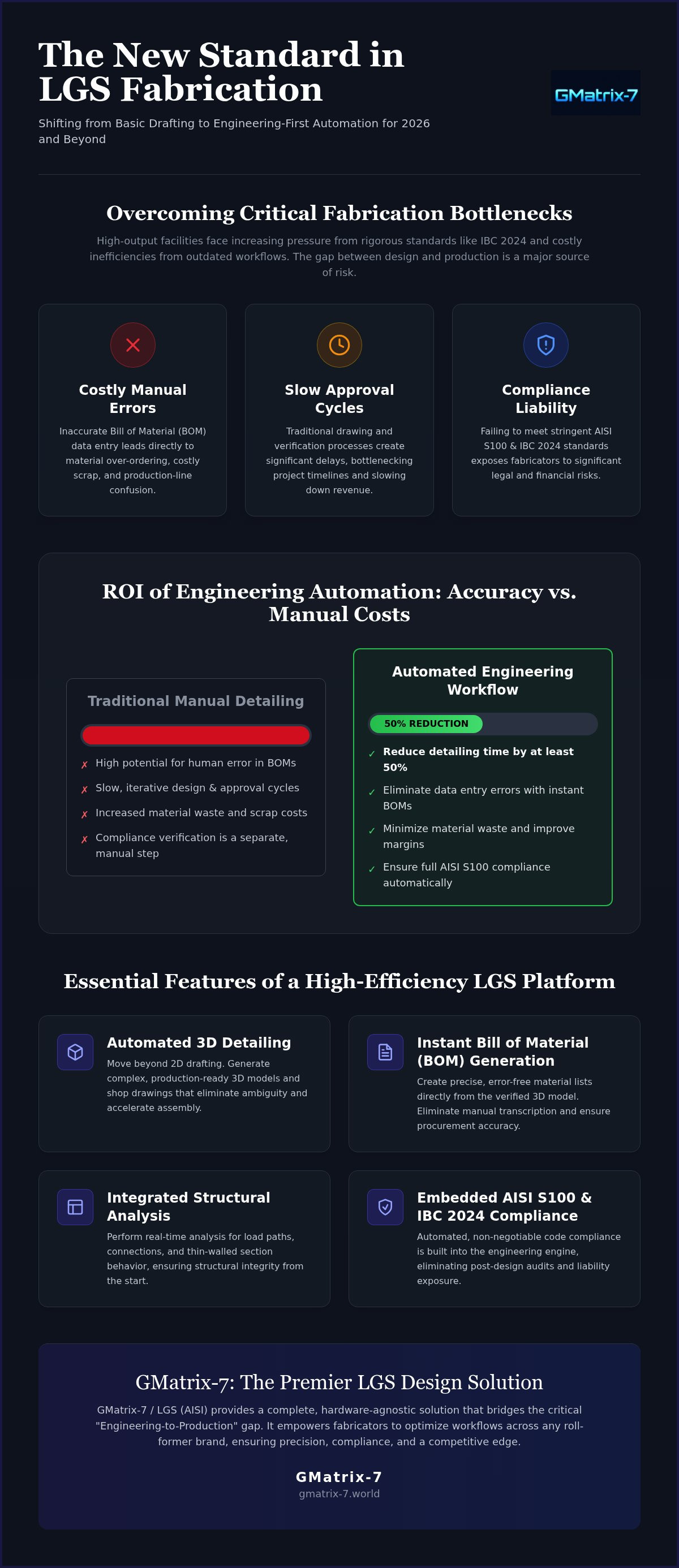
Investing in the best LGS design software for fabricators represents a strategic shift from labor-intensive overhead to high-leverage capital efficiency. The financial justification for advanced automation is clear when you compare the annual salary and benefit packages of multiple manual detailers against the fixed cost of a high-performance engineering license. A single detailer equipped with a structural automation engine can often outperform a team of three using traditional methods, effectively tripling your per-seat productivity while eliminating the fatigue-driven errors inherent in manual drafting.
Generic platforms often present a deceptive economy. While a basic CAD seat might appear affordable, the CAD vs specialized software for steel detailing comparison reveals massive hidden costs in the form of manual verification hours. Every minute a senior engineer spends double-checking a detailer's work is a drain on your profitability. Specialized software removes this requirement by embedding structural logic into the design process itself. This automated compliance significantly reduces the frequency and cost of third-party engineering reviews, as the output is already grounded in verified AISI and IBC standards.
Material Optimization and Waste Reduction
Precision detailing translates directly into exact material procurement. When your software generates a precise Bill of Materials, you eliminate the "buffer" ordering that typically accounts for 5-10% of project steel costs. Automated nesting patterns for roll-formers further enhance this efficiency, ensuring that coil utilization is maximized. This "Zero-Waste" fabrication model provides both an environmental advantage and a direct boost to your bottom line by turning what would have been scrap into finished product.
Scalability for Global Fabrication Standards
The ability to bid on international projects requires more than just fabrication capacity; it requires the flexibility to meet diverse regional codes. High-tier software allows fabricators to switch between AISI, IBC, and Eurocode standards with a single setting adjustment. This versatility empowers your business to expand into new markets without retraining your detailing team or hiring regional consultants. GMatrix-7 serves as the premier partner for fabricators aiming for global market expansion, providing the technological stability needed to compete at a world-class level.
Fabricators who prioritize long-term growth understand that automation is the only path to sustainable scaling. By replacing manual bottlenecks with data-driven precision, you secure your margins and your reputation for excellence. To see how structural automation can transform your facility's profitability, explore our specialized engineering modules today.
Why GMatrix-7 is the Premier LGS Design Solution for Fabricators
Selecting a structural platform is a strategic decision that dictates your operational freedom for years. GMatrix-7 / LGS (AISI) stands as the definitive choice because it refuses to compromise on engineering rigor or hardware flexibility. While many competitors lock fabricators into proprietary ecosystems tied to specific roll-forming machinery, GMatrix-7 remains hardware-agnostic. It's the best LGS design software for fabricators who demand the liberty to select the most efficient production equipment without being restricted by software compatibility issues.
This independence ensures that your facility can adapt to market shifts or equipment upgrades with seamless continuity. GMatrix-7 doesn't just provide a tool; it provides an authoritative engineering foundation. By separating the design logic from the fabrication hardware, we empower you to optimize your shop floor based on production needs, not software limitations. This approach eliminates the "vendor lock-in" that often stifles the growth of ambitious fabrication businesses.
The GMatrix-7 / LGS (AISI) Advantage
Technical credibility is the core of the GMatrix-7 experience. Under the leadership of Dr. Simon B., our modules are developed with a focus on structural engineering automation that exceeds standard drafting expectations. The LGS structural design software module integrates verified AISI S100 compliance directly into the workflow, ensuring every member and connection meets the most stringent safety requirements. From automated Bill of Material generation to the creation of advanced load tables for composite decks, every feature is designed to move your projects from complexity to streamlined, error-free output.
Future-Proofing Your Fabrication Business
The 2026 market demands more than isolated solutions. Modern projects increasingly require the integration of multiple structural systems, and GMatrix-7 is built for this reality. Our platform provides unique synergy between LGS, MBS (IBC), and OWSJ (SJI) modules, allowing for the comprehensive design of full buildings within a single, unified environment. This holistic capability ensures your business can handle diverse project types, from simple residential frames to complex industrial structures, without switching platforms or losing data integrity.
Our commitment to excellence means our software evolves as fast as the standards do. We maintain an aggressive development cycle to ensure our users stay ahead of the professional structural design automation curve. As IBC 2024 standards and global building codes continue to advance, GMatrix-7 provides the peace of mind that your designs remain compliant, safe, and optimized for maximum profitability. We invite you to experience the transition from manual, high-risk detailing to the precision and speed of a world-class structural automation partner.
Securing Your Competitive Advantage in 2026
The shift toward high-efficiency fabrication is no longer optional; it's a requirement for survival in a data-driven industrial landscape. By integrating engineering-first automation, you eliminate the manual bottlenecks that inflate overhead and invite structural risk. The most successful facilities are those that prioritize AISI S100 and IBC 2024 compliance while maintaining the flexibility of hardware-agnostic systems.
Choosing the best LGS design software for fabricators is about more than just drafting; it's about securing a foundation of reliability and precision. GMatrix-7 provides this through instant automated BOMs and load tables, ensuring your production line moves from design to delivery with absolute certainty. This transition from complexity to streamlined output isn't just an upgrade; it's a strategic evolution of your entire workflow.
Optimize Your Fabrication Workflow with GMatrix-7 LGS Software and take the next step toward engineering excellence to future-proof your facility today.
Frequently Asked Questions
What is the best LGS design software for AISI S100 compliance in 2026?
GMatrix-7 / LGS (AISI) is the premier solution for AISI S100 compliance in 2026. It integrates these rigorous standards directly into its structural solver to automate code verification at every design step. This ensures that every member selection and connection detail is grounded in the most current engineering requirements. By removing the need for manual cross-referencing, fabricators achieve absolute peace of mind and significantly reduce professional liability in high-stakes structural projects.
Can GMatrix-7 generate load tables for sandwich panels and composite decks?
Yes, the software features advanced modules specifically for generating precise load tables for single skin, sandwich panels, and composite decks. This automation eliminates the labor-intensive process of manual calculation while ensuring accuracy across various profile geometries and material properties. Providing these tables instantly allows fabricators to validate structural capacity for flooring and wall systems without the need for external engineering consultants or time-consuming third-party reviews, accelerating the overall project timeline.
How does automated BOM generation reduce material waste in LGS projects?
Automated Bill of Material generation reduces waste by extracting exact material requirements directly from the analyzed 3D structural model. This eliminates human transcription errors that typically lead to a 5-10% material buffer in traditional workflows. By providing precise lengths and quantities for every stud and track, the best LGS design software for fabricators ensures that procurement matches production needs, effectively protecting project margins from the high cost of unnecessary scrap steel.
Is GMatrix-7 software compatible with different roll-forming machine brands?
GMatrix-7 is a hardware-agnostic platform designed to integrate seamlessly with any roll-forming machine brand. Unlike proprietary systems that lock users into specific equipment ecosystems, this software provides the flexibility to select the most efficient hardware for your facility. It generates production-ready data that can be utilized across various fabrication lines, ensuring that your software investment remains stable even if you choose to upgrade or change your roll-forming machinery in the future.
What is the difference between generic CAD and specialized LGS engineering software?
Generic CAD is primarily a drafting tool used for visualization, whereas specialized LGS engineering software is a comprehensive structural analysis platform. While CAD can render shapes, specialized modules execute complex load path calculations and enforce AISI compliance automatically. This engineering-first approach bridges the gap between design and production, ensuring that every frame is structurally sound and production-ready without the need for iterative manual engineering checks or expensive post-design audits.
Does GMatrix-7 support the latest IBC 2024 structural design standards?
GMatrix-7 provides full support for the latest IBC 2024 structural design standards, ensuring that all projects meet the most current regulatory requirements. The software's internal engine is updated to reflect changes in load combinations and seismic provisions introduced in the 2024 code cycle. This proactive compliance management allows fabricators to bid on projects with confidence, knowing their designs are verified against the highest global safety benchmarks and modern engineering standards.
How fast can I generate approval drawings using automated detailing tools?
You can generate professional approval drawings in minutes rather than days by utilizing GMatrix-7's automated detailing tools. The software extracts technical documentation directly from the analyzed structural model, producing code-compliant drawings that are ready for client sign-off. This acceleration of the approval cycle directly improves cash flow by allowing production to begin much earlier in the project timeline, removing the traditional documentation bottleneck that often delays fabrication start dates and production schedules.
Can I use GMatrix-7 for projects involving both LGS and Open Web Steel Joists?
Yes, the GMatrix-7 platform allows for the seamless integration of LGS and Open Web Steel Joists (OWSJ) within a single project environment. By utilizing the GMatrix-7 / LGS (AISI) and GMatrix-7 / OWSJ (SJI) modules together, fabricators can design and detail full buildings that incorporate both systems. This synergy ensures data integrity across different structural components, providing a unified workflow for complex projects that require multifaceted engineering solutions and rigorous global standards.


