
The era of manual cold-formed steel calculations is officially over, and those clinging to legacy spreadsheets are compromising both safety and profitability. As the industry transitions toward the rigorous ANSI/SDI AISI S100-24 standards, selecting a reliable AISI structural design tool that bridges the gap between engineering and fabrication is no longer a luxury. It's a fundamental requirement for staying competitive in a global market that demands absolute precision and rapid turnaround times.
You've likely felt the mounting pressure of chasing manual detailing errors or spending countless hours generating a bill of materials while project deadlines loom. It's a common pain point for professionals who value excellence but are held back by fragmented, manual workflows. Discover how GMatrix-7 LGS delivers total AISI S100 compliance and eliminates manual detailing errors through the industry's most advanced structural design automation. This guide explores how this sophisticated platform slashes engineering hours by automating approval drawings and generating accurate, fabrication-ready BOMs that drive industrial progress with confidence.
Key Takeaways
- Achieve total compliance with the latest ANSI/SDI AISI S100-24 standards while eliminating the inherent risks of manual cold-formed steel calculations.
- Leverage a professional AISI structural design tool to automate the generation of professional approval drawings and high-precision technical documentation.
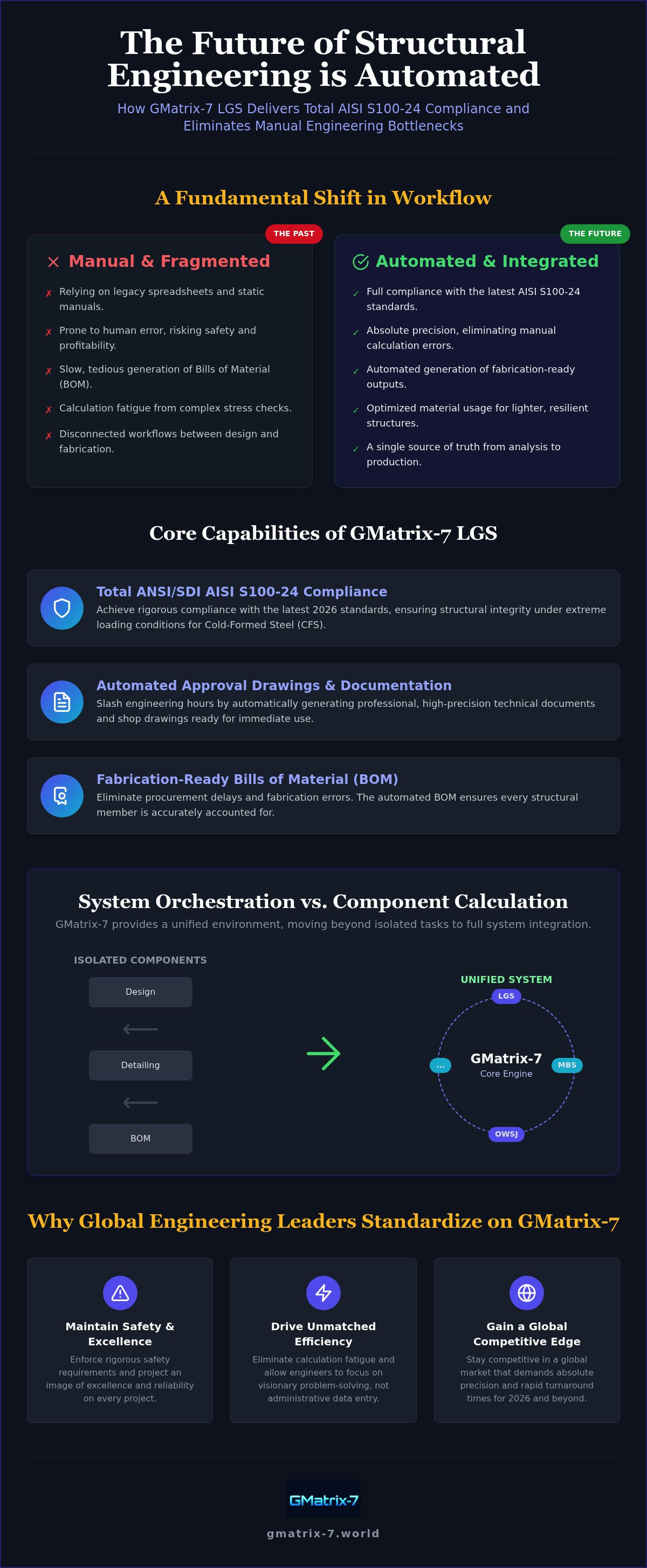
- Transition from isolated component design to full system orchestration by integrating LGS, MBS, and OWSJ modules within a single, unified engineering environment.
- Eliminate procurement delays and fabrication errors through automated Bills of Material (BOM) that ensure every structural member is accurately accounted for.
- Understand why global engineering leaders standardize on battle-tested automation to maintain safety, excellence, and a competitive edge in 2026.
What Defines a Professional AISI Structural Design Tool?
An AISI structural design tool is a software solution that automates Cold-Formed Steel (CFS) engineering according to American Iron and Steel Institute standards. Beyond simple math, a professional-grade platform serves as the essential bridge between theoretical structural standards and practical fabrication requirements. It must rigorously automate the complex design provisions found within the AISI S100 Specification, ensuring every member meets the highest safety criteria. High-performance engineering requires more than just checking a box; it demands a tool capable of executing sophisticated braced and unbraced moment, shear, web-crippling, and axial strength calculations.
The Role of AISI S100 in Modern Structural Engineering
The transition to the ANSI/SDI AISI S100-24 standard represents a significant shift in how the industry approaches cold-formed steel. This standard, now maintained by the Steel Deck Institute, enforces rigorous safety requirements that protect structural integrity under extreme loading. Modern 2026 standards prioritize material optimization, allowing engineers to achieve lighter, more resilient structures without sacrificing security. Software-driven compliance is now a necessity. Complex loading conditions, such as seismic or high-wind scenarios, require data-driven precision that manual processes simply cannot provide with consistency.
From Manual Standards to Automated Engineering Outputs
Relying on static manuals or disconnected spreadsheets is a liability for multi-story LGS projects. Manual methods are slow and prone to human error, particularly when managing stress checks and combined interaction analysis across thousands of components. Automation transforms this workflow by moving from component-level math to comprehensive system-level structural integrity. A professional AISI structural design tool ensures that every input leads to a streamlined, high-value output. This transition provides several critical advantages:
- Elimination of calculation fatigue: Automated engines handle repetitive, complex algorithms with absolute accuracy.
- Optimized material usage: Precision engineering allows for thinner gauges where appropriate, reducing total project costs.
- Seamless data flow: Analysis results move directly into detailing and fabrication phases, maintaining a single source of truth.
Standardizing on a battle-tested automation platform allows firms to project an image of excellence and reliability. By removing the friction between design theory and physical production, engineers can focus on visionary problem-solving rather than administrative data entry. This efficiency is the hallmark of a world-class structural engineering firm.
Core Capabilities of the GMatrix-7 LGS Structural Design Module
GMatrix-7 LGS (AISI) represents a paradigm shift in cold-formed steel engineering. It provides a robust framework for managing the intricacies of light gauge steel framing, offering comprehensive support for studs, tracks, and sophisticated built-up sections. This isn't a simple calculator; it's a high-performance engine that integrates AISI S100-16 and IBC structural design requirements directly into your workflow. By automating the generation of professional approval drawings and technical documentation, the system ensures that engineering intent is perfectly preserved from the first stress check to the final fabrication stage.
Precision Detailing for Light Gauge Steel Systems
Accuracy in structural modeling defines project success. GMatrix-7 generates precise geometric models for complex LGS framing configurations, ensuring that every nested stud and back-to-back section is engineered for optimal performance. This automation accelerates the fabrication phase by producing shop drawings that are ready for immediate use. These documents eliminate the ambiguity often found in manual detailing, providing clear instructions for the shop floor. When you standardize your detailing workflow, you eliminate the friction that typically slows down large-scale CFS projects. The software handles the heavy lifting of geometric modeling, allowing your team to focus on high-level design optimization.
Advanced Load Table Generation for Panels and Decks
Engineering modern building envelopes requires a deep understanding of material capacity under varying span conditions. GMatrix-7 provides advanced load capacity analysis for both single skin and sandwich panel systems. This capability is particularly valuable for those utilizing a composite deck load table generator, as it removes the need for tedious manual data entry. The software calculates structural deck load capacity with data-driven precision, allowing engineers to provide high-value, optimized solutions to their clients. This methodical approach ensures that every panel meets safety standards while minimizing material waste and maximizing structural resilience.
The platform's ability to handle complex loading scenarios, including web-crippling and combined interaction analysis, positions it as the premier AISI structural design tool for the modern era. It moves beyond isolated component design to provide a holistic view of structural integrity. This ensures that every project, whether a single-story warehouse or a multi-story LGS facility, benefits from world-class engineering standards. By leveraging this level of automation, firms can deliver superior results that are both safe and economically viable, maintaining a competitive edge in a demanding global market.
System Orchestration vs. Component Calculation: The GMatrix-7 Advantage
Most engineering software functions as a sophisticated calculator, focusing on the capacity of a single stud or joist in isolation. GMatrix-7 LGS (AISI) breaks this mold by prioritizing system orchestration over isolated component analysis. It manages the entire structural building system, ensuring that every load path is accounted for across the entire assembly. This data-driven architecture positions the platform as a high-level consultant rather than a mere utility, making it the definitive AISI structural design tool for firms that value precision. It doesn't just provide answers; it provides optimized structural solutions based on rigorous, real-world parameters.
Integrating MBS and LGS for Comprehensive Project Management
Seamless project management requires a unified engineering environment where different framing types coexist. The MBS IBC design software module within GMatrix-7 complements LGS design by allowing engineers to handle Metal Building Systems and Light Gauge Steel simultaneously. This integrated approach eliminates the friction often found when jumping between siloed tools. When structural parameters are modified, the system's reactive logic triggers updates across the entire model. You won't have to manually re-check every connection when a load changes because the software handles the ripple effect automatically. This ensures total structural compliance across various framing types, maintaining a single source of truth from the foundation to the roof. It's a level of coordination that traditional component-focused software simply cannot match.
The ROI of System-Level Engineering Automation
Efficiency translates directly to the bottom line, and siloed tools are a drain on resources. Manual data transfer between disconnected programs increases the likelihood of human error and extends engineering hours unnecessarily. GMatrix-7 slashes this time investment through deep, multi-module integration. By leveraging a unified AISI structural design tool, you eliminate the risk of mismatched data between different framing modules. High-precision detailing also quantifies a significant reduction in material waste, as every member is optimized for its specific role in the system. This is why professional structural design automation is becoming the standard for world-class entities that prioritize excellence. The platform ensures that your engineering outputs are not just compliant, but are also commercially optimized and ready for immediate fabrication.
Standardizing on a system that manages MBS, OWSJ, and LGS modules concurrently provides an unmatched competitive edge. It allows your firm to take on more complex, high-value projects with a smaller, more focused team. By automating the technical minutiae, you empower your engineers to focus on visionary design and safety rather than administrative data entry. This transition from calculation to orchestration is the key to thriving in the 2026 structural engineering landscape.
Optimizing Your Engineering Workflow with Automated BOMs
Engineering excellence requires more than valid math. It demands a workflow that translates structural intent into physical inventory without the risk of human error. Most firms lose significant time in the gray zone between design finalization and material procurement. A professional AISI structural design tool must close this gap by ensuring the transition from analysis to procurement is seamless and error-free. By generating material lists directly from the design model, you eliminate the delays associated with manual data entry and mismatched specifications. This methodical approach ensures that every light gauge steel (LGS) member is accounted for long before the first truck arrives at the site.
Step 1: Parametric Input and AISI Analysis
Precision begins with the rigorous setup of project parameters within the GMatrix-7 / LGS (AISI) module. The system allows engineers to define complex geometric constraints and material properties with absolute confidence. Once the inputs are established, the engine runs automated stress checks against the current ANSI/SDI AISI S100-24 standards. This process validates span and loading conditions for total structural safety, identifying potential failures before they become costly field issues. By leveraging a sophisticated AISI structural design tool, you ensure that your structural resilience is backed by data-driven analysis rather than conservative, manual approximations.
Step 2: Generating Approval Drawings and Material Lists
Once the analysis is complete, the focus shifts to technical documentation and procurement. GMatrix-7 provides one-click generation of technical approval drawings, allowing project stakeholders to review and sign off on designs with speed. These drawings are not mere sketches; they are detailed engineering outputs that can be customized to meet specific local building code requirements. GMatrix-7's automated BOM feature eliminates the manual tallying of steel members, directly impacting project timelines. These comprehensive material lists are exported for immediate use by fabrication teams, ensuring that procurement is based on the exact requirements of the engineered model.
Efficiency is the ultimate driver of profitability in high-stakes structural engineering. When your software handles the administrative burden of material counting and drawing generation, your engineers are free to focus on optimizing the building system. This level of automation provides the peace of mind that comes from knowing your project is both safe and commercially lean. To see how this automation can transform your next project, explore the full capabilities of our automated material lists. By standardizing these outputs, you project an image of world-class expertise and reliability to every client and partner involved in the project.
Why Global Engineering Leaders Standardize on GMatrix-7 LGS
Global leadership in structural engineering isn't achieved by accident. It requires a relentless commitment to precision and the adoption of technologies that can withstand the rigors of high-stakes infrastructure. GMatrix-7 LGS (AISI) has emerged as the definitive choice for firms that refuse to settle for the limitations of component-level software. While competitors often focus on isolated framing elements, this platform provides a battle-tested, globally minded solution that integrates the complexities of modern engineering into a unified workflow. It offers a level of reliability and security that manual tools simply cannot replicate.
Authoritative Expertise in Cold-Formed Steel Design
Standardizing on LGS structural design software allows firms to leverage the specialized knowledge of Dr. Simon B. and the GMatrix-7 team. This isn't just a utility; it's a partnership with a visionary developer that understands the practical hurdles of structural design. The platform acts as a high-level consultant, providing a data-driven architecture that ensures consistent project quality across international borders. By choosing this AISI structural design tool, engineering leaders gain access to a solution that is both a guardian of safety and a driver of industrial progress. It balances formal sophistication with an earnest commitment to excellence, creating a voice that is both cutting-edge and deeply dependable.
Securing the Future of Structural Engineering in 2026
The complexity of global infrastructure projects continues to accelerate. As we move through 2026, the ability to adapt to evolving standards such as SJI, IBC, and the latest ANSI/SDI AISI S100-24 specifications is a competitive necessity. Firms that rely on fragmented workflows risk obsolescence in a market that demands rapid, error-free execution. Automation is the only viable path forward for entities that value excellence above all else. GMatrix-7 provides the peace of mind required to tackle ambitious projects, knowing that every calculation is backed by the industry's most advanced AISI structural design tool. It transforms technical complexity into streamlined simplicity, allowing you to focus on high-level achievement.
Excellence is a choice. World-class entities standardize on GMatrix-7 because it delivers the precision, speed, and global compliance required to lead the industry. Secure your firm's future and eliminate the risks of manual detailing. Standardize your LGS workflow with GMatrix-7 and experience the pride of high-level achievement in every project you deliver.
Lead the Future of Structural Engineering with Precision Automation
The landscape of cold-formed steel design is shifting toward total system orchestration. Relying on an advanced AISI structural design tool is no longer just an option for firms seeking excellence; it's a fundamental requirement for global competitiveness. By integrating automated BOM generation and approval drawings into your workflow, you eliminate the risks of manual detailing and secure a significant commercial advantage. GMatrix-7 LGS provides the industry-leading AISI S100 compliance automation that world-class entities demand.
As a winner of the 2024 Structural Engineering Innovation Awards, this platform bridges the gap between theoretical standards and high-precision fabrication. It's time to move beyond isolated component calculations and embrace a unified engineering environment that delivers absolute peace of mind. You have the opportunity to redefine your firm's capabilities and set a new standard for structural resilience. Scale Your Engineering Precision with GMatrix-7 LGS today and project an image of world-class expertise in every project you deliver.
Frequently Asked Questions
What is an AISI structural design tool?
An AISI structural design tool is a specialized software solution that automates the engineering of Cold-Formed Steel (CFS) according to the American Iron and Steel Institute standards. It executes complex algorithms for moment, shear, web-crippling, and axial strength calculations. This automation allows engineers to move beyond manual spreadsheets, ensuring that every structural member meets rigorous safety and performance criteria in a fraction of the time.
How does GMatrix-7 ensure compliance with AISI S100-16?
GMatrix-7 incorporates the specific design provisions of the AISI S100 Specification directly into its calculation engine. The software undergoes continuous updates to reflect the latest industry changes, such as the transition to the ANSI/SDI AISI S100-24 standard. This methodical approach provides engineers with the confidence that their designs are fully compliant with both IBC and AISI requirements, protecting project integrity.
Can GMatrix-7 LGS generate automated Bills of Materials?
Yes, the platform features a robust automated Bill of Material (BOM) generation tool. This feature extracts exact material counts and specifications directly from the engineered model. By eliminating manual tallying, it prevents the procurement errors that often lead to project delays. Every LGS member is accounted for with data-driven precision, ensuring a seamless transition from the design phase to the fabrication floor.
Does the software support multi-story light gauge steel framing?
The software is specifically designed to handle the complexities of multi-story light gauge steel framing systems. It manages system-level structural integrity by analyzing how loads interact across various levels and components. This capability allows engineering firms to take on ambitious, high-rise LGS projects with absolute certainty in their structural safety. It moves beyond simple component checks to orchestrate the entire building system.
How does the LGS module integrate with MBS and OWSJ modules?
Integration is achieved through a unified engineering environment that allows the simultaneous design of LGS, MBS, and OWSJ modules. When structural parameters are modified in one area, the system's reactive logic updates the entire project in real-time. This orchestration reduces friction between different framing types. It ensures that all structural modules remain synchronized, maintaining a single source of truth throughout the engineering workflow.
What types of approval drawings can GMatrix-7 LGS generate?
GMatrix-7 LGS generates professional technical approval drawings and fabrication-ready shop drawings with a single click. These outputs include detailed geometric models and technical documentation required for project stakeholders. The software allows for customization to meet specific local building code requirements. This ensures that every drawing provides clear, authoritative instructions that accelerate the approval and fabrication phases of a project.
Is GMatrix-7 suitable for international structural design standards?
GMatrix-7 is a world-class entity designed for global engineering leaders who work across diverse jurisdictions. The platform is battle-tested and incorporates international standards including SJI, IBC, and AISI. This globally minded architecture makes it an ideal partner for firms handling infrastructure projects that require rigorous, multi-standard compliance. It provides a stable and technologically advanced foundation for engineers operating in any market.
How does automated detailing reduce material waste in LGS projects?
High-precision detailing reduces material waste by calculating the exact capacity required for each structural member. Rather than relying on conservative approximations, this AISI structural design tool identifies opportunities for material optimization. This process ensures that members aren't over-engineered, which slashes total material costs. It delivers a commercially lean structural solution that maintains the highest levels of safety and excellence.


