
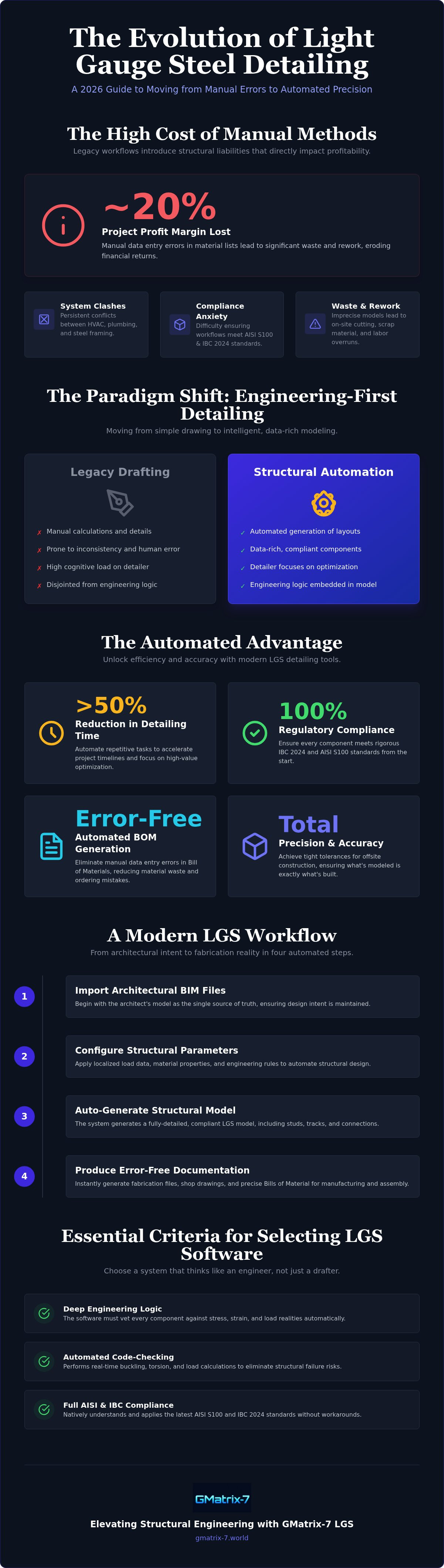
Manual data entry errors in material lists aren't just a minor technical inconvenience; they're a structural liability that can erode project profit margins by nearly 20 percent through waste and rework. You likely recognize the persistent frustration of managing clashes between HVAC systems and steel framing or the anxiety of ensuring your current workflow meets the rigorous AISI S100-16(2020) supplements. In a high-stakes industry where precision is the only currency, relying on legacy drafting methods is no longer a viable strategy for growth.
We've designed this guide to help you transition from manual bottlenecks to high-velocity, automated light gauge steel detailing tools that ensure 100 percent compliance with IBC 2024. By integrating advanced engineering engines into your process, you'll eliminate human error and secure the peace of mind that comes with absolute technical accuracy. It's time to move beyond simple drawing aids and embrace integrated systems that bridge the gap between architectural intent and fabrication reality.
This comprehensive 2026 guide examines the latest advancements in LGS technology, including GMatrix-7's specialized structural modules and automated Bill of Material generation. You'll discover how to reduce detailing time by over 50 percent while generating error-free documentation that streamlines the entire construction lifecycle. We provide a methodical breakdown of the tools and strategies required to dominate the modern steel framing market.
Key Takeaways
- Understand why modern light gauge steel detailing tools must move beyond traditional CAD to ensure full compliance with AISI S100 and IBC 2024 standards.
- Learn to automate the transition from architectural BIM files to structural models by configuring parameters based on localized load data.
- Discover how automated Bill of Material (BOM) generation eliminates manual data entry errors and significantly reduces material waste.
- Explore the integration of specialized LGS structural design modules to bridge the gap between engineering logic and final fabrication.
- Master the specific strategies required to reduce detailing time by over 50 percent while maintaining 100 percent regulatory compliance.
The Paradigm Shift in Light Gauge Steel Detailing Tools
LGS detailing acts as the vital bridge between architectural vision and the roll-forming machine. It's the point where abstract designs transform into manufacturable components. While traditional CAD software served the industry for decades, it's no longer sufficient for the complexities of modern cold-formed steel frames. Modern requirements demand a move away from generic drafting toward specialized light gauge steel detailing tools that embed engineering logic directly into every model.
A decisive shift toward an "Engineering-First" detailing philosophy defines the 2026 industry landscape. This approach ensures that every stud, track, and gusset isn't just a geometric shape but a data-rich entity compliant with AISI S100-16(2020) standards. By integrating structural analysis within the detailing phase, firms achieve a triple-threat advantage: accelerated project timelines, absolute dimensional accuracy, and guaranteed regulatory compliance.
From Manual Drafting to Structural Automation
The evolution from 2D manual drafting to structural automation represents a fundamental leap in productivity. Legacy workflows relied on drafters to manually calculate spacing and connection details; this process was prone to inconsistency and material waste. Advanced light gauge steel detailing tools now automate these repetitive tasks. They generate complex wall layouts and truss configurations based on predefined structural parameters, ensuring that every component fits perfectly the first time. This automation removes the cognitive load from the detailer, allowing them to focus on optimization rather than manual data entry.
Why Precision is Non-Negotiable in 2026
Precision is the cornerstone of offsite construction. Because LGS components are often pre-assembled in controlled factory environments, even a minor discrepancy can cause cascading failures during on-site erection. Detailing software eliminates these risks by maintaining tight tolerances across the entire building envelope. This level of accuracy provides several critical benefits:
- Automated Opening Adjustments: Detailing tools prevent the costly resizing of door and window openings by accounting for exact material thicknesses.
- Waste Mitigation: Precise modeling links directly to fabrication, which eliminates on-site cutting and reduces material scrap.
- Labor Efficiency: Error-free kits arrive on-site ready for assembly, which slashes labor hours and simplifies the construction sequence.
High-velocity detailing ensures that what's modeled is exactly what's built. It secures the financial health of the project by removing the guesswork that often plagues traditional construction methods.
Essential Criteria for Selecting AISI-Compliant Software
Selecting superior light gauge steel detailing tools requires a shift in perspective. You shouldn't settle for a tool that merely visualizes geometry; you need a system that thinks like an engineer. The primary criterion for any professional-grade software is the deep integration of LGS structural design software logic. This ensures that every member added to the model is automatically vetted against the physical realities of stress and strain before it ever reaches the factory floor.
In 2026, the baseline requirement for industry leaders is absolute compliance with the latest AISI Design Standards and the IBC 2024 code. Modern projects involve increasingly complex loading conditions, from high-velocity wind zones to significant seismic requirements. Your chosen software must demonstrate the capability to handle these variables without resorting to external spreadsheets or manual overrides. A seamless user interface that facilitates the handoff between the engineering phase and the detailing phase is essential for maintaining project momentum and reducing communication errors.
Navigating AISI S100 Structural Design Standards
Automated code-checking is the hallmark of a world-class detailing environment. When your software performs real-time buckling and torsion calculations, it eliminates the risk of structural failure during the design phase. Cold-formed steel is uniquely susceptible to local, distortional, and global buckling. Therefore, your tool must apply the Direct Strength Method (DSM) accurately across all member types. Utilizing a dedicated AISI structural design tool within your detailing workflow ensures that every connection meets the rigorous safety margins required for modern certification. This level of technical depth provides the security needed for high-stakes commercial developments.
Automated Approval Drawing Generation
The speed of a project often hinges on the efficiency of the approval process. Professional-grade light gauge steel detailing tools must automate the creation of technical documentation, including plan views, elevations, and intricate connection details. This automation isn't just about drawing lines; it's about extracting data-rich section views directly from the structural model to ensure consistency.
When your software generates "seal-ready" calculations and drawings, you bypass the traditional bottlenecks of the engineering review. This capability allows for a rapid transition from design to fabrication, ensuring that your production schedule remains on track. For firms looking to optimize this specific workflow, implementing a high-performance structural design module can reduce the documentation cycle by several weeks. This efficiency isn't just a convenience; it's a competitive necessity in an industry that prizes speed and accuracy above all else.
A Step-by-Step Guide to Automating LGS Workflows
High-velocity detailing begins with the seamless ingestion of architectural BIM or CAD data to establish a precise geometric foundation. Once the geometry is finalized, you must configure structural parameters based on localized IBC 2024 load data, including specific wind, snow, and seismic variables. This step ensures the model isn't just a visual representation but a fully compliant structural assembly. Deploying advanced light gauge steel detailing tools at this stage allows you to refine wall panels and trusses through optimized member selection. This process significantly reduces total steel tonnage while maintaining the rigorous safety margins required for modern commercial certification.
Integrating Architectural Inputs with Engineering Logic
Adapting architectural wall layouts for steel framing requires a methodical, data-driven approach. You don't just trace existing lines; you map specific wall finishes to panel placement within the software to account for exact material thicknesses. Modern detailing environments automate the management of floor elevation changes and lintel height adjustments. This capability eliminates the manual recalculations that frequently lead to on-site assembly errors. By linking architectural intent directly to engineering logic, you create a stable data pipeline that supports rapid project scaling and ensures that every component is structurally sound from the outset.
Advanced Collision Testing and Error Mitigation
Identifying clashes before fabrication is a critical requirement for maintaining project profitability. Automated collision testing identifies conflicts between plumbing, HVAC ductwork, and structural steel framing. This proactive detection prevents the expensive field modifications that often delay traditional construction workflows. 3D visualization enables you to verify complex roof configurations and intricate stairwells with absolute certainty, ensuring that tight tolerances are maintained throughout the building envelope.
Refine your model further through automated tolerance checks for jambs and sills. This ensures that every pre-fabricated kit fits its designated rough opening perfectly. Once the model passes these rigorous internal audits, you can export production-ready files directly to your roll-forming equipment. This streamlined sequence transforms complex inputs into high-precision structural components with minimal human intervention. Utilizing sophisticated light gauge steel detailing tools provides the reliability and peace of mind needed to guarantee that what is modeled is exactly what is manufactured.
Maximizing Efficiency with Automated Documentation and BOMs
Manual counting is a relic of an inefficient era that the modern industry has outgrown. High-performance light gauge steel detailing tools have transformed the transition from shop drawings to the Bill of Materials (BOM) into a seamless, data-driven event. This shift ensures that every piece of steel modeled is accounted for with absolute certainty. By automating this documentation, firms eliminate the risk of human error during the estimation phase and prevent the material over-ordering that frequently erodes profit margins. It's a fundamental change that moves the detailing department from a cost center to a driver of precision procurement.
The Power of the Automated Bill of Materials (BOM)
Precision in procurement is non-negotiable for commercial success. A modern, automated BOM captures granular data points, including gauge, exact length, and precise quantity for every structural member. These lists sync directly with inventory management systems, which allows for real-time tracking and procurement optimization. In large-scale Metal Building System (MBS) projects, this level of accuracy is the difference between a streamlined assembly and a stalled site. When your detailing environment generates these lists automatically, you secure a level of operational reliability that manual drafting simply cannot match. It ensures that your fabrication team receives exactly what they need, exactly when they need it.
Generating Precise Load Tables for LGS Panels
Beyond simple member lists, advanced detailing tools must address the structural performance of specific panel assemblies. These systems calculate load capacities for single skin and sandwich panels with rigorous precision, ensuring that each component performs as intended under stress. The integration of a composite deck load table generator is vital for designers working with multi-story LGS frames. These tools ensure that structural deck load capacity meets localized building codes, providing the necessary validation for complex commercial applications. This data-driven approach removes the ambiguity from panel selection and ensures that every assembly is optimized for its specific structural role.
Achieving this level of technical sophistication is central to professional structural design automation and its impact on long-term project profitability. It's about moving from a reactive drafting posture to a proactive engineering stance that prioritizes data integrity. For those ready to eliminate waste and secure their supply chain, implementing automated Bill of Material generation is the logical next step toward total project control.
Elevating Structural Engineering with GMatrix-7 LGS
GMatrix-7 represents the definitive standard for high-velocity structural design and detailing. It's not just another software package; it's a comprehensive engineering engine designed to dominate the modern market. Its specialized LGS (AISI) module is the benchmark for light gauge steel detailing tools, providing a direct, unshakeable link between complex engineering logic and manufacturing precision. By consolidating the entire workflow into a single, high-performance platform, fabricators can generate professional approval drawings in nearly half the time required by traditional, fragmented methods. This speed is a result of optimization, not shortcuts, ensuring every structural output is fundamentally stable and globally compliant.
The GMatrix-7 Advantage: Beyond Detailing
The platform automates the entire engineering documentation lifecycle, moving far beyond the limitations of basic drafting. It serves as a unified source of truth for LGS, Open Web Steel Joists (OWSJ), and Metal Building Systems (MBS). This integration is critical for large-scale commercial projects where coordination between different structural elements often fails under pressure. GMatrix-7 provides unrivaled MBS IBC design software integration, which allows engineers to manage multifaceted structural inputs from a single, sophisticated interface. Recognized with industry awards in 2024 for technical excellence, the software provides the battle-tested reliability required for international fabricators scaling their operations across diverse jurisdictions. You don't just get a tool; you get a partner in industrial progress.
Future-Proofing for 2026 and Beyond
Structural standards are not static; they're constantly shifting to accommodate new safety data and material innovations. GMatrix-7 maintains its leadership position by staying ahead of evolving AISI S100 and SJI requirements. Automated updates ensure that your detailing environment always reflects the latest regulatory shifts, maintaining 100 percent structural compliance without the need for manual intervention. This proactive approach protects your firm from the significant liabilities associated with outdated codes and ensures that your designs remain world-class. It's a stable foundation for a visionary future. Don't let legacy systems hold back your production capacity. Explore GMatrix-7 LGS Solutions today to secure your competitive edge and lead the industry into 2026 and beyond.
Dominating the Future of LGS Construction
The transition from manual drafting to structural automation isn't just a technical upgrade; it's a strategic necessity for firms that value precision and profitability. You've seen how modern light gauge steel detailing tools eliminate the inconsistencies that plague traditional workflows. By prioritizing AISI S100 and IBC 2024 compliance, you protect your firm from structural liabilities and ensure seamless project approvals. Automated Bill of Materials generation and precision load table calculations turn complex data into actionable fabrication instructions, which reduces on-site waste and slashes labor hours.
Don't let legacy methods compromise your competitive edge in an increasingly digitized market. GMatrix-7 provides the authoritative platform required to manage the entire engineering lifecycle with absolute confidence. It's time to embrace a system that delivers results-oriented performance and peace of mind. Streamline your LGS engineering with GMatrix-7 today. Your commitment to excellence deserves a tool that's as ambitious as your vision. Success in 2026 belongs to those who prioritize technical superiority.
Frequently Asked Questions
What are light gauge steel detailing tools used for?
Light gauge steel detailing tools are used to transform architectural designs into precise, manufacture-ready structural components. These sophisticated systems manage the creation of wall panels, roof trusses, and floor joists by embedding engineering logic into geometric shapes. They ensure that every member is correctly sized and placed for the roll-forming process, effectively bridging the gap between digital models and physical construction while maintaining absolute dimensional accuracy.
How do automated LGS tools ensure AISI S100 compliance?
Automated tools ensure AISI S100 compliance by performing real-time structural analysis using the Direct Strength Method (DSM). These systems automatically calculate local, distortional, and global buckling for cold-formed steel members throughout the modeling process. By vetting every design against the latest 2020 supplements, the software guarantees that all structural outputs meet rigorous safety margins before any technical drawings are issued for professional approval.
Can detailing software generate a Bill of Materials automatically?
Yes, professional-grade detailing software extracts data directly from the 3D structural model to generate a comprehensive Bill of Materials (BOM) automatically. This process captures granular details such as gauge, length, and quantity for every member in the assembly. By removing manual counting, these tools eliminate human error and prevent material over-ordering, which directly protects project profit margins and optimizes the procurement cycle.
What is the difference between CAD and specialized LGS detailing software?
Traditional CAD focuses on generic 2D or 3D geometry, whereas specialized light gauge steel detailing tools integrate structural engineering logic directly into the modeling environment. While CAD requires manual calculation for every stud and track, specialized software automates panel layouts and connection details based on IBC 2024 standards. This automation allows for faster iterations and ensures that the final model is structurally sound and ready for fabrication.
How does collision testing work in light gauge steel framing software?
Collision testing identifies physical overlaps between structural steel framing and other building systems, such as plumbing or HVAC ductwork, within a 3D environment. The software scans the entire model to flag "clashes" where MEP runs intersect with studs or joists. This proactive detection allows detailers to adjust framing layouts before fabrication, preventing the expensive field modifications and delays that occur when systems conflict on-site.
Is it possible to generate load tables for composite decks using these tools?
It's possible to generate load tables for composite decks and sandwich panels when using advanced structural modules. These tools calculate specific load-bearing capacities for various spans and configurations, ensuring compliance with localized building codes. This capability removes the need for external spreadsheets and provides engineers with precise data for single skin or composite assemblies, ensuring the structural integrity of complex multi-story LGS frames.
How does GMatrix-7 improve structural engineering productivity?
GMatrix-7 improves productivity by consolidating structural design, detailing, and documentation into a single, high-performance platform. It automates the generation of approval drawings and material lists, which reduces traditional workflow timelines by over 50 percent. By providing a unified source of truth for LGS, OWSJ, and MBS, it eliminates data silos and allows engineering teams to focus on optimization rather than repetitive manual data entry tasks.


