

In an era where the pre-engineered metal building market is surging toward a $47.9 billion valuation, the industry's greatest bottleneck isn't material supply; it's the fragmentation of data. You likely recognize the high cost of discovering a discrepancy between an engineering drawing and a shop fabrication list after production begins. These manual entry errors in your Bill of Materials (BOM) don't just delay projects. They erode profit margins and stall approval cycles when you can least afford it.
Integrating MBS design with fabrication software is no longer a luxury for the technologically curious; it's a fundamental requirement for maintaining global structural standards and operational excellence. This guide provides the definitive roadmap to mastering this transition. We'll examine how advanced automation enables error-free BOM generation, accelerates your drawing cycles, and ensures total IBC compliance through 2026 and beyond. By the end of this guide, you'll have the technical framework to transform your workflow from a series of disconnected steps into a singular, high-velocity engine of precision.
Key Takeaways
- Eliminate the high cost of translation errors by bridging the historical gap between structural design intent and shop-ready fabrication instructions.
- Accelerate your project timelines by integrating MBS design with fabrication software to produce error-free Bill of Materials and automated approval drawings.
- Gain a competitive edge by utilizing specialized detailing modules for AISI and IBC standards that provide superior accuracy over generic BIM workflows.
- Master the automated generation of precise load tables for single skin, sandwich panels, and composite decks to ensure total structural compliance.
- Transition from manual documentation to professional structural design automation to optimize material usage and meet 2026 engineering standards.
The Engineering-to-Fabrication Gap in Metal Building Systems
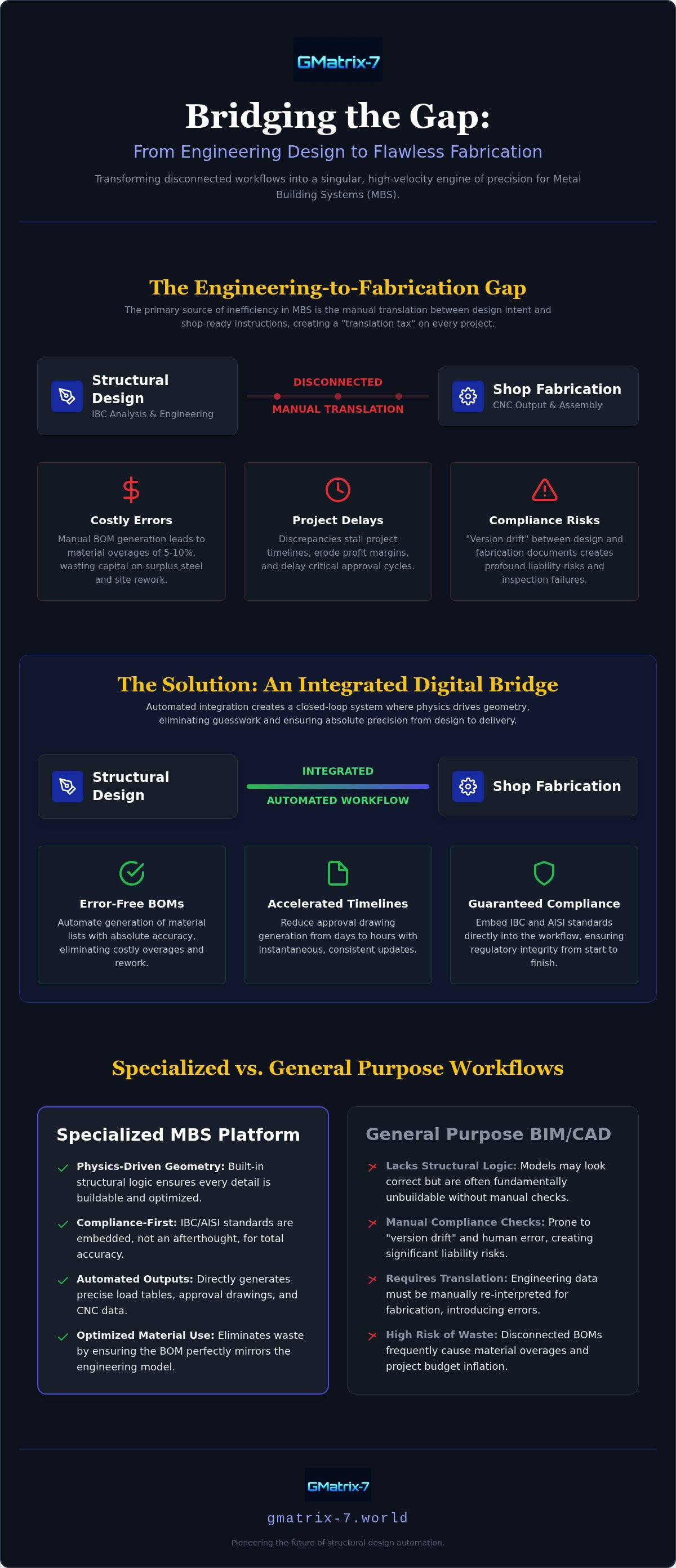
The disconnect between a structural engineer’s intent and the fabricator’s reality remains the primary source of inefficiency in Metal Building Systems (MBS). Historically, this gap required manual translation, a process where complex engineering drawings are re-interpreted into shop instructions. This manual intervention introduces a "translation tax" on every project, manifesting as lost time and compromised accuracy. Integrating MBS design with fabrication software serves as the vital digital bridge between rigorous IBC structural analysis and high-precision, CNC-ready output. Relying on general-purpose CAD tools often fails because these platforms lack the specialized structural logic required to maintain integrity during the detailing phase. General CAD cannot interpret the specific load paths or connection requirements inherent in MBS, leading to structural models that look correct but are fundamentally unbuildable.
The Cost of Manual Material Lists
Manual generation of a Bill of Materials (BOM) is a high-risk activity that frequently results in material overages of 5% to 10%. These discrepancies aren't merely administrative errors; they represent significant wasted capital in the form of surplus steel and hundreds of hours in site rework. When a fabrication list doesn't perfectly mirror the engineering model, the resulting friction stalls project timelines and inflates budgets. By integrating MBS design with fabrication software, firms can automate the generation of BOMs, ensuring that every bolt, plate, and member is accounted for with absolute accuracy. In 2026, this level of automated documentation is essential for firms seeking to maintain profitability and professional standards.
Regulatory Hurdles in Design Synchronization
Maintaining IBC 2024 compliance across multiple software platforms presents a significant challenge for modern engineering firms. Without a synchronized data flow, "version drift" becomes inevitable. This occurs when the structural documentation used for fabrication no longer matches the approved engineering analysis. This misalignment creates profound liability risks and leads to costly delays during the inspection phase. A "compliance-first" integration strategy solves this by embedding regulatory standards directly into the data transfer process. By utilizing specialized modules like GMatrix-7 / MBS (IBC), engineers ensure that every detail remains compliant with global standards from the initial design through to the final shop drawing. This synchronization provides:
- Real-time updates to structural documentation that reflect the latest design changes.
- Elimination of manual entry errors in regulatory reporting and material certifications.
- Verified compliance with the latest AISI and IBC revisions throughout the fabrication cycle.
This automated approach secures the project’s integrity. It moves the workflow from a fragmented series of tasks to a unified, data-driven process that prioritizes safety and excellence.
Mechanisms of Automated MBS Design Integration
Integrating MBS design with fabrication software requires a sophisticated algorithmic handshake between structural analysis and geometric detailing. Instead of a linear hand-off, GMatrix-7 utilizes specialized modules for MBS (IBC) and LGS (AISI) to ensure that every structural input directly dictates the fabrication output. This eliminates the guesswork. When an engineer defines a load case within the IBC-compliant module, the software automatically maps those forces to member sizing and connection detailing. It’s a closed-loop system where physics drives the geometry. These modules are specifically engineered to handle the nuances of metal building design, such as cold-formed steel behavior and complex rigid frame interactions. This direct mapping ensures that connections aren't just "standard" but are optimized for the specific stresses calculated during analysis. It provides a level of security that generic BIM tools simply cannot match.
From IBC Analysis to Approval Drawings
Speed is the primary metric of success here. Traditional drafting methods often take days to finalize a set of professional approval drawings. Automation reduces this timeline to mere hours. Because the system is built on unified data, it maintains absolute consistency across every elevation, plan, and section. If a frame spacing changes in the design module, the approval drawings reflect that update instantaneously. This responsiveness ensures your project moves through the review phase without the friction of "stale" data or conflicting views. You gain peace of mind knowing that what the client approves is exactly what the engineering logic supports. For firms looking to optimize their technical output, exploring GMatrix-7 / MBS (IBC) offers a proven path to high-velocity project delivery.
Automating the Bill of Materials (BOM)
Precision in procurement is the final frontier of efficiency. Automated Bill of Material generation tracks every nut, bolt, and panel with granular detail. The software extracts data directly from the 3D detailing engine, feeding it into fabrication software without manual re-entry. This direct feed significantly reduces procurement errors that often lead to site shortages or expensive over-ordering. By integrating MBS design with fabrication software, you secure a reliable data stream that informs your entire supply chain. The logic of automated material list generation accounts for complex geometries, such as tapered members and varying panel profiles, ensuring the shop floor receives perfect instructions every time. This automation goes beyond simple counting; it categorizes materials by phase and assembly, facilitating a streamlined fabrication sequence that minimizes downtime.
Specialized Detailing vs. General BIM Workflows
General BIM suites offer a broad approach to infrastructure lifecycle management, yet they often lack the granular logic required for complex metal building systems. While a "one-size-fits-all" model might suffice for standard commercial frames, it falters when faced with the specific detailing requirements of tapered members or cold-formed sections. Integrating MBS design with fabrication software allows engineers to bypass the bloated complexity of generic CAD. Specialized platforms outperform general BIM by embedding structural rules directly into the geometric engine. This ensures that every millimeter of the model respects the physical limits of the material. In 2026, the debate between manual calculation and automated efficiency has been settled by the sheer volume and complexity of modern projects. Relying on manual checks in a generic environment is a liability that high-performing firms can't afford.
Precision in Cold-Formed Steel Detailing
Cold-formed steel (LGS) requires strict adherence to AISI S100 standards, which govern the unique buckling and torsional behaviors of thin-walled members. General CAD tools often miss these nuances, treating LGS members as simple extruded shapes. This oversight leads to detailing errors that are only discovered during assembly. By contrast, GMatrix-7 / LGS (AISI) provides an environment where these structural nuances are baked into the workflow. This precision is detailed further in our LGS Structural Design Software documentation, which highlights how automated detailing maintains structural integrity through every phase of the project.
Bar Joist Detailing: Achieving SJI Compliance
For bar joist manufacturers, compliance with SJI 100-2020 standards is non-negotiable. Specialized OWSJ modules provide a significant advantage by automating the complex web and chord configurations that define these structural elements. Generic BIM workflows struggle to manage the variable load requirements and connection types specific to joist girders. Integrating MBS design with fabrication software specifically designed for these standards ensures that every joist produced meets rigorous safety criteria. Errors in bar joist manufacturing are expensive and dangerous; utilizing a SJI compliant joist design guide ensures that your fabrication data is both accurate and reliable. This specialized approach protects the manufacturer's reputation and ensures the safety of the final structure. It moves the production line from reactive error correction to proactive excellence.
Optimizing Load Table Generation for Fabrication
Precision in load table generation is the final step in securing a building’s structural integrity before materials arrive on site. Integrating MBS design with fabrication software ensures that these performance metrics are not just theoretical estimates but are derived directly from the primary structural model. For single skin and sandwich panels, these tables dictate the safe allowable spans and fastening patterns required to withstand environmental stressors. Without this data, fabrication remains a guessing game that risks failure under peak wind or snow loads. Modern engineering demands that this information is embedded within the documentation package, providing a seamless transition from the engineer's desk to the production line.
Composite Deck Load Capacity Calculation
The physics of composite floor deck load tables involves a complex interplay between the steel profile and the concrete slab. Automation eliminates the manual calculation risks that historically plagued structural deck design. We utilize a rigorous 4-step process to generate these tables: first, defining the material properties; second, establishing span conditions; third, applying multi-stage load cases; and fourth, producing localized capacity data. This methodical approach ensures the composite deck load table generator produces data that is both accurate and compliant with global safety standards. It provides the peace of mind that comes from battle-tested engineering logic and removes the potential for human error in high-stakes calculations.
Sandwich Panel and Single Skin Optimization
Calculating load capacities for modern cladding systems requires an uncompromising focus on accuracy; sandwich panel load capacity must account for core shear strength and face buckling to prevent delamination under thermal stress. These load table generators support faster architectural approvals by providing immediate, data-backed evidence of panel performance under specific site conditions. This speed is a commercial necessity in a market projected to reach USD 47.9 billion by the end of 2026. Ensuring that panel fabrication matches structural performance requirements prevents the costly rework associated with under-specified cladding. By integrating MBS design with fabrication software, firms can generate comprehensive load tables that are perfectly synchronized with the building's geometry. To see how these tools can transform your documentation, explore the specialized modules available at GMatrix-7.
Implementing GMatrix-7 for Fabrication Excellence
GMatrix-7 represents the gold standard in specialized metal building engineering. By integrating MBS design with fabrication software, firms move beyond the inherent limitations of generic BIM to achieve a unified, data-driven workflow. Transitioning to professional structural design automation isn't merely a software upgrade; it's a strategic shift toward total operational precision. The financial impact is immediate. Industry data demonstrates that automating the design-to-detailing flow can reduce detailing errors by up to 90%. This massive reduction in discrepancies saves thousands in material waste and prevents the catastrophic site rework that often cripples project profitability. Excellence in 2026 is defined by this ability to move seamlessly from complex engineering analysis to a flawless shop floor execution.
Global Compliance and Global Standards
GMatrix-7's architecture supports IBC, SJI, and AISI requirements simultaneously, providing a robust framework for international projects. This multi-standard capability is essential for firms operating in the competitive global structural market. Being "battle-tested" means our algorithms have already navigated the complexities of diverse regional building codes, including the latest IBC 2024 implementation. Whether you're designing for high-seismic zones or heavy snow loads, the flexible software modules adapt to ensure total compliance. This reliability provides the peace of mind that comes from knowing your engineering logic is inherently secure, globally valid, and rigorously updated to reflect current industrial progress.
Next Steps for Structural Fabricators
Success begins with a thorough audit of your current design-to-fabrication workflow. You must identify the specific points where data is manually re-entered or where "version drift" occurs between engineering and shop drawings. Integrating MBS design with fabrication software allows for the seamless transfer of data into existing ERP or CNC systems, removing the final human-error variable from the production line. This creates a high-performance environment where the structural model directly drives the machinery. It's time to position your business as a guardian of safety and a driver of excellence. Explore GMatrix-7 Structural Modules today to secure your firm's future as a world-class engineering leader. The transition from manual complexity to automated simplicity is the only path to maintaining a competitive edge in an increasingly demanding global market.
Securing the Future of Structural Engineering Excellence
The path to industrial leadership in 2026 requires a definitive departure from fragmented, manual workflows. By integrating MBS design with fabrication software, you establish a rigorous, data-driven environment where structural analysis dictates every shop floor instruction with absolute precision. This integration moves beyond simple connectivity; it embeds global standards like IBC 2024 and SJI 100-2020 directly into your production cycle. You gain the security of automated approval drawing generation and the peace of mind that comes from a significant reduction in detailing errors.
As a global engineering authority, GMatrix-7 provides the specialized modules necessary to transform your technical inputs into high-value, fabrication-ready documentation. Don't let your firm be slowed down by the inefficiencies of general-purpose CAD or manual Bill of Materials generation. It's time to embrace a system built for the uncompromising demands of modern structural excellence and safety. Streamline your structural workflow with GMatrix-7 automation and lead the industry with confidence. The transition to professional automation is your most powerful tool for ensuring long-term commercial success and structural integrity.
Frequently Asked Questions
How does integrating MBS design with fabrication software reduce project costs?
Integrating MBS design with fabrication software reduces costs by eliminating the "translation tax" associated with manual data entry. Automation minimizes material overages, which often reach 5% to 10% in manual workflows, by ensuring the fabrication list perfectly mirrors the engineering analysis. This precision prevents expensive site rework and reduces procurement errors. Faster approval cycles also lower overhead costs, allowing firms to move from design to production with significantly higher capital efficiency.
Can GMatrix-7 modules handle IBC 2024 and SJI 100-2020 standards?
Yes, GMatrix-7 modules are specifically engineered to maintain total compliance with the latest global standards, including IBC 2024 and SJI 100-2020. These modules embed regulatory logic directly into the design process, ensuring that every structural detail respects current safety requirements. This "compliance-first" approach protects your firm from version drift and liability risks. It provides the security needed when navigating the rigorous demands of modern structural engineering and bar joist manufacturing.
What is the difference between general CAD and specialized MBS detailing software?
General CAD tools focus on geometric representation, often lacking the underlying structural logic required for complex metal buildings. Specialized MBS software incorporates physical material properties and engineering rules like AISI S100 directly into the detailing engine. This ensures that LGS and MBS members behave correctly under load. While general BIM can be "overkill" or structurally inaccurate, specialized detailing maintains the integrity of cold-formed sections and tapered members through every phase of the project.
How does automated BOM generation improve accuracy for steel fabricators?
Automated BOM generation improves accuracy by extracting data directly from the 3D structural model without human intervention. This process tracks every nut, bolt, and panel with granular precision, ensuring the shop floor receives perfect instructions. By integrating MBS design with fabrication software, you eliminate the discrepancies that lead to site shortages or costly over-ordering. This direct data feed informs the entire supply chain, facilitating a streamlined fabrication sequence that maximizes production uptime.
Is it possible to generate load tables for sandwich panels and composite decks automatically?
GMatrix-7 features advanced modules designed to generate precise load tables for single skin, sandwich panels, and composite decks automatically. These tools account for complex variables like core shear strength and buckling to ensure total structural compliance. Automating this process removes the risks associated with manual calculations in structural deck design. It provides immediate, data-backed evidence of performance, which significantly accelerates architectural approval cycles and ensures that panel fabrication matches the required structural performance.
How long does it take to implement automated detailing into an existing workflow?
The timeline for implementing automated detailing depends on the complexity of your current design-to-fabrication workflow. The process begins with a comprehensive audit of your existing ERP or CNC systems to identify data fragmentation points. Transitioning to professional structural design automation is a methodical shift that prioritizes accuracy and security. While implementation varies, the result is a high-velocity engine of precision that yields immediate returns by reducing detailing errors and streamlining the engineering-to-shop transition.
Does the software support international structural standards for global projects?
The software provides a robust framework that supports international structural standards, making it ideal for global projects. GMatrix-7 is a global engineering authority with a worldwide scope, offering flexible modules that adapt to regional building codes. Whether your project requires adherence to AISI, SJI, or IBC standards, the software ensures that your engineering logic is globally valid. This battle-tested reliability allows firms to compete effectively in diverse international markets while maintaining the highest safety standards.
What types of approval drawings can be generated automatically?
GMatrix-7 automates the generation of professional approval drawings, including detailed elevations, floor plans, and cross-sections. These drawings are derived directly from the unified structural data, ensuring absolute consistency across every view. Because the system is built on synchronized engineering logic, any design change reflects instantaneously in the documentation. This responsiveness ensures that your submittals are always accurate and move through the review phase without the friction of conflicting data or manual drafting errors.


