

The fastest engineering drawing approval isn't the one that moves the quickest through the queue; it's the one that requires zero revisions. You've likely experienced the mounting frustration of endless back-and-forth between engineers and detailers, where a single manual error in a Bill of Materials (BOM) stalls fabrication and erodes profitability. It's a significant challenge to maintain rigorous 2026 IBC and SJI compliance while project deadlines continue to shrink. Learning how to speed up engineering drawing approval requires a shift from manual oversight to a high-precision, automated framework that embeds structural integrity into the design phase itself.
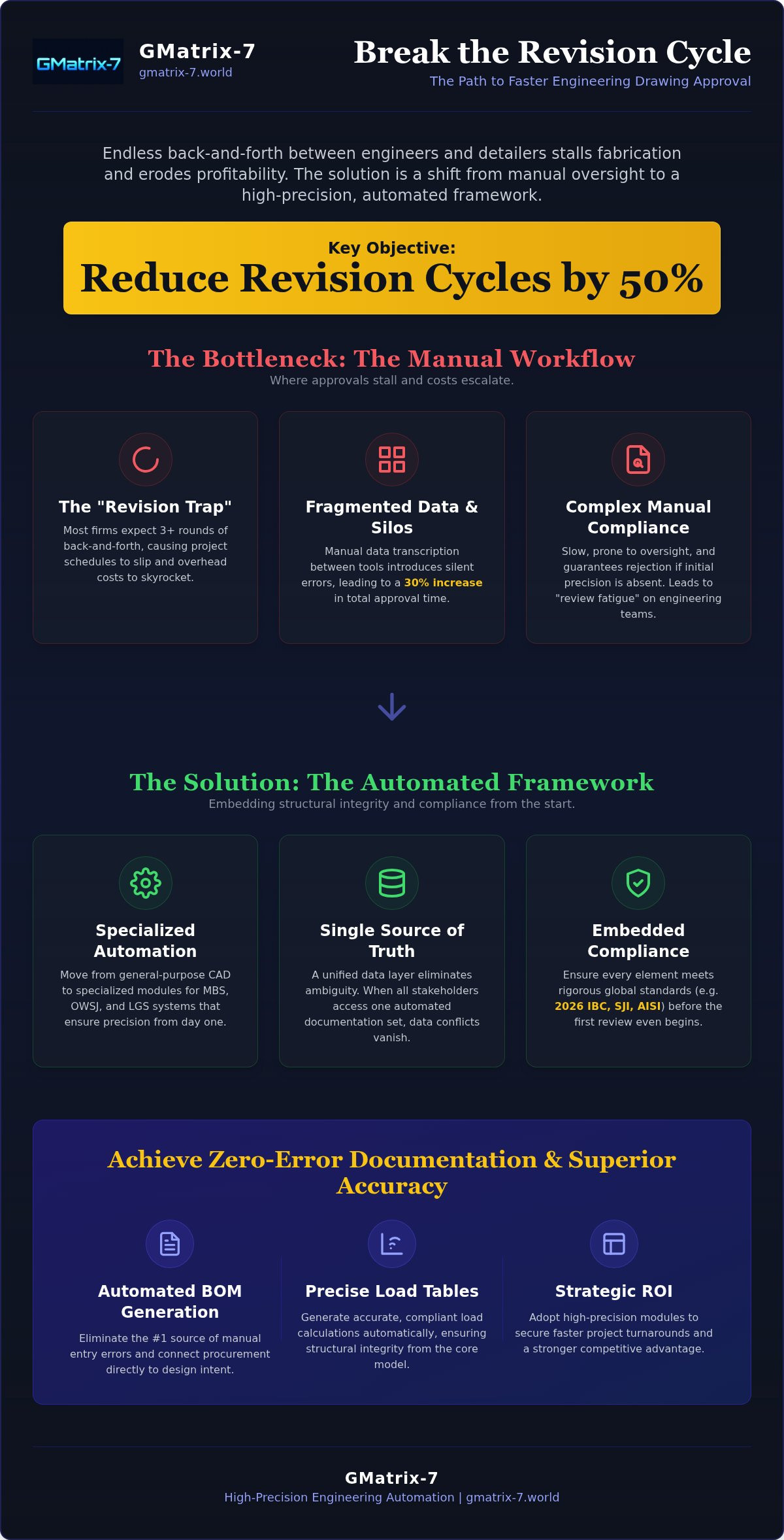
We've engineered this guide to help you eliminate approval bottlenecks and reduce your revision cycles by 50% using automated structural engineering workflows. You'll discover how to leverage specialized modules for MBS, OWSJ, and LGS systems to ensure zero-error documentation and precise load tables from the start. We'll examine the transition from manual complexity to automated simplicity, providing a roadmap for achieving seamless compliance with global structural standards while securing a faster, more reliable project turnaround.
Key Takeaways
- Identify the hidden financial drain caused by manual drafting iterations and fragmented data between design and fabrication.
- Discover how to speed up engineering drawing approval by shifting from general-purpose CAD to specialized structural automation.
- Eliminate the error-prone gap between drawings and procurement using integrated, automated Bill of Materials (BOM) generation.
- Master the transition to a single source of truth workflow that ensures absolute compliance with 2026 global structural standards.
- Evaluate the strategic ROI of adopting high-precision engineering modules to secure faster project turnarounds and superior documentation accuracy.
The Bottleneck: Why Engineering Drawing Approvals Stall in 2026
Manual drafting iterations aren't just a nuisance; they're a high-stakes financial drain. Every hour spent re-aligning a beam or correcting a material schedule is an hour stolen from project profitability. In 2026, the "Revision Trap" has become a standard industry failure. Most firms now expect three or more rounds of back-and-forth before a drawing set reaches final sign-off. This repetitive cycle stems from a fundamental disconnect between high-level design intent and the granular, technical requirements of the shop floor. When your team is stuck in this loop, project schedules slip, and the cost of engineering overhead skyrockets.
Fragmented Data and Manual Entry Errors
Data fragmentation remains the primary obstacle for firms asking how to speed up engineering drawing approval. When designers manually transcribe data from one software tool to another, they introduce "silent" errors that often remain undetected until the fabrication stage. These errors frequently originate in foundational Computer-aided design (CAD) environments that lack built-in structural intelligence. Outdated drafting standards fail to communicate effectively with modern, AI-driven review platforms, leading to unnecessary flags and delays. It's a systemic failure. Data silos between the design office and the detailing department directly correlate to a 30% increase in total approval time.
The impact of this fragmentation is felt most acutely during the generation of the Bill of Materials (BOM). A single manual entry error in a steel schedule can cause a cascade of delays, forcing the entire drawing set back to the first stage of review. This lack of a unified data layer ensures that even minor changes require a complete, manual audit of the entire project documentation.
The Complexity of Modern Structural Compliance
Compliance is no longer a static checkbox. The 2024 and 2026 updates to the IBC, alongside rigorous SJI and AISI standards, demand a level of documentation that exceeds previous cycles. Manual compliance checks are inherently slow and prone to oversight. If technical precision is absent at the initial input stage, rejection at the final review is almost guaranteed. This creates a compounding effect known as "review fatigue" on engineering teams.
Overwhelmed by repetitive manual audits, professionals eventually miss critical details. This lack of initial rigor forces a return to the drafting board, extending the approval timeline and compromising the project schedule. Moving from manual complexity to automated simplicity is the only viable path to maintaining safety and speed. Without specialized modules that embed these global standards into the design phase, your approval drawings will continue to stall under the weight of modern regulatory requirements.
Implementing a Standardized Single Source of Truth Workflow
Efficiency in 2026 requires more than faster drafting; it demands a unified architectural truth. Transitioning from generic CAD to specialized structural design modules creates a direct pipeline between conceptual design and the shop floor. This unified data layer eliminates the ambiguity that typically triggers revision requests. By utilizing SJI 100-2020 compliant joist software, firms ensure that every bar joist and structural element meets rigorous industry standards before the first review even begins. This "capability-to-outcome" pattern allows technical features to translate immediately into high-value results, significantly reducing the need for time-consuming explanatory meetings.
Centralizing Structural Documentation
Fragmented communication is a relic of slower eras. Moving from a chaotic mix of screenshots and emails to integrated documentation environments provides the clarity needed for how to speed up engineering drawing approval. When all stakeholders access a single, automated structural documentation set, the risk of conflicting data vanishes. This transition is a core component of professional structural design automation, which provides the long-term scalability required to handle increasingly complex 2026 projects. High-precision automation turns complex inputs into streamlined outputs, ensuring that the design intent is preserved from the initial model to the final approval drawing.
Standardizing Compliance Across Global Teams
Maintaining consistency across global fabrication networks is a logistical hurdle that often stalls approvals. Software that automatically enforces AISI and IBC 2024/2026 standards acts as an invisible guardian of project safety. This automation reduces the heavy burden of manual code-checking for senior engineers, allowing them to focus on high-value optimization rather than routine audits. Global fabricators benefit from a consistent quality register, ensuring that every component produced aligns perfectly with the original structural requirements.
The result is a seamless transition from complexity to simplicity. By embedding these standards into the workflow, firms eliminate the lack of technical precision that leads to late-stage rejections. For organizations seeking to dominate their market, implementing automated structural workflows is the most direct path to zero-error documentation and industry-leading turnaround times. This methodical approach ensures that project safety is never sacrificed for the sake of speed, providing total peace of mind for both the engineer and the client.
Leveraging Specialized Software to Speed Up Engineering Drawing Approval
Generic CAD tools are essentially digital drafting boards that lack the structural logic required for high-stakes engineering. Specialized software acts as an expert consultant, embedding building codes directly into the drawing geometry. This shift from manual drafting to automated generation is the foundational pillar of how to speed up engineering drawing approval. By automating the production of professional approval drawings, firms eliminate the manual transcription errors that typically trigger rejection. In 2026, automated detailing is no longer an optional luxury; it is a competitive necessity for firms that prioritize precision and safety over repetitive manual labor.
MBS and OWSJ Automation: Precision at Scale
GMatrix-7 / MBS (IBC) modules transform complex structural inputs into code-compliant drawings instantly. These modules don't just draw lines. They execute rigorous structural analysis based on the most current IBC standards. When detailing bar joists, SJI-compliant algorithms ensure that every web and chord member satisfies the latest SJI 100-2020 requirements. This level of automated rigor drastically reduces the "human variable," ensuring that the first submission is technically unassailable. Utilizing high-performance MBS IBC design software ensures that your outputs are consistently professional, moving projects from the design phase to the shop floor with unprecedented speed.
LGS and AISI Design Speed-ups
Light gauge steel (LGS) projects often suffer from high-volume detailing requirements that overwhelm manual teams. Specialized AISI structural design tools automate this process, generating cold-formed steel details with surgical precision. This technology allows for a rapid project release that manual workflows simply cannot match. Extensive industry benchmarks demonstrate that specialized software reduces manual drawing time by up to 70%. By automating the generation of single skin and sandwich panel load tables alongside the drawings, firms create a comprehensive documentation package that flows through the review process without friction. This methodical approach ensures that every structural detail is data-driven, creating a reliable path to project success.
Reducing Iterations Through Automated BOM and Load Table Integration
A first-pass approval is only possible when the underlying data is incontrovertible. Understanding how to speed up engineering drawing approval requires looking beyond the lines on a page to the data that drives fabrication. Mismatches between structural drawings and material lists are leading causes of field errors and project delays. By integrating an automated Bill of Materials (BOM) directly into the design workflow, you eliminate the gap between what is drawn and what is procured. This synchronization ensures that the reviewer sees a cohesive, error-free package, which drastically reduces the need for technical clarifications or secondary audits.
Synchronizing Drawings with Material Lists
Manual transcription is the enemy of project margins. When a detailer manually counts members or calculates weights, they invite the "human variable" to compromise the project's integrity. High-precision systems follow a methodical path to ensure accuracy. The five steps to automated BOM generation include defining structural parameters, executing code-compliant analysis, generating precise geometry, extracting member schedules, and finally, synchronizing that data with procurement databases. This process ensures that the approval drawing and the final material list are identical mirrors of the structural model. Deploying automated bill of materials software protects your project margins by ensuring that every ton of steel is accounted for before fabrication begins.
Automating Load Table Generation for Faster Review
Engineers often spend hours, if not days, verifying manual load tables for composite decks and sandwich panels. This verification bottleneck is a primary driver of approval lag. Automated generation tools remove this burden by producing precise tables based on real-time structural inputs and the latest global standards. Whether you are dealing with single skin panels or complex composite deck configurations, automation provides the professional validation that reviewers demand.
Instead of catching mistakes after they are made, these tools prevent errors from entering the documentation package in the first place. This proactive accuracy is essential for maintaining a rapid project release cycle. For a deeper technical analysis of these processes, referencing a composite deck load table generator guide can provide the granular detail needed for complex structural validation. By integrating these calculations into the initial approval package, you provide a level of technical depth that facilitates immediate sign-off. This methodical approach transforms a typically slow review into a streamlined formality.
Scaling Excellence with GMatrix-7’s Engineering Automation
Positioning your firm as an industry leader requires more than just meeting deadlines; it demands the adoption of high-precision technology that sets a new standard for excellence. The ROI of moving from manual CAD to GMatrix-7 structural modules is immediate and measurable, manifesting as reduced overhead and significantly faster project delivery. Automated documentation builds an unshakeable foundation of trust with both clients and regulatory bodies, as it demonstrates a rigorous commitment to data-driven accuracy. Learning how to speed up engineering drawing approval is not just a tactical fix; it is a strategic evolution that future-proofs your workflow for 2027 and beyond.
The GMatrix-7 Competitive Advantage
The speed benefits of GMatrix-7’s MBS, OWSJ, and LGS automation modules allow firms to process complex structural requirements in a fraction of the time required by traditional methods. By generating AISI and SJI compliant outputs automatically, the software eliminates the uncertainty that often plagues manual drafting. This technology positions GMatrix-7 as a guardian of safety in the industrial sector, providing a level of reliability that manual oversight simply cannot replicate. High-value results are achieved through a methodical transition from complexity to simplicity, ensuring that every approval drawing is technically superior and ready for immediate fabrication.
This competitive edge is rooted in the software's ability to act as a visionary developer of structural logic. When your firm utilizes specialized bar joist modules that adhere to SJI 100-2020 standards, you aren't just producing a drawing; you are delivering a battle-tested structural solution. This authoritative approach to engineering ensures that your team remains focused on high-level achievement rather than repetitive manual audits.
Getting Started with Structural Automation
Transitioning your team to an automated approval workflow is a structured process that prioritizes long-term stability and performance. Success begins with moving away from fragmented legacy tools and embracing an integrated documentation environment. Specialized training plays a critical role in maximizing software ROI, as it empowers your engineers to leverage the full depth of the GMatrix-7 / MBS (IBC) and LGS (AISI) modules. This focused investment in team capability ensures a seamless shift toward zero-error documentation and optimized project turnarounds.
The move toward automation is a bold, ambitious stance that separates premier firms from the rest of the market. By embedding global standards directly into the design phase, you provide your clients with the peace of mind that comes from world-class engineering precision. To begin your transition toward a more efficient, high-precision future, Explore GMatrix-7 Structural Design Solutions and discover how our specialized modules can redefine your project outcomes.
Dominating the 2026 Structural Landscape
The path to industrial leadership is paved with precision and technological agency. By replacing manual drafting iterations with automated structural logic, your firm eliminates the "Revision Trap" and secures a significant reduction in approval cycles. This guide has detailed how a unified data layer, supported by specialized software, transforms complex inputs into streamlined, error-free outputs. Implementing these high-precision workflows is the definitive answer for firms asking how to speed up engineering drawing approval while maintaining absolute structural integrity.
Adopting SJI 100-2020 compliant joist software and IBC 2024/2026 structural design tools ensures that your documentation is battle-tested before the first review. With automated load table generation and synchronized material lists, you provide the technical depth required for immediate sign-off. It's time to move away from fragmented legacy processes and embrace a world-class standard of achievement. You have the tools to transform your design office into a high-performance engine of progress.
Scale your engineering production with GMatrix-7 structural automation and lead the market with confidence. Your journey toward zero-error documentation and total peace of mind starts now.
Frequently Asked Questions
How can I speed up engineering drawing approval without compromising safety?
You can accelerate approvals by utilizing software that embeds structural building codes directly into the initial design geometry. This proactive approach ensures that every drawing is technically unassailable from the first submission. By automating the generation of professional approval drawings through GMatrix-7, you eliminate the manual transcription errors that typically trigger safety rejections. This methodical transition ensures project safety is never sacrificed for the sake of speed, providing total peace of mind for every stakeholder.
What is the biggest bottleneck in structural engineering approval workflows?
The primary bottleneck is the "Revision Trap," where fragmented data between design, detailing, and fabrication leads to multiple rounds of back-and-forth reviews. Manual entry errors in material schedules and load tables often cause silent failures that stall the entire approval process. Establishing a unified data layer between the design office and the shop floor is the most effective way to eliminate these friction points. This centralized approach ensures that all stakeholders work from a single source of truth.
Does automated structural design software comply with 2026 IBC standards?
Yes, specialized platforms like GMatrix-7 are engineered to satisfy the rigorous requirements of the IBC 2024 and 2026 updates. These modules execute complex structural analysis based on the latest global standards, ensuring that every output is fully code-compliant. By automating the generation of IBC-compliant documentation, firms reduce the burden of manual audits for senior engineers. This automated rigor provides a reliable path to first-pass approval while maintaining high safety standards across the industrial sector.
How does an automated Bill of Materials (BOM) reduce project delays?
An automated Bill of Materials (BOM) eliminates the discrepancy between structural drawings and final material procurement. When material lists are generated directly from the structural model, the risk of field errors and fabrication delays vanishes. This synchronization ensures that the reviewer receives a cohesive, error-free package that facilitates immediate sign-off. It's a critical component of how to speed up engineering drawing approval, as it prevents the "human variable" from compromising project schedules and margins.
Can specialized software handle complex OWSJ bar joist detailing?
Specialized modules such as GMatrix-7 / OWSJ (SJI) are specifically designed to manage the intricacies of bar joist detailing. These tools utilize SJI-compliant algorithms to ensure that every web and chord member satisfies the latest SJI 100-2020 requirements. By automating this level of granular detail, firms can handle complex structural projects at a scale that manual workflows cannot match. This precision at scale ensures that bar joist outputs are consistently professional and technically accurate.
What is the difference between generic CAD and specialized structural design software?
Generic CAD serves as a digital drafting board that lacks built-in structural intelligence or building code logic. In contrast, specialized structural design software acts as an expert consultant, embedding specific standards like AISI and SJI directly into the geometry. This shift from manual drafting to automated generation allows for the instant creation of professional approval drawings. Specialized software reduces manual drawing time by up to 70%, allowing engineers to focus on high-value optimization rather than routine drafting.
How do automated load tables improve the engineer's review process?
Automated load tables remove the time-consuming burden of manual verification, which is a primary driver of approval lag. By generating precise tables for composite decks, sandwich panels, and single skin configurations, the software provides the professional validation that reviewers demand. This data-driven approach ensures that all calculations are accurate and based on real-time structural inputs. Providing this level of technical depth in the initial approval package transforms a slow review into a streamlined, high-precision formality.
Is structural automation suitable for large-scale metal building systems?
Structural automation is essential for large-scale metal building systems (MBS) where high-volume detailing requirements can overwhelm manual teams. Specialized modules automate the generation of technical documentation and material lists, ensuring that even the most complex structures are processed with surgical precision. This technology allows for a rapid project release and consistent quality across global fabrication networks. By leveraging high-precision automation, firms can scale their production effectively while maintaining a rigorous commitment to safety and global standards.


