
Engineering excellence in 2026 isn't defined by how well you navigate a manual; it's defined by how effectively you automate the process. You understand that manual joist detailing is a high-stakes environment where a single oversight in SJI compliant joist design can lead to costly fabrication waste and structural risks. Staying current with the 45th Edition of the SJI 100-2020 standards while accounting for ASCE 7-22 load provisions requires a level of precision that manual workflows simply cannot sustain without significant overhead.
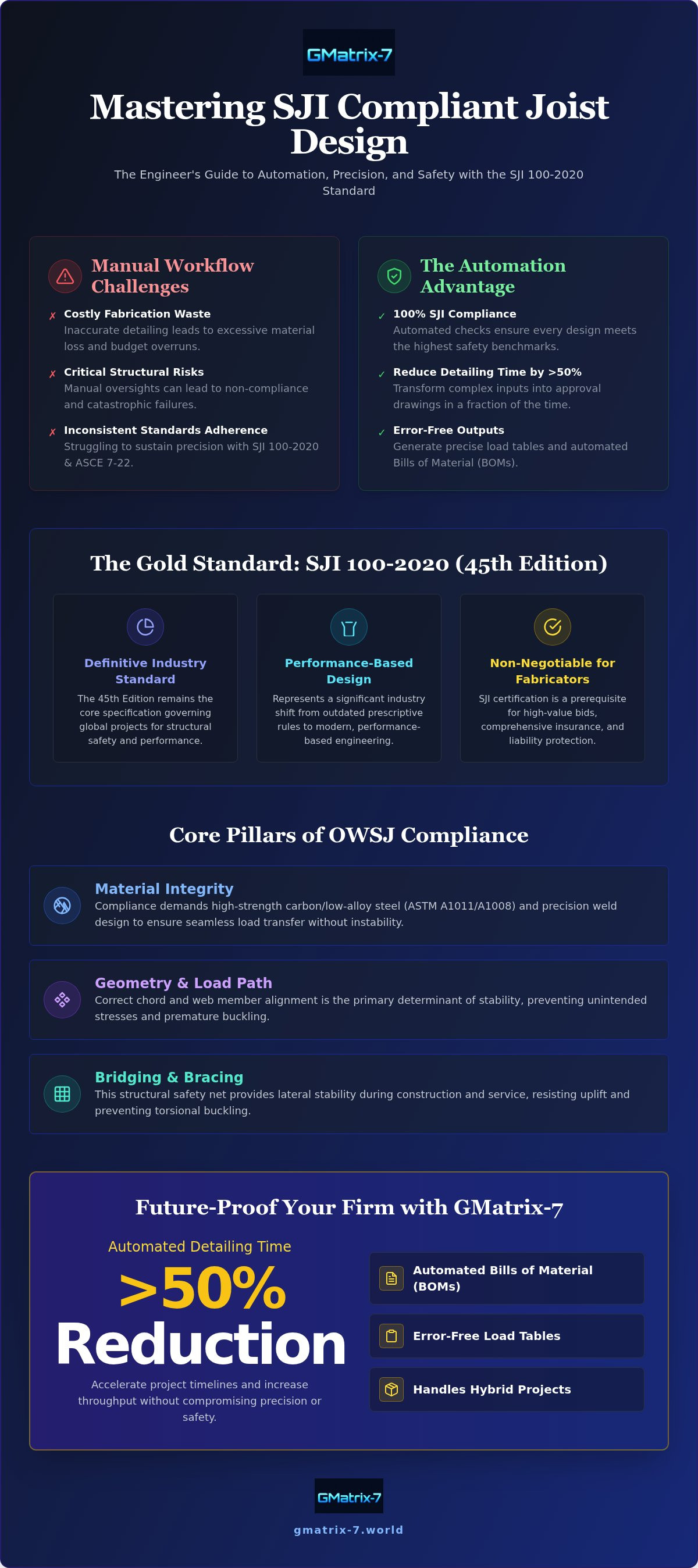
This guide provides the roadmap to master these complexities through structural automation. You'll discover how to achieve 100% compliance and reduce detailing time by 50% or more. We'll examine how GMatrix-7 transforms complex inputs into professional approval drawings and automated, error-free Bills of Material. By the end of this article, you'll have a clear strategy to generate precise load tables and optimize your OWSJ workflows for maximum efficiency and safety.
Key Takeaways
- Understand why the SJI 100-2020 specification remains the definitive standard for open web steel joist safety and performance in 2026.
- Identify critical material specifications and geometry requirements necessary to ensure load path integrity for SJI approval.
- Discover how transitioning from manual calculations to automated detailing ensures SJI compliant joist design while reducing project timelines by over 50%.
- Learn to generate precise, error-free load tables and automated Bills of Material for complex single skin and sandwich panel configurations.
- Future-proof your engineering firm by integrating GMatrix-7 OWSJ software to handle hybrid projects involving cold-formed steel and bar joists.
Navigating the Complexity of SJI Compliant Joist Design
SJI compliance represents a commitment to the highest tiers of structural safety and performance. It requires strict adherence to the Steel Joist Institute’s established specifications for the design and manufacture of open web steel joists. As of September 2026, the SJI 100-2020 standard remains the definitive core pillar for the industry. While newer iterations like SJI 100-2025 are in development, the 45th Edition continues to govern the majority of global projects. Achieving a truly SJI compliant joist design demands a meticulous approach to geometry and material strength that manual methods often fail to deliver with consistency.
The consequences of non-compliant engineering extend far beyond simple technical errors. Structural failures pose catastrophic legal and financial risks, while inaccurate detailing leads to excessive material waste during fabrication. To mitigate these dangers, industry leaders are turning to professional structural design automation. This technology bridges the gap between complex theoretical standards and practical, error-free execution. Understanding the foundational principles of What is a Joist? is essential for any professional seeking to master these advanced compliance workflows.
The Evolution of SJI 100-2020 Standards
The SJI 100-2020 specification introduced critical updates to load combinations and material strength requirements. It reflects a significant industry shift from prescriptive rules toward performance-based joist design. Modern engineering demands faster compliance cycles to keep pace with rapid construction schedules. Automation tools allow designers to apply these complex updates instantly, ensuring that every calculation reflects the latest errata and unified standards.
Why Compliance is Non-Negotiable for Fabricators
SJI certification is a prerequisite for high-value project bidding and securing comprehensive insurance coverage. It serves as a shield against liability, providing documented proof that the structural members meet rigorous safety benchmarks. Fabricators often leverage MBS IBC design software to integrate these SJI workflows seamlessly into their broader project management systems. This integration ensures that compliance isn't a separate hurdle but a built-in feature of the detailing process.
Technical Requirements for Open Web Steel Joist (OWSJ) Compliance
Precision is the foundation of structural integrity. Achieving an SJI compliant joist design requires more than a passing familiarity with structural principles; it demands absolute precision in material selection and component interaction. Every member must adhere to the SJI Standard Specifications to ensure the assembly performs predictably under load. This begins with material integrity. Components typically utilize high-strength carbon or low-alloy steel conforming to ASTM A1011 or A1008 standards. These specific grades provide the ductility and yield strength necessary for cold-formed or hot-rolled sections. Weld design is equally critical, as the connection between web members and chords must facilitate seamless load transfer without introducing local instabilities. Rigorous testing and quality control protocols during the design phase validate these connections, confirming they meet or exceed the minimum shear and tensile requirements.
Geometry and Load Path Integrity
Correct chord and web member alignment is the primary determinant of overall stability. Any deviation in the load path creates unintended secondary stresses that don't just weaken the member but can compromise the entire structure. Engineers must meticulously calculate eccentricities at joist panel points to ensure that the intersection of member centerlines remains within SJI-mandated tolerances. The neutral axis represents the theoretical line where no longitudinal stress occurs, serving as the pivot point for calculating bending moments in SJI chord design. By maintaining this alignment, designers prevent premature buckling and ensure the joist behaves as a unified truss.
Bridging and Bracing: The Structural Safety Net
Bridging acts as the structural safety net, providing lateral stability during both the construction and service phases. SJI requirements for horizontal and diagonal bridging vary significantly based on the joist series. For K-Series joists, spacing is often governed by the span and the specific chord size, whereas LH-Series joists require more robust bracing to manage higher load intensities. Diagonal bridging is mandatory at specific intervals to resist uplift and prevent lateral-torsional buckling. Modern software platforms, such as those found in advanced OWSJ detailing modules, automate the placement of these components. This automation ensures that every bridging row is positioned according to exact SJI spacing rules, eliminating the manual errors that frequently lead to field-fix requirements.
Automated Detailing vs. Manual Calculations
The 2026 "efficiency audit" has exposed manual detailing as a relic of a slower industrial era. Relying on hand-checked spreadsheets and generic CAD tools is no longer a viable strategy for firms targeting high-value contracts. When you analyze CAD vs specialized software for steel detailing, the contrast in throughput is stark. Specialized automation ensures an SJI compliant joist design by embedding the standard's logic directly into the modeling environment. This prevents the top three manual calculation errors: panel point eccentricity oversights, mismatched load transfers, and inconsistent material grade application. By eliminating these bottlenecks, firms can transition from design to fabrication with unprecedented speed.
The Hidden Costs of Manual SJI Calculations
Beyond the obvious time loss, manual SJI calculations carry significant fiscal weight. Engineers often lose 40 to 60 hours per project simply on cross-referencing tables and validating manual inputs. To mitigate the risk of error, many designers resort to "conservative" estimates, which leads to over-ordering steel by as much as 15%. While the official SJI Design Tools offer essential guidance, they cannot replace the integrated optimization found in modern software. Automation identifies the exact material requirements for every chord and web member, slashing fabrication waste and ensuring project bids remain competitive without sacrificing structural fidelity.
Accelerating Approval Drawings with Intelligent Detailing
GMatrix-7 redefines the approval process by transforming raw engineering data into professional, inspector-ready documentation. These automated drawings are not merely visual representations; they are data-rich documents that provide site inspectors with the clarity needed for rapid certification. The true power lies in parametric agility. When a client requests a mid-project change to the load tables or joist spacing, GMatrix-7 enables "one-click" updates across the entire project file. This ensures that every drawing, load table, and Bill of Material remains synchronized and fully compliant, protecting your firm from the liability of outdated documentation.
Generating SJI Compliant Load Tables and BOMs
Precision in output is the final hurdle in the engineering workflow. An SJI compliant joist design requires more than just a structural model; it necessitates the generation of precise load tables that reflect real-world conditions. For projects involving single skin or sandwich panels, these tables must account for varied thermal and environmental stresses. Integrating composite deck load table generators with your joist design ensures that the entire floor or roof assembly behaves as a unified system. SJI standards mandate a clear display of both uniform and concentrated load capacities, providing fabricators and inspectors with a transparent view of the member's structural limits. Automation eliminates the risk of transposition errors that frequently occur when manually migrating data from analysis software to final documentation.
Standardizing Data for Joist Girders
Roof and floor systems often present complex load distributions that standard tables cannot capture. Calculating point loads for these systems requires a rigorous approach to tributary area analysis and load path tracking. SJI nomenclature for specialty joists and girders provides a standardized language for communicating these complexities to the shop floor. The "Load/Load" method for specialty joist designation involves specifying both the total load and the live load in pounds per linear foot to clearly define design parameters. This standardization ensures that custom girders are manufactured to the exact requirements of the project, preventing onsite structural discrepancies.
Integrating BOMs for Lean Fabrication
Fabrication accuracy depends entirely on the quality of the Bill of Materials (BOM). Automated material lists remove the ambiguity from the procurement process, significantly reducing shop errors and material waste. By synchronizing design software with fabrication machinery, you ensure that every cut and weld matches the engineering intent. GMatrix-7 excels in this area, generating comprehensive, error-free bills of material instantly from the structural model. This seamless data flow protects your profit margins by optimizing material usage and accelerating the manufacturing cycle. Experience the precision of automated output by visiting GMatrix-7's OWSJ solutions.
Future-Proofing Engineering with GMatrix-7 OWSJ Software
GMatrix-7 / OWSJ (SJI) stands as the definitive solution for modern bar joist detailing, providing a bridge between complex regulatory requirements and high-velocity production. It isn't merely a calculation tool; it's a comprehensive engineering partner that ensures every output reflects a 100% SJI compliant joist design. By embedding the rigorous logic of the SJI 100-2020 standards into its core architecture, the software eliminates the manual verification cycles that traditionally bottleneck project timelines. This proactive approach to compliance allows firms to focus on structural innovation rather than administrative oversight. As code cycles evolve, GMatrix-7 remains ahead of the curve, integrating updates to IBC and SJI specifications long before they become industry stressors, securing your firm’s position as a leader in safety and precision.
Seamless Integration with IBC and AISI Workflows
Modern industrial projects rarely exist in a vacuum, often requiring a hybrid approach to structural members. GMatrix-7 provides a unified platform where MBS, OWSJ, and LGS structural design software coexist within a single ecosystem. This integration is critical for complex industrial buildings that must satisfy multiple cross-standard compliance requirements simultaneously. Instead of juggling disparate software packages, engineers can manage cold-formed steel and bar joist detailing through a professional interface designed for industry experts. This streamlined workflow ensures that load transfers between different material types are handled with mathematical certainty, maintaining structural integrity across the entire building envelope.
Scaling Production with Global Compliance Tools
Strategic automation empowers smaller engineering firms to compete for large-scale projects that were once the exclusive domain of massive corporations. By utilizing GMatrix-7’s "battle-tested" algorithms, your team can scale production without a proportional increase in headcount. The software has been validated across various global jurisdictions, proving its reliability in diverse regulatory environments. This global perspective ensures that your designs meet the highest standards of excellence, whether you're detailing a standard warehouse or a complex multi-story facility. The result is a more agile, more profitable engineering practice that values precision above all else. To see these capabilities in action and elevate your detailing standards, Request a demo of GMatrix-7 OWSJ software.
Mastering the Future of OWSJ Engineering
Adopting structural automation is the only path toward maintaining competitive dominance in 2026. The shift from manual detailing to intelligent software isn't just about speed; it's about the absolute elimination of human error in high-stakes environments. You've seen how a data-driven approach ensures an SJI compliant joist design while simultaneously slashing detailing time and material waste. By integrating precise load table generation and automated Bills of Material, you protect your profit margins and your professional reputation. Engineering excellence is now defined by the tools you use to bridge the gap between complex theory and flawless execution.
GMatrix-7 stands as your partner in this evolution, offering a platform that is fully SJI 100-2020 compliant and capable of generating professional, automated approval drawings with ease. Our global engineering support team is ready to help you scale your production and master even the most complex hybrid projects. It's time to move beyond the limitations of legacy workflows and embrace a future built on precision and safety. Optimize Your OWSJ Workflows with GMatrix-7 and take the lead in modern structural detailing.
Frequently Asked Questions
What is the current SJI standard for joist design in 2026?
As of late 2026, the 45th Edition, designated as SJI 100-2020, remains the official standard for steel joist and joist girder design. While the Steel Joist Institute is developing the 2025 specifications, they haven't been formally released for public use. Engineers must continue to adhere to the 2020 standards to ensure a safe and SJI compliant joist design that meets current building code requirements.
How does GMatrix-7 ensure SJI 100-2020 compliance?
GMatrix-7 embeds the specific logic and load table requirements of the SJI 100-2020 specification directly into its structural algorithms. The software automatically applies the correct material strengths and geometry constraints during the modeling phase. This systematic approach eliminates the risk of manual calculation errors. It provides engineers with the security that every member is analyzed against the most rigorous industry benchmarks for safety and performance.
Can I generate composite deck load tables within the OWSJ module?
Yes, the platform includes advanced tools specifically designed for generating precise load tables for composite decks. This functionality allows you to analyze the interaction between the joist and the deck assembly under various load conditions. By integrating these calculations within the OWSJ module, the software ensures that the entire system behaves as a unified structural unit. This capability is essential for accurately documenting performance for single skin or sandwich panel roof and floor systems.
What is the difference between K-Series and LH-Series joist compliance?
Compliance differences primarily involve depth, span, and bracing requirements dictated by the SJI specifications. K-Series joists are standardized for depths up to 30 inches and spans up to 60 feet. LH-Series joists handle greater loads with depths up to 48 inches and spans reaching 96 feet. GMatrix-7 automatically adjusts the internal compliance checks based on the series selected. This ensures that bridging and bracing rules are applied correctly for the specific joist type.
Does GMatrix-7 software automate the generation of shop drawings?
The software automates the generation of professional approval drawings directly from your engineering data. These technical documents provide the clarity required for site inspectors and fabrication teams to verify structural intent. By transforming raw structural inputs into detailed visual documentation, GMatrix-7 slashes the time spent on manual drafting. This automation ensures that every drawing remains synchronized with the latest design changes, maintaining a high standard of accuracy throughout the project lifecycle.
How does automated BOM generation reduce material waste?
Automated Bill of Material (BOM) generation eliminates the "conservative" padding often added during manual estimation. The software calculates exact material requirements for every chord and web member based on the structural analysis. This precision ensures that fabricators order only what is necessary for the project. By reducing over-ordering by significant margins, firms can protect their profit margins while contributing to leaner, more sustainable fabrication processes.
Is the OWSJ module compatible with IBC 2024 standards?
GMatrix-7 is fully compatible with the International Building Code (IBC) standards, including the latest 2024 updates. The software architecture is designed to handle the complex load combinations and safety factors required by modern building codes. This compatibility ensures that your structural designs meet both SJI and IBC requirements simultaneously. This ensures a fully SJI compliant joist design that satisfies local regulatory bodies across various jurisdictions.
What are the hardware requirements for GMatrix-7 structural software?
GMatrix-7 is designed to run efficiently on professional-grade workstations typically used in the structural engineering industry. While specific requirements depend on the complexity of your projects, licensed users are provided with a detailed technical specification sheet upon installation. The software is optimized for modern Windows environments to ensure high-speed processing of complex structural modules. Licensed professionals should contact our technical support team for the current hardware compatibility list for 2026.


