
In 2026, treating your design platform as a mere drafting tool is a strategic error that invites structural liability. As the global market for cold-formed steel approaches a value of 45 billion dollars, the demand for absolute engineering precision has never been higher. High-performing firms understand that manual calculation errors are the primary drivers of material waste and project delays. You require a light gauge steel framing software solution that functions as a structural compliance engine rather than a simple visual aid.
We recognize the difficulty of maintaining pace with the ANSI/SDI AISI S100-2024 standards while simultaneously generating accurate shop drawings under tight deadlines. This guide provides an authoritative look at how GMatrix-7 / LGS (AISI) transforms these technical complexities into streamlined, automated outputs. You will learn to master structural automation, from generating precision load tables for composite decks to the rapid production of professional approval drawings. We explore the specific tools that ensure your designs remain both globally compliant and commercially optimized, providing the peace of mind that only comes from data-driven excellence.
Key Takeaways
- Learn how to navigate the stringent ANSI/SDI AISI S100-2024 standards using automated engineering engines that eliminate manual calculation errors.
- Discover how premium light gauge steel framing software integrates complex structural logic with real-world fabrication data to maximize material efficiency.
- Identify the hidden costs of manual drafting and the strategic advantages of transitioning to a workflow centered on data-rich structural objects.
- Master the generation of precision load tables for single skin, sandwich panels, and composite decks to ensure total structural compliance and safety.
- Accelerate project delivery cycles through the automated production of professional approval drawings and comprehensive Bills of Materials.
The Shift to Light Gauge Steel (LGS) Engineering in 2026
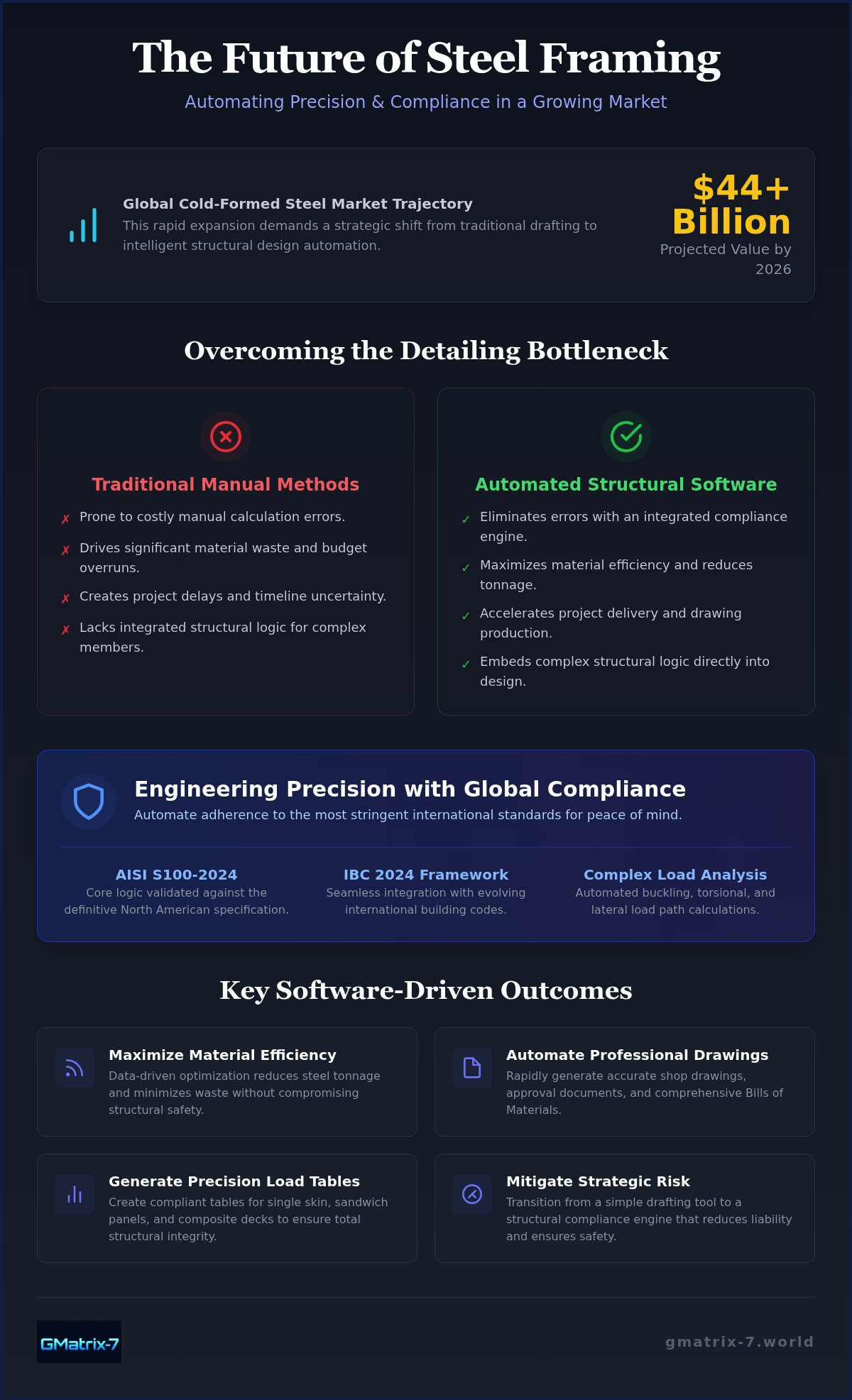
The global trajectory for cold-formed steel is undeniable. With a projected market value surpassing $44 billion in 2026, light gauge steel (LGS) has transitioned from a supplementary material to a dominant force in both commercial and residential sectors. This growth creates a technical vacuum that traditional CAD methods cannot fill. Legacy drafting tools lack the inherent logic required to manage the unique structural behaviors of high-strength, thin-walled steel. These members are prone to complex buckling modes that demand rigorous mathematical validation, not just geometric representation. Engineering firms now face a choice between manual stagnation and automated precision.
Specialized light gauge steel framing software bridges this gap by embedding engineering logic directly into the design environment. This shift moves the industry from simple drafting to integrated structural design automation, where the software acts as a guardian of safety and efficiency. By automating the transition from complexity to simplicity, firms can focus on high-level achievement rather than repetitive manual checks.
Why Efficiency Now Requires Structural Intelligence
True efficiency in 2026 is defined by a capability-to-outcome pattern. It's the ability to translate complex structural inputs into streamlined, material-optimized outputs. Global supply chain volatility has made material waste a financial liability that firms can't afford. Implementing LGS structural design software provides the foundational precision needed to minimize steel tonnage without compromising safety. By analyzing Cold-formed steel frames through the lens of data-driven optimization, engineers achieve a level of accuracy that manual processes simply can't replicate. This structural intelligence ensures that every pound of steel is utilized to its maximum potential.
Meeting Global Demand with Scalable Engineering
Scalability has become the hallmark of the modern engineering firm. Advanced automation allows smaller teams to execute large-scale MBS projects with the same authoritative expertise as global conglomerates. This democratization of high-level engineering is driven by light gauge steel framing software that automates compliance with evolving international standards. For international fabricators, maintaining adherence to the latest AISI specifications is a non-negotiable requirement for market entry. This level of reliability provides peace of mind in a competitive global landscape. LGS engineering is the strategic intersection of material science and software automation, where digital precision dictates physical structural integrity.
Engineering Precision: Navigating AISI S100 Standards
The structural integrity of cold-formed steel hinges on the rigorous application of the AISI S100 standards. In 2026, the ANSI/SDI AISI S100-2024 serves as the definitive specification for North American design. Engineering excellence requires more than just following a manual; it demands a system that automates the intricate buckling and torsional calculations inherent to thin-walled members. High-tier light gauge steel framing software eliminates the risk of manual error by embedding these standards into the core design logic. This ensures that every stud, track, and joist is validated against the latest structural requirements, providing engineers with the peace of mind that comes from absolute data-driven certainty.
Automating Complex Load Path Analysis
Modern structural engineering has moved beyond simple member sizing. Today's projects require a holistic understanding of load distribution across the entire frame. Specialized software modules now handle the heavy lifting of lateral load analysis and shear wall design. In high-wind or seismic zones, the complexity of these calculations increases exponentially. Automated systems track these loads from the roof down to the foundation, ensuring that every connection is capable of withstanding extreme environmental stressors. This transition from complexity to simplicity is achieved through algorithms that simulate real-world conditions, allowing for rapid iteration without sacrificing safety.
Integration of AISI S100 with IBC 2024 Frameworks
Compliance isn't a static goal; it's a moving target influenced by evolving building codes. The GMatrix-7 / LGS (AISI) module is specifically engineered to align with the IBC 2024 framework, offering a seamless integration that reduces professional liability. By utilizing automated compliance checks, firms can mitigate risk and avoid the costly rework associated with code violations. This software doesn't just draw lines; it acts as a high-level consultant that guards the project against regulatory failures. For engineers seeking a partner in industrial progress, exploring the capabilities of GMatrix-7 / LGS (AISI) is the logical next step in achieving structural superiority. The result is a workflow that is both intellectually rigorous and commercially urgent, ensuring your firm remains at the cutting edge of global construction standards.
Manual vs. Automated Detailing: The Detailing Bottleneck
Manual drafting is a relic of a slower era. It creates a bottleneck that stifles project velocity and introduces unacceptable risks. When engineers rely on disconnected 2D lines, they lose the structural intelligence inherent in the AISI S100 Standards. Modern light gauge steel framing software replaces these static drawings with data-rich structural objects that carry their own engineering logic. This transition improves visibility and fundamentally accelerates the engineering-to-fabrication cycle. By eliminating the manual translation of design intent into shop data, firms remove the primary source of human error in complex structural connections. You don't just save time; you eliminate the uncertainty that plagues manual workflows.
The hidden costs of manual detailing often surface during the fabrication and assembly phases. A single mislabeled stud or a missing connection detail can trigger a chain reaction of delays, resulting in expensive field fixes and damaged reputations. Automated detailing ensures that the digital twin of the building is an exact, high-fidelity blueprint for the physical reality. It's about moving away from the labor-intensive act of "drawing" toward the sophisticated realm of "engineering automation." This shift empowers your team to focus on high-value problem solving rather than repetitive drafting tasks.
The Critical Role of Automated Bill of Materials (BOM)
A precise Bill of Materials isn't a luxury. It's the backbone of project profitability. Manual material counting leads to costly overages or on-site shortages that halt production. Integrating automated bill of materials software ensures that every cut list and material report is derived directly from the engineering model. This precision reduces material waste, which is critical in an industry where margins are thin and material optimization is a competitive necessity. You gain total control over your material procurement and fabrication schedules, ensuring that your shop floor operates at peak efficiency.
Approval Drawings: From Weeks to Minutes
Approval drawings often represent a weeks-long hurdle in the project timeline. Building officials require professional, clear, and compliant documentation that leaves no room for interpretation. Automated systems generate these drawings in minutes, maintaining total consistency between the 3D model and 2D outputs. This speed drives faster project approvals and moves the project into the fabrication phase with unprecedented confidence. By automating the documentation process, you provide building officials with the rigorous data they expect while drastically reducing your overhead. It's a seamless transition from complex structural logic to simplified, actionable documentation.
Advanced Load Table Generation for Panels and Decks
Precision in load table generation is a non-negotiable requirement for modern structural integrity. Relying on static, generic PDF tables is a strategy fraught with inefficiency and potential liability. These traditional documents often force engineers into conservative assumptions that result in significant material overages. Advanced light gauge steel framing software allows for the dynamic generation of data that reflects specific project conditions rather than broad industry averages. This precision directly influences the overall building weight and cost. Accurately calculated capacities prevent the unnecessary accumulation of steel, ensuring that every member performs at its peak structural limit. Static tables are insufficient. They invite waste. Dynamic generation provides the only path to true optimization.
The transition from static documentation to dynamic software generation represents a fundamental shift in engineering philosophy. High-performance software provides the flexibility to input specific variables, such as varying steel grades or unique deck profiles, to produce bespoke load tables. This capability allows for a seamless transition from complexity to simplicity, ensuring that every structural decision is backed by rigorous, site-specific data. You gain the peace of mind that comes from knowing your load capacities are verified against real-world inputs rather than outdated estimates.
Optimizing Sandwich Panel Performance
Designing sandwich panels requires a sophisticated understanding of thermal and structural interactions. These components must withstand environmental stressors while maintaining their insulating properties and structural load-bearing capacity. Modern light gauge steel framing software generates tables that meet exact project-site requirements, accounting for local wind loads and temperature gradients. For those seeking specialized assistance in this area, the composite deck load table generator offers a pathway to tailored engineering solutions. This level of granularity ensures that each panel is engineered for its specific environment, maximizing both safety and thermal efficiency.
Rigorous analysis of these interactions is essential for high-level achievement in the field. Automated systems track how thermal expansion affects structural stability, providing a level of detail that manual calculations cannot match. This data-driven approach is the hallmark of a world-class engineering workflow.
Composite Deck Load Capacity Calculation
Composite systems rely on the complex interaction between steel and concrete to achieve superior strength-to-weight ratios. Calculating the exact deck load capacity involves analyzing the mechanical bond and the transfer of shear forces within the assembly. Automation streamlines the generation of span-to-load ratios, allowing for rapid iteration during the design phase. Automated load tables prevent over-engineering by providing exact capacity data that eliminates the need for excessive safety margins. This ensures that the structural frame is both lean and robust, satisfying even the most stringent global standards.
To achieve this level of engineering superiority and reduce project costs, implement the GMatrix-7 / LGS (AISI) module for automated load table generation.
GMatrix-7 / LGS: Accelerating Structural Excellence
GMatrix-7 / LGS (AISI) represents the pinnacle of structural engineering technology. It isn't just a tool for design; it's a comprehensive engine for industrial progress. By unifying the entire workflow from initial engineering to final fabrication data, this light gauge steel framing software ensures that every project meets the highest standards of safety and efficiency. Global fabricators rely on GMatrix-7 for high-value projects because it delivers a seamless transition from complexity to streamlined, actionable output. The software handles the intricate data-driven requirements of modern construction, allowing your team to focus on achieving excellence without being bogged down by manual verification.
The core of this capability lies in the automated generation of critical project documentation. GMatrix-7 / LGS (AISI) produces precise Bills of Materials, professional Approval Drawings, and accurate Load Tables for panels and decks. This automation eliminates the material waste and calculation errors that frequently erode project margins. When you implement a system that is fundamentally stable and technologically advanced, you gain more than just speed. You gain the peace of mind that comes from total structural reliability.
The GMatrix-7 Advantage for Fabricators
Success in fabrication depends on the accuracy of the data entering the shop floor. GMatrix-7 provides direct export of manufacturing data, which minimizes production errors and ensures that the physical frame matches the digital model exactly. The software features customizable material libraries that allow you to define proprietary shapes and profiles, giving you the flexibility to innovate within your specific market. Integration is a key differentiator. By linking the LGS module with GMatrix-7 / MBS (IBC) and GMatrix-7 / OWSJ (SJI) modules, firms can manage total building design within a single, authoritative environment. This holistic approach reduces the friction between different structural systems and accelerates the entire delivery cycle.
Future-Proofing Your Engineering Workflow
The construction industry is moving toward a future defined by digital precision and offsite efficiency. Maintaining a competitive edge requires more than just keeping up; it requires leading through innovation. Adopting professional structural design automation is a strategic investment that provides a measurable ROI through reduced labor costs and optimized material usage. This software acts as a guardian of your firm's reputation, ensuring that every design is compliant, safe, and commercially optimized. It's time to move away from legacy methods and embrace a workflow that is battle-tested and globally minded. Experience the future of light gauge steel framing software and secure your position as an industry leader with GMatrix-7.
Leading the Future of Structural Engineering Automation
The transition toward cold-formed steel is more than a market trend; it's a fundamental shift in how we build. Engineering firms that continue to rely on manual drafting and static calculations risk being sidelined by a more efficient, automated industry. Implementing sophisticated light gauge steel framing software is the definitive way to bridge the gap between complex AISI S100 standards and high-fidelity structural outputs. By prioritizing data-driven precision, you eliminate the material waste and calculation errors that compromise project profitability and safety.
GMatrix-7 / LGS (AISI) provides the authoritative framework needed to maintain a competitive advantage in a global landscape. Our platform is fully AISI S100 and IBC 2024 compliant, offering automated BOM and load table generation that satisfies the most rigorous building officials. It's no coincidence that global structural engineering leaders utilize our technology to drive industrial progress and achieve total peace of mind. Optimize Your LGS Engineering with GMatrix-7 today and experience the pride of world-class achievement. Your journey toward structural excellence starts with the right digital partner.
Frequently Asked Questions
What is the best light gauge steel framing software for AISI S100 compliance?
GMatrix-7 / LGS (AISI) is the premier choice for ensuring total compliance with the ANSI/SDI AISI S100-2024 standards. It integrates rigorous engineering logic to automate complex buckling and torsional calculations that manual methods often miss. This software acts as a structural compliance engine, providing the precision required for high-strength, thin-walled steel design. Leading firms prioritize this platform to mitigate risk and achieve a level of accuracy that aligns with modern global engineering requirements.
How does automated LGS software reduce material waste in fabrication?
Automated platforms eliminate material waste by generating exact cut lists and material reports directly from the structural model. This precision ensures that every pound of steel is utilized efficiently, preventing the costly overages associated with manual estimation. By optimizing member sizing and spacing through data-driven analysis, light gauge steel framing software reduces the overall building weight. This capability-to-outcome pattern results in significant cost savings and a leaner, more sustainable fabrication process for world-class projects.
Can LGS framing software generate automated Bill of Materials (BOM)?
Professional-grade systems like GMatrix-7 / LGS (AISI) provide automated Bill of Material generation as a core feature. This functionality extracts granular data from the design environment to produce comprehensive material lists for procurement and shop floor management. It removes the detailing bottleneck by ensuring that the BOM is always synchronized with the 3D model. This synchronization eliminates human error in material counting, which is essential for maintaining project profitability and meeting tight construction schedules.
What is the difference between generic CAD and specialized LGS engineering software?
Generic CAD serves as a basic drafting tool for geometric representation, whereas specialized LGS engineering software functions as an intelligent structural design engine. Generic tools don't have the inherent logic to calculate complex load paths or validate members against AISI standards. Specialized solutions automate the transition from complexity to simplicity by embedding engineering rules into the design process. This differentiation ensures that your designs aren't just visual aids but are structurally sound, compliant, and optimized for real-world application.
How does automated load table generation improve composite deck design?
Automated generation replaces static PDF tables with dynamic, site-specific data that reflects the actual steel-concrete interaction of your project. This precision allows engineers to calculate exact span-to-load ratios, preventing the over-engineering that leads to excessive material costs. By producing bespoke load tables for single skin, sandwich panels, and composite decks, the software ensures total structural reliability. This data-driven approach provides the peace of mind that comes from knowing every deck assembly is optimized for its specific load requirements.
Is GMatrix-7 software compatible with IBC 2024 building codes?
GMatrix-7 / LGS (AISI) is engineered to align perfectly with the IBC 2024 building codes. The software undergoes continuous updates to ensure that all automated compliance checks reflect the latest regulatory frameworks. This alignment reduces professional liability and ensures that your structural designs satisfy building officials in any jurisdiction. By utilizing a platform that stays ahead of evolving codes, your firm's status as an innovative, battle-tested partner in the global construction market is secured through rigorous data validation.
How long does it take to generate approval drawings with automated software?
Automated software reduces the timeline for generating professional approval drawings from weeks to mere minutes. By extracting documentation directly from the structural model, the system maintains total consistency between the 2D drawings and the 3D engineering data. This speed accelerates the project approval cycle and moves the design into the fabrication phase with unprecedented confidence. It eliminates the repetitive manual drafting tasks that traditionally stall project velocity, allowing your team to focus on higher-level engineering achievements.
Does LGS framing software support both residential and commercial projects?
Modern light gauge steel framing software is built for versatility, supporting high-load commercial structures and complex residential framing with equal precision. The software handles everything from multi-story load-bearing walls to intricate roof trusses and floor joists. Whether you're designing a large-scale MBS project or a sophisticated residential assembly, the platform provides the scalable engineering power needed to achieve excellence. This flexibility ensures that your firm can confidently bid on a wide range of global infrastructure and housing projects.


