

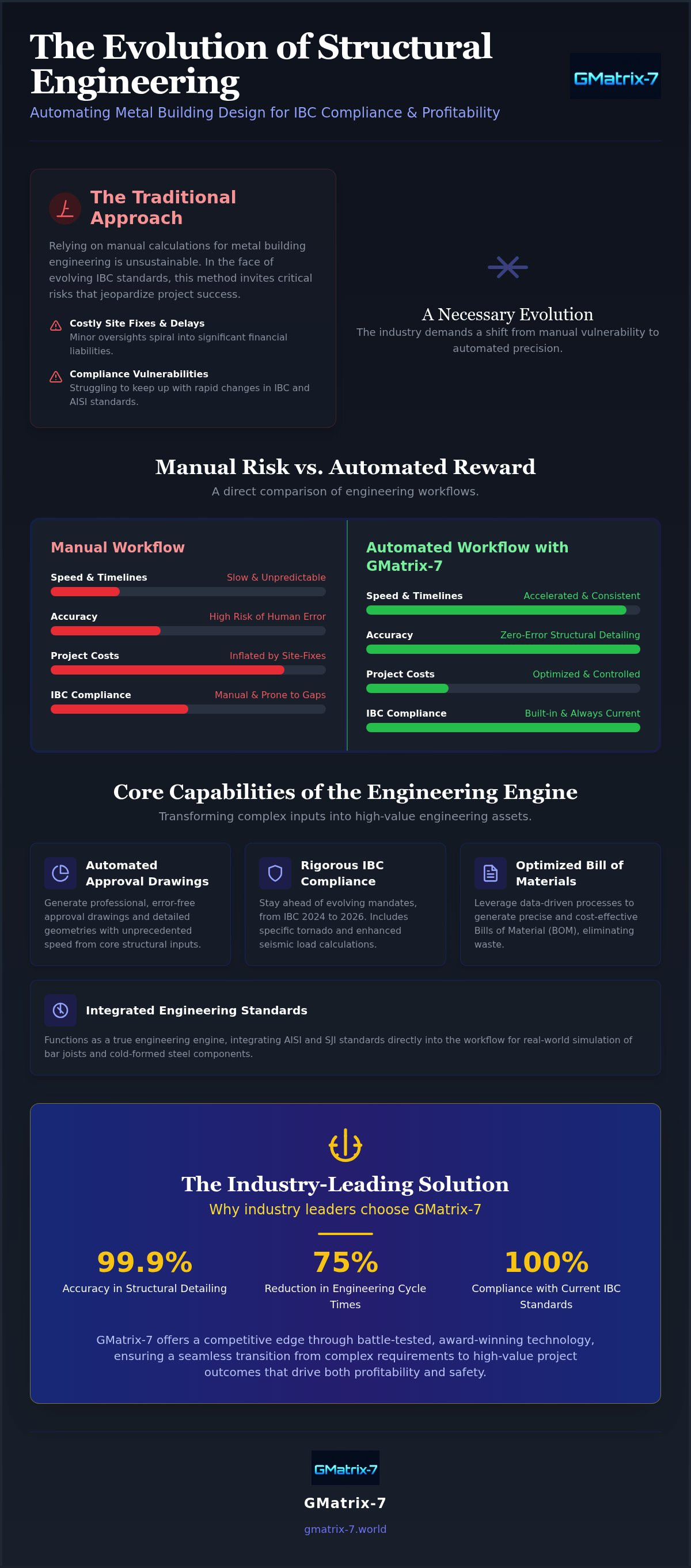
The traditional approach to metal building engineering is no longer sustainable in a landscape defined by the rigorous 2024 IBC updates and increasingly complex structural mandates. Relying on manual calculations instead of specialized MBS IBC design software invites costly site fixes and delays that your project timeline simply cannot afford. You know that even a minor oversight in structural detailing can spiral into a significant financial liability, yet keeping up with the rapid evolution of AISI standards remains a constant challenge for even the most seasoned firms.
Advanced automation solves these critical pain points by replacing manual vulnerability with technical precision. By integrating this gold standard technology, you'll achieve zero-error structural detailing and generate professional approval drawings with unprecedented speed. This article examines how GMatrix-7 leverages data-driven processes to optimize your bills of material; we'll demonstrate how to ensure a seamless transition from complex engineering requirements to high-value project outcomes that drive both profitability and safety.
Key Takeaways
- Understand the critical transition from IBC 2024 to the 2026 standards and how automation ensures your projects remain compliant without manual oversight.
- Learn how MBS IBC design software accelerates project timelines by converting complex structural inputs into error-free approval drawings and detailed geometries.
- Evaluate the significant cost-saving benefits of replacing manual load calculations with a streamlined, high-speed engineering workflow that eliminates site-fix expenses.
- Discover the integrated process for generating optimized Bills of Material and precise load tables for composite decks, single skin, and sandwich panels.
- Explore why industry leaders utilize GMatrix-7 to minimize engineering cycle times and maintain a competitive edge through battle-tested, award-winning technology.
The Evolution of MBS IBC Design Software: Navigating 2026 Standards
The structural engineering industry is undergoing a fundamental transformation as modern building codes evolve from the 2024 IBC to the more stringent 2026 mandates. Relying on manual oversight in this high-stakes environment has become a primary business risk that few fabricators can afford. MBS IBC design software serves as the specialized structural engine required to navigate these complexities. It isn't merely a software package; it's a rigorous compliance framework built specifically for the unique demands of metal building systems.
Professional structural design automation is no longer a luxury for elite firms; it's a commercial necessity for any fabricator seeking to maintain a competitive edge. As projects grow in scale and complexity, the margin for error shrinks. Manual calculation methods don't scale with modern demand. By adopting advanced MBS IBC design software, businesses replace manual vulnerability with technical precision, ensuring that every project meets the highest standards of safety and efficiency from the initial quote to final fabrication.
Why IBC Compliance is the Foundation of Structural Integrity
Modern building codes demand sophisticated load path analysis that frequently exceeds the capacity of traditional manual spreadsheets. The latest standards introduce high-risk design requirements, including specific tornado load calculations and enhanced seismic resistance protocols. High-performance software prevents the "drift" between the engineer's intent and the actual code requirements. By implementing a "compliance-by-design" methodology, firms ensure that every structural member meets global safety standards before a single piece of steel is cut. This proactive approach eliminates the need for reactive, expensive site fixes that occur when designs fail to meet evolving IBC criteria.
The Shift from Drafting Tools to Engineering Engines
Traditional CAD-based detailing focuses on visual representation, but it often lacks the underlying structural intelligence needed for material optimization. Modern MBS IBC design software functions as an engineering engine that integrates AISI and SJI standards directly into the detailing workflow. This integration allows for real-world simulation of bar joists and cold-formed steel components under varying stress conditions. Modern MBS design software serves as the technological bridge between code-mandated safety and manufacturing efficiency. This transition from drafting to automated analysis allows engineers to focus on high-level design strategy while the software handles the granular, data-heavy compliance checks that define world-class structural engineering.
Core Capabilities: Automating Approval Drawings and Detailing
MBS IBC design software transforms raw structural data into refined engineering assets with surgical precision. This transition from manual drafting to automated generation represents a paradigm shift in how metal building systems are conceived and executed. By leveraging a centralized structural engine, the software ensures that every geometric output remains tethered to the underlying load requirements. This eliminates the catastrophic risk of manual detailing errors that frequently lead to site misfits and project overruns. When you automate the detailing process, you aren't just saving time; you're installing a digital safeguard for your firm's reputation and bottom line.
Efficiency in technical documentation is a primary driver of project velocity. Stakeholders require clarity and speed to keep construction timelines on track. Modern automation modules handle the heavy lifting of documentation, allowing your team to focus on high-level optimization. Integrating these advanced engineering modules into your workflow ensures that your documentation is both battle-tested and ready for immediate fabrication.
From Inputs to Professional Approval Drawings
The journey from a client's vision to a professional approval drawing requires the synthesis of several critical data points. The software ingests specific inputs to drive its automated engine, including:
- Primary building geometry and bay configurations.
- Design loads, including wind, snow, and seismic requirements.
- Bracing locations and clearance requirements.
- Wall and roof panel specifications.
The resulting outputs are high-fidelity drawings that adhere to the strictest industry standards. This level of precision provides immediate peace of mind for project managers. It effectively eliminates the "plant manager breathing down your neck" scenario by ensuring that the drawings sent to the shop floor are accurate, readable, and fully compliant. There's no room for ambiguity when the geometry is generated through rigorous algorithmic checks rather than manual drafting.
Precision Detailing for Complex Metal Buildings
Handling complex components like rigid frames, girts, and purlins requires a level of detail that general-purpose tools cannot provide. This is where the distinction between CAD vs specialized software for steel detailing becomes evident. General CAD tools lack the structural intelligence to understand how a change in one member affects the entire load path. In contrast, specialized MBS IBC design software automatically adjusts every connection and member size based on the structural analysis.
This capability-to-outcome pattern is clear: automated detailing leads to a drastic reduction in material waste. By optimizing every plate, bolt, and weld through data-driven analysis, you reduce the overall steel weight without compromising structural integrity. This level of optimization is particularly vital in hybrid structures that integrate OWSJ (SJI) and LGS (AISI) modules. The software manages these distinct material standards within a single, unified environment, ensuring that the interface between different structural systems is seamless and error-free.
Strategic ROI: Manual Calculation vs. Automated IBC Workflows
Manual structural analysis is a drain on high-value engineering resources. While traditional firms might spend 40 or more hours on manual IBC load calculations and detailing for a standard metal building, the integration of MBS IBC design software reduces this cycle to a fraction of the time. This efficiency gain isn't merely about speed; it's about the strategic reallocation of expertise. When engineers are freed from the drudgery of manual data entry, they can focus on high-level structural optimization and cost-reduction strategies that provide a measurable competitive advantage.
The commercial value of professional structural design automation becomes undeniable when analyzing the hidden costs of manual error. In large-scale MBS projects, a single detailing mistake in a rigid frame connection can trigger a cascade of site-fix expenses, material waste, and schedule delays. These errors often remain hidden until the steel arrives at the job site, at which point the cost of rectification is exponential. Automated workflows eliminate these vulnerabilities by ensuring that every geometric output is fundamentally linked to code-compliant structural analysis.
Efficiency Metrics in Structural Engineering
Transitioning to automated workflows fundamentally alters the engineering-to-fabrication timeline. Traditional manual detailing often requires extensive "RFI loops" between the engineer and the fabricator to clarify ambiguous connections or resolve load path discrepancies. GMatrix-7 streamlines this communication by providing high-fidelity, error-free outputs that stakeholders can trust immediately. This reduction in back-and-forth communication accelerates the approval process and ensures that production lines remain active. By delivering rapid, precise outputs, firms can handle a higher volume of projects without increasing their engineering headcount, directly improving the bottom line.
Mitigating Risk through Algorithmic Compliance
Structural safety is the paramount concern for any Engineer of Record (EOR). The legal and safety implications of IBC non-compliance are severe, ranging from project shutdowns to professional liability claims. Advanced MBS IBC design software serves as a reliable guardian of safety by embedding battle-tested, code-compliant algorithms directly into the design process. These algorithms are updated to reflect the latest global standards, ensuring that every project is built on a foundation of rigorous, data-driven compliance. This technological reliability provides global firms with the peace of mind that their designs are fundamentally stable and legally defensible in any jurisdiction. It's a proactive approach to risk management that positions your firm as a world-class leader in structural excellence.
Integrating Load Tables and Automated Bill of Materials (BOM)
A structural skeleton is only as effective as the architectural skin it supports. In modern metal building systems, the interface between the primary frame and cladding components requires a level of analytical depth that manual methods cannot provide. Advanced MBS IBC design software ensures this integration is seamless by generating high-fidelity load tables tailored to specific project geometries. Whether you're utilizing single skin or sandwich panels, the software calculates precise load capacities based on real-world stress variables. This data-driven approach replaces generic manufacturer lookup tables with project-specific engineering data, ensuring both safety and material optimization.
Precision Load Tables for Modern Cladding
The physics behind load table generation involves synthesizing material thickness, yield strength, and span conditions into a reliable performance matrix. Manual load table lookup is fundamentally outdated for bespoke MBS projects where unique bay spacings or environmental loads deviate from standard catalog values. Within this automated ecosystem, GMatrix-7 handles composite deck load capacity calculations by analyzing the interaction between steel decking and concrete fill under various serviceability limits. The integration of composite deck load table generators allows engineers to validate performance in real-time, providing immediate peace of mind for complex flooring and roofing systems. This precision is vital for modern cladding systems where the physics of panel deflection and fastener stress can create significant fiscal liability if miscalculated.
Streamlining Procurement with Automated BOMs
Procurement efficiency is the final frontier of project profitability. The transition from a structural model to a material list is often where manual errors creep in, leading to the over-ordering of steel or, worse, missing critical components on delivery day. An automated Bill of Materials (BOM) creates a direct, digital link between the engineering analysis and the procurement department. The software accounts for every individual bolt, plate, and structural member, ensuring that the BOM is a perfect reflection of the finalized design. This eliminates the guesswork that often plagues the purchasing phase of a project.
The impact of automated BOMs on project profitability and lean manufacturing is profound. By providing an exact count of required materials, the software allows fabricators to minimize inventory overhead and reduce scrap rates. This level of granular accuracy supports a more predictable cash flow and ensures that project timelines aren't derailed by missing hardware. When your procurement is driven by the same engine that handles your IBC compliance, you achieve a level of operational harmony that manual workflows simply cannot replicate. Automate your procurement and load table generation today.
GMatrix-7 / MBS (IBC): The Industry-Leading Engineering Solution
GMatrix-7 / MBS (IBC) represents the zenith of structural engineering automation. It provides a unified environment where technical precision meets high-speed execution. Under the authoritative leadership of Dr. Simon B., a specialist in structural engineering automation, the platform has evolved into a global benchmark for excellence. This dedication to technical superiority was officially recognized with major industry awards in 2024, cementing its status as the premier choice for fabricators who refuse to compromise on quality or compliance. By utilizing this advanced MBS IBC design software, you aren't just adopting a tool; you're securing a partnership with a world-class innovator.
The platform's true power lies in its comprehensive integration. While other solutions offer isolated tools, this ecosystem seamlessly incorporates GMatrix-7 / OWSJ (SJI) and GMatrix-7 / LGS (AISI) modules. This allows for the automated design of bar joists and light-gauge steel components within a single, cohesive workflow. You'll achieve a level of high-level achievement that manual processes simply cannot match. It’s about more than just efficiency; it’s about the peace of mind that comes from delivering a world-class structural product that is both battle-tested and data-driven.
A Visionary Approach to Structural Detailing
GMatrix-7 serves as a practical problem-solver for the modern fabricator. It addresses the real-world complexities of global engineering by providing battle-tested modules that have been refined through rigorous analysis. The software doesn't just generate drawings; it builds security and reliability into every joint and member. We invite you to experience the "Gold Standard" of MBS engineering, where complexity is transformed into streamlined, high-value outputs. This visionary approach ensures that your firm remains at the forefront of industrial progress, protected by technology that is both cutting-edge and fundamentally stable.
Next Steps: Transitioning to Automated Excellence
Integrating GMatrix-7 into your existing engineering workflow is a strategic move toward long-term profitability. Transitioning to an automated environment requires specialized support, and our team provides the technical expertise needed to master MBS, OWSJ, and LGS design. This transition eliminates the "drift" between design intent and fabrication reality. You'll gain access to a world-class engineering solution that optimizes every facet of your production cycle, from initial load calculations to the final bill of materials. Take the next step toward engineering superiority by exploring our licensing options and joining the ranks of global leaders who prioritize precision. Discover GMatrix-7 licensing today.
Securing Your Competitive Advantage in Structural Engineering
The 2026 building code cycle demands a level of precision that manual workflows can't sustain. Transitioning to specialized MBS IBC design software isn't just an operational upgrade; it's a strategic move to insulate your firm from the risks of non-compliance and detailing errors. By automating the generation of approval drawings and bills of material, you unlock a level of efficiency that directly impacts your bottom line. You've seen how integrated load tables and automated BOMs eliminate material waste while streamlining the path from design to fabrication.
GMatrix-7 provides a world-class solution led by industry authority Dr. Simon B. Our platform, recognized with the 2024 Structural Engineering Automation Awards, ensures global compliance across IBC, SJI, and AISI standards. You'll gain the peace of mind that comes from using a battle-tested engine to solve complex structural challenges. It's time to replace manual vulnerability with technical superiority and join the ranks of global leaders who prioritize data-driven excellence. Your projects deserve the precision of the gold standard.
Elevate your structural engineering with GMatrix-7 / MBS (IBC) today.
Frequently Asked Questions
What is the difference between general CAD and specialized MBS IBC design software?
General CAD operates primarily as a drafting tool for visual representation, while specialized MBS IBC design software functions as a structural engine that embeds engineering intelligence into every line. This specialized software automatically calculates load paths and member capacities based on the International Building Code. It ensures that your detailing isn't just geometrically accurate but also structurally sound. This transition from simple drafting to automated analysis eliminates the disconnect between design intent and code mandated safety requirements.
Does GMatrix-7 support the latest IBC 2026 structural standards?
GMatrix-7 is engineered to support the rigorous transition from IBC 2024 to the latest IBC 2026 structural standards. Our development team, led by Dr. Simon B., ensures that the software's algorithmic engine is updated to reflect evolving load requirements and safety protocols. This proactive approach allows fabricators to maintain global compliance without the need for manual code interpretation. It's a battle-tested solution that provides the technical security needed for high-stakes metal building projects.
Can this software generate load tables for sandwich panels and composite decks?
Yes, GMatrix-7 includes specialized modules for generating high-fidelity load tables for single skin, sandwich panels, and composite decks. Unlike generic manufacturer tables, our software calculates performance based on your project's specific span conditions and environmental loads. This data-driven precision ensures that your cladding and flooring systems meet all serviceability limits. It provides engineers with immediate peace of mind by validating complex structural interactions through rigorous, project-specific analysis rather than manual lookup methods.
How does automated BOM generation reduce material waste in metal buildings?
Automated Bill of Materials (BOM) generation eliminates material waste by creating a direct, digital link between the finalized structural model and the procurement list. The MBS IBC design software accounts for every individual bolt, plate, and structural member with surgical precision. This level of granular accuracy prevents the over-ordering of steel and ensures that procurement is a perfect reflection of the engineering analysis. It supports lean manufacturing and significantly improves project profitability by reducing scrap rates.
Is the software compliant with SJI 100-2020 for bar joist design?
The GMatrix-7 / OWSJ (SJI) module is fully compliant with SJI 100-2020 standards for the design and analysis of bar joists. Our software integrates these industry-standard requirements directly into the automated workflow, allowing for the seamless design of open web steel joists within your metal building system. This integration ensures that your hybrid structures meet the highest levels of structural integrity while maintaining the speed and efficiency of a fully automated engineering environment.
Can I generate professional approval drawings directly from the structural model?
Professional approval drawings are generated directly from the finalized structural model, ensuring absolute geometric accuracy. The software converts complex structural inputs into high-fidelity technical documentation that adheres to the strictest industry standards. This automation accelerates the approval cycle and provides project stakeholders with clear, error-free drawings. It effectively removes the risk of manual drafting oversights, providing a reliable foundation for fabrication and on-site construction while reducing the need for extensive RFI loops.
What modules are available for Light Gauge Steel (LGS) design?
For Light Gauge Steel (LGS) design, we offer the specialized GMatrix-7 / LGS (AISI) module. This tool is specifically engineered to handle the unique structural requirements of cold-formed steel members in accordance with AISI standards. It allows fabricators to automate the design and detailing of light-gauge components within a unified MBS environment. By integrating LGS capabilities, you achieve a higher level of structural optimization and material efficiency for a wide range of metal building applications.
How does GMatrix-7 handle complex load combinations for IBC compliance?
GMatrix-7 utilizes a sophisticated algorithmic engine to process complex load combinations, including wind, snow, seismic, and tornado-specific requirements. The software automatically applies these loads to the structural model in accordance with IBC mandates, ensuring that every member is sized for the most critical stress conditions. This automated approach replaces error-prone manual load factoring with a rigorous, data-driven methodology. It provides the Engineer of Record with a secure, battle-tested framework for managing structural safety.


