

The margin for error in structural steel has vanished, yet manual detailing remains a liability that world-class engineering firms can no longer afford. You've likely felt the pressure of managing high error rates in manual material lists or the exhaustion of chasing the latest SJI 100-2025 specifications. These bottlenecks in the approval drawing phase don't just delay schedules; they compromise the integrity of the entire project lifecycle. Adopting steel joist detailing automation isn't just a technical upgrade; it's a strategic mandate for leaders who demand absolute precision and accelerated project velocity.
We understand that your professional reputation rests on the reliability of your documentation and the safety of your structural designs. You're looking for a way to bridge the gap between complex engineering requirements and the shop floor without the risk of human error. This article demonstrates how automated detailing workflows eliminate manual inconsistencies and ensure rigorous SJI compliance while generating fabrication-ready documentation. We'll examine how modern software modules transform complex inputs into streamlined outputs, providing you with a clear path toward faster turnarounds and error-free execution.
Key Takeaways
- Transition from static drafting to a rule-based engineering workflow that leverages intelligent, data-driven structural modeling for superior accuracy.
- Guarantee absolute regulatory compliance by integrating SJI 100-2020 design logic directly into every phase of your automated load calculations.
- Eliminate procurement errors and manual bottlenecks through steel joist detailing automation that produces precise, fabrication-ready Bills of Materials (BOMs) and approval drawings.
- Modernize your fabrication shop by executing a strategic migration from legacy CAD systems to specialized engineering software designed for high-performance joist detailing.
- Leverage industry-leading solutions like GMatrix-7 / OWSJ (SJI) to achieve the precision and global standards required in modern structural engineering.
The Evolution of Steel Joist Detailing: From Manual Drafting to Intelligent Automation
Structural engineering excellence no longer permits the inefficiencies of manual drafting. The industry has reached a tipping point where steel joist detailing automation serves as the definitive bridge between conceptual design and physical reality. This is a rule-based engineering workflow that prioritizes data integrity over simple geometry. Historically, detailing Steel joists involved tedious manual calculations and repetitive 2D CAD tasks. Today, we utilize data-driven structural modeling to ensure that every joist, girder, and attachment point is governed by rigorous engineering logic. This evolution isn't just about speed; it's about the security of structural integrity across increasingly complex project scopes.
Why Traditional Detailing Methods Fall Short in 2026
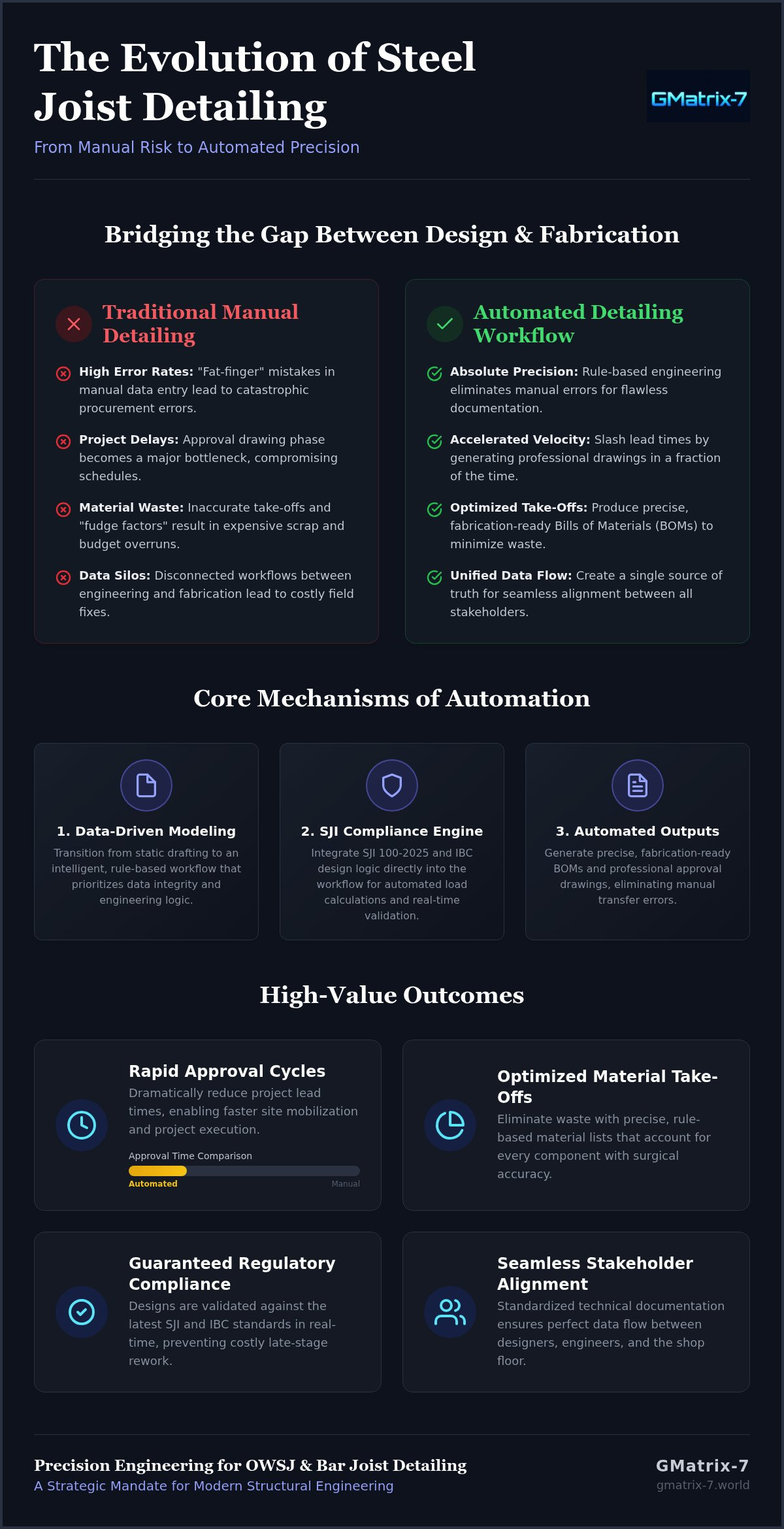
Relying on legacy CAD methods in 2026 is a calculated risk that few firms can justify. Manual data entry in high-volume joist manufacturing remains the primary source of catastrophic procurement errors. When a detailer manually transfers loads or dimensions, the probability of a "fat-finger" mistake increases with project complexity. These errors often remain hidden until the fabrication phase, leading to expensive scrap and project delays. The industry also faces a persistent labor shortage of veteran detailers who understand the nuances of SJI standards. Traditional methods also foster a dangerous "silo" effect. When engineering design and the fabrication shop operate in isolation, the lack of a unified data stream results in misaligned expectations and costly field fixes.
The Core Benefits of Detailing Automation
The transition to steel joist detailing automation delivers immediate, high-value outcomes for stakeholders. By automating the approval drawing phase, firms can slash project lead times, allowing for faster site mobilization. This efficiency is paired with a drastic reduction in material waste. Precise, automated material take-offs ensure that every pound of steel is accounted for, eliminating the "fudge factors" common in manual estimates. Enhanced collaboration is another critical result. Standardized technical documentation creates a single source of truth for engineers, fabricators, and erectors.
- Rapid Approval Cycles: Generate professional drawings in a fraction of the time required by manual teams.
- Optimized Take-offs: Reduction in material waste via precise, rule-based material lists.
- Stakeholder Alignment: Seamless data flow between design, engineering, and the shop floor.
By automating the repetitive aspects of detailing, engineers can focus on optimizing structural performance and safety. This shift ensures that the final product matches the design intent with surgical precision, providing peace of mind to everyone involved in the project lifecycle.
Core Mechanisms of Automated Joist Engineering and SJI Compliance
Precision is non-negotiable in modern structural design. The shift toward steel joist detailing automation relies on the seamless integration of engineering intelligence into the drafting environment. It isn't enough to simply draw a joist; the system must understand the physical constraints and regulatory demands of the project. By embedding SJI 100-2020 design logic into the core workflow, engineers eliminate the ambiguity of manual code interpretation. This rigorous approach ensures that every SJI compliant joist design meets the highest safety standards while optimizing material usage. Automated load calculations for open web steel joists (OWSJ) now account for complex point loads and non-uniform distributions with surgical accuracy, removing the variance inherent in manual methods.
Automating SJI 100-2020 and IBC Standards
Modern software modules act as a digital guardian, validating designs against the latest SJI and IBC standards in real time. This capability allows for immediate compliance checks during the detailing phase, preventing the costly rework associated with late-stage engineering audits. These systems excel at automating seismic and wind load considerations, which are often the most complex variables in structural design. As industry leaders discuss the Innovation in Erection and Fabrication, it's clear that these automated checks are foundational to modern site safety. Automation transforms static drawings into dynamic engineering models that respond to every environmental constraint.
Advanced Load Table Generation for Panels and Decks
Precision engineering extends beyond the joist itself to the panels and decks they support. Generating load tables for single skin and sandwich panels used to require exhaustive manual spreadsheet work. Today, a sophisticated composite deck load table generator can produce error-free capacity calculations in seconds. This automation handles the intricate variables of composite action and thermal performance in sandwich panels without the risk of manual data entry errors. Moving from manual spreadsheets to automated outputs ensures that your load tables are both defensible and optimized for real-world performance. If you're looking to upgrade your engineering precision, exploring the modules in GMatrix-7 software provides a direct path to these results.
- SJI 100-2020 Logic: Embedded rules that prevent non-compliant design geometry.
- Dynamic Load Analysis: Real-time updates to capacity tables as design inputs change.
- Seismic Resilience: Automated calculation of lateral force requirements for complex roof systems.
Eliminating the "Human Factor": Automated BOMs and Approval Drawings
Human error remains the single greatest threat to structural steel fabrication schedules and project profitability. In a traditional workflow, the manual transcription of data from drawings to material lists is where precision often fails. Steel joist detailing automation removes this liability by treating the Bill of Materials (BOM) as a direct, immutable output of the engineering model. This transition ensures that what is designed is exactly what is ordered, fabricated, and delivered. By leveraging automated bill of materials software, firms can bridge the gap between the engineering office and the shop floor with absolute confidence. This integration doesn't just save time; it protects the bottom line from the compounding costs of field fixes and re-orders.
Precision in Automated Bill of Material Generation
The link between detailing data and material lists represents a critical "capability-to-outcome" shift in modern engineering. When your detailing engine generates the BOM, the risk of manual counting errors is effectively eliminated. This is particularly vital when managing high-volume projects that require thousands of individual components. Automated systems provide a granular level of detail that manual methods struggle to maintain. Every accessory is accounted for with surgical precision.
- Comprehensive Hardware Lists: Automatically include every bolt, nut, and washer required for joist-to-girder connections.
- Accessory Accuracy: Generate precise counts for bridging clips, headers, and outriggers without manual tallying.
- Direct CNC Integration: Export detailing data directly to CNC fabrication machinery to ensure the physical part matches the digital model.
Streamlining Approval and Shop Drawings
Approval drawings serve as the gatekeepers of the project timeline. Delays during the Engineer of Record (EOR) review phase can stall an entire site. Automation accelerates this process by generating professional, standardized approval drawings that are clear, concise, and technically rigorous. Once approval is secured, the system transitions these models into fabrication-ready shop drawings in a fraction of the time required by manual teams. This speed is a primary driver of project velocity, allowing fabricators to meet aggressive deadlines without sacrificing quality. For those seeking deeper technical implementation strategies, you'll find specialized insights in our analysis of OWSJ bar joist detailing software. This level of documentation clarity ensures that stakeholders remain aligned, reducing the friction that typically occurs during the transition from design to production.
The impact on profitability is immediate. By reducing the time spent on repetitive drafting tasks, your most skilled engineers can focus on high-value optimization. This shift from manual labor to intelligent oversight defines the modern standard for excellence in structural engineering.
Strategic Integration: Implementing Automation in Modern Fabrication Shops
Implementing steel joist detailing automation is a strategic mandate for fabrication shops aiming to dominate an increasingly globalized construction market. Staying anchored to legacy CAD systems creates a technical debt that manifests as slower lead times and higher overhead. The transition requires a methodical shift toward engineering software for steel joists that prioritizes data flow over simple lines on a screen. This evolution ensures that your shop floor receives precise, actionable data without the friction of manual interpretation. It's a move from reactive drafting to proactive engineering management that positions your firm as a leader in industrial progress.
Assessing Your Detailing Workflow for Automation
Traditional OWSJ and MBS detailing often suffer from chronic bottlenecks, specifically during the manual verification of SJI standards and the creation of material take-offs. When evaluating the ROI of specialized detailing modules, the primary metric is the reduction of detailing hours by 50% or more. Unlike general-purpose CAD, these modules are pre-loaded with engineering logic that validates every connection in real time. This scalability is critical for maintaining project velocity on large-scale industrial builds. For a deeper analysis of these trends, consider the professional structural design automation outlook for the coming year. Identifying these friction points early allows for a smoother migration of data and personnel.
Bridging the Gap Between Design and Production
Successful implementation relies on the seamless migration of existing project data and the rigorous training of your engineering team. While some fear software complexity, modern module designs prioritize user-friendly interfaces that mask the sophisticated engineering engines beneath them. These automated outputs feed directly into fabrication management systems, ensuring that CNC machinery and procurement teams operate from a single, standardized database. Technical support and regular software updates play a vital role here, ensuring that your logic remains compliant with evolving SJI and IBC regulations. The long-term value lies in the creation of a battle-tested engineering database that improves with every project. This digital infrastructure provides the reliability and security required to tackle high-stakes structural projects.
To secure your competitive advantage and eliminate detailing bottlenecks, integrate GMatrix-7 engineering modules into your workflow today.
GMatrix-7: Precision Engineering for OWSJ and Bar Joist Detailing
GMatrix-7 serves as the premier authority for firms that refuse to compromise on structural accuracy. While general CAD platforms provide basic geometric capabilities, they often fail to address the intricate engineering requirements of modern metal building systems. Our platform delivers a level of steel joist detailing automation that transforms the detailing department from a cost center into a driver of efficiency. We don't just provide software; we deliver a world-class partnership rooted in safety, excellence, and the relentless pursuit of industrial progress. By choosing a solution built specifically for the joist industry, you ensure that your firm remains at the cutting edge of structural engineering.
The GMatrix-7 Advantage: Specialized Modules for Specialized Needs
Precision requires specialized tools. The GMatrix-7 / OWSJ (SJI) module is specifically designed to handle the nuances of bar joist engineering with absolute authority. It works alongside our MBS and LGS modules to provide a comprehensive solution for diverse project demands, ensuring that every structural element is accounted for. The integration of MBS IBC design software logic allows for the management of entire building systems within a secure, data-driven environment.
Because the SJI 100-2020 design software logic is embedded in the platform's core, engineers work with the confidence that their designs are fundamentally compliant. This "built-in" compliance reduces the need for manual oversight and minimizes the risk of regulatory rejection during the approval phase. It's about providing the reliability you need to tackle high-stakes projects on a global scale while maintaining a bold, ambitious stance on quality.
From Approval to BOM: The Complete GMatrix-7 Workflow
The GMatrix-7 workflow is a methodical progression from complex technical inputs to streamlined, high-value outputs. We've optimized the transition from approval drawing generation to the creation of automated Bills of Materials. This ensures that every component, from the primary joist girders to the smallest connection hardware, is documented with surgical precision. It's a capability-to-outcome model that guarantees your shop floor receives perfect data every time.
Our commitment to speed is always balanced by an earnest dedication to safety. By automating the repetitive tasks of detailing and material listing, we empower your team to focus on high-level achievement and structural optimization. This approach doesn't just accelerate project timelines; it elevates the standard of your entire engineering output. You gain the peace of mind that comes from using battle-tested, globally compliant tools designed for the modern era of construction.
Ready to lead the industry in precision and performance? Contact GMatrix-7 for a high-level consultation on implementing steel joist detailing automation within your organization and discover how our specialized modules can drive your next project toward excellence.
Securing the Future of Structural Precision
The transition from manual drafting to a data-driven engineering environment is no longer optional for firms pursuing excellence. You've seen how integrating SJI 100-2020 compliant logic directly into your workflow ensures regulatory safety while eliminating the human factor that leads to costly site errors. By treating the Bill of Materials as a direct output of the detailing engine, you bridge the gap between design and the shop floor with absolute confidence. It's a strategic shift that moves your department from reactive drafting to proactive engineering management.
Adopting steel joist detailing automation is the most direct path to accelerating project velocity without sacrificing integrity. GMatrix-7 provides the specialized modules required to achieve these results, offering battle-tested tools that reduce detailing time by up to 50%. Take the next step toward industrial leadership and optimize your structural engineering with GMatrix-7 detailing automation. Our SJI 100-2020 compliant platform and automated BOM generation provide the security your high-stakes projects demand. Your path to surgical precision and superior ROI starts here. We look forward to supporting your next high-level achievement.
Frequently Asked Questions
What is steel joist detailing automation?
Steel joist detailing automation is a rule-based engineering workflow that utilizes intelligent software to transform complex structural inputs into precise, fabrication-ready documentation. Unlike traditional drafting, which relies on manual geometry creation, this automated approach leverages data-driven modeling to govern every connection and load path. It acts as a digital bridge between the structural engineer's intent and the fabrication shop floor, ensuring that technical specifications are translated with absolute accuracy and zero manual transcription errors.
How does automated detailing ensure SJI 100-2020 compliance?
Automated detailing ensures SJI 100-2020 compliance by embedding the Steel Joist Institute's latest design logic directly into the software's core calculation engine. As detailers input project parameters, the system performs real-time validation against the SJI 100-2020 specifications for K, LH, and DLH-Series joists. This proactive verification eliminates the risk of code violations, providing engineers with the peace of mind that every structural component meets the industry's highest safety and performance standards.
Can automated detailing software generate accurate Bills of Material (BOM)?
Yes, the software generates highly accurate Bills of Material (BOM) by extracting data directly from the intelligent detailing model. This direct output removes the "human factor" associated with manual material counting, which is a frequent source of procurement errors. By leveraging steel joist detailing automation, firms can produce granular lists that include every bolt, nut, and accessory required for assembly, ensuring that the final material order perfectly matches the structural design.
What is the difference between generic CAD and specialized joist detailing software?
Generic CAD functions as a digital drafting board that lacks inherent engineering intelligence or structural awareness. In contrast, specialized software like GMatrix-7 is built upon a foundation of engineering rules and fabrication constraints. While generic CAD requires manual verification of every dimension, specialized detailing software automatically calculates load capacities and validates geometry against SJI standards. This fundamental difference transforms the detailing process from a simple drawing task into a rigorous, data-driven engineering exercise.
How does automation reduce material waste in steel fabrication?
Automation reduces material waste by providing precise material take-offs that reflect the exact requirements of the structural model. Manual estimates often include excessive buffers to account for counting errors or drafting inaccuracies. By utilizing steel joist detailing automation, fabricators can order raw materials with surgical precision, significantly reducing scrap and optimizing inventory management. This level of accuracy directly enhances project profitability by ensuring that every pound of steel purchased is utilized in the final structure.
Is GMatrix-7 compatible with IBC and AISI structural standards?
GMatrix-7 is engineered for full compatibility with the International Building Code (IBC) and the American Iron and Steel Institute (AISI) standards. The GMatrix-7 / MBS (IBC) and LGS (AISI) modules are specifically designed to handle the complex requirements of metal building systems and light-gauge steel. This global compatibility ensures that your designs remain compliant across different jurisdictions, providing a stable and reliable platform for firms operating in diverse international construction markets.
What are the benefits of automated load table generation for composite decks?
Automated load table generation for composite decks replaces error-prone manual spreadsheets with a sophisticated engineering engine. The software calculates complex variables, such as composite action and thermal performance in sandwich panels, to produce defensible capacity data in seconds. This speed allows engineers to evaluate multiple design scenarios rapidly while maintaining absolute confidence in the structural integrity of the final output. It's an essential tool for delivering high-performance building systems that meet rigorous load-bearing requirements.


