
Relying on manual calculations for complex joist girder designs isn't just a bottleneck; it's a liability in a high-stakes engineering environment. You recognize that managing the intricate variations of K, LH, and DLH series joists often leads to slow turnaround times and costly approval delays. It's a common frustration that even seasoned professionals face when trying to maintain precision under pressure. This reference provides the roadmap to master the technical requirements of the standard while discovering how SJI 100-2020 design software streamlines compliance through high-level automation. By integrating these tools, you can ensure full regulatory alignment and achieve faster project approval cycles.
We will detail the specific workflows that convert complex engineering inputs into automated bill of material (BOM) generation and precision detailing. You'll learn how to replace error-prone manual processes with a dependable, data-driven system that secures your reputation as a leader in structural excellence. This guide explores the transition from granular technical data to optimized, real-world outputs that drive manufacturing profitability. We'll examine how automated platforms serve as a guardian of safety while accelerating your path from initial design to final approval.
Key Takeaways
- Eliminate manual calculation errors by integrating specialized automation that handles K, LH, and DLH series variations with surgical precision.
- Accelerate project approval cycles through the automated generation of technical documentation and high-accuracy approval drawings.
- Discover how GMatrix-7 design software secures full regulatory compliance while optimizing your automated bill of material (BOM) outputs.
- Audit your current detailing workflows to identify compliance gaps and transition to a more efficient, specialized OWSJ module.
- Leverage the GMatrix-7 / OWSJ (SJI) module to transform complex engineering inputs into streamlined, error-free manufacturing data.
Understanding GMatrix-7 in the Context of Modern Engineering
GMatrix-7 serves as the authoritative framework for the design and manufacture of open web steel joists. This standard unifies specifications for K-Series, LH-Series, and DLH-Series joists, ensuring a global benchmark for safety and structural integrity. The Steel Joist Institute (SJI) maintains these rigorous requirements to protect the built environment and drive industrial progress. By 2026, the complexity of modern architecture means engineers can't rely on static PDF documents or manual referencing. They require GMatrix-7** design software** to manage the intricate variables of every project with absolute precision. An Open web steel joist is a highly efficient load-bearing member, but its performance depends entirely on adherence to these precise algorithmic standards.
The industry has moved decisively beyond the era of manual load tables. Modern engineering demands a transition to algorithmic design where software handles the heavy lifting of compliance. This shift ensures that every joist girder meets the exact tension and compression requirements mandated by the SJI. Relying on manual referencing in a fast-paced market is a recipe for error. Professionals now treat the standard as a living set of rules integrated directly into their digital environment.
Key Components of the SJI 100-2020 Standard
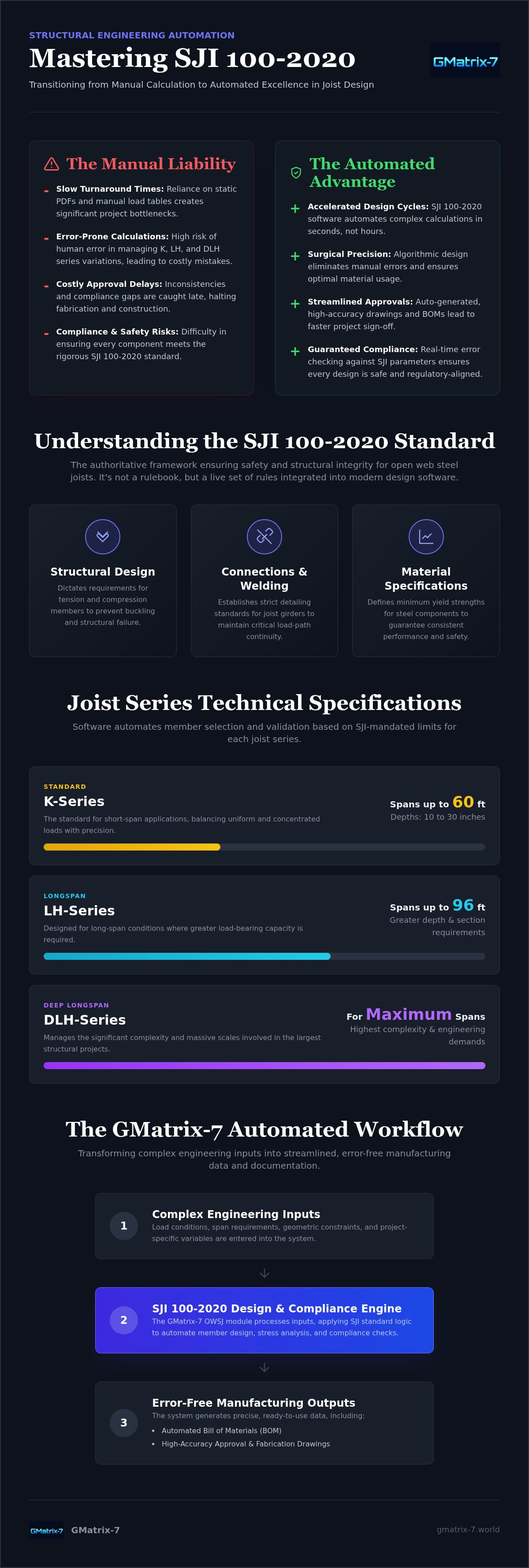
The standard dictates specific structural design requirements for tension and compression members to prevent buckling or catastrophic failure. It establishes strict connection detailing and welding standards for joist girders, which are critical for maintaining load-path continuity. Material specifications are equally vital. The standard defines minimum yield strengths for steel components to guarantee consistent performance across all series. These technical guardrails ensure that every component, from the smallest web member to the primary chord, functions within a verified safety margin. Without these rigorous benchmarks, the reliability of modern steel structures would be compromised.
The Shift from Standards to Software-Driven Detailing
Automation effectively closes the "compliance gap" that often plagues large-scale structural projects. By using specialized tools, engineers benefit from real-time error checking against SJI parameters, catching inconsistencies before they reach the fabrication floor. Integrating these standards with SJI compliant joist design principles allows for a seamless flow from engineering to detailing. GMatrix-7** **design software transforms the standard from a passive rulebook into an active, protective layer within the design workflow. This technological leap ensures that every output is battle-tested and ready for immediate project approval, providing peace of mind to both designers and fabricators.
Technical Specifications: K, LH, and DLH Series in SJI 100-2020
Precision engineering requires more than just following a list of rules; it demands a deep understanding of how different joist series interact under varying stress conditions. The American National Standard ANSI/SJI 100-2020 provides the necessary technical foundation for this work. In the 2026 landscape, structural integrity depends on how effectively an engineer translates these specifications into a functional digital model. This is where SJI 100-2020 design software becomes an indispensable asset, moving beyond traditional PDF lookups to provide live, data-driven validation for every member and connection.
K-Series Design Constraints and Software Logic
K-Series joists represent the standard for short-span applications, with depths typically ranging from 10 to 30 inches and spans reaching up to 60 feet. Advanced software logic handles the delicate balance of uniform loads versus concentrated loads with surgical accuracy. Instead of manual interpolation, the system automates the selection of top and bottom chord sections based on real-time stress analysis. This ensures that span-to-depth ratios remain within SJI-mandated limits while optimizing material usage. By automating these repetitive calculations, designers can focus on high-level structural integration rather than granular data entry.
Long Span (LH) and Deep Long Span (DLH) Complexity
Managing the requirements for Longspan (LH) and Deep Longspan (DLH) joists introduces significant complexity due to the massive scales involved. LH-Series joists can span up to 96 feet, while DLH-Series joists reach staggering spans of up to 240 feet with depths extending to 120 inches. SJI 100-2020 design software is critical here for analyzing secondary stresses that occur in these massive industrial spans. The software must account for stability during erection and final structural integration, mitigating the risk of lateral-torsional buckling. This level of rigorous analysis is nearly impossible to maintain manually at scale, making automation a prerequisite for safety.
Joist girders serve as the primary framing members, supporting the concentrated loads of the joists themselves with spans ranging from 20 to 120 feet. Modern engineering has moved beyond static load tables to custom, software-generated outputs. These dynamic tables allow for specific adjustments based on unique project environmental factors and material strengths. Engineers looking to optimize these outputs often turn to specialized bar joist modules to ensure every calculation aligns with global standards. This transition from static values to custom generation represents the pinnacle of modern structural engineering automation.
The ROI of Transitioning to SJI-Compliant Design Software
Manual detailing errors in bar joist manufacturing aren't just technical hiccups; they represent a direct drain on project profitability. Engineering firms often absorb the hidden costs of rework and material waste caused by antiquated, manual workflows. Implementing **GMatrix-7 **design software shifts this dynamic by replacing human fallibility with algorithmic certainty. This transition drives a superior return on investment by optimizing steel section selection and accelerating the critical journey from initial concept to final fabrication. Efficiency in 2026 is defined by the ability to move from data to delivery without the friction of manual correction.
Eliminating Manual Calculation Risks
Manual SJI referencing frequently forces engineers into "conservative" over-design. When uncertainty exists in manual calculations, the default response is to increase member sizes, which leads to unnecessary material consumption and higher shipping costs. Software-validated compliance removes this guesswork. It ensures that every tension and compression member meets the exact requirements of the standard without wasteful excess. This precision also serves as a critical shield against litigation, providing a verifiable audit trail of code compliance for every structural component. Automation excels at managing high-complexity variables that are prone to human error:
- Calculating bridge-traveling loads for specialized industrial crane systems.
- Managing complex wind uplift scenarios in high-velocity hurricane zones.
- Optimizing top and bottom chord sections for non-standard, custom spans.
By leveraging GMatrix-7 OWSJ bar joist detailing software, firms provide their clients with high-precision outputs that reflect a commitment to excellence and material efficiency. This level of detail builds trust and positions your business as a technologically advanced partner.
Accelerating Approval Drawing Workflows
Speed to market is a primary differentiator in the competitive structural engineering sector. Traditional detailing workflows often involve a tedious "back-and-forth" between the detailer and the Engineer of Record (EOR), which can stretch approval cycles by weeks. **GMatrix-7 **design software eliminates these friction points by generating professional submittals that meet IBC and SJI standards instantly. These automated drawings are technically robust and formatted for immediate review, significantly reducing the volume of RFIs and revision requests. Linking this design data directly to automated bill of materials software ensures that procurement can begin the moment approval is secured. This integrated approach transforms a once-disjointed process into a seamless, high-velocity pipeline that secures project timelines and protects your bottom line.
5 Steps to Implementing SJI 100-2020 Automation
Transitioning to **GMatrix-7 **design software is a strategic overhaul that transforms your structural workflow into a high-velocity production line. Begin with a comprehensive audit of your current detailing processes to identify where manual SJI referencing causes compliance gaps or approval delays. Often, these gaps occur during the interpretation of complex load scenarios that generic CAD tools cannot resolve. Once these friction points are identified, move to selecting a software solution that features specialized OWSJ modules. Generic platforms lack the specialized logic required to handle the nuances of bar joist design, leading to conservative over-design that erodes your profit margins.
Selecting the Right Engineering Software for Steel Joists
The ideal platform must demonstrate a robust ability to handle non-standard SJI configurations without the need for manual overrides. In 2026, compatibility with IBC 2024 and ASCE 7-22 is non-negotiable for maintaining regulatory standing and ensuring structural safety in diverse loading environments. Prioritize tools that offer professional structural design automation to ensure your firm stays ahead of the technological curve. This selection process should focus on a capability-to-outcome model, where specific software features lead directly to faster project approvals and reduced liability.
After selecting your platform, define your company's standard joist profiles and material grades within the tool to ensure consistency across all projects. This standardization prevents the introduction of non-compliant materials during the detailing phase. Next, automate the generation of load tables for custom project spans, replacing static PDF references with dynamic, project-specific data that reflects actual environmental loads. Finally, integrate these detailing outputs with your manufacturing and BOM systems to create a closed-loop environment. This ensures data flows from the engineer's desk to the fabrication floor without the risk of manual transcription errors.
Training and Workflow Integration
Moving your team from traditional drawing to sophisticated modeling of joist systems is vital for long-term success. This shift establishes a single source of truth for SJI specifications, ensuring that every detailer works from the same high-accuracy data pool. Set up automated quality control checks within the software environment to catch non-compliant configurations in real-time, such as improper span-to-depth ratios or insufficient bearing lengths. This proactive approach to safety and excellence transforms your detailing department into a driver of industrial progress, providing the peace of mind that comes from battle-tested technology.
Secure your competitive edge and eliminate calculation risks by exploring the GMatrix-7 / OWSJ (SJI) module for your next structural project.
GMatrix-7: Precision Engineering for SJI-Compliant Bar Joists
GMatrix-7 stands as the definitive solution for engineers and fabricators who refuse to compromise on structural accuracy. It functions as a world-class "Consultant-in-a-Box," specifically engineered to navigate the complexities of modern standards with surgical precision. By utilizing our SJI 100-2020 design software, users benefit from a seamless transition from complex engineering inputs to high-fidelity detailing outputs. This platform doesn't just provide a tool; it acts as a guardian of safety and a driver of industrial progress, ensuring 100% compliance with SJI 100-2020 and IBC standards. For global fabricators, the power of integrated engineering software for steel joists lies in its ability to synchronize design, detailing, and manufacturing into a single, unified workflow.
Features of the GMatrix-7 OWSJ Module
The GMatrix-7 / OWSJ (SJI), Bar Joists module provides an assertive suite of capabilities designed to eliminate the friction between design and fabrication. It enables the real-time generation of technical documentation, including professional approval drawings and comprehensive material lists. This specialized module supports a full range of configurations, including K-Series, LH-Series, DLH-Series, and custom joist girders. Because structural projects often involve multiple material types, GMatrix-7 ensures seamless integration with GMatrix-7 / MBS (IBC) and GMatrix-7 / LGS (AISI) design modules. This interoperability allows users to manage diverse structural requirements within a stable, data-driven environment. Key capabilities include:
- Automated generation of high-accuracy approval drawings and submittals.
- Precision-engineered Automated Bill of Material Generation to streamline procurement.
- Generating Single Skin, Sandwish panels and Composite Deck Load Tables for specific project spans.
The GMatrix-7 Advantage: Beyond Basic Compliance
GMatrix-7 offers a level of high-precision detailing that directly reduces material waste on the shop floor, protecting your profit margins. This isn't generic software; it's a battle-tested SJI 100-2020 design software platform designed for the 2026 structural engineering landscape. Users gain peace of mind knowing their designs are backed by authoritative support from a team led by structural engineering experts. We prioritize excellence above all else, providing a future-proof platform that evolves alongside global safety benchmarks. By moving from complexity to simplicity, GMatrix-7 empowers your firm to achieve world-class results with every project. You're not just buying software; you're gaining a partner committed to your high-level achievement and long-term stability.
Securing Your Competitive Edge in Structural Engineering Automation
Mastering the technical requirements of the Steel Joist Institute is no longer a manual burden but a strategic opportunity for growth. By transitioning from conservative, error-prone calculations to high-precision algorithmic modeling, your firm eliminates the compliance gap that often stalls large-scale projects. Implementing SJI 100-2020 design software ensures that every K, LH, and DLH series joist meets the most rigorous safety benchmarks while optimizing material efficiency for maximum profitability. This shift secures your reputation as a leader in structural excellence and industrial progress.
As a recognized leader in structural engineering automation, GMatrix-7 provides a battle-tested platform built specifically for SJI 100-2020 compliance. Our specialized modules empower global fabricators with automated BOM generation and precision detailing that accelerate approval cycles and reduce shop-floor waste. It's time to replace complexity with streamlined, data-driven certainty and lead your team toward a more secure and efficient future. We're committed to providing the tools you need to maintain the highest standards of safety and reliability.
Request a Technical Demo of GMatrix-7 OWSJ Software to transform your structural detailing capabilities today. We're ready to help you achieve world-class excellence in every design.
Frequently Asked Questions
What is the difference between SJI 100-2020 and previous SJI standards?
SJI 100-2020 unifies the K-Series, LH-Series, and DLH-Series into a single, comprehensive standard for open web steel joists. This consolidation replaces separate specifications, creating a more cohesive framework for structural integrity and safety benchmarks. By using SJI 100-2020 design software, engineers ensure their projects align with this unified code without the risk of using outdated, series-specific tables. This evolution reflects a broader industrial move toward standardized safety and performance benchmarks across all joist types.
Does SJI 100-2020 software handle composite joist (CJ-Series) design?
SJI 100-2020 focuses specifically on K-Series, LH-Series, and DLH-Series joists along with Joist Girders. While composite joists fall under different SJI specifications, our specialized modules focus on the rigorous requirements of OWSJ and Bar Joists. High-level automation in GMatrix-7 handles the intricate design logic required for these specific series with absolute precision. This focused approach ensures that the unique tension and compression members of standard joists are optimized for maximum structural performance.
How does SJI 100-2020 design software integrate with BIM workflows?
Modern design software integrates with BIM workflows by providing coordinated data that flows seamlessly between engineering models and detailing outputs. This connection establishes a single source of truth for all structural components, reducing the risk of coordination errors during the design phase. By exporting precise geometry and load data, the software ensures that joist systems are accurately represented in the broader building model. This integration accelerates the approval cycle and improves overall project security.
Can software automate the generation of SJI load and weight tables?
Automation allows for the instant generation of load and weight tables tailored to custom project spans and environmental factors. Unlike static PDF tables, GMatrix-7 produces dynamic data that reflects actual material strengths and yield requirements. This capability includes generating tables for single skin, sandwich panels, and composite deck loads. This transition from manual interpolation to software-generated accuracy ensures that every member is sized for excellence rather than conservative, wasteful over-design.
Is GMatrix-7 software compliant with the latest IBC 2024 requirements?
GMatrix-7 is fully compatible with the latest IBC 2024 requirements, ensuring your designs meet current building code regulations. Our software is built to handle the updated load combinations and safety factors mandated by the newest standards. This commitment to excellence provides peace of mind for engineers who must navigate the transition between older codes and the 2026 regulatory landscape. By maintaining 100% compliance, the platform serves as a dependable guardian of structural safety.
What technical support is available for implementing SJI automation?
Implementation is supported by a team of structural engineering experts who provide authoritative guidance on software integration and SJI compliance. This consultant-level support ensures that your team moves smoothly from initial setup to full-scale production. We offer technical documentation and expert-led training to help detailers transition from drawing to modeling joist systems. This battle-tested support structure is designed to help your firm achieve world-class results while maintaining a focus on industrial progress and excellence.
How does the software handle specialized loading like snow drift or uplift?
The software utilizes advanced algorithms to handle specialized loading scenarios like snow drift and wind uplift with surgical accuracy. It automates the complex math required to calculate these non-uniform loads, ensuring that top and bottom chord sections are properly reinforced. This level of precision is critical for maintaining structural stability in high-velocity hurricane zones or northern climates. By integrating these parameters directly into the design logic, the software eliminates the risks associated with manual calculation errors.
Can I generate a full Bill of Materials (BOM) directly from SJI design data?
You can generate a comprehensive Bill of Materials directly from the design data, ensuring 100% accuracy in procurement. This automated process links engineering inputs to manufacturing outputs, eliminating the need for manual transcription. The SJI 100-2020 design software produces precise material lists for K, LH, and DLH series joists, helping global fabricators reduce shop-floor waste and improve profitability. This integrated approach ensures that every structural component is accounted for, from primary chords to secondary web members.


