
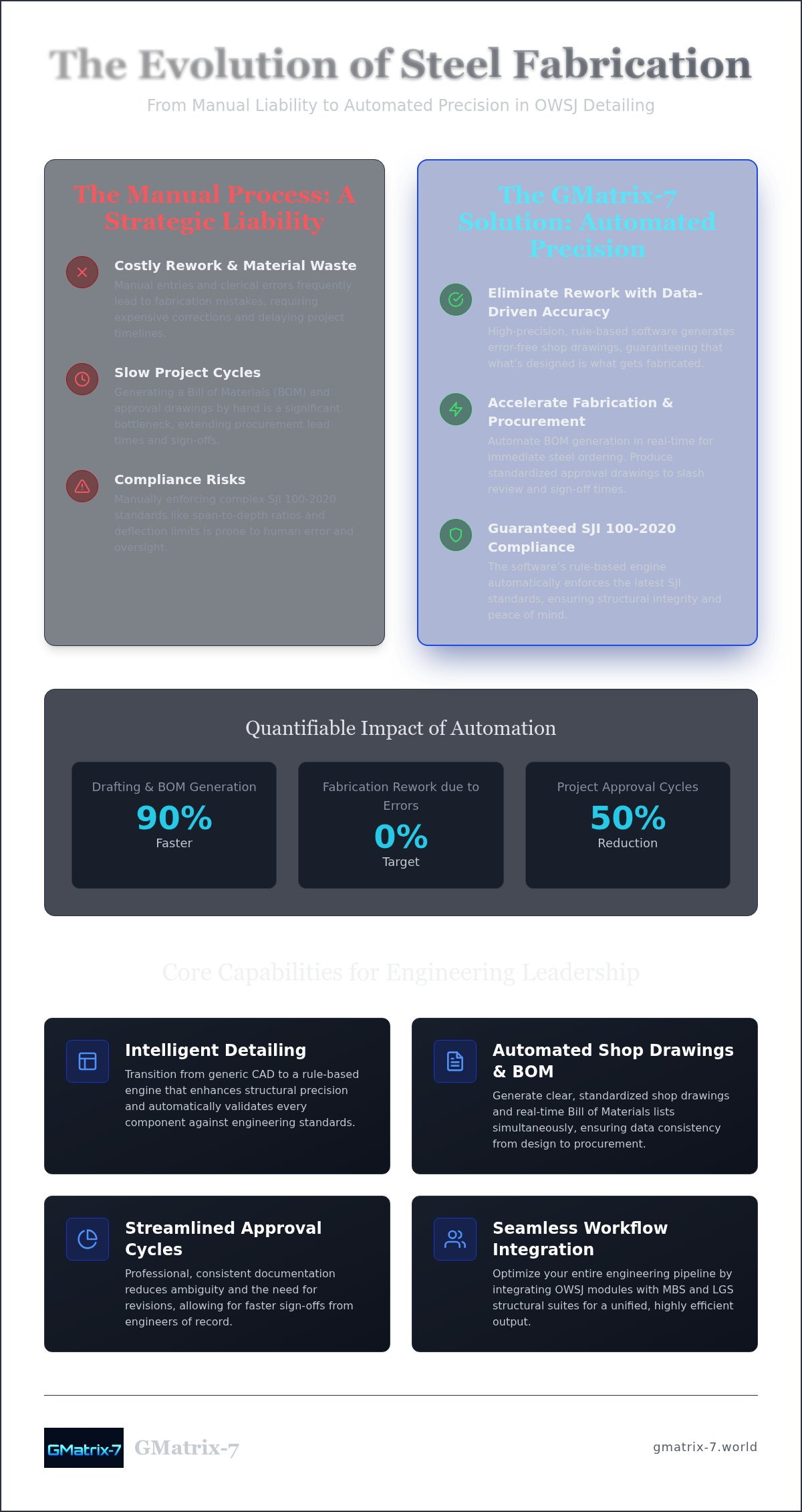
Manual detailing is no longer just a time-consuming task; it's a strategic liability that compromises your fabrication margins. Every manual entry increases the risk of costly rework, especially as you strive to maintain rigorous SJI 100-2020 compliance in an increasingly demanding market. You've likely experienced the friction of slow Bill of Material generation and the anxiety of potential errors during the drafting phase. It's a common pain point for firms that prioritize excellence but find themselves tethered to outdated, manual processes that cannot keep pace with modern industrial demands. Using automated OWSJ shop drawings is the only way to maintain a competitive edge in this high-stakes environment.
This engineering guide illustrates how specialized OWSJ detailing software replaces these vulnerabilities with high-precision automation. By implementing GMatrix-7, you can generate automated OWSJ shop drawings that bridge the gap between complex engineering inputs and profitable fabrication outcomes. We'll examine the technical processes that enable error-free BOM generation and seamless approval drawings. You'll learn how to accelerate your fabrication workflows while maintaining the peace of mind that comes from absolute data-driven accuracy. This is the 2026 standard for engineering leadership and operational superiority.
Key Takeaways
- Transition from manual CAD to intelligent, rule-based detailing to enhance structural precision and engineering authority.
- Accelerate project approval cycles and streamline procurement through the generation of automated OWSJ shop drawings.
- Maintain rigorous SJI 100-2020 compliance with automated enforcement of span-to-depth ratios and complex deflection limits.
- Eliminate fabrication rework and material waste by utilizing real-time, error-free Bill of Material generation.
- Optimize your entire engineering workflow by integrating OWSJ modules with MBS and LGS structural suites for a seamless output.
OWSJ Bar Joist Detailing Software: Why It's Essential
Structural engineering in 2026 demands a level of precision that manual calculations simply cannot sustain. An Open web steel joist (OWSJ) system serves as the backbone of modern commercial construction, yet its detailing has historically been a bottleneck. Specialized detailing software isn't just a digital drafting board; it's a rule-based engine designed to enforce structural integrity from the first input. This technology represents a fundamental shift from generic CAD drafting to intelligent, data-driven modeling that bridges the gap between engineering theory and fabrication reality. It ensures that every joist, girder, and bridging component is optimized for its specific load case while strictly adhering to global safety standards.
The Evolution of Steel Joist Detailing
The industry has moved beyond the era of manual drafting tables and static 2D CAD blocks. Today's sophisticated platforms interpret SJI 100-2020 standards automatically, ensuring that every span-to-depth ratio and load requirement is met without manual oversight. This evolution is critical because current project timelines don't allow for the slow, iterative cycles of the past. By integrating these tools with Building Information Modeling (BIM), detailers can coordinate complex joist layouts with HVAC, plumbing, and electrical systems in a unified digital environment. This prevents the on-site clashes that frequently derail construction schedules and inflate project costs. It's a transition from simple drawing to comprehensive project management.
Core Benefits for Manufacturers and Detailers
Implementing specialized software delivers immediate, high-value outcomes for fabrication shops. The most significant advantage is the generation of automated OWSJ shop drawings, which slashes drafting hours and accelerates the approval cycle. By removing the "human element" from repetitive load calculations, firms eliminate the risk of fabrication rework caused by simple clerical errors. This creates a secure, reliable workflow where the focus shifts from error correction to production volume.
- Accelerated Procurement: Real-time Bill of Material (BOM) generation allows for immediate steel ordering, reducing lead times.
- Standardized Outputs: Professional approval drawings ensure clear, authoritative communication with engineers of record, facilitating faster sign-offs.
- Operational Efficiency: Utilizing automated OWSJ shop drawings allows senior engineers to focus on complex structural problem-solving rather than rote drafting tasks.
This methodical approach ensures that every component leaving the shop is optimized for both safety and profitability. It provides the peace of mind that comes from knowing your detailing process is as rigorous as the engineering standards it supports.
Key Features of High-Performance Joist Detailing Tools
High-performance detailing tools serve as the vital link between structural theory and profitable fabrication. These systems don't just draft; they calculate, validate, and document with a level of precision that manual workflows can't replicate. By utilizing sophisticated SJI design and analysis tools, modern software ensures that every joist configuration meets rigorous safety benchmarks while maximizing material efficiency. This capability-to-outcome approach allows firms to move from complex project inputs to streamlined fabrication outputs with total confidence. It transforms the detailing phase from a potential bottleneck into a driver of industrial progress and operational stability.
Automated Approval Drawing Generation
Securing rapid client sign-off is essential for maintaining project momentum. Automation generates clear, defensible technical documentation that adheres to consistent formatting across even the largest-scale industrial projects. This consistency eliminates the ambiguity that often triggers the repetitive "review-and-revise" cycle. By delivering precision-first designs from the outset, detailers provide reviewers with authoritative documentation that requires fewer corrections. This reduces administrative overhead and ensures that fabrication can begin without the delays typically associated with manual drafting errors. It's about establishing trust through technical excellence.
Comprehensive Bill of Material (BOM) Automation
True efficiency occurs when drawings and material lists exist in a unified data environment. High-performance software moves from automated OWSJ shop drawings to detailed material lists in seconds, tracking every component from seat angles to web members. This real-time visibility is crucial for streamlining procurement and minimizing waste on the shop floor. By linking BOM data directly to manufacturing and nesting software, fabricators can optimize their inventory management and ensure that every pound of steel is accounted for. This seamless transition from data to physical material is the hallmark of a world-class detailing operation.
Customization and Load Table Logic
Every fabrication shop operates with unique equipment and internal standards. Leading detailing tools allow for customizable detailing rules that align software outputs with specific shop capabilities and fabrication limits. This includes the intelligent generation of load tables for various joist configurations, including single skin, sandwich panels, and composite deck scenarios. This level of specialization ensures that the software adapts to your professional workflow, rather than forcing your team to adapt to the software. To see how these features integrate into a complete structural suite, explore the professional modules available at GMatrix-7.
SJI Compliance: Detailing for Structural Integrity
Engineering excellence requires an uncompromising commitment to industry standards. For open web steel joists, this means translating the SJI Standard Specifications into a digital framework that actively prevents design violations. High-performance detailing software provides this protection by enforcing critical design limits, such as span-to-depth ratios and deflection requirements, directly within the model. This is particularly vital when navigating complex projects that must simultaneously align with SJI 100-2020 and regional requirements like Canadian building codes (NBC). Relying on generalized calculators is a risk that modern firms can't afford. You need a specialized engine that understands the nuances of joist geometry and load paths.
Digital Enforcement of SJI Standards
Software automation removes the ambiguity of manual checks for K-Series, LH-Series, and DLH-Series joists. It ensures that seat and connection details meet rigorous safety requirements before a single drawing is issued. When projects involve non-standard loading conditions or concentrated point loads, the software applies compliant logic to ensure structural stability without manual recalculation. This systematic approach is essential for generating automated OWSJ shop drawings that are audit-ready and technically sound. It effectively transforms the SJI code from a static document into a dynamic, real-time guardian of your project's integrity, even in the most demanding industrial environments.
- Deflection Monitoring: Automated verification of live load and total load deflection limits to prevent structural sagging or finish damage.
- Span-to-Depth Ratios: Continuous monitoring of geometric limits to ensure joist stability and vibration control across long spans.
- Seat Depth and Bearing: Precise calculation of bearing lengths and seat depths to prevent connection failure during the erection phase.
The ROI of Compliance Automation
The financial impact of compliance automation extends far beyond simple speed. It's about reducing liability through traceable, standards-aligned outputs that stand up to rigorous structural engineering audits. Avoiding even a single field fix caused by non-compliant detailing can save tens of thousands of dollars in labor, material, and logistical costs. This level of precision positions your firm as a leader in professional structural design automation. You're not just selling drafting services; you're providing the security and peace of mind that only comes from verified, battle-tested engineering data. It's a strategic move toward higher achievement and operational security.
Implementing OWSJ Software in Your Workflow
Transitioning to an automated environment requires a methodical approach that prioritizes data integrity and shop floor reality. The first step involves a rigorous assessment of your current detailing bottlenecks, specifically identifying where manual data entry leads to material waste. Once these friction points are identified, you must configure your software rules to align perfectly with your specific fabrication capabilities. This ensures that the automated OWSJ shop drawings produced are not just mathematically correct, but also optimized for your shop's physical welding and handling limits.
Integration is the next pillar of a successful implementation. By connecting OWSJ modules with broader structural project data, you create a unified structural model that eliminates silos between different building components. This leads to Step 4: training your team to leverage automated BOM and drawing outputs effectively. Finally, establishing a continuous feedback loop between the detailing office and the shop floor ensures that the software settings evolve alongside your fabrication technology. Advanced detailing software serves as the operational backbone of a modern steel plant.
Overcoming Common Implementation Hurdles
Many firms struggle with the gap between legacy CAD files and intelligent, rule-based models. Achieving data continuity from the engineering office to the fabrication line requires a commitment to a "single source of truth" model. This transition moves your team away from static lines and toward dynamic components that carry engineering intelligence throughout the project lifecycle. It's about replacing fragmented drafting tasks with a seamless, data-driven workflow that supports global standards and eliminates the "human-element" errors that plague manual drafting.
Optimizing for Speed and Accuracy
Scaling your operations to handle peak project volumes is only possible when you leverage steel joist detailing automation. Using automated templates for repetitive joist types allows your senior detailers to focus on complex geometry while the system handles the standard K and LH series. You don't have to sacrifice rigor for speed; the software performs simultaneous checks to ensure SJI compliant joist design while generating automated OWSJ shop drawings at a fraction of the manual time. This balance provides the competitive advantage needed to secure larger, more complex industrial contracts. To upgrade your firm's technical capacity and streamline your production, explore the high-precision modules at GMatrix-7.
The GMatrix-7 Advantage: Precision OWSJ Detailing
GMatrix-7 isn't just a tool; it's a modular ecosystem designed for the most demanding structural environments. The GMatrix-7 / OWSJ (SJI), Bar Joists module represents the pinnacle of specialized engineering automation. Unlike standalone solutions that isolate tasks, our platform offers seamless integration with MBS (IBC) and LGS (AISI) suites. This synergy allows fabricators to manage complex, multi-material projects from a single, high-precision interface. The platform bridges the gap between complex engineering inputs and streamlined fabrication outputs, ensuring that even the most intricate bar joist designs are executed with surgical precision. By generating automated OWSJ shop drawings within this unified framework, you reduce material waste and ensure that every output is optimized for both safety and profitability.
Why Industry Leaders Choose GMatrix-7
World-class fabricators demand more than just drafting speed. They require a battle-tested platform that acts as a guardian of structural safety. GMatrix-7 provides unmatched reliability in generating SJI-compliant load tables and technical documentation. Our assertive approach to automation eliminates the guesswork that often leads to costly field errors. The generation of automated OWSJ shop drawings is no longer a luxury but a baseline for industrial survival. By adhering to the most rigorous global standards, we provide the peace of mind that comes from total engineering confidence. This is why industry leaders choose us to handle their most critical infrastructure projects. We don't just provide software; we provide a foundation for high-level achievement.
The Future of Detailing: 2026 and Beyond
As we look toward 2026 and beyond, the trend toward fully automated engineering documentation is accelerating. GMatrix-7 leads this charge by fostering synergy between OWSJ detailing and LGS structural design software. This interconnectedness ensures that as building codes evolve, your detailing workflow remains ahead of the curve. The future belongs to those who embrace precision-first automation and data-driven workflows. You shouldn't settle for fragmented tools when you can command a comprehensive structural suite that handles everything from single skin panels to complex joist girders. Elevate your detailing standards today by integrating a system built for excellence and long-term industrial progress.
Command the Future of Structural Detailing
The transition to intelligent, rule-based detailing isn't just an operational upgrade; it's a fundamental requirement for firms that prioritize technical authority. You've explored how specialized software eliminates the vulnerabilities of manual drafting and ensures that every project meets the rigorous SJI 100-2020 standard. By integrating high-precision tools, you transform your workflow into a data-driven engine that bridges the gap between engineering theory and fabrication profit. This systematic approach provides the security and peace of mind that only world-class technology can deliver.
Generating automated OWSJ shop drawings allows your team to handle peak project volumes without compromising on accuracy or safety. With GMatrix-7, you gain a battle-tested platform featuring automated BOM generation and a seamless MBS/LGS ecosystem designed for world-class fabricators. It's time to move beyond legacy drafting bottlenecks and embrace a future of industrial progress and operational superiority. Optimize Your OWSJ Detailing with GMatrix-7 and lead the charge in structural engineering excellence. Your firm's path to high-level achievement starts with the right technical foundation.
Frequently Asked Questions
What is the difference between general CAD and specialized OWSJ detailing software?
Specialized OWSJ detailing software functions as a rule-based engineering engine rather than a simple drafting tool. While general CAD requires manual entry of every line and dimension, specialized platforms automatically apply SJI standards to the structural geometry. This intelligence ensures that every component is structurally sound from the initial input. It eliminates the clerical errors inherent in manual drafting and provides a data-driven foundation for the entire fabrication lifecycle.
Does OWSJ detailing software ensure compliance with SJI 100-2020?
Yes, the software enforces SJI 100-2020 standards through digital design limits and automated verification. It continuously monitors span-to-depth ratios, deflection requirements, and bearing lengths during the modeling process. If a design choice violates these specifications, the system flags the error immediately. This proactive enforcement provides engineers with the security that their outputs are fully compliant with current industry safety benchmarks and rigorous structural specifications.
Can GMatrix-7 generate both shop drawings and Bills of Material?
GMatrix-7 provides a unified platform that simultaneously creates professional approval drawings and comprehensive Bills of Material. This integration ensures that the material list exactly matches the finalized engineering model. By automating both outputs, the software removes the risk of transcription errors between the drafting office and procurement. This seamless transition from technical documentation to material lists is a core feature of the GMatrix-7 / OWSJ (SJI) module.
How does automated detailing reduce material waste in bar joist manufacturing?
Automated detailing reduces material waste by providing high-precision calculations that eliminate the need for excessive safety buffers often used in manual design. Generating automated OWSJ shop drawings that are linked directly to fabrication data allows manufacturers to optimize steel usage and reduce off-cuts. Precise BOMs ensure that only the necessary material is ordered, preventing the accumulation of unused inventory and significantly lowering overall project costs.
Is the software compatible with MBS (IBC) and LGS (AISI) modules?
GMatrix-7 is built as a modular structural suite that allows for full interoperability between OWSJ, MBS (IBC), and LGS (AISI) components. This ecosystem ensures that data flows smoothly across different structural systems within a single building project. You can design a metal building frame and its joist system in a unified environment. This integration prevents coordination errors and ensures that all structural elements align with their respective global design codes.
What are the hardware requirements for modern structural detailing software in 2026?
Modern structural detailing software in 2026 performs best on high-performance workstations equipped with multi-core processors and at least 32GB of RAM. A dedicated graphics card with high VRAM is essential for handling complex 3D models and large-scale industrial layouts. While cloud-based collaboration is common, local processing power remains critical for the intensive calculations required for real-time SJI compliance checks and rapid drawing generation.
How long does it take to implement automated joist detailing in a fabrication shop?
Implementation typically follows a methodical step-by-step progression that spans several weeks. This period includes assessing current bottlenecks, configuring software rules to match your shop's fabrication limits, and training your team on automated outputs. While basic functionality is immediate, the full optimization of the feedback between detailing and the shop floor ensures long-term efficiency. Most fabricators see a significant return on investment within their first few major projects.
Can the software handle custom or non-standard bar joist designs?
The software is designed to handle non-standard loading conditions and custom configurations while maintaining a compliant structural framework. It applies rigorous engineering logic to unique seat details, concentrated point loads, and varying joist depths. Even with custom designs, the system produces automated OWSJ shop drawings that are audit-ready and technically defensible. This flexibility allows your firm to take on complex industrial contracts that exceed the capabilities of standard design tables.


