

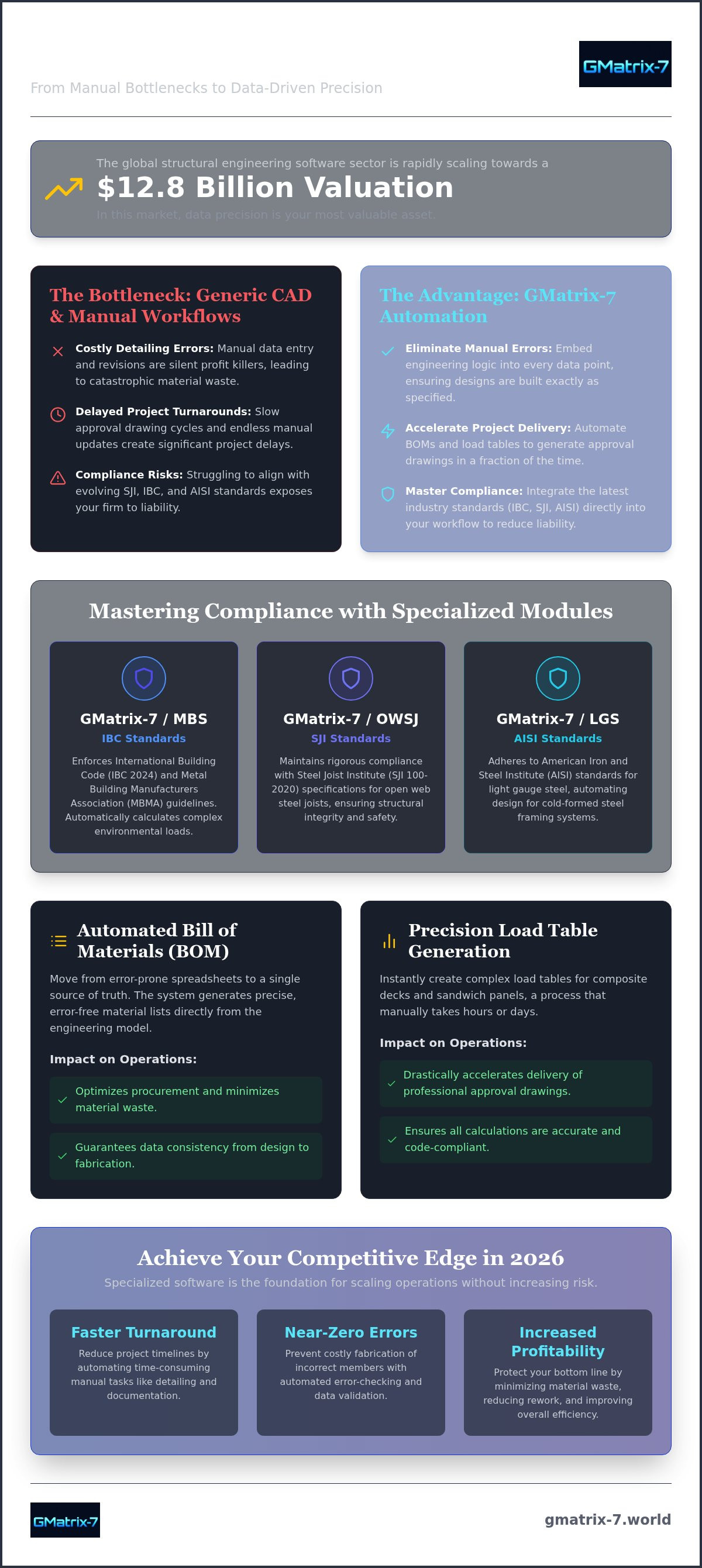
In a market where the global structural engineering software sector is rapidly scaling toward a $12.8 billion valuation, the most expensive asset in your facility isn't the CNC machinery; it's the precision of your data. Implementing the right structural design software for fabricators is no longer optional if you intend to mitigate the risks of manual detailing errors and material waste. You've likely experienced the frustration of delayed project turnarounds caused by slow approval drawing cycles or the struggle to align with evolving SJI and IBC standards. It's a common bottleneck that separates standard shops from industry leaders.
This guide reveals how specialized automation transforms these technical challenges into decisive competitive advantages. You'll discover how specialized structural design automation eliminates manual detailing errors and streamlines compliance for modern steel fabricators. We'll examine the specific capabilities of GMatrix-7 / MBS (IBC), GMatrix-7 / OWSJ (SJI), and GMatrix-7 / LGS (AISI) modules. We'll also detail how automated bill of material generation and seamless load table creation ensure faster, error-free project delivery.
Key Takeaways
- Learn how specialized structural design software for fabricators bridges the gap between complex engineering and shop-floor production to eliminate manual detailing errors.
- Understand the strategic integration of GMatrix-7 / MBS (IBC), OWSJ (SJI), and LGS (AISI) modules to maintain rigorous compliance with the latest industry standards.
- Discover how automated Bill of Material (BOM) generation optimizes procurement by providing precise, error-free data that minimizes material waste.
- Master the automation of complex load tables for composite decks and sandwich panels to accelerate the delivery of professional approval drawings.
- Identify the workflow improvements necessary to achieve faster project turnaround times and maintain a competitive edge in the 2026 steel fabrication market.
Beyond Generic CAD: Why Fabricators Need Specialized Structural Design Software
Generic CAD platforms provide versatility across multiple industries; however, they lack the granular, engineering-driven intelligence required for high-volume steel fabrication. Relying on general-purpose drafting tools in the 2026 market is a strategic liability. Precision is the primary currency of the modern shop floor. Transitioning to specialized structural design software for fabricators isn't just about drawing lines faster. It's about embedding engineering logic into every data point to ensure that what's designed is exactly what's built.
The "automation-first" philosophy has become the global benchmark for excellence. Leading fabricators no longer view software as a digital pencil but as a comprehensive engine that bridges the gap between complex engineering inputs and streamlined shop outputs. This shift eliminates the disconnect between the design office and the production line, ensuring that technical specifications translate into physical reality without manual intervention.
The Detailing Bottleneck in Modern Fabrication
Manual drawing revisions are a silent profit killer. Every hour spent manually updating a BOM or correcting a detailing error is an hour lost to production. Data silos between structural engineers and fabricators often lead to redundant work and catastrophic material waste. When teams rely on static drawings, a single change in load requirements can trigger a cascade of manual updates across dozens of sheets.
Modern excellence demands a move from drafting to data-driven design. Software like Tekla Structures has demonstrated the power of 3D modeling in the broader construction sector, yet specialized systems take this further by integrating specific fabrication rules. By utilizing specialized structural design software for fabricators, your team can generate approval drawings that are intrinsically linked to the engineering model. This synchronization ensures that when the design changes, the data follows automatically, eradicating the bottleneck of manual oversight.
Specialized vs. General Software ROI
The return on investment for specialized modules is measured in both speed and security. General software often requires extensive customization or third-party plugins to handle specific steel standards. When analyzing the choice between CAD vs specialized software for steel detailing, the distinction lies in the automation of the engineering logic itself.
- Accelerated Implementation: Specialized modules like GMatrix-7 / MBS (IBC) are pre-configured for industry-standard workflows, reducing setup time.
- Reduced Learning Curve: New engineering staff can reach peak productivity faster when the software enforces compliance with SJI and IBC codes.
- Long-term Profitability: Automated error-checking prevents the costly fabrication of incorrect members, directly protecting your bottom line.
In a competitive landscape, the ability to deliver error-free projects with faster turnaround times is the ultimate differentiator. Specialized software provides the reliable foundation necessary to scale operations without increasing the risk of human error.
Mastering Compliance: MBS, OWSJ, and LGS Engineering Standards
Compliance isn't a suggestion; it's a foundation. In the 2026 engineering landscape, staying current with the IBC 2024 and SJI 100-2020 standards is non-negotiable. Leading firms rely on the GMatrix-7 / MBS (IBC) module to enforce these rules at the source. This advanced structural design software for fabricators integrates guidelines from the Metal Building Manufacturers Association (MBMA), allowing for the automatic calculation of complex environmental loads. It's a system built for precision, ensuring that regional code variations don't lead to costly design revisions or safety compromises.
Automating structural compliance checks is the only reliable way to reduce liability in high-volume production. When the software handles the heavy lifting of code verification, your engineering team is free to focus on project optimization. This transition from manual oversight to automated validation creates a secure environment where safety and efficiency coexist. It's a results-oriented approach that positions your business as a premier leader in the field.
Engineering OWSJ and SJI Joist Systems
Open web steel joists demand a level of detail that manual processes can't consistently provide. The GMatrix-7 / OWSJ (SJI) module simplifies this complexity by automating bar joist detailing and analysis. It handles intricate load requirements with ease, ensuring every component meets the rigorous benchmarks of SJI compliant joist design. By integrating joist engineering with the broader building model, you eliminate the data silos that often lead to coordination errors. It's a methodical approach that guarantees both speed and safety in high-stakes projects.
Light Gauge Steel (LGS) and AISI S100 Compliance
Cold-formed steel requires specialized knowledge of AISI standards to prevent buckling and member failure. The GMatrix-7 / LGS (AISI) module offers dedicated tools for LGS framing layouts, ensuring full AISI S100 compliance through automated verification. It generates comprehensive technical documentation that reflects the exact structural needs of lightweight steel projects. This level of automation allows engineers to focus on optimization rather than repetitive compliance checks. It's about achieving world-class results while maintaining an earnest commitment to structural excellence. This level of automation positions GMatrix-7 as the premier structural design software for fabricators who prioritize data-driven safety.
Eliminating Errors with Automated Bills of Material (BOM)
Precision engineering is only as valuable as the accuracy of the data reaching the procurement department. In the high-stakes 2026 material market, even a minor discrepancy in a material list can lead to significant financial loss and project delays. High-performance structural design software for fabricators solves this by creating a direct, digital link between the engineering model and the final bill of materials. This automation ensures that every pound of steel ordered is exactly what the design requires, effectively eliminating the material waste associated with manual estimation and redundant data entry.
Strategic inventory management depends on this level of data integrity. When design data flows directly into fabrication-ready documentation, procurement teams can secure materials with total confidence. This results-oriented approach moves beyond simple drafting; it establishes a rigorous, data-driven workflow that protects your margins and accelerates project timelines from day one.
From Approval Drawings to Material Lists
The workflow for modern excellence begins with the precise input of project parameters. These inputs generate professional approval drawings that serve as the single source of truth for the entire project. For engineers utilizing MBS IBC design software, the transition from these drawings to a comprehensive BOM is instantaneous. This synchronization ensures total data consistency across all project documents, from the initial structural analysis to the final shipping manifest. By removing the need for manual transcription, you secure the peace of mind that comes with knowing your material lists are perpetually aligned with the latest design revisions.
Reducing Human Error in Detailing
Manual entry points are the primary breeding grounds for detailing errors. Whether it's a mistyped member length or an incorrect steel grade, these small mistakes often remain hidden until they cause a disaster during the fabrication or erection phases. Automated software validation acts as a guardian of safety, flagging inconsistencies before they leave the digital environment.
- Validation: Software cross-references every component against the engineering model.
- Standardization: Ensuring all OWSJ components meet the latest criteria from the Steel Joist Institute (SJI).
- Efficiency: Reducing the time spent on manual audits by up to 80% through automated checking.
The impact on project timelines is immediate and profound. By automating the detailing process, fabricators can move projects into production faster while maintaining an earnest commitment to structural excellence. It's a battle-tested method for maintaining high-level achievement in an increasingly complex industrial landscape.
Precision Load Table Generation for Composite Decks and Panels
The technical complexity of composite floor deck load tables represents a significant engineering challenge in modern steel construction. In 2026, manual load table generation is more than just a time-sink; it's a profound liability. Leading firms recognize that structural design software for fabricators must do more than just draft. It must calculate with absolute precision. Relying on spreadsheets or disconnected plugins introduces unacceptable risks in structural integrity and project timelines. Utilizing a composite deck load table generator allows for rapid, precise engineering that meets rigorous global standards without the burden of manual input.
Automating these calculations for single skin and sandwich panels ensures that every output is verified against the latest structural codes. This data-driven approach allows fabricators to provide reliable, high-value documentation to their clients, reinforcing their position as industry leaders. It's about moving from uncertainty to absolute precision. When you automate the generation of Single Skin, Sandwich panels, and Composite Deck Load Tables, you eliminate the human error that often plagues cladding and decking specifications.
Calculating Capacity for Sandwich Panels
Addressing thermal and structural load factors simultaneously requires a sophisticated engineering engine. Specialized software automates these inputs, standardizing the output for immediate engineering approval. This precision speeds up the cladding design process significantly. By integrating these complex variables into a single workflow, fabricators can deliver optimized panel designs that maintain safety while reducing material excess. It's a methodical progression that ensures every panel meets the specific environmental demands of the project. This capability allows for a seamless transition from complexity to simplicity in the engineering office.
Automated Documentation for Decking Systems
Generating professional-grade load tables for composite decks is essential for market competitiveness. Fabricators must ensure compliance with global structural deck standards to secure high-value contracts. Automated systems enhance the value proposition for deck fabricators by providing clear, error-free documentation that engineers trust. This level of transparency and accuracy builds the pride of high-level achievement and provides the peace of mind that comes with world-class engineering. Secure your reputation as a premier provider by adopting the advanced structural design software for fabricators that automates these critical safety documents.
Implementing GMatrix-7: Streamlining Fabrication Workflows
Transitioning to a world-class, automated engineering environment requires more than just a software license. It demands a strategic integration of specialized tools into your existing shop culture. Implementing structural design software for fabricators like GMatrix-7 involves aligning your engineering inputs with shop-floor capabilities. This synchronization ensures that GMatrix-7 / MBS (IBC), GMatrix-7 / OWSJ (SJI), and GMatrix-7 / LGS (AISI) modules don't just sit in a silo but drive the entire production cycle with absolute precision.
Customizing these software modules for your specific fabrication needs is where the real optimization happens. Every shop has unique manufacturing tolerances and material preferences. The flexibility of GMatrix-7 allows for a seamless transition from traditional drafting to a high-performance, data-driven environment. By tailoring the software to your specific project types, you ensure that every output is optimized for your facility's efficiency.
The GMatrix-7 Advantage for Fabricators
Excellence is achieved through a visionary approach to structural engineering. GMatrix-7 provides more than just calculation tools; it offers a guardian of safety for every project. By utilizing authoritative expertise in MBS, OWSJ, and LGS design, the platform delivers the peace of mind that comes from rigorous, battle-tested software. The future of professional structural design automation is rooted in this reliability. It's a commitment to precision that elevates your business from a standard supplier to a globally-minded partner.
Next Steps for Engineering Optimization
Modernizing your fabrication shop begins with a cold, hard look at your current detailing and design bottlenecks. If your team is still manually revising approval drawings or double-checking BOMs, you're losing money. Identifying these friction points is the first step toward reclaiming your margins and accelerating project delivery.
- Audit your workflow: Pinpoint exactly where manual data entry causes delays or errors.
- Consult the experts: Request a specialized module consultation to see how GMatrix-7 fits your specific project types.
- Execute the transition: Move toward an "automation-first" standard to secure your competitive edge in the 2026 market.
Actionable progress requires bold leadership and the right technology. By choosing a structural design software for fabricators that prioritizes data integrity, you ensure that your facility remains both technologically advanced and fundamentally stable. It's time to move beyond generic CAD and embrace a results-oriented engineering future that values excellence above all else.
Securing Your Competitive Advantage in Modern Steel Fabrication
Precision is the benchmark of the 2026 market. By integrating specialized automation, you replace the inherent risks of manual detailing with the security of data-driven design. You've seen how automated BOMs and professional approval drawings eliminate material waste. Now, you must apply that efficiency across your entire operation. Choosing the right structural design software for fabricators ensures that every project meets the most rigorous IBC, SJI, and AISI standards without the burden of manual compliance checks.
GMatrix-7 provides the advanced load table technology and engineering logic necessary to scale your operations safely. It moves beyond drafting to deliver a world-class engineering environment that prioritizes excellence. Secure your reputation as a premier provider by adopting a platform built for high-level achievement and reliability. Explore GMatrix-7 Structural Design Modules to optimize your engineering output and achieve total peace of mind. Your path to error-free fabrication begins with the right digital foundation.
Frequently Asked Questions
What is the best structural design software for steel fabricators in 2026?
GMatrix-7 stands as the premier structural design software for fabricators in 2026 because it integrates engineering logic with fabrication-ready outputs. Unlike generic tools, it offers specialized modules like GMatrix-7 / MBS (IBC) and GMatrix-7 / OWSJ (SJI) that enforce industry standards automatically. This results-oriented platform ensures high-level achievement by providing a seamless transition from complex inputs to streamlined outputs, making it the gold standard for global steel fabrication facilities.
How does automated BOM generation reduce structural project costs?
Automated Bill of Material generation reduces costs by eliminating the human errors that lead to material waste and procurement delays. By linking the engineering model directly to the material list, fabricators ensure that every pound of steel ordered is essential for the project. This data-driven approach accelerates inventory management and protects profit margins. It provides the peace of mind that comes from knowing your documentation is perpetually aligned with the latest design revisions.
Can structural design software handle IBC 2024 and SJI 100-2020 compliance?
Yes, modern platforms like GMatrix-7 are specifically engineered to handle the latest regulatory requirements. The GMatrix-7 / MBS (IBC) module incorporates IBC 2024 standards, while the GMatrix-7 / OWSJ (SJI) module aligns with SJI 100-2020 for US and Canadian codes. Automating these compliance checks reduces liability and ensures that your structural integrity meets global standards. This rigorous approach allows your engineering team to focus on optimization rather than manual code verification.
What are the benefits of specialized OWSJ bar joist detailing software?
Specialized OWSJ bar joist detailing software, such as GMatrix-7 / OWSJ (SJI), automates the complex analysis required for open web systems. It handles intricate load requirements and generates precise technical documentation that meets SJI benchmarks. By integrating joist design with the overall building system, you eliminate data silos and coordination errors. This methodical workflow increases shop throughput while maintaining an earnest commitment to safety and excellence in every structural component.
How do you generate load tables for composite floor decks automatically?
You can generate these tables automatically by utilizing the advanced load table tools within GMatrix-7. The software calculates capacities for single skin, sandwich panels, and composite decks by addressing thermal and structural load factors simultaneously. This automation replaces the liability of manual spreadsheets with professional-grade, error-free documentation. It significantly speeds up the cladding and decking design process, providing the precision required for immediate engineering approval and market competitiveness.
Is specialized software better than AutoCAD for steel detailing?
Specialized structural design software for fabricators is superior to AutoCAD because it embeds specific engineering intelligence into the design process. While AutoCAD is a versatile drafting tool, it lacks the automated compliance checks and fabrication-ready outputs inherent in GMatrix-7. Specialized systems automate the generation of BOMs and load tables, which reduces the learning curve for new staff and prevents costly fabrication errors that often arise from generic CAD workflows.
How does GMatrix-7 improve structural engineering productivity?
GMatrix-7 improves productivity by automating the most time-consuming aspects of the engineering workflow. It generates professional approval drawings and comprehensive bills of material instantaneously from project parameters. This reduction in manual detailing allows firms to achieve faster project turnaround times without sacrificing accuracy. By streamlining the path from design to the shop floor, GMatrix-7 empowers fabricators to handle higher project volumes while maintaining a world-class standard of excellence.
What technical documentation can be automated for metal building systems?
Fabricators can automate a wide range of technical documentation, including professional approval drawings and comprehensive material lists. The GMatrix-7 / MBS (IBC) module also generates precise load tables for single skin and sandwich panels. This level of automation ensures that all project documents are consistent and reflect the latest engineering data. By standardizing these outputs, metal building manufacturers can accelerate the cladding design process and provide reliable documentation that engineers trust.


