
What if your shop drawings weren't just static blueprints, but live, data-driven assets that eliminated manual detailing errors before they ever reached the shop floor? You understand the high stakes of structural engineering; a single detailing oversight can trigger a cascade of expensive on-site fixes and stalled approval cycles. It's a costly bottleneck that destroys margins. By leveraging advanced metal building system shop drawing software, you can finally bridge the gap between complex engineering logic and precision manufacturing.
This guide explores how GMatrix-7 / MBS (IBC) and other specialized modules automate the generation of 100% accurate Bills of Material and instant approval drawings through a seamless, data-driven process. You'll learn how to maintain full compliance with the rigorous IBC 2024 and SJI standards while achieving the rapid, error-free transition from engineering to fabrication that defines industry leadership in 2026. We will examine how shifting to an engineering-led detailing workflow secures both structural integrity and your competitive advantage.
Key Takeaways
- Eliminate the detailing bottleneck by replacing manual drafting with data-driven automation that prevents expensive on-site errors.
- Discover how advanced metal building system shop drawing software accelerates the workflow from engineering models to fabrication-ready documentation.
- Ensure full compliance with IBC 2024 and SJI standards through software modules that automate rigorous structural detailing requirements.
- Maximize project margins by generating 100% accurate Bills of Material and specialized load tables for single skin and sandwich panels.
- Master the transition to GMatrix-7 to achieve a sophisticated, engineering-led fabrication process that sets a new standard for precision.
The Detailing Bottleneck: Why Manual Shop Drawings Fail Modern MBS Projects
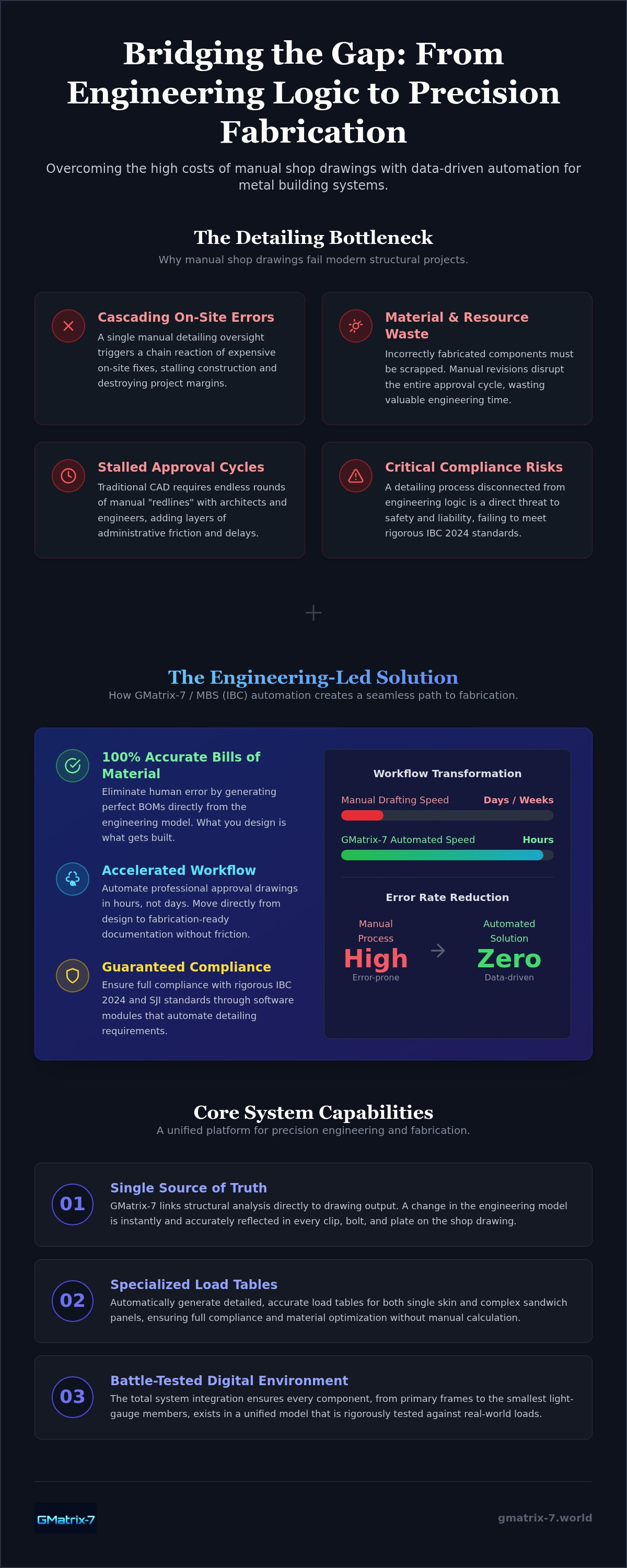
Shop drawings represent the critical DNA of any successful project within steel building systems. They translate abstract engineering models into actionable fabrication instructions that govern every cut, weld, and assembly. However, as we move through 2026, the reliance on manual drafting has become a primary driver of project failure. Manual processes simply cannot keep pace with the rigorous demands of modern structural logic or the accelerated timelines of global construction. They create a dangerous "Engineering-to-Fabrication" gap where critical design intent is frequently lost in translation. Transitioning to data-driven detailing is no longer a luxury for the few; it is the industry standard for maintaining profitability and structural integrity.
The Hidden Costs of Manual Detailing Errors
Manual errors carry a heavy price that extends far beyond the drafting table. When shop drawings contain even minor inaccuracies, the result is often a cascade of on-site modifications that stall construction schedules for weeks. These errors lead to significant material waste as incorrectly fabricated components must be scrapped and replaced. Beyond the physical waste, manual revisions disrupt the entire approval cycle with architects and engineers. Each round of "redlines" adds layers of administrative friction and delays the start of fabrication. Perhaps most critical is the risk of structural non-compliance. With the introduction of new tornado loading provisions in IBC 2024, a detailing process disconnected from engineering logic is a direct threat to safety and long-term liability.
Why Traditional CAD is No Longer Sufficient
General-purpose drafting tools are fundamentally insufficient for the complex geometries of modern Pre-Engineered Buildings. There is a vast difference between CAD vs specialized software for steel detailing. Traditional CAD requires manual input for every line, hole, and connection, which invites human error at every junction. These tools lack the "intelligence" to understand how a change in one structural member affects the entire system. In contrast, advanced metal building system shop drawing software like GMatrix-7 / MBS (IBC) links structural analysis directly to the drawing output. This unified platform ensures that every clip, bolt, and plate aligns perfectly with the engineering model. By automating this transition, firms eliminate the friction of manual entry and secure a seamless, reliable path to fabrication.
From Engineering Model to Shop Floor: The Mechanics of Detailing Automation
The transition from a structural model to the shop floor requires absolute fidelity. While basic 3D tools serve sales teams for visual planning, professional engineering demands a much higher standard of technical documentation. Advanced metal building system shop drawing software ingests complex engineering parameters, including load paths, deflection limits, and connection geometries, to generate fabrication-ready files. What used to take days of meticulous manual drafting now happens in a matter of hours. This efficiency isn't just about speed; it's about the security that comes from a single source of truth. Total system integration ensures that every component, from the primary frame to the smallest light-gauge member, exists in a unified digital environment that remains battle-tested against real-world loads.
Automating Approval Drawing Generation
GMatrix-7 redefines the detailing process by automating professional approval drawings for even the most complex structural projects. This system follows a strict capability-to-outcome pattern where accurate engineering inputs lead directly to streamlined shop outputs. Automation handles complex connections and member sizing instantly, removing the human error that typically plagues the approval cycle. By utilizing metal building system shop drawing software, you eliminate the repetitive manual entry that creates bottlenecks in the engineering workflow. This precision allows engineers to move directly from design to fabrication without the friction of traditional redlining. It's a level of achievement that turns a traditional technical hurdle into a powerful driver of industrial progress.
Specialized Modules for Diverse Structural Needs
A "one size fits all" approach fails in high-stakes engineering. To achieve true optimization, firms must utilize specialized modules designed for specific structural systems. The GMatrix-7 / MBS (IBC) module provides the authoritative logic required for rigid frame systems, ensuring every detail aligns with the latest code requirements. For projects involving bar joists, the GMatrix-7 / OWSJ (SJI) module delivers unmatched precision in open web steel joist detailing. When working with light gauge framing, the GMatrix-7 / LGS (AISI) module automates compliance with the latest AISI standards. This modular approach allows you to scale your capabilities while maintaining a battle-tested standard of excellence across all project types. Explore how our structural design automation tools can redefine your workflow and secure your project's success.
Compliance-First Detailing: Integrating IBC 2024 and AISI Standards
Detailing in 2026 is no longer just a drafting exercise; it is a rigorous process of legal and safety adherence. The 2024 International Building Code (IBC) has significantly evolved, reorganizing Chapter 22 and introducing Section 2210 specifically for Metal Building Systems. Most notably, it now includes the industry's first provisions for tornado loading, a change that demands absolute precision in structural calculations. Manual detailing cannot reliably account for these complex variables across thousands of unique components. High-performance metal building system shop drawing software acts as a digital gatekeeper, ensuring that every structural output inherently meets these updated standards. This integration significantly reduces the professional liability of structural engineers and fabricators by eliminating the risk of human error in code interpretation.
Automating the SJI 100-2020 Standard
For bar joist manufacturers, adhering to the SJI 100-2020 standard is a non-negotiable requirement for safety and performance. Achieving SJI compliant joist design requires rigorous verification of load-bearing capacities and material specifications. GMatrix-7 / OWSJ (SJI) automates these compliance checks during the detailing phase, ensuring every joist meets the exact requirements for its intended application. This automated approach provides massive efficiency gains, allowing manufacturers to validate thousands of joist configurations against safety standards in a fraction of the time required for manual review. It's a battle-tested method for maintaining excellence while accelerating production, ensuring that your output remains both safe and commercially competitive.
Global Structural Engineering Compliance
Modern fabricators often operate across borders, requiring a platform that handles multi-regional code requirements with authoritative ease. Whether addressing the IBC, AISI S100, or Canadian structural codes, a unified platform is essential for consistency. This reflects the broader professional structural design automation trends where software serves as a guardian of safety. Since the American Iron and Steel Institute ceased standards development in 2023, custodianship has shifted to organizations like the SFIA and MBMA. GMatrix-7 stays ahead of these shifts by integrating the latest AISI S100-24 specifications directly into the detailing engine. For projects requiring specific government or military standards, referencing the Unified Facilities Criteria for Metal Building Systems provides a foundational baseline for high-stakes engineering. By embedding these global standards into the metal building system shop drawing software, GMatrix-7 ensures that every project is built on a foundation of rigorous compliance and industrial progress. This capability-to-outcome model transforms complex regulatory hurdles into a streamlined, reliable workflow.
Beyond Lines and Circles: The Critical Role of Automated Bills of Material (BOM)
A shop drawing is only as valuable as the data that supports it. While lines and circles provide the visual framework, the Bill of Material (BOM) drives the commercial reality of the project. Manual material lists are notoriously prone to error, often resulting in "phantom material" costs where over-ordering or incorrect quantities erode project margins. High-performance metal building system shop drawing software eliminates these financial leaks by synchronizing the structural model with a live procurement database. This ensures that every individual component, from primary frames to the smallest fastener, is captured with 100% accuracy. For an industry where precision is the baseline for success, automating this link is the most direct path to securing project profitability.
The Science of Load Table Generation
Engineering excellence requires more than just member sizing; it demands rigorous validation of cladding and flooring systems under specific environmental stresses. The process of generating precise load tables for sandwich panels and single skin metal cladding is now a fully automated function within the GMatrix-7 ecosystem. This software calculates structural deck load capacity by ingesting specific engineering parameters, ensuring that every panel meets the required safety margins without over-engineering. The precision of composite deck load table generators in 2026 provides a level of technical documentation that was previously impossible to achieve manually. This automated documentation serves as a battle-tested record of compliance, giving engineers and fabricators the peace of mind that their material choices are structurally sound and optimized for the specific project loads.
Streamlining Procurement with Automated BOMs
The transition from design to the shop floor must be frictionless to maintain an accelerated production schedule. An automated bill of materials software serves as the bridge, feeding precise data directly into fabrication and procurement systems. This capability-to-outcome flow ensures that the shop floor receives exactly what the engineer designed, eliminating the risk of misinterpretation that often occurs with manual lists. By utilizing software-calculated lengths and quantities, fabricators achieve a significant reduction in material waste, which directly translates to improved bottom-line results. This methodical approach highlights the data-driven nature of modern engineering, where complexity is distilled into simple, actionable outputs. To secure your next project with this level of precision, explore our automated BOM solutions and request a technical demonstration.
Implementing GMatrix-7: Streamlining Your MBS Fabrication Workflow
Adopting a high-performance metal building system shop drawing software is a strategic pivot that secures the future of your engineering operations. It marks the transition from a reactive, error-prone environment to a proactive, data-driven workflow. GMatrix-7 provides the authoritative framework needed to navigate the complexities of modern structural design while maintaining absolute compliance with global standards. This shift isn't merely about software; it's about establishing a battle-tested standard of excellence that defines your firm as an industry leader. By integrating these tools, you move away from the limitations of traditional drafting toward a future of optimized, engineering-led detailing.
The ROI of Engineering Automation
The Return on Investment for engineering automation is immediate and measurable. When you compare the man-hours required for manual shop drawings against the rapid generation capabilities of GMatrix-7, the efficiency gains are undeniable. Manual detailing often consumes days or weeks of a senior engineer's time. Automation reduces this timeline to mere hours. Licensing specialized structural engineering software is a long-term investment in precision that pays dividends by eliminating the costs of material waste and on-site rework. For fabricators, this translates into a significant competitive advantage through faster turnaround times and 100% accurate material procurement. It's a capability-to-outcome model that directly boosts your bottom line and enhances project profitability.
Getting Started with GMatrix-7
Implementation begins with a modular assessment of your specific structural needs. GMatrix-7 offers a sophisticated, tailored approach where you select only the specialized tools required for your project portfolio. You can deploy the MBS (IBC) module for rigid frames, the OWSJ (SJI) tool for bar joists, or the LGS (AISI) module for light gauge framing as independent or integrated solutions. This modularity ensures you maintain a lean, efficient operation while accessing world-class technology. Professional support and regular software updates ensure your team remains aligned with 2026 standards, including the latest IBC and AISI requirements. To see these tools in action, you can easily request a technical consultation or a live demonstration. Secure your project's success today by exploring the full GMatrix-7 suite and experiencing the peace of mind that comes from metal building system shop drawing software built for the highest level of achievement.
Securing the Future of Engineering-Led Detailing
The transition from manual drafting to automated precision is the defining shift for structural engineering in 2026. Precision is no longer optional. You've seen how professional metal building system shop drawing software eliminates the detailing bottleneck by linking engineering logic directly to the shop floor. This methodical process ensures 100% accurate Bills of Material and instant approval drawings, removing the friction of manual revisions. By utilizing modules compliant with IBC 2024 and SJI 100-2020 standards, you protect your firm from liability while significantly accelerating project timelines.
GMatrix-7 provides the authoritative tools needed for this evolution, featuring advanced load table generation for sandwich panels and composite decks. It's time to replace outdated CAD workflows with a battle-tested platform designed for global excellence. Request a Technical Consultation with GMatrix-7 to experience how our automated professional approval drawings and BOMs can redefine your fabrication workflow. Secure your project's success with the gold standard of structural design automation and gain the peace of mind that comes from world-class precision.
Frequently Asked Questions
What is the best software for metal building shop drawings?
GMatrix-7 is widely considered the gold standard for engineering-led detailing in 2026. It provides specialized modules for MBS, OWSJ, and LGS that integrate structural analysis directly with technical drawing output. Unlike generic drafting tools, this metal building system shop drawing software ensures every component is battle-tested against real-world loads. It's a world-class solution that transforms technical complexity into streamlined, fabrication-ready documentation for global industrial progress and safety.
How does automated BOM software reduce material waste in steel construction?
Automated Bill of Material generation eliminates the "phantom material" costs associated with manual lists. The software synchronizes the engineering model with procurement data to calculate exact lengths and quantities for every structural member. This precision ensures that the shop floor receives only the necessary materials, preventing the over-ordering that typically erodes project margins. It's a data-driven approach that secures profitability while maintaining a commitment to excellence in every project.
Is GMatrix-7 compliant with IBC 2024 and SJI 100-2020 standards?
Yes, GMatrix-7 is fully compliant with the latest IBC 2024 and SJI 100-2020 standards. The software includes specialized modules like GMatrix-7 / MBS (IBC) and GMatrix-7 / OWSJ (SJI) that automate the rigorous verification required for modern safety codes. These modules ensure every structural output meets the industry's first provisions for tornado loading and updated seismic requirements. This integration significantly reduces professional liability for engineers and fabricators alike.
Can structural engineering software generate load tables for composite decks?
Advanced structural engineering platforms like GMatrix-7 feature dedicated tools for generating precise load tables for composite decks, sandwich panels, and single skin cladding. The software calculates structural deck load capacity by ingesting specific engineering parameters and calculating performance under varying environmental stresses. This automated documentation provides a reliable record of compliance. It allows you to optimize material choices without compromising safety or structural integrity in complex building systems.
What is the difference between general CAD and specialized MBS detailing software?
General CAD tools require manual input for every line and connection, which often invites human error and slows the approval cycle. Specialized metal building system shop drawing software, such as GMatrix-7, uses engineering logic to automate the detailing process. This software understands how a change in one member affects the entire system, ensuring every plate and bolt aligns perfectly. It creates a seamless transition from structural analysis to fabrication-ready documentation.
How long does it take to generate shop drawings using automation?
Automation reduces the time required for shop drawing generation from days or weeks to a matter of hours. By ingesting engineering parameters directly, the software eliminates the repetitive manual entry that creates traditional detailing bottlenecks. This rapid turnaround time provides a significant competitive advantage for fabricators working on large-scale projects. It allows firms to move from the engineering model to the shop floor with unprecedented speed and authoritative precision.
Does GMatrix-7 support light gauge steel (LGS) structural design?
GMatrix-7 provides full support for light gauge steel structural design through its specialized GMatrix-7 / LGS (AISI) module. This tool automates the creation of technical documentation and material lists specifically for cold-formed steel framing. It integrates the latest AISI S100-24 specifications to ensure every design is both safe and optimized. This modular approach allows you to scale your structural capabilities while maintaining a battle-tested standard of excellence across diverse project types.
Can I generate approval drawings and BOMs in the same platform?
Yes, GMatrix-7 is a unified platform that automates both professional approval drawings and comprehensive Bills of Material. This total system integration ensures the data used for structural documentation is identical to the data used for procurement. By generating these outputs simultaneously, you eliminate the risk of misinterpretation between the engineering department and the shop floor. This capability-to-outcome flow is essential for maintaining accuracy and efficiency in high-stakes structural projects.


