

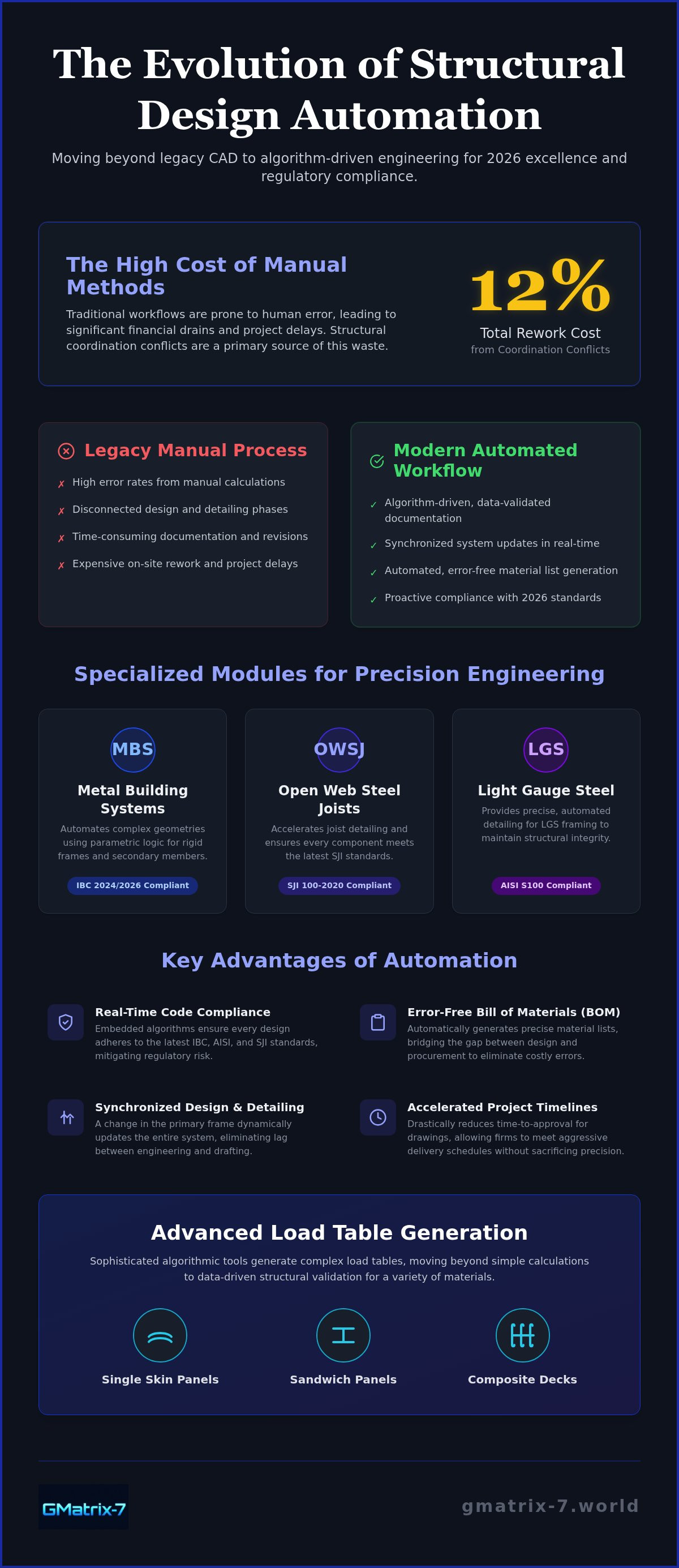
Structural coordination conflicts account for an estimated 12% of the total cost of rework on commercial construction projects, a figure that remains a persistent drain on firm profitability. You've likely experienced the frustration of manual Bill of Materials generation where a single oversight triggers a series of expensive site corrections. Implementing professional structural design automation has shifted from a competitive advantage to a fundamental regulatory necessity for 2026 engineering excellence. By moving beyond manual entry into data-driven workflows, you can eliminate the administrative bottlenecks that stifle project momentum.
This article details how advanced automation in structural design is revolutionizing MBS, OWSJ, and LGS workflows while eliminating manual documentation errors. We'll explore the seamless integration of IBC and AISI S100 standards, ensuring your outputs remain compliant as local jurisdictions adopt 2024 and 2026 building codes. You'll learn how to drastically reduce time-to-approval for drawings and generate automated, error-free material lists that safeguard your reputation for precision. We'll also examine the transition from complex inputs to streamlined, high-value outputs that define the modern engineering standard.
Key Takeaways
- Understand why professional structural design automation is the new benchmark for 2026, moving beyond general CAD to algorithm-driven engineering documentation.
- Explore how specialized modules for MBS, OWSJ, and LGS automate compliance with SJI and AISI standards, ensuring precision across global projects.
- Discover how automated Bill of Materials (BOM) software bridges the gap between design and procurement to eliminate the high cost of manual material list errors.
- Learn to generate sophisticated load tables for single skin, sandwich panels, and composite decks through specialized algorithmic tools.
- Analyze the commercial ROI of implementing GMatrix-7 to streamline approval drawing generation and scale your structural engineering output.
The Evolution of Professional Structural Design Automation
The engineering landscape has reached a critical inflection point where legacy drafting methods no longer suffice for high-velocity industrial projects. Traditional Computer-aided design (CAD) served as a digital replacement for the drafting table, but it lacked the inherent intelligence to validate structural integrity in real-time. Modern professional structural design automation represents a move toward algorithm-driven documentation that treats engineering data as the primary driver of the project lifecycle. Relying on manual calculations has become a significant liability for firms aiming to maintain thin margins and rigorous safety standards. These manual processes introduce high error rates that often lead to costly rework during fabrication or construction.
Automation accelerates project timelines by synchronizing the design and detailing phases. When a change occurs in the primary frame, the entire system updates dynamically. This eliminates the lag between engineering decisions and drafting execution, allowing firms to meet aggressive 2026 delivery schedules without sacrificing precision or safety margins. The result is a streamlined workflow that moves from complex inputs to optimized outputs with minimal human intervention. It transforms the engineering firm from a service provider into a driver of industrial progress.
Beyond BIM: Specialized Structural Logic
While Building Information Modeling (BIM) provides a general framework for coordination, it often lacks the specialized logic required for industrial steel systems. Professional structural design automation distinguishes itself by embedding structural-specific rules directly into the software environment. In Metal Building Systems (MBS), this manifests as parametric design where every component, from girts to rigid frames, remains aware of its structural purpose. This approach ensures total consistency across global engineering teams, preventing the discrepancies that typically arise when different offices interpret design intent manually. It moves the focus from drawing a building to engineering a system.
Meeting 2026 Regulatory Demands
Regulatory compliance is becoming increasingly complex as jurisdictions adopt the 2024 International Building Code (IBC) and prepare for 2026 standards. These updates include stringent tornado-specific design requirements in Chapter 32, mandating that structures in high-risk areas resist tornadic wind loads per ASCE 7-22. Real-time compliance checking is now a necessity rather than a luxury. Structural automation is the integration of code-compliant algorithms with drafting output. By automating these checks, firms ensure that every OWSJ or LGS component adheres to the latest SJI and AISI S100 standards from the first iteration. This proactive approach to safety provides the peace of mind that comes from knowing every detail is battle-tested and data-driven.
Key Modules in Modern Structural Automation: MBS, OWSJ, and LGS
Modern engineering demands more than generic modeling; it requires specialized logic for specific structural systems. Professional structural design automation provides this through a modular software architecture, allowing firms to scale their solutions based on project requirements. This modularity ensures that specialized systems like Metal Building Systems (MBS), Open Web Steel Joists (OWSJ), and Light Gauge Steel (LGS) aren't just modeled, but engineered to exact standards. By utilizing these targeted modules, engineers can bypass the limitations of general-purpose CAD and move directly into high-precision, fabrication-ready documentation.
MBS and IBC Compliance
Metal building systems involve complex geometries that are notoriously time-consuming to model and validate manually. Automation simplifies this process by using parametric logic to align rigid frames and secondary members with the latest IBC standards. Utilizing specialized MBS IBC Design Software ensures that every taper, flange, and connection meets the rigorous requirements of the 2024 and 2026 codes. This reduces the risk of misaligned components and ensures structural integrity from the first iteration, providing the reliability that global fabricators demand.
SJI 100-2020 and OWSJ Detailing
Automating bar joist detailing is essential for meeting SJI 100-2020 requirements without the traditional overhead of manual drafting. Lead times for joist manufacturers are often a project bottleneck, yet automated detailing drastically reduces this friction. By implementing SJI compliant joist design, engineers generate precise shop drawings that move directly to production. Academic research into generative design and deep generative models suggests that the future of these modules lies in even higher levels of optimization, where software suggests the most efficient joist configurations based on dynamic load and span data.
LGS and AISI S100 Standards
Cold-formed steel design requires strict adherence to AISI S100 protocols, which can be difficult to maintain across large-scale projects. Professional structural design automation integrates LGS framing logic into larger structural assemblies, ensuring that light-gauge components work seamlessly with primary steel frames. Utilizing LGS structural design software allows for the rapid generation of wall panels and floor joists that are both code-compliant and ready for the factory floor. This level of precision eliminates the guesswork typically associated with thin-gauge material behaviors under load.
This modular approach allows firms to adopt the specific tools they need without the bloat of unnecessary features. It's a scalable path toward engineering excellence that prioritizes safety and efficiency. If you're looking to modernize your current workflow, you can explore the full capabilities of GMatrix-7 to see how these specialized modules integrate into a unified, high-performance platform.
Eliminating Manual Errors with Automated BOMs and Detailing
Manual errors in material lists represent more than just administrative friction; they are direct threats to project profitability. When a Bill of Materials (BOM) is generated by hand, the probability of miscounting plates or fasteners increases exponentially with project complexity. Professional structural design automation mitigates this risk by creating a direct, digital link between the engineering model and the procurement list. This synchronization ensures that the materials ordered are the exact materials required for the structural assembly. It eliminates the "safety buffer" ordering that often leads to excessive on-site waste and unnecessary overhead.
Automated Bill of Material Generation
Extracting material lists directly from structural models ensures that the procurement phase reflects the exact requirements of the engineered design. This level of precision guarantees 100% accuracy in member counts, plate thicknesses, and fastener specifications. Automated BOMs reduce project costs by up to 15% through substantial waste reduction and the elimination of emergency site orders. This transition from manual estimation to data-driven output is a cornerstone of AI-Powered Structural Engineering, where every component is tracked with surgical precision. By removing the human element from the counting process, firms can reallocate their engineering talent toward higher-value optimization tasks rather than clerical data entry. It's a shift that prioritizes accuracy and speed in equal measure.
Approval Drawings and Documentation
Standardizing technical documentation is the fastest route to securing client and regulatory approval. Professional structural design automation empowers firms to generate approval drawings that adhere to rigorous industry standards, reducing the back-and-forth typically associated with code compliance reviews. For steel fabricators, the software produces detailed shop drawings that are ready for immediate use on the factory floor. These drawings include all necessary dimensions, weld symbols, and assembly instructions, leaving no room for interpretation by the fabrication team. This maintains a continuous digital thread, ensuring that the design intent is preserved from the initial analysis through to the final bill of materials. The result is a seamless transition from the digital model to the physical structure, providing a level of reliability that legacy workflows simply cannot match. High-level achievement in 2026 relies on this ability to deliver flawless documentation at the speed of modern commerce.
Advanced Load Table Generation for Composite Decks and Panels
Calculating load capacities for composite systems is one of the most mathematically intensive tasks in modern structural engineering. Traditional manual verification is no longer a viable path for firms that prioritize both speed and safety. Professional structural design automation eliminates the uncertainty of manual modeling by applying rigorous algorithmic checks to every span, gauge, and material property. This ensures that load tables are precise reflections of structural performance under diverse environmental conditions. By automating these calculations, engineers move from time-consuming data entry to high-level system optimization.
The complexity of modern materials demands a shift toward data-driven verification. Manual spreadsheets cannot easily account for the non-linear behaviors of thin-gauge steel or the composite action between concrete and deck profiles. Automation bridges this gap, providing a reliable framework for generating documentation that meets global standards. It's about moving from a "good enough" estimate to a battle-tested structural certainty that protects both the firm and the end-user.
Composite Deck Load Table Generators
Composite floor systems require a sophisticated balance of strength and serviceability analysis. Automating the generation of SDI-compliant load tables allows engineers to account for varying concrete densities, reinforcement patterns, and deck profiles simultaneously. Utilizing an advanced composite deck load table generator provides a methodology that validates these complex interactions with absolute precision. This capability allows firms to deliver optimized deck designs that reduce concrete volume and steel weight without compromising structural integrity. It's a data-driven approach that ensures every composite assembly is engineered for maximum performance and cost-efficiency.
Sandwich and Single Skin Panel Analysis
Cladding systems such as sandwich and single skin panels must withstand significant wind loads and thermal stresses that vary by geographic location. Automated panel analysis evaluates these environmental variables against local building code safety factors, ensuring that every panel design is secure before it reaches the field. This process generates manufacturer-specific load tables that simplify the specification phase for contractors and architects alike. By automating this analysis, you ensure that cladding systems meet the rigorous safety margins required for 2026 industrial standards. It eliminates the conservative "guesswork" that often leads to over-engineered, expensive cladding solutions.
Structural excellence in 2026 is defined by the ability to handle complexity with speed and reliability. You can automate your load table generation now to ensure your projects remain on the cutting edge of engineering precision. This shift toward automation provides the peace of mind that comes from knowing every calculation is backed by world-class structural logic.
Implementing GMatrix-7: Scaling Structural Productivity in 2026
Professional structural design automation has reached a level of sophistication where GMatrix-7 stands as the definitive ecosystem for high-output engineering. Legacy workflows that rely on general-purpose CAD are no longer sustainable in a market that demands surgical precision and rapid delivery. Transitioning from generic drafting tools to specialized structural modules provides an immediate ROI by eliminating the manual verification steps that traditionally stall project momentum. GMatrix-7 synthesizes complex engineering inputs into fabrication-ready data, ensuring that your firm operates as a driver of industrial progress rather than a bottleneck. It's a platform built for those who value excellence and refuse to compromise on safety or speed.
Future-proofing your engineering workflow requires more than just new software; it requires a shift toward data-driven stability. As project complexity increases, GMatrix-7 provides the reliable framework needed to manage intricate geometries and rigorous code requirements simultaneously. This authoritative approach to design ensures that every output is battle-tested and compliant with global standards. By centralizing your engineering logic within a unified system, you create a seamless transition from initial analysis to final documentation, providing the peace of mind that comes from total structural certainty.
The GMatrix-7 Advantage for Fabricators
Specialized detailing modules accelerate the fabrication cycle by delivering error-free shop drawings and material lists directly to the factory floor. This precision allows fabricators to gain a competitive edge in bidding, as they can guarantee lower waste and tighter timelines than competitors using legacy methods. Leveraging automated documentation ensures that design intent is preserved throughout the digital thread, preventing the costly misinterpretations that often occur during manual handoffs. You can explore the broader industry shifts in our professional structural design automation 2026 outlook to understand how these tools are redefining the global standard for excellence.
Next Steps for Engineering Leaders
Scaling your productivity begins with a rigorous evaluation of current detailing bottlenecks. Identifying where manual entry persists is the first step toward implementing a more efficient, automated tech stack. GMatrix-7 modules integrate into your existing environment, providing the specialized logic needed for MBS, OWSJ, and LGS systems without the bloat of non-essential features. This methodical integration allows for a smooth transition that prioritizes immediate gains in accuracy and output. To begin your modernization, you should schedule a consultation with GMatrix-7 experts to automate your structural workflow and secure your position as a leader in the 2026 engineering landscape.
Defining the Next Era of Structural Excellence
The shift toward professional structural design automation represents more than a technological upgrade; it's a fundamental reimagining of engineering documentation. By integrating SJI 100-2020 compliant modules and specialized LGS logic, firms move directly from complex analysis to fabrication-ready outputs. You've seen how automated BOM generation for precision detailing eliminates the high cost of manual errors while synchronizing your procurement cycle. Trusted by global structural fabricators, these tools ensure that your projects meet the rigorous demands of 2026 building codes without sacrificing speed or profitability.
Securing your firm's position in this evolving landscape requires a commitment to data-driven stability and innovative workflows. GMatrix-7 provides the reliable framework needed to scale your productivity and navigate increasing project complexity with ease. It's time to replace legacy drafting bottlenecks with a system built for high-level achievement and total structural certainty. Explore GMatrix-7 Structural Automation Solutions today and lead the industry with world-class engineering precision. Your journey toward optimized, error-free structural design begins now.
Frequently Asked Questions
What is professional structural design automation?
Professional structural design automation is the integration of code-compliant algorithms with drafting output to streamline the engineering project lifecycle. It moves beyond basic geometry by embedding structural logic directly into the software environment. This allows firms to generate fabrication-ready documentation, including material lists and shop drawings, with minimal manual intervention. By automating repetitive calculations, engineers focus on high-level optimization while ensuring every component meets rigorous global safety standards.
How does GMatrix-7 ensure compliance with IBC and SJI standards?
GMatrix-7 utilizes specialized modules that are pre-configured with the latest IBC, SJI, and AISI protocols. The software performs real-time compliance checks as the model evolves, ensuring that Open Web Steel Joists meet SJI 100-2020 requirements. This proactive validation eliminates the risk of code violations during the detailing phase. It provides the peace of mind that comes from knowing every tapered frame or bar joist is engineered to satisfy the most current regulatory demands.
Can automated BOM software really reduce material waste?
Automated Bill of Material software reduces material waste by synchronizing the structural model with the procurement list to ensure 100% accuracy in component counts. Manual estimation often leads to over-ordering as a buffer against human error; however, automation provides exact counts for fasteners, plates, and members. This precision can reduce project costs by up to 15%. It bridges the gap between design and fabrication, ensuring that only the necessary materials reach the site.
What are the benefits of using a specialized composite deck load table generator?
A specialized composite deck load table generator provides precise strength and serviceability analysis for complex floor systems. It automates the generation of SDI-compliant tables by accounting for non-linear material behaviors and composite actions simultaneously. This level of precision allows for optimized deck designs that reduce steel weight without compromising integrity. It replaces conservative manual estimates with data-driven certainty, ensuring that every assembly is both cost-efficient and structurally secure.
Is GMatrix-7 compatible with existing CAD workflows?
GMatrix-7 is designed to integrate seamlessly into modern engineering tech stacks, providing specialized logic that enhances existing CAD environments. It serves as a high-performance layer that handles the complex structural analysis and documentation that general-purpose tools often lack. This compatibility allows firms to modernize their detailing processes without a total overhaul of their current infrastructure. The software ensures a smooth transition from legacy drafting to a more efficient, algorithm-driven workflow.
How does automation impact the speed of approval drawings?
Automation drastically reduces the time-to-approval by standardizing technical documentation and ensuring every drawing is code-compliant from the first iteration. By generating shop drawings directly from the engineered model, the software eliminates the back-and-forth typically associated with manual reviews. This speed is a critical component of professional structural design automation, allowing firms to meet aggressive 2026 delivery schedules. It transforms the approval phase from a bottleneck into a streamlined, high-speed process.
What structural modules does GMatrix-7 offer for LGS design?
GMatrix-7 offers the GMatrix-7 / LGS (AISI) module, which is specifically engineered for cold-formed steel design automation. This module integrates LGS framing logic into larger structural assemblies, ensuring that wall panels and floor joists meet AISI S100 protocols. It automates the creation of detailed material lists and technical documentation for light-gauge components. This specialized approach ensures that thin-gauge materials behave predictably under load while maintaining total compliance with current safety factors.
How does structural design automation handle custom metal building systems?
Structural design automation handles custom metal building systems by utilizing parametric logic to adapt to unique geometries and load requirements. The GMatrix-7 / MBS (IBC) module ensures that rigid frames and secondary members remain aligned with IBC standards even in highly specialized configurations. As changes occur in the primary frame, the entire system updates dynamically to preserve structural integrity. This flexibility allows firms to engineer custom solutions with the same speed and precision as standard buildings.


