

Relying on manual spreadsheets for structural compliance is no longer just an operational lag; it's a significant liability that threatens the integrity of your engineering workflow. You understand the intense pressure to deliver rapid approval drawings while navigating the complex updates within the 2024 IBC and the latest AISI S100 standards. The implementation of professional single skin panel load table software has become the definitive benchmark for firms seeking to eliminate calculation errors and secure their competitive edge.
It's time to move beyond the limitations of legacy processes that stall your production timeline. This guide shows you exactly how to transition to automated load table generation, allowing for the instant creation of multi-span data without compromising on safety or precision. You'll discover how to achieve seamless integration with MBS design workflows and produce sophisticated, code-compliant documentation that meets the highest industry expectations. We will examine the technical shift toward structural automation and how it ensures your projects remain both profitable and fundamentally secure in 2026.
Key Takeaways
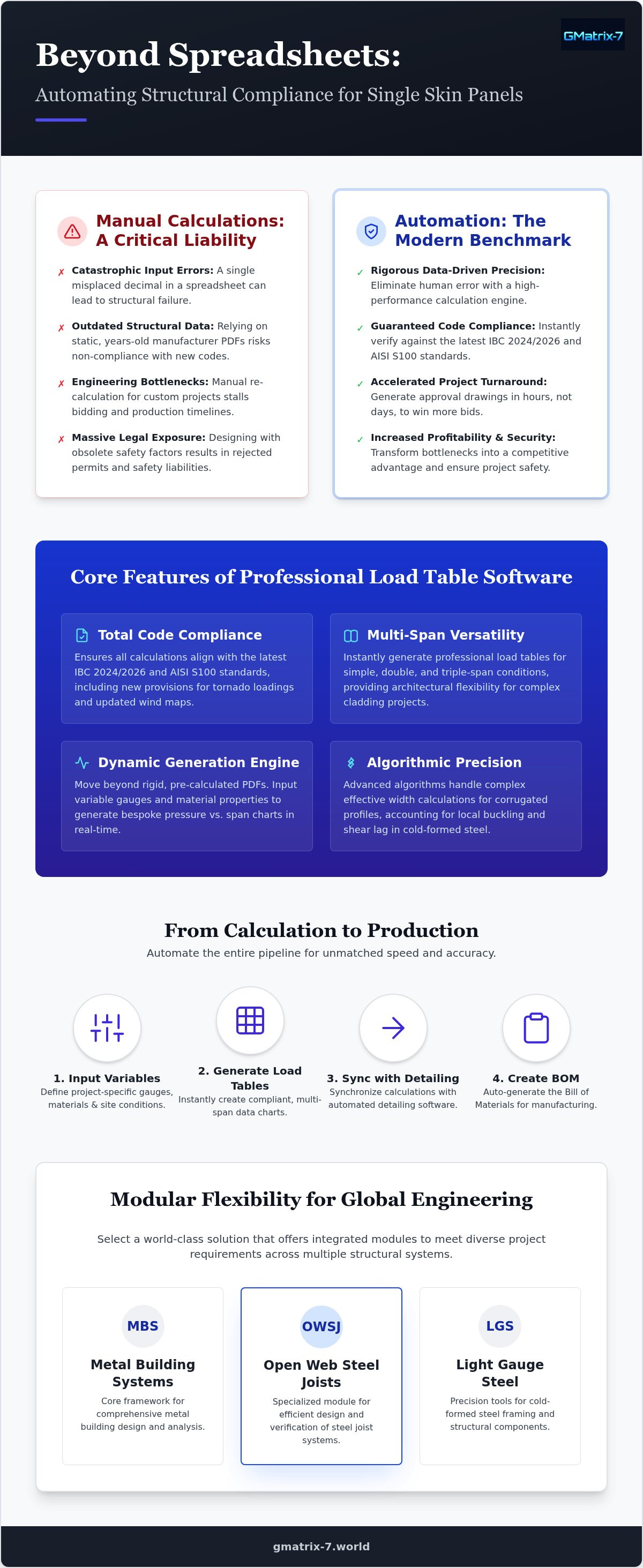
- Eliminate catastrophic input errors by transitioning from manual spreadsheets to a rigorous, data-driven automation framework.
- Ensure total structural compliance with IBC 2024/2026 and AISI S100 standards through specialized single skin panel load table software.
- Optimize architectural versatility by instantly generating professional load tables for simple, double, and triple-span conditions.
- Streamline the manufacturing pipeline by synchronizing structural calculations with automated detailing and Bill of Material (BOM) generation.
- Select a world-class solution that offers modular flexibility across MBS, OWSJ, and LGS platforms to meet diverse global engineering requirements.
Why Manual Single Skin Panel Load Calculations are a Liability
Load tables represent the critical safety threshold for any metal building system. They dictate how a structure responds to intense environmental stressors like extreme wind and heavy snow loads. In modern engineering, these calculations rely on the principles of stressed-skin design, where the panel itself acts as a structural element to carry loads. Relying on manual spreadsheets to calculate these values is a dangerous gamble. One misplaced decimal or an outdated formula in a cell can lead to catastrophic structural failure and total loss of professional credibility.
The 2026 regulatory environment demands a level of precision that manual entry simply cannot sustain. With the 2024 IBC introducing new provisions for tornado loadings and updated wind maps, the margin for error has evaporated. Static PDFs from manufacturers are often based on testing data that is years out of date and lacks the flexibility for modern builds. Using single skin panel load table software allows engineers to move from rigid, pre-calculated tables to dynamic generation. Static tables are rigid. If a project requires a non-standard gauge or a specific triple-span condition not covered in a PDF, the engineer is forced back into manual calculations. Dynamic software eliminates this limitation by generating bespoke data for every unique project variable while ensuring every span is verified against current AISI S100 standards.
The Risk of Outdated Structural Data
Building codes are not static. Jurisdictions frequently adopt new editions of the IBC, such as the 9th Edition of the Florida Building Code effective December 31, 2026. If your firm relies on 5-year-old manufacturer data, you're likely designing for obsolete safety factors. This creates massive legal exposure. Manual engineering errors in metal building systems aren't just technical flaws; they're safety liabilities that result in rejected permits or structural collapse. Real-time calculation engines provide the only reliable path to total compliance in a shifting regulatory landscape.
Commercial Impact of Engineering Bottlenecks
Manual calculations don't just risk safety; they destroy profitability. Fabricators often lose significant time re-calculating tables for custom cladding projects or non-standard spans. This manual detailing creates a bottleneck that slows down the entire bidding process. Implementing single skin panel load table software transforms this bottleneck into a competitive advantage by automating the tedious aspects of structural verification. When a competitor provides an automated, code-compliant approval drawing in hours, a manual firm taking days is already out of the running. Automation is a commercial necessity that links technical capability directly to faster project turnaround and higher win rates.
Core Features of Professional Load Table Software
Professional single skin panel load table software isn't just a digital version of a printed manual; it's a high-performance calculation engine designed for rigorous structural verification. Unlike static product finders that offer rigid, pre-calculated documents, this software enables real-time analysis for the 2024 and 2026 IBC standards. It provides the agility to input variable gauges and material properties, generating instant pressure versus span charts for both suction and pressure loads. This capability ensures that every panel profile is optimized for specific site conditions, including the new 2024 IBC provisions for tornado loadings and updated wind maps.
Engineering flexibility is a core requirement for modern metal building systems. The software supports diverse architectural needs by providing multi-span condition support for simple, double, and triple spans. This level of detail allows fabricators to provide accurate structural data for complex cladding projects that standard tables simply don't cover. By automating these calculations, firms eliminate the manual bottleneck while maintaining a high standard of professional excellence.
Algorithmic Precision for Cold-Formed Steel
The technical core of the software relies on advanced algorithms that handle effective width calculations for corrugated profiles. This process is essential for AISI compliance, as it accounts for the local buckling and shear lag inherent in thin-gauge metal. By integrating LGS structural design software principles, the system performs a granular analysis of each panel's structural integrity. This rigorous approach aligns with OSHA proof-testing requirements for prefabricated structures, ensuring that every generated table is backed by sound engineering logic. Manufacturers looking to optimize their workflow should explore how advanced structural modules can transform their engineering output while maintaining total code compliance.
Output Customization and Branding
Precision is meaningless if the output isn't professional. Leading single skin panel load table software generates professional-grade approval drawings automatically, moving seamlessly from technical input to streamlined documentation. This feature allows manufacturers to brand their own load tables, creating high-value marketing assets that double as certified technical data. You can customize headers, footers, and logos to ensure that every structural report reflects your firm's commitment to excellence. This transition from complex raw data to a polished, branded output is what separates industry leaders from those still tethered to manual spreadsheet entry.
Comparing Single Skin, Sandwich Panel, and Composite Deck Modules
A unified engineering platform is the hallmark of a world-class fabrication operation. While many competitors silo technical data into disconnected documents, advanced single skin panel load table software integrates multiple structural modules into a single, cohesive workflow. This versatility allows engineers to manage the distinct calculation requirements of metal cladding, insulated systems, and flooring decks simultaneously. By leveraging GMatrix-7, firms can utilize a composite deck load table generator alongside specialized panel modules to ensure every building component adheres to the same rigorous safety standards. This integration eliminates the friction of switching between disparate tools, providing a seamless transition from raw design inputs to certified structural outputs.
The complexity of modern building systems requires a granular approach to component analysis. A single error in calculating the interaction between a panel and its support structure can compromise the entire building's integrity. By centralizing these calculations, you ensure that every part of the metal building system is optimized for performance and compliance. This methodical progression from individual component design to full-system validation is what defines a battle-tested engineering process.
Single Skin vs. Sandwich Panel Mechanics
The engineering principles governing these two systems are fundamentally different. Single skin metal cladding analysis focuses primarily on flexural capacity and the local buckling of thin-gauge elements. In contrast, sandwich panels require a complex shear stress analysis of the core material and an evaluation of thermal bowing effects. Using a generic tool for both is a significant safety risk. Each panel type demands a specialized module that accounts for its unique mechanical behavior. This modular approach is a core pillar of high-level MBS IBC design software, where precision in panel analysis directly informs the overall structural integrity of the metal building system. It's about moving from a one-size-fits-all mentality to a specialized, data-driven methodology.
Composite Deck Load Capacity Calculation
Designing for high-rise applications requires a deep understanding of concrete-steel interaction. Composite deck load table generation automates the calculation of structural capacity by evaluating the mechanical bond between the profiled steel sheet and the concrete slab. These calculations must align with modern SDI standards to ensure the deck can withstand both construction loads and long-term service requirements. The integration of SDI standards into the calculation engine ensures that factors such as shoring requirements and diaphragm action are handled with absolute precision. For large-scale flooring projects, the capability to instantly generate these tables translates into a high-value outcome: reduced engineering lead times and guaranteed code compliance. Automating these intricate interactions allows your firm to focus on innovation rather than repetitive data entry, securing your position as a technologically advanced leader in the global market.
Integrating Load Tables with Automated Detailing and BOMs
The disconnect between engineering calculations and the manufacturing floor is a frequent source of costly project delays. While standard analysis tools provide structural data, they often leave a manual gap where engineers must translate results into material orders. Implementing professional single skin panel load table software solves this by creating a direct, automated link between load capacity and the final material list. This synchronization ensures that the precise gauge and profile selected during the structural phase are accurately reflected in the production queue, eliminating the risk of human error during data entry.
Using precise load data to select the optimal gauge reduces material waste. It ensures that every panel is fit for purpose without over-engineering. This level of project synchronization moves a firm from a fragmented workflow to a unified system where approval drawings and shop floor instructions exist in perfect harmony. It's about achieving a seamless transition from complexity to simplicity through automated documentation.
From Load Capacity to Material Lists
Ordering errors can derail even the most meticulously planned structural project. Implementing automated bill of materials software prevents these discrepancies by generating a BOM directly from the load-optimized panel design. The workflow is logical and efficient. The system performs a granular load analysis, selects the ideal panel profile, and instantly populates the material list. This automation is particularly critical for global fabricators managing complex, multi-site projects where consistency is paramount. By bridging this gap, GMatrix-7 allows firms to transition from raw engineering complexity to high-value manufacturing simplicity. The integration of single skin panel load table software with downstream manufacturing processes ensures that every structural decision is backed by real-world material availability.
Streamlining the Approval Drawing Workflow
Automated detailing significantly reduces the revision cycle with architects and owners. When load tables are integrated directly into the detailing phase, generating professional approval drawings becomes a matter of minutes rather than days. This speed's essential for maintaining the momentum of high-stakes structural projects where delays translate into liquidated damages. Using "battle-tested" software ensures that the documentation produced isn't only fast but also rigorously compliant with the latest standards. As we look toward professional structural design automation trends for 2026, the firms that prioritize this level of integration will be the ones that define the future of the industry. To secure your manufacturing pipeline and eliminate manual entry errors, explore the automated detailing solutions offered by GMatrix-7.
Selecting the Right Load Table Generator for Your Firm
Selecting a partner for structural automation requires a strategic focus on long-term scalability and technical rigor. You shouldn't settle for a tool that only performs basic arithmetic; you need a system that offers modular flexibility across MBS, OWSJ, and LGS platforms. The right single skin panel load table software must demonstrate a sophisticated understanding of global building codes, including the latest SJI and AISI standards. Prioritize solutions that offer high-value features such as automated detailing and professional report generation. These capabilities transform raw engineering data into polished, client-ready documentation, ensuring your firm maintains its status as a premier leader in the field.
A proven track record in structural engineering automation is the most reliable indicator of future performance. You need a partner who understands the granular intricacies of metal building systems and can provide a stable, technologically advanced platform. This selection process is about more than just software; it's about securing a guardian of safety and a driver of industrial progress for your organization. By choosing a world-class solution, you ensure that your engineering team remains both intellectually rigorous and commercially agile.
The GMatrix-7 Advantage: Beyond Basic Calculations
GMatrix-7 stands as the world-class gold standard for MBS and OWSJ engineering. We don't just provide a tool; we deliver a comprehensive engineering ecosystem designed for excellence. Under the visionary leadership of Dr. Simon B., we've consistently pioneered the technology that drives industrial progress. Our modules are built on a foundation of authoritative expertise, offering a level of precision that manual entry can never replicate. When you implement our single skin panel load table software, you're investing in the peace of mind that comes from battle-tested reliability and high-level achievement. It's a bold, ambitious stance that moves your firm away from legacy bottlenecks toward a future of streamlined structural compliance.
Implementation and ROI for Engineering Teams
The transition from manual complexity to automated simplicity yields a rapid and measurable return on investment. GMatrix-7 modules are engineered for rapid deployment across global engineering teams, ensuring immediate gains in operational efficiency. We quantify this ROI through the significant reduction in manual labor hours and the exponential increase in total project capacity. This capability-to-outcome pattern allows your engineers to focus on high-value design challenges while the software automates the tedious generation of load tables and Bill of Materials. To experience this level of professional optimization firsthand, Book a consultation for GMatrix-7 structural modules and secure your firm's competitive advantage in the 2026 market.
Securing Your Competitive Advantage in the 2026 Structural Landscape
The shift toward total structural automation is no longer optional for firms that value precision and profitability. Relying on legacy spreadsheets creates unacceptable risks in a regulatory environment defined by the 2024 and 2026 IBC updates. By implementing professional single skin panel load table software, you transition from manual bottlenecks to a streamlined, data-driven workflow that synchronizes engineering with production. This integration ensures that every structural decision is backed by sound logic and reflected instantly in your material lists. It's the only way to maintain the speed required for modern approval cycles without compromising on safety.
GMatrix-7 provides the world-class tools needed to maintain this standard of excellence. Our modules are fully IBC 2024/2026 and AISI S100 compliant, offering automated BOM and approval drawing generation that is trusted by global fabricators and engineers. This battle-tested technology allows you to move away from complexity toward high-level achievement with total peace of mind. Optimize Your Structural Detailing with GMatrix-7 and lead the industry with a commitment to safety that is as bold as it is dependable. Your projects deserve the precision of a global leader.
Frequently Asked Questions
What is single skin panel load table software?
It's a specialized engineering tool used to calculate the structural capacity of metal cladding under various environmental loads. Unlike static tables, this software performs real-time analysis based on specific project inputs such as gauge, span, and material yield strength. It allows engineers to verify safety margins for wind and snow loads while ensuring every profile meets rigorous structural benchmarks without the risk of manual spreadsheet errors.
How does the software ensure compliance with IBC 2024 and 2026?
The software integrates the latest model code updates directly into its calculation engine, including new provisions for tornado loadings and updated wind maps. It automatically applies the required safety factors and load combinations mandated by the 2024 and 2026 editions of the International Building Code. This ensures that every generated table is legally defensible and structurally sound for jurisdictions that have adopted these most recent standards.
Can I generate load tables for custom corrugated profiles?
The system allows for the input of custom geometry and material properties to generate bespoke load data for any unique profile. You can define the rib height, pitch, and thickness to perform an accurate effective width analysis for cold-formed steel elements. This flexibility is essential for fabricators who develop proprietary cladding systems that aren't covered by standard industry tables or generic manufacturer PDFs.
Does the software support multi-span conditions for metal cladding?
Professional single skin panel load table software provides full support for simple, double, and triple-span conditions to reflect real-world architectural configurations. It calculates the moment and shear capacity at interior supports while accounting for web crippling and deflection limits. This multi-span analysis is crucial for optimizing material usage and ensuring the structural integrity of continuous panel runs across multiple purlins or girts.
How does load table generation integrate with the Bill of Materials (BOM)?
The software bridges the gap between engineering and procurement by automatically populating the material list based on the optimized panel design. Once the load capacity is verified, the system generates a precise BOM that includes the exact gauge, length, and profile required for the project. This integration eliminates manual data entry errors and ensures that the manufacturing floor receives instructions that are perfectly synchronized with the structural calculations.
Is GMatrix-7 compatible with AISI S100 standards for cold-formed steel?
GMatrix-7 is fully compliant with AISI S100 standards, utilizing advanced algorithms to handle the complex structural behavior of thin-gauge metal members. The software performs rigorous checks for local, distortional, and global buckling as required by the North American Specification for the Design of Cold-Formed Steel Structural Members. This compliance provides engineers with the authoritative expertise needed to secure project approvals in highly regulated global markets.
What is the difference between single skin and sandwich panel load calculations?
Single skin analysis focuses primarily on the flexural and buckling behavior of the metal profile itself. Sandwich panel calculations are more complex, requiring a simultaneous evaluation of the shear capacity of the core material and the face-to-core bond strength. Additionally, sandwich panels must account for thermal bowing effects caused by temperature differentials between the interior and exterior skins, which isn't a factor in single skin design.
Can the software generate professional approval drawings for submittal?
The software automates the creation of professional-grade approval drawings that are ready for architect and owner submittal. These documents include all necessary structural data, span charts, and profile details required for a comprehensive technical review. By producing these drawings instantly, the system significantly reduces the revision cycle and allows engineering teams to maintain a high-level achievement pace on high-stakes industrial projects.


