

A single mathematical oversight in a multi-span load calculation isn't just a minor clerical error; it's a structural liability that can compromise an entire project's integrity. You understand that maintaining precision while navigating the 2024 International Building Code (IBC) and the new AISI S100-2024 standards requires more than just diligence. It demands a sophisticated shift toward technology that replaces human error with algorithmic certainty. By adopting automated load table generation, engineering firms can transform raw material data into certified structural performance metrics without the traditional risks of manual entry.
It's frustrating when a minor material change forces your team to spend hours recalculating tables or updating documentation. We'll show you how to secure verified, code-compliant load tables in minutes, drastically reducing engineering overhead while ensuring SJI 100-2020 compliance. This guide explores the science behind modern deck capacity calculations and the transition to professional, automated documentation ready for immediate approval. You'll discover how to streamline your workflow and maintain an elite standard of safety and excellence in every structural project.
Key Takeaways
- Align your structural designs with the latest IBC 2024, AISI S100-2024, and SJI 100-2020 standards to ensure total regulatory compliance.
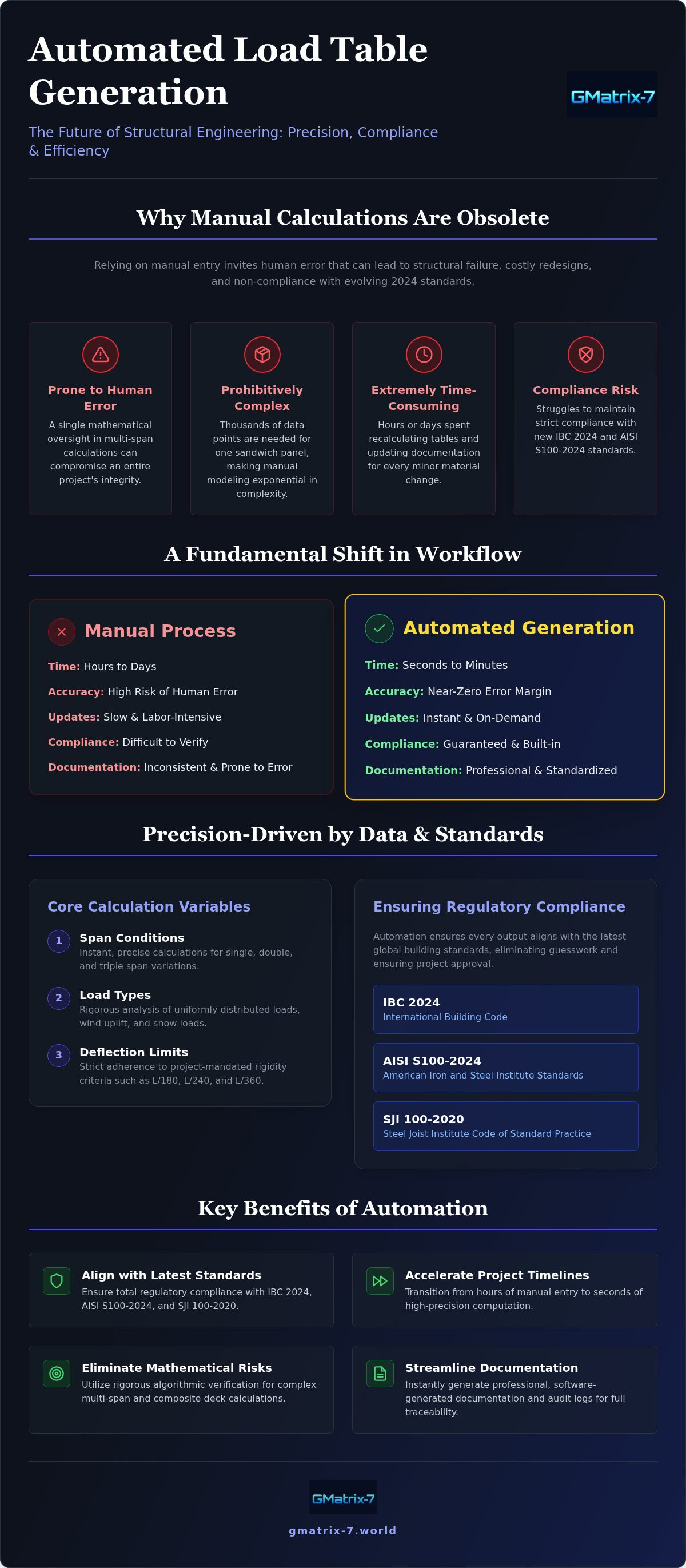
- Transition from hours of manual data entry to seconds of high-precision computation by implementing automated load table generation.
- Eliminate mathematical risks in complex multi-span calculations for sandwich panels and composite decks through rigorous algorithmic verification.
- Accelerate project approval timelines with professional, software-generated documentation and transparent audit logs for complete structural traceability.
- Establish a centralized material property database to streamline workflows across specialized MBS, OWSJ, and LGS structural modules.
What is Automated Load Table Generation in Structural Engineering?
Automated load table generation is the algorithmic calculation of material capacities based on specific structural inputs. It represents a fundamental shift from static, pre-calculated PDF tables to dynamic, software-driven data sets. Within modern Metal Building Systems (MBS), real-time capacity updates are essential because material specifications and code requirements evolve rapidly. Static tables simply can't keep pace with the iterative nature of high-performance engineering. Precision isn't just a goal; it's a requirement for every project you undertake.
This technology bridges the critical gap between initial design and final fabrication. It ensures that the load-bearing capabilities of single skin or sandwich panels are accurately reflected in the bill of materials and approval drawings. Instead of relying on generalized data, engineers generate bespoke tables that reflect the exact geometry and material properties of the project. This seamless integration optimizes the workflow, ensuring that what's designed is exactly what's built.
The Core Components of a Structural Load Table
Structural load tables provide a comprehensive matrix of performance data. Foundational concepts such as Structural Load profiles, including dead, live, and environmental forces, form the basis for these digital models. The automated output typically accounts for several critical variables:
- Span conditions: Precise calculations for single, double, and triple span variations are processed instantly.
- Load types: The software performs a rigorous analysis of uniformly distributed loads, wind uplift, and snow loads.
- Deflection limits: Every output adheres to L/180, L/240, and L/360 criteria as mandated by the project's specific rigidity requirements.
By defining these parameters within a centralized system, engineers maintain absolute control over the structural integrity of the deck. The software processes these inputs against global standards, ensuring every result is both safe and optimized for material efficiency.
Why Manual Calculations are Obsolete in 2026
The engineering landscape of 2026 demands strict compliance with AISI S100-2024 and IBC 2024 standards. Manual calculations for multi-span composite decks have become prohibitively complex. As material science advances, the number of calculation points for iterative mathematical modeling grows exponentially. A single multi-span sandwich panel requires thousands of data points to account for shear, bending, and web crippling across various thicknesses and yield strengths. Relying on manual entry invites human error that can lead to structural failure or costly redesigns. Automated systems eliminate the variables of human fatigue and oversight, reducing the margin of error to near-zero through consistent, code-verified logic.
The Mathematical Complexity of Multi-Span Load Capacity
Calculating multi-span load capacity requires a rigorous analysis of how material thickness, yield strength, and span length interact under stress. In a multi-span configuration, the structural behavior is non-linear. Stress distribution shifts across supports, creating complex bending moments that simple linear equations cannot capture. Automated load table generation utilizes advanced algorithms to solve these equations across thousands of iterations, ensuring that every thickness and span combination is optimized for maximum performance without sacrificing safety. This level of precision is vital when the integrity of a high-rise floor or an industrial roof is at stake.
Standardized spreadsheets often fail because they lack the depth to manage Finite Element Analysis (FEA) integration. FEA allows engineers to simulate real-world conditions, identifying potential failure points that traditional manual modeling might overlook. By automating this process, you maintain absolute consistency across diverse material lists and bills of material. Every data point in your load table remains synchronized with your project's technical specifications, providing a single source of truth for both the design team and the fabrication floor. For engineers seeking this level of precision, exploring advanced structural design modules is the next logical step in modernizing their workflow.
Composite Deck and Sandwich Panel Specifics
Composite floor systems introduce another layer of complexity: the mechanical bond between the steel deck and the concrete slab. Automation handles the intricate calculation of shear stud capacity and embossment patterns to ensure the system acts as a unified structural unit. For sandwich panels, the software must address thermal bridging and core shear. These panels rely on the bond between the insulating core and the metal skins to resist loads. Automated systems calculate the effective section properties for "Z" and "C" sections in Light Gauge Steel (LGS) structures, ensuring AISI compliance for every profile.
Structural Deck Load Capacity Calculation Logic
The core logic of modern table generation embeds the latest industry standards, including AISI S100-2024 and SJI 100-2020. This ensures that every output is inherently compliant with the most recent safety protocols. The algorithm performs exhaustive checks for web crippling and local buckling, which are critical failure modes in cold-formed steel. These checks are performed at every support point and mid-span location simultaneously. GMatrix-7 processes these variables simultaneously to produce a verified capacity matrix that accounts for every possible stress state in the structural system.
Manual Calculation vs. Automated Load Table Generation
Manual engineering methods rely on legacy spreadsheets that often lack the rigorous validation required for high-stakes structural projects. While an experienced engineer might spend hours manually verifying a single multi-span profile, automated load table generation completes the same task in seconds. This speed doesn't just save time; it fundamentally changes how firms manage resources. Instead of hiring more staff to handle a complex material list, you can scale to 100+ panel variations using your existing team. This efficiency allows your elite engineers to focus on high-level design rather than repetitive data entry.
Accuracy is another critical differentiator. Manual entry is prone to transcription errors that cascade through a project. These errors directly threaten the integrity of your automated bill of materials for steel, leading to costly fabrication mistakes or material waste. Automated systems maintain a digital thread from initial calculation to final documentation. This ensures that every piece of steel ordered matches the verified capacity of the design, providing a level of reliability that manual processes simply cannot match. Digital logs also provide superior auditability, offering a clear trail of traceability for project approvals.
Reliability and Risk Management
The hidden cost of manual errors often surfaces too late, usually during fabrication or on the construction site. Automated systems mitigate this risk through built-in validation checks that flag unrealistic load scenarios or code violations before they reach the drawing phase. Version control is another major advantage. When AISI or IBC standards change, such as the recent shift to AISI S100-2024, manual tables become obsolete overnight. Automation allows you to update your entire database instantly. It ensures every project reflects the most current safety requirements without manual intervention, providing peace of mind and structural security.
Output Quality and Professionalism
A professional engineer's reputation rests on the quality of their documentation. Automated load table generation produces standardized, high-resolution outputs that meet the expectations of global fabricators and approval agencies. You can customize these formats to satisfy specific regional requirements without rebuilding the data from scratch. By integrating this load data directly into MBS IBC design software, you create a cohesive workflow where design, calculation, and documentation function as a single, synchronized unit. This transition ensures your project documentation is always professional, accurate, and ready for immediate approval.
Best Practices for Implementing Automated Load Table Workflows
Transitioning to automated load table generation requires a methodical approach to data management and software configuration. The foundation of a reliable workflow is a centralized material property database. This repository ensures that every structural module, whether for MBS or LGS, utilizes identical yield strengths and material thicknesses. Without this single source of truth, inconsistencies can creep into your documentation, undermining the precision of your project. Before fully deploying the system, cross-verify the initial outputs against established manual benchmarks. This validation phase builds confidence in the algorithmic logic and ensures that the software's interpretation of span conditions aligns with your firm's rigorous standards.
Investing in your team's expertise is equally vital for long-term success. Training engineers on professional structural design automation tools empowers them to leverage the full capacity of the software. It isn't just about clicking buttons; it's about understanding how to define standardized deflection and safety factors before the generation process begins. This proactive setup minimizes the need for iterative corrections later in the project lifecycle, directly reducing engineering overhead and improving overall output quality.
Standardization and Compliance Setup
Configuring your software to default to industry standards like SJI 100-2020 or AISI S100-2024 is a non-negotiable step for compliance. For firms managing global engineering projects, the ability to set regional code overrides is essential. This flexibility allows you to adapt to local building codes without compromising the core integrity of your calculations. You should also automate the inclusion of required legal disclaimers on every generated table. This ensures that your documentation is not only technically accurate but also legally robust across all jurisdictions, maintaining a high-register professional standard throughout.
Integration with Detailing and BOM
The true value of automation is realized when you link load tables directly to automated steel shop drawings for real-time updates. When a material specification changes in the load table, the corresponding shop drawings and Bill of Materials (BOM) must reflect that change instantly. This synchronization eliminates the risk of ordering incorrect material, which is a common and costly manual oversight. To further streamline your workflow, implement digital signatures on all generated tables to accelerate the internal and external approval process. If you're ready to optimize your engineering pipeline, implement GMatrix-7 structural modules today to achieve world-class precision.
GMatrix-7: Precision Engineering for Composite and Sandwich Panels
GMatrix-7 represents the pinnacle of structural engineering software, specifically engineered to master the complexities of automated load table generation. It isn't just a calculation tool; it's a comprehensive engineering ecosystem that unifies design, analysis, and documentation. The platform's ability to handle single skin, sandwich panels, and composite decks ensures that every structural component is accounted for with absolute precision. By utilizing a single, authoritative platform, your firm achieves global compliance while maintaining the highest standards of structural integrity.
Integration is the core of the GMatrix-7 philosophy. Our MBS (IBC) and LGS (AISI) modules communicate seamlessly, ensuring that load distributions across the entire building frame remain consistent and verified. When you modify a span or material thickness in one module, the load table updates across all relevant documentation instantly. This 100% automated documentation includes professional material lists and bills of materials, effectively removing the friction between the engineering office and the procurement department. You don't just get data; you get a synchronized digital thread that protects your project from end to end.
The GMatrix-7 Advantage for Fabricators
Fabricators gain a decisive competitive edge by implementing our specialized modules. GMatrix-7 can reduce the engineering-to-fabrication cycle by up to 70%, allowing you to move from approved drawings to the production floor with unprecedented speed. By eliminating the need for expensive third-party load capacity consultants, you retain full control over your project timelines and overhead costs. We also empower fabricators to generate 'white-label' load tables. These professional, code-compliant documents can be branded for your own product catalogs, enhancing your market authority with verified structural performance data that your customers can trust.
Future-Proofing Your Engineering Firm
Elite engineering firms must adapt to evolving regulations to stay competitive. GMatrix-7 ensures you stay ahead of IBC 2024 and upcoming 2026 code revisions through automated software updates that reflect the latest AISI S100-2024 standards. The platform also features GMatrix-7 / OWSJ for bar joist detailing and capacity analysis, providing a robust solution for open web steel joist design that aligns with SJI 100-2020. This comprehensive approach ensures your firm remains a leader in structural innovation. Discover GMatrix-7's load table generation capabilities today and elevate your engineering standards to a world-class level.
Mastering Structural Integrity through Digital Precision
The transition from manual, error-prone spreadsheets to high-precision digital systems is a fundamental shift for firms prioritizing safety and efficiency. You now understand how automated load table generation eliminates mathematical risks while ensuring seamless integration with the latest 2024 IBC and AISI S100 standards. By centralizing material data and automating complex multi-span calculations, you don't just save time; you secure the structural integrity of every project from design through to fabrication.
GMatrix-7 provides the authoritative platform needed to maintain this excellence. Our software is SJI 100-2020 compliant and features advanced modules for automated BOM generation and detailing, ensuring your documentation is always professional and fabrication-ready. It's time to replace legacy workflows with a solution that offers total reliability and peace of mind. Optimize your structural engineering workflow with GMatrix-7 and lead the industry with world-class precision. Your commitment to structural excellence deserves a tool that never compromises on safety.
Frequently Asked Questions
How does automated load table generation handle different span conditions?
It uses algorithmic logic to calculate single, double, and triple span variations instantly. The software accounts for shifting bending moments and stress distribution across multiple supports. This ensures that the generated data reflects the actual physics of the structural system rather than generic estimates found in static tables. You get a precise performance matrix for every span configuration in your project.
Is software-generated load data compliant with AISI S100 and SJI 100-2020?
Yes, professional automated load table generation systems like GMatrix-7 integrate the latest AISI S100-2024 and SJI 100-2020 standards directly into their core algorithms. This ensures that every capacity calculation for bar joists or cold-formed steel members is inherently compliant with current building codes. It provides engineers with verified, code-compliant safety data required for project approvals and structural certification.
Can I customize the deflection limits in automated structural load tables?
You can define specific deflection criteria such as L/180, L/240, or L/360 before the tables are generated. This customization allows engineers to align the software output with the unique rigidity requirements of each specific project. The system then filters all capacity data to ensure that your specified limits are never exceeded in the final documentation, maintaining total structural control.
What is the difference between a load table generator and a general FEA tool?
A load table generator is a specialized tool that iterates through thousands of material and span combinations to produce a comprehensive performance matrix. While a general Finite Element Analysis (FEA) tool can analyze a single specific model, a generator uses FEA logic to create a standardized, easy-to-read capacity guide for fabricators and designers across an entire product line or material set.
How does automation improve the accuracy of an automated bill of materials?
Automation creates a direct digital link between the verified load capacity and the final material specifications. By ensuring the Bill of Materials (BOM) reflects the exact material thickness and yield strength used in the calculations, the system eliminates transcription errors. This synchronization prevents costly material waste and ensures that the fabricated components match the structural design perfectly for every building module.
Can GMatrix-7 generate load tables for both single skin and sandwich panels?
GMatrix-7 features specialized modules specifically designed for both single skin and sandwich panel configurations. The software accounts for unique variables like core shear and thermal bridging in sandwich panels, which differ significantly from the section properties of single skin sheets. This versatility allows fabricators to provide accurate performance data for their entire diverse product catalog through a single engineering platform.
What are the benefits of integrating load tables into approval drawings?
Integrating load tables directly into approval drawings provides a complete, self-contained technical package for reviewers and stakeholders. It streamlines the approval process by offering immediate proof of structural compliance alongside the visual detailing. This transparency reduces the back-and-forth between engineers and building officials, accelerating the project timeline and ensuring that your documentation meets the highest professional standards.
How often should structural load tables be regenerated for compliance?
You should regenerate your structural load tables whenever there is a change in material specifications or a significant update to building codes like the IBC 2024. Automation makes this process instantaneous, allowing your firm to stay current without manual overhead. Regular updates ensure that your documentation always reflects the most accurate safety factors and material performance metrics currently required by the industry.


