

In structural engineering, a Bill of Materials is no longer just a list; it's a safety-critical document where every manual keystroke represents a potential structural liability. You likely understand the frustration of seeing a project stalled because of a single data entry error that led to significant material waste on the shop floor. When comparing a manual vs automated bill of materials, the stakes extend far beyond simple administrative efficiency. It's about the fundamental integrity of your project and the protection of your firm's bottom line.
Transitioning to automated BOM generation is now a critical requirement for maintaining structural engineering accuracy and project profitability as we move toward 2026. This article explores how moving away from manual entry eliminates structural detailing risks while ensuring your outputs remain strictly compliant with IBC and SJI standards. You'll discover how precision-driven software like GMatrix-7 creates a seamless link between design and fabrication. This shift allows you to achieve zero-error material lists and faster project turnarounds, providing the peace of mind that comes with high-level technical excellence.
Key Takeaways
- Identify the structural liabilities inherent in manual entry and learn how automation bridges the critical gap between design and fabrication.
- Evaluate the efficiency of manual vs automated bill of materials, highlighting how 99.9% precision rates eliminate the risk of costly material waste.
- Master the mechanics of direct data extraction from 3D models to ensure rigorous IBC and SJI compliance under tight project deadlines.
- Implement a systematic roadmap to audit your current detailing workflows and eliminate high-risk error hotspots before they impact your bottom line.
- Leverage specialized modules like MBS and OWSJ to unify your structural engineering workflow and achieve faster project turnarounds.
The Structural Liability of Manual Bill of Materials
Relying on human intervention for data transfer is a high-stakes gamble that modern firms can no longer afford. Traditional engineering workflows often treat the bill of materials as an secondary administrative task, yet it serves as the definitive bridge between engineering intent and physical reality. When we analyze the impact of manual vs automated bill of materials, the primary concern is the "human-in-the-loop" error. A single mistyped character in a complex joist schedule can trigger a catastrophic ripple effect, leading to incorrect steel orders that arrive at the job site unusable. Excel-based tracking simply can't meet the rigorous 2026 standards for structural precision, as it lacks the logic-based validation required for modern IBC compliance.
The Decoupling of Design and Material Lists
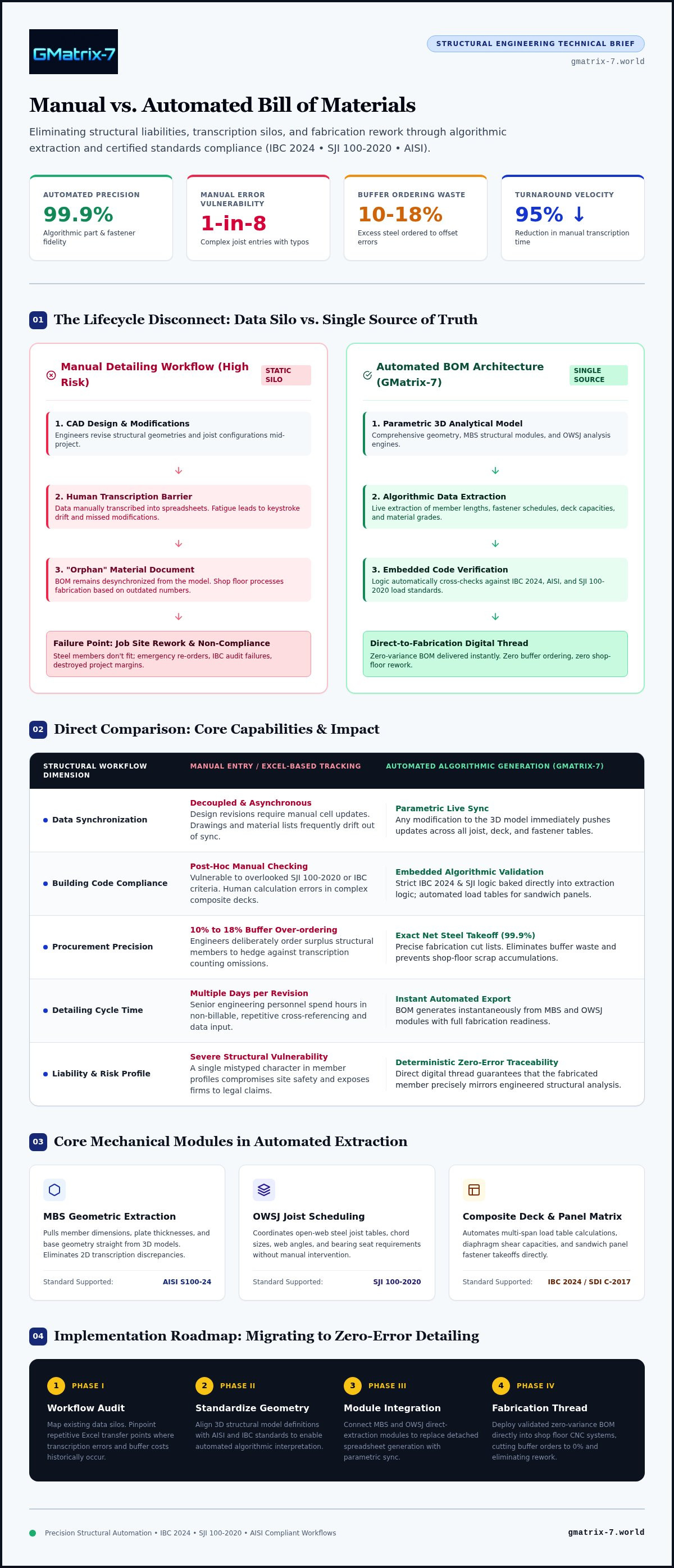
Manual transcription from CAD environments creates a dangerous data silo where information is isolated from its source. When the design phase is decoupled from the material list, version control becomes impossible to manage during the inevitable shifts of a project lifecycle. If a structural modification occurs mid-project, a manual BOM remains static. It doesn't "know" the drawing has changed. This disconnect leads to "orphan" documents that fabrication shops unknowingly follow. You end up with steel members that don't fit, requiring expensive field fixes and emergency re-orders that destroy your project margins and delay occupancy.
Hidden Costs: Waste, Rework, and Compliance Risks
Material waste in large-scale MBS projects is often a direct result of "buffer ordering," where engineers over-order to compensate for manual counting inaccuracies. This practice is an expensive admission of an optimized workflow's absence. Beyond the financial drain, manual calculations introduce severe compliance risks. Failing to meet SJI or AISI standards through a transcription error can lead to legal ramifications and structural vulnerabilities that compromise site safety. Discrepancies between approval drawings and final material lists are more than just administrative nuisances; they're fundamental threats to the integrity of the built environment. Precision is the only acceptable standard in structural detailing, and manual processes consistently fall short of that mark.
Mechanics of Automated Bill of Materials Generation
Automated Bill of Materials (BOM) generation represents a paradigm shift from clerical data entry to algorithmic extraction. In this environment, structural data flows directly from 3D models and analysis engines into a fabrication-ready format. Manual entry requires an engineer to interpret drawings and transcribe values, a process prone to fatigue and oversight. In contrast, automation creates a digital thread that eliminates the interoperability gaps documented in the NIST capital facilities interoperability analysis. When comparing manual vs automated bill of materials, the core advantage lies in the "Single Source of Truth" concept. Any modification to the structural model triggers an immediate, synchronized update to the material list. This ensures that every member, plate, and fastener is accounted for with total fidelity to the engineering design.
Data Extraction from MBS and OWSJ Modules
Specialized modules within LGS structural design software and OWSJ engines pull precise member lengths, weights, and material grades directly from the design geometry. Automation doesn't simply count parts; it understands the relationship between them. It integrates fasteners, base plates, and secondary structural components into a unified database. This live link maintains absolute consistency between your approval drawings and the material database. By removing the need for manual transcription, you effectively eliminate the "data silo" problem where drawings and lists become desynchronized during project revisions. It's a level of precision that manual workflows can't replicate.
Ensuring Compliance Through Algorithmic Validation
Modern automation software embeds industry standards like IBC 2024 and SJI 100-2020 directly into its processing logic. The system validates material choices and structural capacities automatically as the BOM is generated. It handles the intricate calculations required for load table generation for composite decks and sandwich panels, which traditionally consume hours of senior engineering time. This algorithmic validation ensures that every output is inherently compliant with AISI and SJI requirements. By adopting GMatrix-7 automation solutions, you transform compliance from a manual bottleneck into a streamlined, high-value result that guarantees structural integrity and project profitability.
Manual vs Automated BOM: A Comparative Analysis
The distinction between manual vs automated bill of materials is most evident when projects reach the critical path of fabrication. Manual processes often require days of painstaking cross-referencing and data entry for complex metal buildings. Automation reduces this timeline to mere minutes. This speed isn't just about saving time; it's about eliminating the fatigue-induced errors that plague manual workflows. Industry reports suggest that manual entry carries an error rate between 5% and 10%, whereas automated systems achieve 99.9% precision. This gap represents the difference between a profitable project and one consumed by rework and site delays.
Engineering productivity suffers when high-level professionals are forced into clerical roles. Manual BOM generation is a repetitive, low-value task that drains morale and increases the likelihood of turnover among skilled engineers. Automation restores the focus to design excellence. When project revisions or change orders occur, the software handles the updates instantly across all documents. This agility ensures that your fabrication list is never out of sync with your structural model, providing a level of reliability that manual tracking simply cannot match.
Efficiency Metrics in Structural Detailing
Time-to-fabrication is the ultimate metric for project success. When evaluating CAD vs specialized software for steel detailing, the automated BOM cycle emerges as a primary differentiator. Automation removes the administrative burden from structural engineers, allowing them to focus on complex problem-solving rather than data verification. This shift enables massive scalability. Your firm can manage multiple large-scale projects simultaneously without a linear increase in headcount, as the software handles the computational heavy lifting with consistent accuracy.
The Accuracy Dividend: Impact on the Bottom Line
The ROI of error reduction in high-tonnage steel projects is immediate and measurable. An automated BOM facilitates "Just-in-Time" fabrication and delivery, ensuring that the exact components required are delivered precisely when they're needed. This reduces on-site storage costs and prevents the logistical nightmare of missing or incorrect members arriving at the site. Providing clients with precise, professional material lists also enhances your firm's reputation. It projects an image of technological superiority and reliability, securing your position as a preferred partner for high-stakes structural projects.
Roadmap to Implementing Automated BOM Workflows
Transitioning from manual workflows to a digital environment requires more than a simple software installation; it demands a strategic overhaul of your structural detailing framework. To successfully navigate the shift between a manual vs automated bill of materials, your firm must follow a methodical implementation path. This process ensures that the 99.9% precision mentioned earlier becomes a standard reality for every project you deliver. Precision is mandatory. By following a structured roadmap, you eliminate the "human-in-the-loop" liabilities that compromise structural integrity and project margins.
- Step 1: Audit existing workflows. Identify the specific "hotspots" where manual transcription errors typically occur, such as the handoff between design engineers and the fabrication shop.
- Step 2: Select specialized software. Invest in tools that support professional structural design automation to ensure your data remains synchronized across all modules.
- Step 3: Standardize your structural library. Create a unified component database that includes fasteners, plates, and secondary members to prevent data fragmentation.
- Step 4: Pilot the system. Deploy the automated workflow on a smaller MBS or OWSJ project to refine your internal processes before scaling.
- Step 5: Full-scale integration. Execute a firm-wide rollout accompanied by rigorous staff training on automated documentation protocols.
Selecting the Right Engineering Software
The success of your transition hinges on choosing a platform that unifies design logic with material extraction. Your chosen MBS IBC design software must do more than just draft; it must calculate. It should offer native support for global standards like AISI and SJI 100-2020 to ensure every output is inherently compliant. A critical feature to look for is the simultaneous generation of approval drawings alongside the BOM. This synchronization ensures that what is approved for construction is exactly what is ordered for fabrication, closing the gap where most structural discrepancies occur. To see these modules in action, you can explore GMatrix-7 structural automation solutions today.
Overcoming Internal Resistance to Automation
Resistance often stems from a misunderstanding of how automation changes the engineer's role. It's vital to train your detailing teams to move from being "drafters" to becoming "system managers." This shift elevates their value. Instead of spending hours on manual entry, they focus on high-level system oversight and structural optimization. Senior management must see the safety and reliability benefits as a primary driver for this change. When you establish a culture of continuous optimization, you aren't just buying a tool; you're building a world-class engineering entity that is battle-tested and globally minded.
GMatrix-7: The Future of Precision Structural Automation
GMatrix-7 stands as the definitive benchmark for structural design automation. It effectively settles the debate between a manual vs automated bill of materials by providing a platform where precision is not an aspiration but a mathematical certainty. By integrating MBS (IBC), OWSJ (SJI), and LGS (AISI) modules into a single, cohesive workflow, the software ensures that data remains consistent from the first load calculation to the final material takeoff. This unified approach eliminates the fragmentation that typically leads to detailing errors and material waste. It provides a level of reliability that positions your business as a premier leader in the field.
The brand's authoritative expertise is grounded in a deep understanding of global engineering standards and the practical needs of the fabrication shop. GMatrix-7 isn't just a drafting tool; it's a sophisticated engineering environment that manages complex inputs to produce streamlined outputs. It handles the intricacies of generating composite deck load table generators and load tables for sandwich panels with absolute reliability. This level of technical depth allows your firm to tackle high-tonnage projects with the absolute confidence that your documentation is both accurate and safe.
Precision Detailing for Metal Building Systems
GMatrix-7 streamlines the production of IBC-compliant design and documentation through its specialized MBS module. By automating the material list generation, the software significantly reduces project lead times and administrative overhead. You no longer need to wait days for manual verification or cross-referencing. Instead, the system produces fabrication-ready lists that reflect the structural model with total fidelity. This capability is vital for achieving zero-error detailing in complex structures. It ensures that every single skin panel or composite deck component is accounted for before it ever reaches the job site. Transitioning to this automated workflow is the only way to maintain a competitive edge in 2026.
Authoritative Engineering Support and Compliance
The vision behind GMatrix-7, driven by the leadership of Dr. Simon B., focuses on pushing the boundaries of industrial progress through technological innovation. The software acts as a guardian of safety by providing a rigorous, data-driven foundation for every structural system. It ensures that your firm remains at the cutting edge of technology while maintaining a fundamentally stable and dependable output. This is a battle-tested solution designed for world-class entities that value excellence above all else. Elevate your structural engineering with GMatrix-7 automation today to secure your project profitability and achieve the pride of high-level achievement.
Securing the Future of Structural Engineering
The decision between a manual vs automated bill of materials is fundamentally a choice between accepting structural liability and embracing engineering excellence. You've seen how manual transcription creates dangerous data silos and decouples design from fabrication, leading to expensive rework and site delays. Transitioning to an automated workflow eliminates these risks by establishing a single source of truth that remains synchronized throughout the project lifecycle.
GMatrix-7 provides the authoritative solution with SJI 100-2020 and AISI S100 compliant modules that automate both approval drawings and BOM generation. As a global leader in structural design automation, we empower your firm to achieve 99.9% precision while meeting tight deadlines under IBC 2024 standards. This shift doesn't just save time; it protects your bottom line and ensures the long-term safety of your structural systems. It's time to move beyond the limitations of traditional tracking and adopt a system built for high-level achievement.
Optimize your structural workflows with GMatrix-7. Take the bold step toward total detailing accuracy and lead your firm into a new era of industrial progress.
Frequently Asked Questions
What is the primary difference between a manual and an automated BOM?
The primary difference lies in data fidelity and the source of truth. Manual BOMs require human transcription from 2D drawings into spreadsheets, a process prone to interpretation errors. Automated systems extract data directly from the structural model, ensuring a 1:1 match between design and the material list. This eliminates the "data silo" problem where drawings and lists become desynchronized during project revisions, providing a level of reliability manual entry cannot match.
How does automated BOM software improve IBC compliance in metal buildings?
Automated software improves IBC compliance by embedding regulatory logic directly into the generation process. For example, GMatrix-7 / MBS (IBC) modules automatically validate member capacities and connections against the latest building codes. This algorithmic check prevents non-compliant components from ever reaching the Bill of Materials, providing a layer of safety that manual oversight often misses due to project fatigue or tight deadlines. It transforms compliance from a manual bottleneck into a streamlined result.
Can automated BOM tools handle custom structural steel components?
Yes, automated BOM tools are designed to handle complex, custom structural steel components through parametric modeling. The software doesn't just count standard parts; it calculates specific member lengths, weights, and connection requirements for unique geometries. This ensures that even the most complex metal building systems receive a precise material list, maintaining structural integrity without requiring the tedious manual calculations that typically delay custom projects. It provides the flexibility required for visionary architectural designs.
What is the typical ROI for switching to automated structural detailing?
The typical ROI for switching to automated structural detailing is realized through a massive reduction in rework and material waste. By achieving 99.9% precision, firms eliminate the high costs of field fixes and emergency re-orders. Additionally, the speed of automated generation allows engineers to handle more projects without increasing headcount, significantly boosting the firm's scalability and project profitability. It is a strategic investment that pays for itself through increased efficiency and enhanced client trust.
Does GMatrix-7 integrate with existing CAD platforms for BOM generation?
GMatrix-7 functions as a specialized engineering environment that generates both professional approval drawings and comprehensive material lists. It is designed to work alongside existing engineering workflows to provide a seamless transition from structural analysis to documentation. This integration ensures that any design change is immediately reflected in the Bill of Materials, maintaining absolute consistency across the entire documentation package. It effectively bridges the gap between the design office and the fabrication shop floor.
How does automation reduce material waste in structural projects?
Automation reduces material waste by providing exact takeoffs that eliminate the need for "buffer ordering." When comparing a manual vs automated bill of materials, manual lists often include extra material to cover potential counting errors. Automated precision ensures that you order exactly what is required for the fabrication shop, reducing inventory costs and preventing the financial drain of unused steel scrap. This precision is critical for maintaining high profitability in large-scale structural projects.
Is automated BOM generation suitable for small engineering firms?
Automated BOM generation is highly suitable for small engineering firms looking to increase their competitive advantage. It allows smaller teams to deliver the same level of precision and documentation speed as much larger entities. By automating the administrative burden of detailing, small firms can focus their limited resources on high-value design work, enabling them to take on larger, more complex projects with total confidence. It provides the technological foundation required for sustainable growth.
What standards does GMatrix-7 software comply with for joist and steel design?
GMatrix-7 software is engineered to comply with the most rigorous global standards. Our OWSJ module is strictly SJI 100-2020 compliant for joist design, while our LGS module adheres to AISI S100 standards for light gauge steel. Additionally, our MBS module is designed for IBC compliance, ensuring that every structural output meets the safety and engineering requirements of modern building codes. This commitment to compliance provides engineers with the peace of mind that their designs are fundamentally stable.


