

The era of the standalone spreadsheet for cold-formed steel design is officially over. You likely spend hours manually verifying Z and C purlin capacities, only to find that your calculations don't sync with the final shop drawings. It's a frustrating, error-prone cycle that bottlenecks your entire engineering workflow. This 2026 buyer’s guide explores how modern steel building purlin design software eliminates these manual entry risks by bridging the gap between structural analysis and fabrication.
We understand that precision isn't just a goal; it's a legal and safety mandate. You need a system that ensures absolute AISI S100-2024 compliance while delivering the speed required for competitive bidding. By transitioning to integrated structural automation, you'll discover how to generate instant load tables and seamless MBS detailing without the traditional data-entry lag. This guide provides a comprehensive roadmap for selecting tools that offer automated Bill of Material generation and high-level structural optimization, ensuring your firm remains at the cutting edge of industrial excellence.
Key Takeaways
- Master the transition from manual calculations to automated AISI S100-2024 compliance to ensure structural integrity and professional safety.
- Evaluate how modern steel building purlin design software integrates parametric modeling with continuous span analysis to eliminate repetitive data entry.
- Discover the high-value ROI of integrated MBS suites over standalone calculators by streamlining the path from analysis to fabrication.
- Accelerate your documentation workflow by generating instant, professional-grade load tables and automated Bills of Material for any gauge or span.
The Engineering Complexity of Cold-Formed Steel Purlin Design
Secondary structural members are the unsung heroes of the Metal Building System (MBS). While primary frames handle the heavy lifting, the Purlin system acts as the critical bridge, transferring lateral and vertical loads from the building envelope to the main structure. Designing these components requires more than a simple span calculation. Cold-formed steel (CFS) presents unique engineering hurdles because its high strength-to-weight ratio comes from thin-walled sections. These sections are susceptible to complex instability modes that don't occur in heavier, hot-rolled members. Professional steel building purlin design software must account for these nuances to prevent localized failure or total structural collapse.
In modern construction, purlin spacing and lap lengths are not merely detailing preferences; they are fundamental to global building stability. Longer laps increase continuity and stiffness, which can significantly reduce deflections and allow for lighter gauges. However, calculating the exact capacity of an overlapped system under IBC 2024 requirements is computationally intensive. It requires a rigorous analysis of the interaction between the deck, the fasteners, and the member itself. Precision at this stage ensures that the secondary framework provides adequate lateral bracing for the primary frames, maintaining the building's structural integrity under extreme wind or snow loads.
Understanding Local, Distortional, and Global Buckling
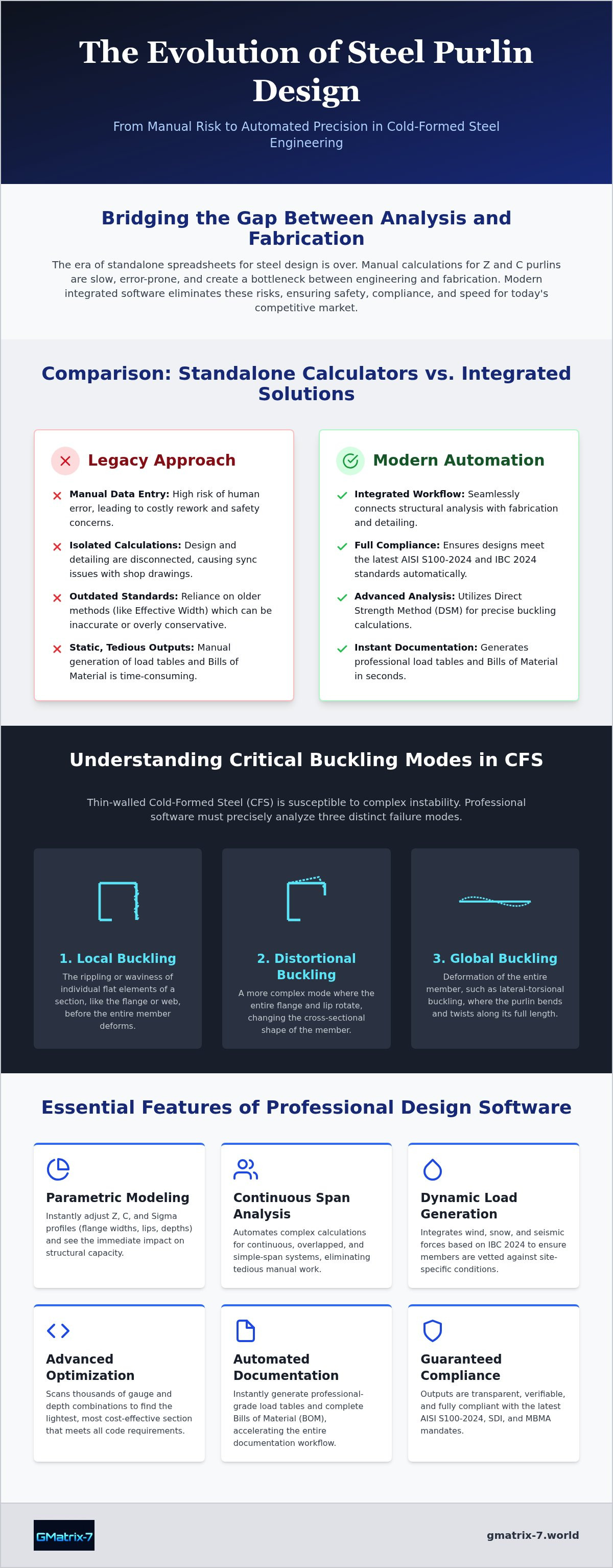
Thin-walled CFS sections behave unpredictably under non-uniform stress. Engineers must manage three distinct buckling modes: local, distortional, and global. Local buckling involves the rippling of individual elements, while distortional buckling occurs when the entire flange and lip rotate. Global buckling, such as lateral-torsional buckling, affects the member's full length. The Direct Strength Method (DSM) has become the preferred approach for these calculations, yet it is nearly impossible to execute manually for complex continuous spans. Legacy tools often rely on the older Effective Width Method, which can lead to overly conservative or inaccurate results. Modern steel building purlin design software utilizes DSM to capture these interaction effects with surgical precision.
Regulatory Standards: From AISI S100 to IBC 2024
Compliance is a moving target. The transition to AISI S100-2024 and the integration of IBC 2024 standards have introduced stricter requirements for structural member design. Relying on "black box" calculators or outdated spreadsheets poses a massive risk to your firm’s reputation and permit approval success. By 2026, engineers must demonstrate that their designs meet these updated North American structural codes. High-tier software ensures your outputs are transparent, verifiable, and fully compliant with the latest SDI and MBMA mandates. This transition from manual entry to integrated structural automation provides the peace of mind that your designs are both optimized for cost and battle-tested for safety.
Essential Features of Professional Purlin Design Software
Professional steel building purlin design software transforms structural engineering from a series of isolated checks into a cohesive, data-driven process. High-performance tools utilize parametric modeling to handle complex Z, C, and Sigma profiles with ease. This allows engineers to adjust flange widths, lip lengths, and depths instantly, seeing the immediate impact on capacity. Automation extends to the analysis of continuous, overlapped, and simple-span systems, which is vital for modern MBS projects where manual calculations for overlapping zones are notoriously tedious.
Modern engines also integrate dynamic load generation for wind, snow, and seismic forces, ensuring that every member is vetted against site-specific environmental conditions. A critical feature is the software's ability to account for diaphragm action. By modeling the shear stiffness provided by roof sheeting, the software recognizes the lateral support the panels offer the purlins. For a deeper understanding of these interactions, the Design Guide for Cold-Formed Steel Purlin Roof Framing Systems serves as an essential technical reference. When your software handles these complex variables, you can focus on high-level design strategy rather than granular data entry.
Advanced Section Optimization
Efficiency in the 2026 market requires more than just meeting code; it requires material minimization. Advanced optimization algorithms within professional steel building purlin design software scan thousands of combinations of gauge and depth to identify the lightest possible section that satisfies all structural requirements. This process identifies the "sweet spot" where material costs are minimized without compromising the safety of the span. Section optimization is the strategic balance of material economy and structural safety, ensuring that every pound of steel delivers maximum load-bearing performance. Utilizing a sophisticated design suite allows fabricators to reduce waste significantly on large-scale projects.
Torsional Restraint and Lateral Stability
Secondary members are highly susceptible to twisting under load. Professional software must model the specific effects of torsional restraint provided by bridging, sag rods, and the rotational stiffness of attached panels. This analysis is crucial for both the final building state and the often-overlooked construction phase, where purlins may lack full lateral support. Accurate modeling ensures stability throughout the building's lifecycle, protecting your firm from the liabilities of unforeseen structural failure.
Comparison Framework: Standalone Calculators vs. Integrated MBS Solutions
Choosing the right steel building purlin design software requires looking beyond the initial price tag. While standalone calculators or custom Excel sheets might suffice for a single-span shed, they fail spectacularly when managing high-volume fabrication. The true ROI of an integrated structural engineering suite lies in the elimination of manual data re-entry. Free online tools often lack the rigorous updates needed for AISI S100-2024 compliance, forcing engineers to spend hours cross-referencing tables. This hidden time sink erodes profit margins and introduces unnecessary risk into the design cycle. Data integrity is the foundation of high-level achievement in structural engineering, and a single source of truth is the only way to prevent costly site errors.
Scalability is another critical factor. A professional-grade system handles everything from a small mezzanine to a massive industrial complex without requiring a change in workflow. This stability allows your team to maintain peak efficiency regardless of project size. Relying on fragmented tools means your data is siloed, making it impossible to achieve the speed and optimization required by the 2026 market. When your software acts as an authoritative expert, it doesn't just provide a result; it provides the peace of mind that every calculation is battle-tested and globally minded.
The Problem with Fragmented Detailing
Manual transcription between a design calculator and a CAD environment is a primary source of liability. When an engineer calculates a Z-purlin capacity in one tool and then manually types those specs into a shop drawing, the risk of a typo is high. Integrated systems solve this by creating a single source of truth. Updates in the analysis phase flow directly into the detailing model. By linking design data directly to MBS IBC design software, firms ensure total compliance while reducing the revision cycle. This seamless transition is documented as a best practice in the Cold-Formed Steel Purlin Roof Framing Systems Design Guide, which highlights the need for consistent data across the entire building envelope.
Feature Matrix for 2026 Software Selection
As we approach 2026, the technological divide between legacy systems and modern platforms is widening. Legacy desktop-bound software often lacks the API capabilities required for custom manufacturing workflows or BIM integration. When selecting your next tool, prioritize these features:
- Cloud-Based Collaboration: Enables real-time access for remote engineering teams and seamless project handoffs.
- API Connectivity: Facilitates direct data transfer to CNC machinery and ERP systems, eliminating manual intervention.
- Engineering-Led Onboarding: Provides direct access to technical support that understands AISI standards and practical structural application.
Having a partner who is both a visionary developer and a practical problem-solver ensures your team isn't just buying a tool, but gaining a guardian of structural safety. This approach moves your business away from mere survival and toward a bold, ambitious stance in the global construction industry.
Beyond Analysis: Automating Load Tables and Bills of Material
Engineering analysis is only half the battle for modern fabricators. While a capacity check proves a member won't fail, it doesn't provide the documentation needed to sell a system or drive a production line. High-performance steel building purlin design software bridges this gap by transforming raw structural data into commercial assets. Instead of treating purlin design as an isolated task, integrated systems treat it as the heartbeat of the Metal Building System (MBS). This transition ensures that your engineering department isn't a bottleneck, but a driver of faster building department approvals and streamlined sales cycles.
Standardizing your documentation through automation eliminates the risk of human error during the submittal process. When you can generate metal cladding load tables in minutes, you provide your clients with the authoritative data they need to trust your structural integrity. This level of professional sophistication separates industry leaders from those still struggling with manual spreadsheets and fragmented toolsets.
Generating Accurate Load Tables
Creating professional-grade load tables requires a methodical, iterative approach that few standalone tools can handle. Professional steel building purlin design software automates this via a rigorous four-step workflow:
- Step 1: Define precise section geometry and material properties, such as yield strength (fy) and Modulus of Elasticity (E).
- Step 2: Configure specific span conditions, including single, double, or triple spans with varying overlapped lengths.
- Step 3: Execute iterative analysis across multiple deflection limits, typically L/180, L/240, and L/360, to ensure serviceability.
- Step 4: Export the results into formatted PDF or Excel tables ready for marketing brochures or engineering submittals.
This process ensures that every gauge and span combination is battle-tested against the latest AISI standards, providing a reliable reference for field contractors and building officials alike.
Automating the Bill of Materials
The final stage of a high-value engineering workflow is the translation of design data into a Bill of Materials (BOM). Manual tallying is a significant liability that leads to material waste and site delays. Integrated software extracts precise cut lengths and punch patterns directly from the design model, ensuring that what was analyzed is exactly what gets fabricated. By connecting your purlin design to professional structural design automation, you enable intelligent nesting integration that minimizes scrap and maximizes profitability.
This seamless data flow from analysis to the factory floor is the hallmark of a world-class operation. It provides the peace of mind that your material lists are accurate, your shop drawings are compliant, and your production is optimized for excellence. To see how these modules can revolutionize your workflow, explore the GMatrix-7 automation suite today.
GMatrix-7: The Gold Standard for Purlin and LGS Engineering
GMatrix-7 stands as the definitive leader in the structural engineering sector, providing a robust platform that integrates the GMatrix-7 / LGS (AISI) and MBS (IBC) modules into a single, high-performance ecosystem. This platform earned its reputation as the "Gold Standard" through rigorous real-world application and was recognized with 2024 industry awards for its innovative approach to automation. Unlike generic tools that offer surface-level analysis, this steel building purlin design software utilizes the specialized engineering logic developed by Dr. Simon B. to solve the industry's most complex secondary framing challenges. It automates the production of approval drawings and Bills of Material, ensuring that every design is optimized for both structural integrity and fabrication efficiency. By consolidating your engineering workflow on this world-class platform, you achieve global structural compliance while eliminating the fragmented data silos that plague traditional methods.
The authority of GMatrix-7 lies in its ability to bridge the gap between visionary technology and practical problem-solving. It provides a level of reliability and security that legacy systems cannot match, particularly when navigating the shifting landscape of international building codes. This software doesn't just perform calculations; it acts as a guardian of safety and a driver of industrial progress. For firms aiming for a bold, ambitious stance in the 2026 market, GMatrix-7 offers the sophisticated tools necessary to maintain a competitive edge while upholding the highest standards of excellence.
Precision Detailing for Fabricators
The transition from design to the factory floor requires absolute accuracy to avoid costly site errors. GMatrix-7 generates shop-ready drawings that respect your specific manufacturing constraints, such as punch patterns and cut tolerances. This level of precision is essential for modern fabricators managing diverse product lines, including single skin, sandwich panels, and composite decks. You can discover more about LGS structural design software to see how these specialized modules handle the intricacies of cold-formed projects. By aligning your detailing with your actual production capabilities, you reduce shop-floor errors and accelerate the delivery of high-value structural components.
Future-Proofing Your Engineering Workflow
Excellence in the 2026 market demands a proactive approach to regulatory shifts and technological progress. GMatrix-7 ensures your firm stays ahead of evolving industry standards through regular updates that incorporate the latest AISI and IBC mandates. Leveraging automated documentation doesn't just save time; it positions your business as a technologically advanced partner capable of winning more bids through faster, more accurate quotations. This is not just a tool; it's a driver of industrial progress that provides the peace of mind necessary for high-level achievement. To experience this transformation firsthand, request a GMatrix-7 demo to see purlin automation in action and secure your position as a leader in the global construction landscape.
Mastering Structural Excellence in the 2026 Market
The transition toward fully integrated structural automation represents the next evolution in high-performance metal building systems. By moving beyond fragmented spreadsheets and adopting sophisticated steel building purlin design software, you ensure that your engineering department remains a driver of profit rather than a documentation bottleneck. You've seen how automated AISI S100-2024 compliance and seamless BIM integration provide the peace of mind necessary for high-level industrial achievement. Precision isn't just a goal; it's the standard by which your firm's reputation is built.
GMatrix-7 provides the world-class tools needed to master this technological shift. With IBC and AISI compliant modules, automated Bill of Materials (BOM) generation, and an industry-leading load table generator for cladding and decks, your firm can deliver excellence with surgical precision. It's time to replace manual liability with automated reliability. Streamline Your Engineering with GMatrix-7 Purlin Design Software and lead the global market with assertive confidence. Your path to optimized structural excellence and industrial progress starts with a single, bold decision to upgrade your workflow today.
Frequently Asked Questions
What is the best software for Z-purlin design in 2026?
GMatrix-7 is the definitive choice for Z-purlin design in 2026 because it integrates specialized engineering logic with high-speed structural automation. It moves beyond simple capacity checks by providing a world-class platform that automates approval drawings and material lists. This ensures that your secondary framing is both structurally sound and optimized for the rigors of high-volume industrial fabrication.
Does GMatrix-7 support the latest AISI S100 and IBC 2024 standards?
Yes, GMatrix-7 is fully compliant with the latest AISI S100-2024 and IBC 2024 standards. Staying current with these North American structural codes is essential for securing permit approvals and maintaining global safety standards. The software’s modules are rigorously updated to reflect the shifting regulatory landscape, providing engineers with the peace of mind that their designs are battle-tested and legally sound.
Can purlin design software generate automated load tables?
Professional steel building purlin design software like GMatrix-7 features a specialized load table generator for single skin and sandwich panels. This tool produces instant, accurate tables for various spans and gauges, replacing the need for manual, error-prone spreadsheets. By automating this documentation, you provide clients and building officials with authoritative data that confirms the structural integrity of your building envelope.
What is the difference between Z-purlin and C-purlin design in software?
The primary difference lies in how the software models continuity and structural efficiency. Z-purlins are designed for lapping over supports, creating a continuous span that reduces deflections and allows for lighter gauges. C-purlins are generally analyzed as simple spans. Sophisticated software calculates the unique torsional behaviors and distortional buckling modes specific to each profile, ensuring optimal performance for both Z and C shapes.
How does automated BOM generation reduce steel building costs?
Automated Bill of Material generation reduces costs by eliminating the manual transcription errors that lead to material waste and site delays. The software extracts precise cut lengths and punch patterns directly from the design data, enabling intelligent nesting. This precision ensures that material utilization is maximized, which significantly lowers the total cost of ownership for large-scale Metal Building Systems.
Is GMatrix-7 suitable for large-scale Metal Building Systems (MBS)?
Yes, GMatrix-7 is specifically engineered for large-scale Metal Building Systems (MBS). Its MBS (IBC) module handles the complex secondary framing and primary structural analysis required for massive industrial complexes. The platform scales effortlessly from simple sheds to high-volume commercial projects, maintaining a single source of truth that ensures structural stability and fabrication accuracy across the entire building lifecycle.
Can I export purlin design data to CNC machines for fabrication?
Yes, you can export design data to streamline the manufacturing process. GMatrix-7 automates the generation of material lists and approval drawings that integrate directly with manufacturing constraints. This seamless data flow allows for the precise transfer of cut lengths and hole locations to factory equipment, ensuring that the final fabricated members match the engineered design with surgical precision.
How does the software handle purlin laps and continuity?
The software utilizes advanced iterative analysis to model the increased stiffness provided by overlapped purlin laps. It automatically identifies the optimal lap length required to maintain continuity across multiple spans while adhering to AISI S100-2024 requirements. This ensures that the secondary framing system provides maximum structural efficiency and lateral stability for the primary frames without unnecessary material waste.


