

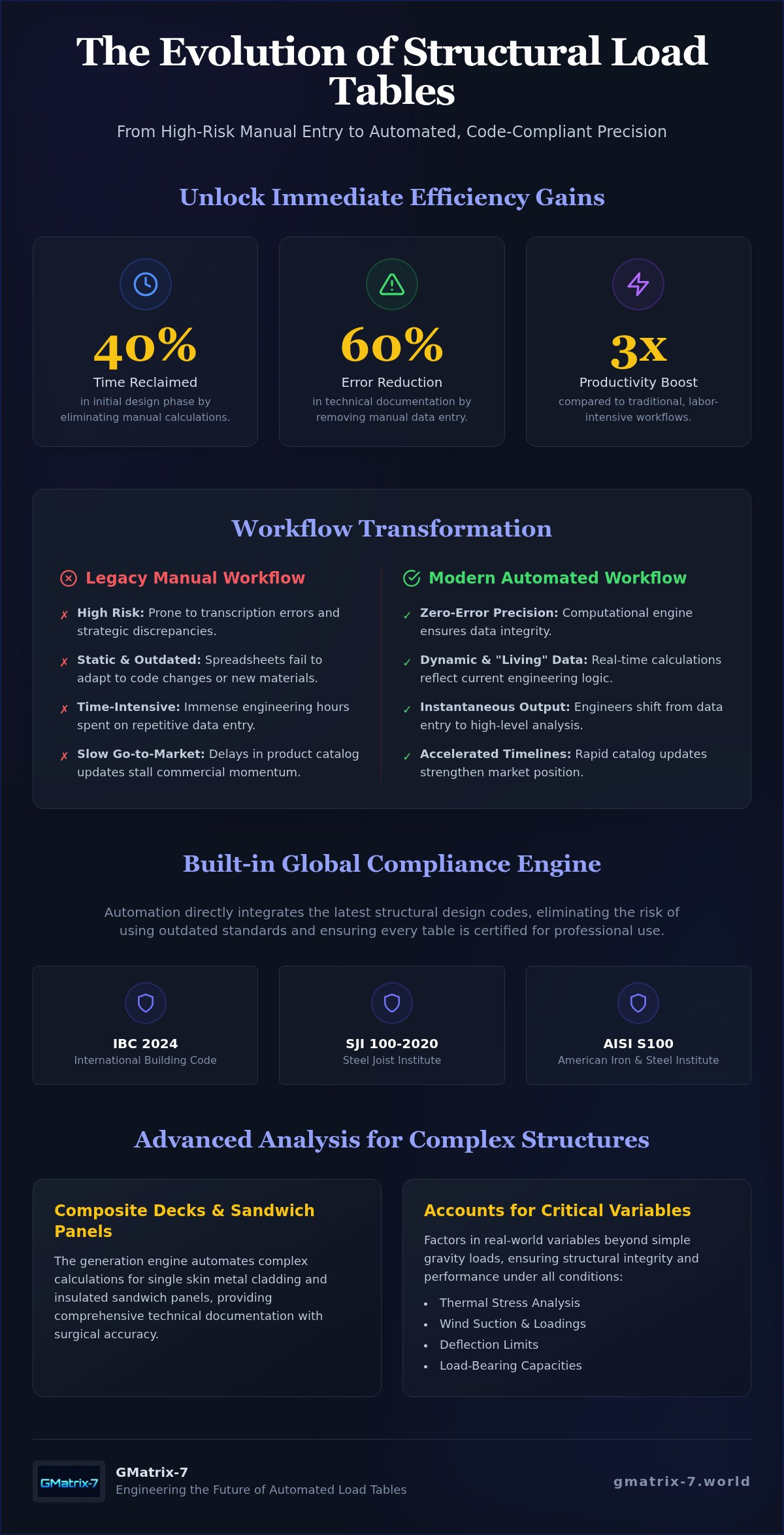
Structural engineers who adopt automated analysis can reclaim up to 40% of their initial design time while reducing calculation errors by a staggering 60%. In an industry where precision is the bedrock of safety, relying on manual data entry for technical documentation is a strategic vulnerability. You recognize that maintaining compliance with the latest IBC 2024 and SJI 100-2020 standards is non-negotiable; however, the immense volume of engineering hours required to update product catalogs often stalls your commercial momentum.
This article demonstrates how automated load table generation serves as a rigorous analysis engine to ensure global compliance at scale. By integrating advanced software like GMatrix-7, you can transform complex structural inputs into instant, zero-error technical documentation for composite decks and sandwich panels. We will detail the transition from manual calculation to a fully automated system that boosts productivity by up to three times. Discover how to leverage these technological advancements to secure your position as an authoritative leader in high-performance steel construction.
Key Takeaways
- Analyze why legacy manual calculations and spreadsheet workflows create strategic risks in modern structural documentation.
- Discover how to integrate IBC, SJI, and AISI standards directly into your workflow to ensure total compliance across various span conditions.
- Identify the specific efficiency gains of automated load table generation by comparing labor-intensive manual entries against software-driven precision.
- Follow a structured implementation path to define structural parameters and select specialized modules for MBS, OWSJ, or LGS design.
- Learn how GMatrix-7 automates the production of complex sandwich panel and composite deck tables to accelerate your product catalog updates.
Beyond the Spreadsheet: The Evolution of Load Table Generation
Automated load table generation represents a fundamental shift in how structural engineering data is processed and presented. It isn't merely a digital version of a physical catalog; it's a sophisticated computational engine that bridges the gap between raw finite element analysis and the polished, code-compliant tables used by designers and contractors. For decades, the industry relied on disconnected spreadsheets that often failed to account for complex iterative design code changes or nuanced structural safety factors. In the high-stakes environment of modern steel construction, these legacy workflows are strategic liabilities.
The 2026 engineering landscape demands documentation that is as dynamic as the projects it supports. Instant, data-driven technical catalogs are no longer a luxury; they're a requirement for firms that intend to remain competitive. Automation allows for a seamless transition from engineering design to professional approval drawings, ensuring that every span condition and load combination is verified against the most current standards. This evolution moves the engineer from the role of a data entry clerk to that of a high-level technical guardian who values precision and excellence.
The Shift from Static to Dynamic Structural Data
Manual span-load data entry carries a high risk of transcription errors that can lead to significant structural discrepancies. Static tables are fundamentally limited because they fail to keep up with evolving material properties or the tightening of global safety requirements. Modern structural design utilizes real-time calculation engines to ensure every data point reflects current engineering logic. This transition replaces the "snapshot" approach of the past with a living data model that maintains its integrity throughout the product lifecycle, providing peace of mind for both the manufacturer and the end-user.
Core Benefits for Steel Fabricators and Manufacturers
Manufacturers face intense pressure to reduce the turnaround time for product catalog updates to maintain their market share. Implementing automated load table generation allows you to accelerate your go-to-market speed for new structural products while enhancing your professional authority. Precise, error-free documentation builds trust with engineers and architects, positioning your brand as a reliable partner in the global supply chain. By removing the bottleneck of manual calculation, you empower your team to focus on innovation rather than administrative repetition.
A mid-sized steel manufacturer achieves immediate ROI by slashing engineering overhead by 40% while simultaneously insulating the firm against the professional liability of manual calculation errors.
The Mechanics of Structural Automation: SJI, AISI, and IBC Compliance
True structural automation transcends simple data mapping; it requires the direct integration of engineering physics into the computational engine. Unlike generic database tools, effective automated load table generation must ingest the rigorous logic of industry-standard design codes. This process involves embedding the specific requirements of SJI 100-2020 for bar joists and AISI S100 for cold-formed steel structural members into the software core. By doing so, the system handles complex iterative calculations across multiple span conditions with a level of precision that manual workflows cannot replicate.
Compliance isn't a static checkbox but a dynamic validation process. The software must automatically verify all outputs against the International Building Code (IBC) 2024 edition, which includes updated provisions for tornado loadings and revised wind and seismic requirements. This automated validation ensures that every generated table is not just a collection of numbers, but a certified document ready for professional application. It eliminates the risk of using outdated standards, providing a foundation of reliability for every project.
Automating Single Skin and Sandwich Panel Calculations
Calculating the performance of single skin metal cladding and sandwich panels requires accounting for variables that go beyond simple gravity loads. The generation engine must factor in thermal stress and wind suction, particularly for insulated sandwich panels where temperature differentials can significantly impact structural integrity. Automated systems calculate deflection limits and load-bearing capacities with surgical accuracy, ensuring the final output reflects real-world performance. By integrating material list data directly into the load table, manufacturers can provide comprehensive technical data that includes both structural limits and bill-of-material specifics.
Complexities of Composite Floor Deck Load Tables
Composite deck analysis is uniquely challenging because it involves the interaction between two distinct materials: concrete and steel. The software must differentiate between construction-stage loads, where the steel deck acts as a form for wet concrete, and service-stage loads, where the cured slab and steel work together as a composite unit. Advanced composite deck load table generators automate the analysis of multi-span conditions, providing precise data for various slab thicknesses and reinforcement configurations.
This level of granular detail ensures that engineers have the exact data they need for safe and efficient floor system design. If you're ready to move beyond manual entry and embrace world-class precision, you can explore specialized modules for automated structural analysis and table generation.
Comparing Manual Calculation vs. Automated Generation Workflows
Producing a standard 50-page span-load catalog manually is a monumental undertaking that consumes hundreds of senior engineering hours. Each page represents a dense matrix of variables, including span lengths, load types, and material gauges. In a manual workflow, the potential for a single typo to compromise the structural integrity of a published table is unacceptably high. Transitioning to automated load table generation eliminates this risk by replacing human data entry with algorithmic precision.
Automation wins in high-stakes projects because it doesn't force a trade-off between speed and accuracy. While a manual revision cycle for a new building code can take months, an automated system updates the entire product line in minutes. This scalability is essential when handling thousands of span combinations across diverse steel grades. You don't just save time; you eliminate the hidden costs of manual audits and the professional liability associated with legacy documentation. It's a shift from reactive data management to proactive structural leadership.
Efficiency Benchmarks for Structural Detailing
Recent industry data indicates that engineers adopting professional structural design automation can reduce their initial analysis time by up to 40%. This efficiency is further amplified when automated Bill of Material (BOM) generation is integrated into the workflow. In OWSJ bar joist detailing, for example, the seamless flow from design to documentation ensures that every component is accounted for without redundant data entry. This methodical progression mirrors a professional workflow that prioritizes intellectual rigor and commercial urgency.
Maintaining Data Integrity Across Global Standards
Standardizing technical outputs for international markets requires a robust engine capable of toggling between IBC 2024 and Eurocode parameters. Manual workflows often suffer from a "transcription gap" where the engineered values don't perfectly match the marketing collateral. By maintaining consistency in SJI compliant joist design across all product lines, you ensure that every published value is backed by a verifiable structural analysis. This level of data integrity builds the professional confidence required to lead in the global construction market and provides peace of mind for every stakeholder involved.
Best Practices for Implementing Load Table Automation
Successful implementation of automated load table generation requires a methodical deployment strategy that prioritizes structural integrity. It isn't enough to simply adopt new software; you must align the engine with your specific material yields and geometric constraints. This process ensures that the transition from manual entry to algorithmic precision doesn't compromise the safety standards your firm is built upon. Follow these steps to establish a world-class automation workflow:
- Step 1: Define your structural parameters and design code requirements to align the computational engine with your specific material yields.
- Step 2: Select specialized modules for MBS, OWSJ, or LGS design to ensure the software handles category-specific iterative calculations correctly.
- Step 3: Validate software outputs against known manual benchmarks to establish a baseline of reliability and peace of mind.
- Step 4: Customize table layouts to meet the rigorous requirements of professional approval drawings and technical catalogs.
- Step 5: Integrate the generator with your existing structural design software to create a unified, end-to-end data pipeline.
By following this logical progression, you move from the complexity of raw analysis to the simplicity of streamlined outputs. This structured approach allows your engineering team to focus on high-level optimization while the software manages the repetitive data verification tasks.
Customizing Output for Professional Approval Drawings
High-performance documentation must balance technical density with readability for end-users. You don't want to overwhelm contractors with extraneous data, yet you must provide every necessary detail for safe field application. Automation allows you to incorporate mandatory safety factor disclaimers and localized code compliance notes without manual intervention. By automating the branding and formatting of your technical documentation, you ensure a consistent, world-class image across every page of your catalog. This level of professional sophistication reinforces your brand's authority in the marketplace.
Future-Proofing Your Engineering Documentation
The regulatory landscape is constantly shifting, and your documentation must keep pace. Preparing for IBC 2027 and future revisions requires a platform that receives regular logic updates to maintain compliance. Utilizing advanced LGS structural design software allows you to stay at the forefront of cold-formed steel innovation, adapting to new profiles and material properties as they emerge. Scaling this level of automation is essential for global structural fabricators who need to maintain uniform standards across multiple international facilities. If you're ready to secure your competitive edge, book a demonstration of our automated load table modules.
GMatrix-7: Engineering the Future of Automated Load Tables
GMatrix-7 stands as the world-class authority for structural automation, offering a suite of specialized modules that redefine industry productivity. By integrating IBC, SJI, and AISI standards directly into its core logic, the platform ensures that automated load table generation is a rigorous engineering process rather than a simple data output. Whether you're producing single skin tables or complex sandwich panel data, the system manages the intricacies of thermal stress and wind suction with surgical precision. This level of technical sophistication allows manufacturers to transition from complex inputs to streamlined, professional outputs without the traditional labor bottlenecks.
The platform bridges the gap between structural detailing and the final fabrication requirements. Automated Bill of Material (BOM) generation ensures that every structural component is accounted for, eliminating the manual reconciliation that often leads to costly site errors. This seamless data flow represents the gold standard for structural engineering productivity in 2026, allowing firms to scale their operations without increasing their technical overhead. It's a battle-tested solution designed for those who value excellence and demand a partner that is both technologically advanced and fundamentally stable.
Precision Detailing for Metal Building Systems
Integrating MBS IBC design software with automated table generation allows manufacturers to move from design to approval drawings with unprecedented speed. Bar joist manufacturers achieve total SJI compliance through battle-tested algorithms that respect the nuances of SJI 100-2020. This methodical progression ensures that your technical catalogs aren't just marketing tools, but legally compliant engineering documents. GMatrix-7’s safety-focused engineering provides the absolute reliability required to sign off on high-stakes structural documentation with total confidence.
Global Scalability and Support
World-class engineering technology requires a visionary foundation to support global fabricators across diverse regulatory environments. Dr. Simon B. and the GMatrix-7 leadership team have cultivated a platform that prioritizes industrial progress while maintaining a commitment to safety and excellence. This vision ensures that your engineering documentation remains a driver of growth rather than a bottleneck for innovation. It's time to replace outdated manual workflows with a cutting-edge solution that values precision above all else. Transform your engineering workflow today by adopting the industry's most sophisticated automation suite and secure your position as a leader in modern steel construction.
Securing Your Competitive Edge in Structural Engineering
The transition from legacy spreadsheets to algorithmic precision is no longer optional for firms that prioritize excellence and safety. You've seen how integrating automated load table generation into your workflow eliminates the strategic vulnerability of manual data entry while ensuring total compliance with IBC, SJI, and AISI standards. By replacing labor-intensive calculation cycles with a rigorous analysis engine, you reclaim critical engineering hours and insulate your firm against professional liability. This methodical approach to technical documentation provides the peace of mind required to lead in a high-stakes global market.
GMatrix-7 empowers you to scale your operations through award-winning technology that bridges the gap between raw structural analysis and professional approval drawings. With automated BOM generation and specialized modules for sandwich panels and composite decks, your team can focus on innovation rather than administrative repetition. It's time to embrace a system that is as dynamic as the projects you support. Experience the Precision of GMatrix-7 Structural Automation and take the first step toward a future of zero-error technical documentation. Your journey toward world-class efficiency starts today.
Frequently Asked Questions
What is automated load table generation in structural engineering?
Automated load table generation is a sophisticated computational process that transforms raw structural analysis into formatted, code-compliant span-load tables. It replaces manual data entry with algorithmic logic to ensure that every published value reflects real-world physics and the latest building codes. This technology allows engineers to move from complex inputs to streamlined, professional outputs with surgical precision and total consistency.
Can I use general data software for structural load tables?
No, general database or spreadsheet tools lack the integrated engineering logic required for structural safety and compliance. Structural tables require specialized engines that understand material non-linearity, deflection limits, and specific iterative code requirements like SJI or AISI. Relying on generic software creates a strategic vulnerability, whereas dedicated structural automation ensures that safety factors and iterative design changes are correctly applied.
How does GMatrix-7 ensure compliance with SJI 100-2020?
GMatrix-7 embeds the SJI 100-2020 standard directly into its calculation core to ensure total adherence to the latest industry specifications. This integration allows the software to automatically apply the correct weight and load tables for bar joists and OWSJ components. By automating these rigorous checks, the platform provides a battle-tested foundation for technical documentation that meets the highest professional standards.
Is automated load table generation suitable for sandwich panels?
Yes, automated load table generation is the most efficient method for managing the complex variables inherent in sandwich panel design. The software simultaneously calculates thermal stress, wind suction, and composite action to produce precise technical data that manual methods often oversimplify. This ensures that manufacturers can provide accurate, high-performance load tables for insulated metal panels across diverse environmental conditions.
How much time can engineers save with automated documentation?
Engineers who adopt automated documentation can reduce their initial analysis time by up to 40% while boosting overall productivity by 2 to 3 times. This efficiency allows firms to update entire product catalogs in minutes rather than weeks, significantly accelerating go-to-market speeds. By removing the bottleneck of manual data entry, your team can focus on high-level optimization and innovation rather than repetitive administrative tasks.
What design codes are supported by GMatrix-7 modules?
GMatrix-7 supports a comprehensive range of global standards, including IBC 2024, SJI 100-2020, and AISI S100-16 (2020). These modules ensure that your technical outputs remain compliant with the latest North American building requirements and international safety protocols. The platform is designed to receive regular logic updates, allowing your firm to maintain a competitive edge as regulatory landscapes continue to evolve.
Do I still need a structural engineer if I use automated generation?
Yes, automation is a high-performance tool that empowers professional engineers rather than replacing them. A structural engineer is essential for defining specific project parameters, validating software outputs against manual benchmarks, and providing final sign-off on technical documentation. Automation serves as a force multiplier that allows your senior staff to focus on complex problem-solving while the software manages the data-heavy execution.
Can automated load tables be integrated into approval drawings?
Absolutely, GMatrix-7 creates a seamless link between engineering analysis and the production of professional approval drawings. This integration ensures that the technical values in your product catalog perfectly match the detailing used in Bill of Material (BOM) generation. By unifying these workflows, you eliminate the "transcription gap" and ensure that every structural component is documented with absolute reliability and professional sophistication.


