

Manual calculation is no longer a viable engineering strategy in a landscape defined by IBC 2024 compliance and hyper-accelerated project timelines. You likely recognize the mounting pressure to deliver precise, multi-span configurations without the luxury of extended design cycles. Relying on legacy spreadsheets often leads to catastrophic manual errors that compromise structural integrity and stall the approval process. Industry leaders now view sandwich panel load table software not as an optional tool, but as the foundational engine for modern structural documentation.
This guide empowers you to master the transition from tedious manual inputs to a fully automated, high-precision workflow. We'll demonstrate how to generate error-free load tables that ensure total compliance with AISI and IBC standards while slashing your turnaround time for approval drawings. You'll gain a comprehensive understanding of integrating these outputs into your current engineering design workflow, turning a historical bottleneck into a competitive advantage for your 2026 projects. We will examine the technical shift from static data to dynamic automation, ensuring your engineering department remains at the cutting edge of global standards and safety protocols.
Key Takeaways
- Eliminate the risk of manual calculation errors by transitioning from static, obsolete documentation to precise, software-driven engineering data.
- Master the complex structural mechanics of core shear and face bending while ensuring total compliance with IBC 2024 and AISI standards.
- Utilize high-performance sandwich panel load table software to accelerate project approval cycles and reduce calculation time from hours to seconds.
- Integrate automated load data directly into your MBS design ecosystem to streamline Bill of Material (BOM) generation and professional drawing workflows.
The Critical Role of Sandwich Panel Load Table Software in Modern Engineering
Static, pre-printed load tables are rapidly becoming obsolete. In the high-stakes environment of 2026 engineering, approximate data is a liability you can't afford. A Sandwich panel functions as a complex composite structure, requiring precise analysis that static tables simply cannot provide for every unique project variable. Modern sandwich panel load table software replaces these rigid documents with dynamic, project-specific data that accounts for actual span conditions, thermal gradients, and specific fastener patterns. This transition transforms your structural documentation into a precise reflection of real-world performance.
The shift toward software-driven data isn't merely a matter of convenience; it's a fundamental requirement for risk mitigation. Automated systems calculate real-time load capacities, allowing you to optimize material usage without compromising safety. This balance is critical for maintaining project timelines and staying competitive. By leveraging automation, you reduce the turnaround time for approval drawings from days to minutes, ensuring that your team stays ahead of aggressive construction schedules.
Moving Beyond Legacy Spreadsheet Calculations
Legacy spreadsheets are the silent killers of engineering efficiency. They often rely on simplified formulas that fail to capture the intricate shear deformation of the core material. When engineers use these outdated tools, they frequently fall into the trap of over-engineering to compensate for uncertainty, which directly inflates material costs. Relying on manual entry introduces several critical vulnerabilities:
- Transcription errors that compromise the integrity of the entire load table.
- Inability to accurately model complex multi-span variables and varying support widths.
- Loss of historical data and lack of version control across design teams.
Utilizing specialized sandwich panel load table software eliminates these human factors. It provides a robust, repeatable process that manages complexity while delivering lean, optimized designs.
Meeting Global Standards: IBC, AISI, and Beyond
Code compliance is a moving target that requires constant vigilance. The 2024 International Building Code (IBC) introduces rigorous requirements for sandwich panel load capacities that demand sophisticated modeling. Achieving automated load table generation isn't just about speed; it's about survival in a highly regulated market. Professional peer reviews are increasingly scrutinizing the methodology behind load capacity claims. Advanced software provides a transparent, data-backed trail that stands up to intense forensic examination. It ensures that every calculation aligns with AISI standards, providing you with the peace of mind that comes from total structural compliance and world-class engineering excellence.
Understanding the Structural Mechanics of Sandwich Panels
Sandwich panels represent the pinnacle of composite engineering, delivering exceptional strength-to-weight ratios that traditional single-skin profiles cannot match. These structures rely on a sophisticated interaction between high-strength faces and a lightweight core. While the faces resist the primary bending moments, the core maintains the distance between the skins and absorbs the shear forces. Sandwich Theory is the mathematical framework used to describe the coupled behavior of these disparate layers under combined loading. Precision drives performance.
Precise sandwich panel load table software must account for wrinkling stress, where the thin face material buckles locally into the core under compression. This phenomenon, along with core compression at support points, dictates the ultimate capacity of the system. In exterior applications, thermal gradients create additional stresses as the outer face expands or contracts relative to the inner face. This thermal bowing can significantly reduce the available capacity for wind or snow loads, requiring the analysis of lightweight sandwich structures to be both rigorous and data-driven. Engineers must also consider the shear modulus of the core, as it directly influences the deflection limits of the entire assembly.
Key Input Variables for Precise Analysis
Achieving engineering excellence requires granular data. You must define face material properties, including steel thickness, yield strength, and the specific profile geometry, to determine local buckling limits. Core material characteristics like density, shear modulus, and thermal conductivity are equally vital for calculating deflection and thermal response. Environmental factors such as wind pressure, snow accumulation, and extreme temperature differentials must be modeled simultaneously to ensure safety. For those seeking to automate these complex variables, exploring a specialized design module provides a seamless transition from raw data to actionable results. Accuracy matters.
Multi-Span vs. Single-Span Performance
Continuous span configurations introduce significant complexity into the structural model. Unlike single-span systems, multi-span panels generate high support reactions at intermediate purlins, which can lead to core crushing or face wrinkling at the support. High-performance sandwich panel load table software calculates these reactions with surgical precision, allowing you to optimize span lengths and minimize material waste. This capability ensures that your roof and wall systems are not just compliant, but also commercially optimized for the specific demands of the project. You can't afford to guess when it comes to support reactions at the central purlin. Automation allows you to navigate these structural intricacies without the risk of manual miscalculation, providing a level of reliability that manual methods simply can't match. Every millimeter of span optimization translates directly into reduced project costs and enhanced structural integrity.
Evaluating Sandwich Panel Software vs. Manual Workflows
The choice between manual workflows and automated systems is a choice between stagnation and scale. Manual calculation for a single project often consumes hours of high-level engineering time, forcing professionals to navigate dense tables and complex formulas. In contrast, sandwich panel load table software processes the same data in mere seconds. This speed enables you to test multiple "what-if" scenarios in real-time. You can rapidly iterate through different core thicknesses or face geometries to find the most cost-effective solution without restarting the entire calculation process. Beyond speed, automation eliminates the human factor in data transcription. One misplaced decimal in a manual table can lead to catastrophic structural failure; software ensures that every output is a direct, error-free result of the defined inputs.
Documentation quality also sees a significant upgrade. Instead of fragmented notes or poorly formatted spreadsheets, you generate professional, approval-ready PDFs instantly. These documents include all necessary compliance data, which the system automatically updates to the latest building codes and standards. This level of precision provides the peace of mind required for high-stakes projects and ensures that your submittals pass peer review on the first attempt.
The ROI of Automation in Structural Detailing
Quantifying the return on investment for automation requires looking at man-hour savings per project. By automating load table generation, you free up senior engineers for high-value design tasks rather than repetitive data entry. Faster turnaround times allow fabricators to win more bids by providing technical submittals while competitors are still crunching numbers. You also reduce the need for expensive third-party engineering consultations, as the software provides the authoritative data needed for most commercial applications. Efficiency drives profitability.
Why FEA Alone is Not Enough for Commercial Projects
General-purpose Finite Element Analysis (FEA) has its place in academic research, but it's often a bottleneck in commercial detailing. General FEA tools require extensive setup, specialized expertise, and significant computing time. Specialized sandwich panel load table software bridges the gap between complex theory and shop floor reality. It outpaces general tools by providing targeted, industry-specific results that are ready for immediate application. You don't need a research-grade simulation for every panel; you need accurate, code-compliant data that moves the project forward.
Selection Criteria for Engineering Leaders
Selecting the right tool requires a focus on ecosystem compatibility. Look for seamless steel building purlin design software integration to ensure that your panel loads align perfectly with your secondary framing. Your workflow should be a unified environment, not a collection of siloed applications. Verify that the software supports both single-skin and sandwich panel types to maintain flexibility across diverse project portfolios. Prioritize platforms that offer automated Bill of Material (BOM) generation, as this ensures your structural data flows directly into procurement and production without manual intervention.
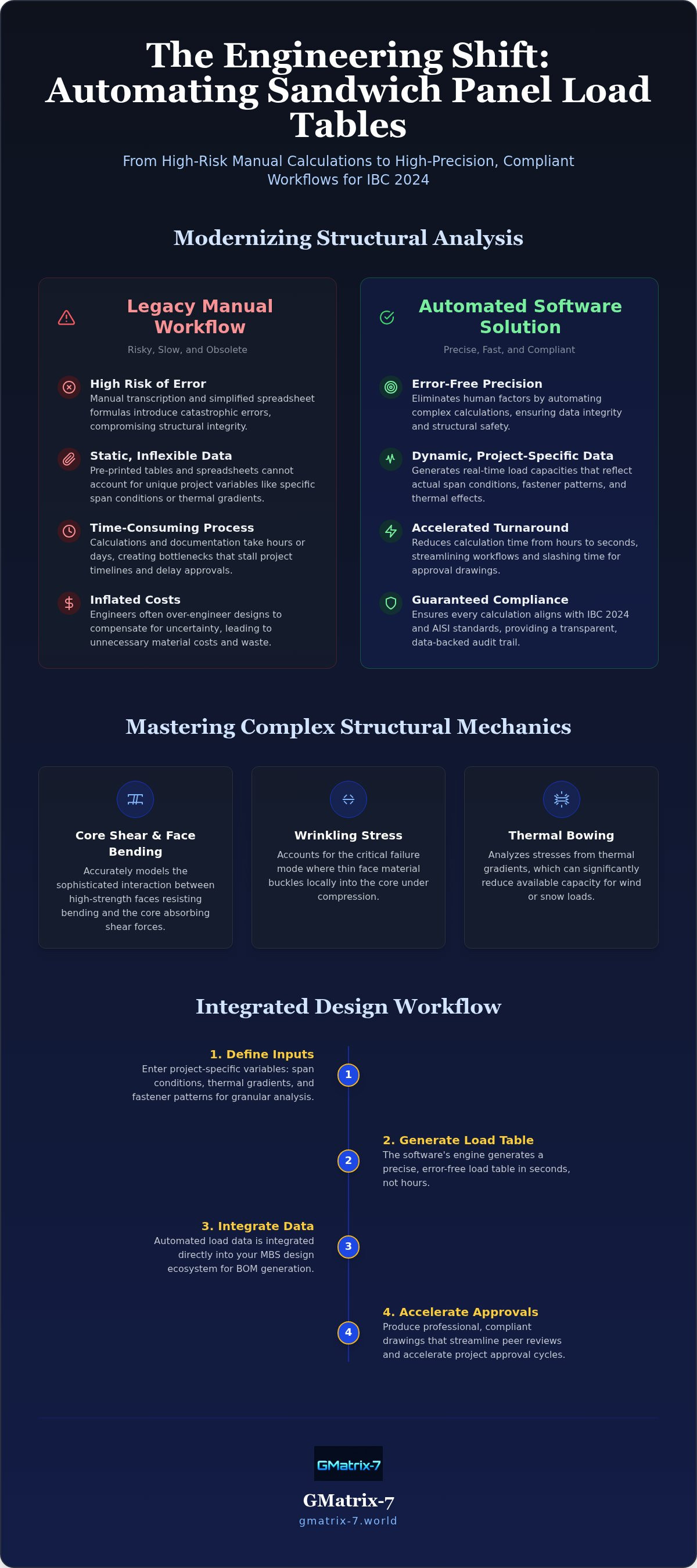
How to Generate Professional Load Tables: A Step-by-Step Workflow
Implementing a standardized workflow is the only way to ensure your structural documentation is both repeatable and defensible. In an era where IBC 2024 compliance is non-negotiable, your process must move beyond guesswork. High-performance sandwich panel load table software provides a structured environment that guides you through complex calculations while maintaining rigorous data integrity. Following a methodical progression ensures that every output meets the highest engineering standards.
The workflow begins with defining the panel profile and material specifications, including exact face thicknesses and core shear properties. Next, you must select the applicable building codes and load combinations, ensuring the model reflects current regulatory requirements. Inputting the specific span configurations and support conditions follows, which accounts for the multi-span complexities discussed in previous sections. Once the data is set, execute the analysis to review deflection and stress limits against the defined parameters. Finally, export the professional load table and approval drawings, providing a comprehensive technical package for project stakeholders. If you're ready to modernize your workflow, explore our automated engineering platform to start generating precise tables today.
Configuring Your Design Parameters
Setting the correct limit state is vital for structural safety. You must decide whether strength or serviceability (deflection) will dictate the panel's performance for a specific application. This stage also requires accounting for fastener capacity and connection types, as the panel is only as strong as its attachment to the secondary framing. Defining safety factors based on building occupancy categories ensures that your design remains conservative where it matters most. Precision at this stage prevents the hidden risks of under-designing critical components.
Interpreting the Output Data
Interpreting the technical output requires a keen eye for permissible load vs. span length charts. You must identify "critical span" thresholds where performance drops significantly, often due to wrinkling stress or core shear failure. Use this data to refine your overall MBS IBC design software model, ensuring that the entire building envelope works in harmony. This integration allows you to optimize the purlin spacing based on the actual capacity of the panels, driving down material costs while maintaining total structural compliance. Accurate interpretation turns raw data into a strategic asset for your project.
Integrating Load Tables into the Metal Building Ecosystem
Standalone calculators are a significant bottleneck in modern structural engineering. When your data lives in a silo, you're forced into a cycle of manual transcription that invites error and slows down the entire project lifecycle. High-performance sandwich panel load table software must function as a core component of a larger, unified design environment. In the hyper-accelerated construction market of 2026, the digital thread must remain unbroken from the initial capacity analysis to the final production floor. Excellence requires a system where your engineering data drives your procurement and fabrication processes without friction.
GMatrix-7 achieves this by synchronizing panel data with Light Gauge Steel (LGS) and Open Web Steel Joist (OWSJ) detailing modules. When you generate a load table, the system links those specific capacities directly to an automated Bill of Material (BOM). This ensures that the material specified in your structural model matches the material ordered for the job site. This level of synchronization is essential for global fabricators who manage high-volume commercial projects across multiple jurisdictions. You can't afford to treat your building envelope as an isolated element; it's an integral part of the structural whole. Future-proofing your engineering department means investing in professional structural design automation to maintain a competitive edge in an increasingly complex regulatory landscape.
The Capability-to-Outcome Pattern in Detailing
Modern engineering isn't just about features; it's about the tangible results those features deliver for your business. Utilizing integrated sandwich panel load table software within a broader design suite creates a direct path from technical capability to commercial success. Consider these critical transitions:
- Capability: Integrated load table generation. Outcome: A 50% reduction in approval drawing turnaround time, allowing your team to move from design to fabrication faster than the competition.
- Capability: Automated IBC 2024 compliance checking. Outcome: Total peace of mind and significantly reduced insurance liability through verified, code-compliant structural documentation.
Why GMatrix-7 is the Gold Standard for 2026
GMatrix-7 stands as the premier authority in structural automation, providing surgical precision across MBS, LGS, and OWSJ modules. It's the only platform that offers seamless composite deck load table generator integration alongside its sandwich panel capabilities. This unified approach eliminates the need for fragmented third-party tools and ensures that every structural component is optimized for safety and performance. Our commitment to industrial progress and engineering excellence makes us the trusted partner for world-class fabricators. Don't settle for approximate data or disconnected workflows. Experience the future of engineering excellence at GMatrix-7 and transform your structural detailing into a driver of industrial progress.
Dominating the Future of Structural Documentation
Modern engineering requires a definitive shift from static data to dynamic automation. You've mastered the transition from manual calculations to high-precision, software-driven results that ensure total structural compliance. Adopting sandwich panel load table software isn't just about operational efficiency; it's about securing your firm's reputation for excellence and reliability. By eliminating manual transcription errors and automating complex multi-span analysis, you ensure every project meets the rigorous demands of IBC 2024.
True leadership in the 2026 market depends on a unified structural ecosystem. Synchronizing your load data with secondary framing and automated Bill of Material generation creates a seamless digital thread that reduces liability and drives profitability. GMatrix-7 provides the authoritative tools you need, featuring specialized modules for IBC, SJI, and AISI compliance that are battle-tested by global fabricators. Our platform empowers you with automated approval drawing and BOM generation, turning technical complexity into a streamlined commercial advantage. Optimize Your Structural Detailing with GMatrix-7 and confidently lead your firm into a new era of engineering excellence.
Frequently Asked Questions
What is the best software for sandwich panel load table generation in 2026?
GMatrix-7 is the premier software solution for generating precise load tables in 2026. It offers specialized design modules for MBS, LGS, and OWSJ, providing a level of authority that generic calculators cannot match. The platform automates the entire process, from raw data input to professional PDF output. It's the gold standard for fabricators who value speed, accuracy, and global code compliance above all else.
How do I calculate the load capacity of a sandwich panel manually?
Manual calculation requires applying Sandwich Theory to evaluate the interaction between the faces and the core. You must determine the wrinkling stress of the faces and the shear capacity of the core material independently. This method is exceptionally time-consuming and increases the risk of transcription errors. It's often insufficient for capturing the complex support reactions found in modern multi-span configurations.
Can sandwich panel software handle both roof and wall applications?
Professional software handles both roof and wall applications by adjusting for specific load orientations and environmental factors. It accounts for the distinct behavior of panels under snow accumulation on roofs versus wind suction on vertical wall assemblies. This dual capability ensures that your engineering department remains versatile across diverse building types. You can manage the entire building envelope within a single, high-performance structural design environment.
What building codes govern sandwich panel load tables in North America?
IBC 2024 and AISI standards serve as the primary regulatory frameworks for North American construction. Specifically, AISI S100 and AISI S240 dictate the design requirements for cold-formed steel components used in these panels. Utilizing professional sandwich panel load table software ensures that your engineering data remains synchronized with these critical updates, providing the peace of mind that comes from total structural compliance.
Does GMatrix-7 software support custom panel profiles for fabricators?
GMatrix-7 supports full customization for proprietary panel profiles and material specifications. Fabricators can define unique face geometries, core shear moduli, and yield strengths to generate project-specific data. This flexibility allows you to innovate with new materials while ensuring that every configuration is backed by authoritative engineering data. It turns your custom offerings into code-compliant solutions that stand up to professional peer review.
How does thermal gradient affect the load capacity in software calculations?
Thermal gradients create internal stresses by forcing the outer face to expand or contract independently of the inner face. This differential movement results in bowing, which software models to determine its impact on overall capacity. Advanced analysis accounts for these temperature fluctuations to prevent face wrinkling or core failure. Ignoring these thermal effects in exterior applications can compromise the long-term stability of the structure.
Is it possible to integrate load table results directly into shop drawings?
Direct integration is a cornerstone of the GMatrix-7 ecosystem. You can synchronize your load table results with the automated generation of approval drawings and Bills of Material. This seamless data flow eliminates the need for manual entry and ensures that your structural analysis is perfectly aligned with the final fabrication documents. It's a critical capability for maintaining speed and accuracy in high-volume projects.
What are the benefits of using automated load tables over static manufacturer charts?
Automated tables offer dynamic precision that static manufacturer charts simply cannot replicate. Manufacturer charts typically rely on conservative generalizations that often lead to expensive over-engineering. By using sandwich panel load table software, you can analyze specific span lengths and real-world load combinations. This optimization reduces material waste while ensuring your structural designs meet the highest safety standards. You don't have to settle for approximate data when precision is readily available.


