

A single manual entry error in a structural steel material list can jeopardize an entire project's profitability before the first beam is even cut. You've likely experienced the frustration of manual drafting bottlenecks and the expensive reality of inconsistent material lists that lead to site waste. It's a common struggle to maintain rigorous compliance with updated IBC or SJI standards while your team is buried under repetitive technical tasks. You deserve a workflow that prioritizes precision over paperwork.
This guide demonstrates how automated engineering documentation eliminates these traditional liabilities. By transitioning to a data-driven model, you'll achieve faster project turnarounds and a 100 percent accurate bill of materials that flows directly into fabrication. We'll explore the technical integration of GMatrix-7 modules for MBS and OWSJ, showing you exactly how to generate approval drawings and load tables that meet the high-stakes demands of 2026. Discover how to bridge the gap between design data and technical documentation to secure your position as an industry leader.
Key Takeaways
- Master the transition from manual drafting to algorithmic asset generation to meet the rigorous demands of IBC 2024 and SJI standards.
- Eliminate procurement discrepancies and material waste by utilizing automated engineering documentation to generate 100 percent accurate bills of material.
- Accelerate project delivery timelines through the rapid, automated production of professional approval drawings and specialized composite deck load tables.
- Quantify the significant ROI of automation by comparing the high costs of manual detailing against the efficiency of specialized software integration.
- Leverage GMatrix-7 modules for MBS, OWSJ, and LGS to ensure total documentation precision and a seamless transition to fabrication.
The Critical Role of Automated Engineering Documentation in 2026 Structural Design
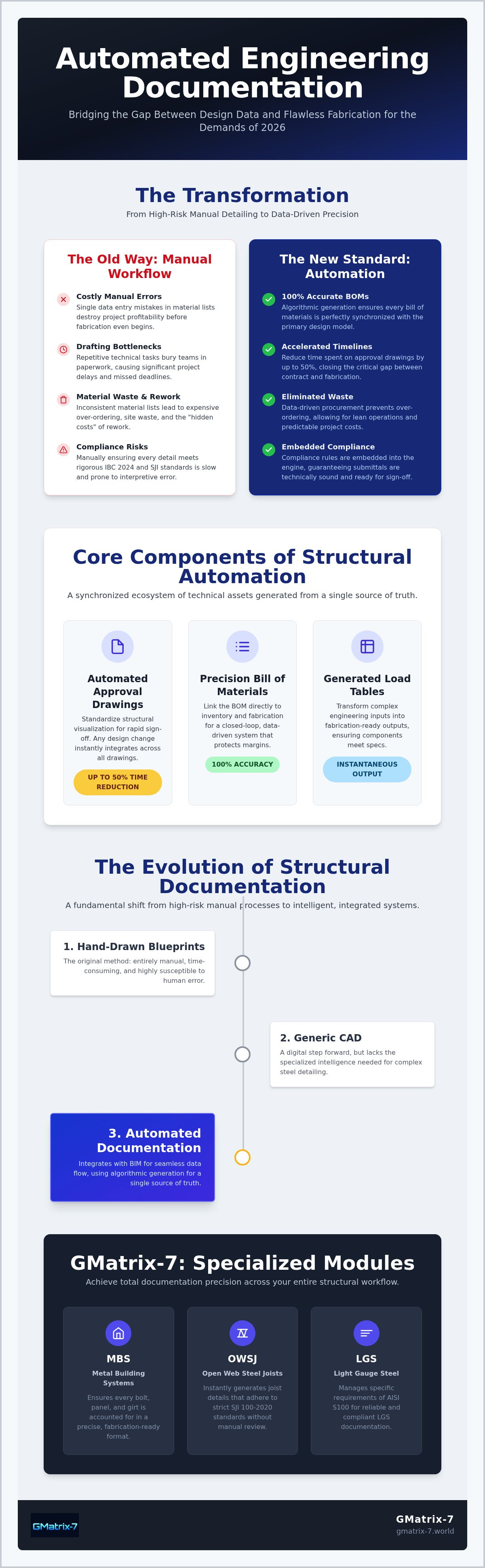
The engineering environment of 2026 demands a departure from traditional, manual drafting. Automated engineering documentation represents the algorithmic generation of technical assets directly from design data, effectively removing the human element from repetitive detailing tasks. This isn't merely a digital upgrade; it's a fundamental shift in how structural intent is communicated to the shop floor. By automating the transition from design to fabrication, firms eliminate the manual errors that frequently erode project margins in the metal building and joist sectors.
The Evolution of Structural Documentation
Structural detailing has moved through distinct phases, from hand-drawn blueprints to the basic digitization of generic CAD. However, generic CAD often lacks the specialized intelligence required for complex steel detailing. The industry now relies on sophisticated automation modules that integrate with Building Information Modeling (BIM) to create a seamless data flow. In this high-stakes environment, manual drafting has become synonymous with high risk. Relying on human input for thousands of data points invites inconsistency, whereas automated engineering documentation ensures that every drawing and material list remains synchronized with the primary design model.
Compliance as a Documentation Driver
Regulatory rigor is intensifying. The adoption of IBC 2024 and the strict requirements of SJI 100-2020 for joist detailing leave no room for interpretive error. Automated systems handle the intricate complexities of these codes by embedding compliance rules directly into the documentation engine. For example, generating joist details that adhere to SJI standards or managing the specific requirements of AISI S100 for light gauge steel (LGS) becomes an instantaneous output rather than a multi-day manual review. This ensures that every submittal is technically sound and ready for regulatory sign-off without costly revisions.
Speed directly dictates project profitability. In the MBS and OWSJ sectors, the time between a signed contract and the start of fabrication is the most critical window. Automation acts as a single source of truth, providing engineers and fabricators with identical, verified data. When documentation is generated algorithmically, the "hidden costs" of rework and material waste vanish. You gain the peace of mind that comes from knowing your technical assets are as precise as your engineering calculations.
Core Components of Structural Automation: Drawings, BOMs, and Tables
Structural automation hinges on the simultaneous generation of diverse technical assets. When you implement a robust system for automated engineering documentation, you aren't just creating files; you're building a synchronized ecosystem of data. This ecosystem ensures that every approval drawing, material list, and load table originates from the same verified engineering logic. The industry relies on this precision to bridge the gap between complex engineering inputs and fabrication-ready outputs.
Automated Structural Approval Drawings
Standardizing the visualization of structural intent is paramount for rapid regulatory sign-off. Firms often report reducing the time spent on automated structural approval drawings by up to 50 percent compared to manual CAD workflows. This efficiency stems from the software's ability to apply global engineering standards and presentation formats automatically. When a design change occurs, the system integrates these modifications instantly across all drawing sets, maintaining absolute consistency without the risk of human oversight.
Precision in Automated BOM for Metal Buildings
Material procurement is where project margins are won or lost. Utilizing an automated BOM for metal buildings prevents the expensive over-ordering and site waste that plague manual counting processes. By linking the bill of materials directly to inventory management and fabrication software, you create a closed-loop system where data drives production. This level of precision ensures that every bolt, panel, and girt is accounted for, allowing for lean procurement and predictable project costs. It transforms the BOM from a static list into a dynamic tool for operational excellence.
Generating Composite Deck Load Tables
Calculating load capacities for single skin, sandwich panels, and composite floors involves complex physics and rigorous adherence to AISI standards. A specialized composite deck load table generator is essential for modern cladding manufacturers who must provide verified technical data sheets to their clients. These automated tools ensure that capacity data is always up-to-date with current regulations, providing the reliability required for high-performance structural applications. By automating these calculations, you eliminate the risk of manual transposition errors that can lead to costly insurance liabilities. To experience this level of precision in your own workflow, you can explore the specialized modules within GMatrix-7.
Quantifying the ROI: Manual Detailing vs. Automated Systems
Quantifying the return on investment requires a shift in perspective from viewing software as an expense to seeing it as a strategic asset. Traditional manual detailing carries a high hourly cost that scales linearly with project complexity. In contrast, automated engineering documentation offers a fixed-cost model that provides exponential returns as your project volume increases. By replacing manual drafting with algorithmic generation, firms eliminate the "hidden costs" of rework, material waste, and site delays that often consume up to 20 percent of a project's potential profit. This transition significantly reduces the gap between design finalization and fabrication start, ensuring your shop floor stays productive and your projects stay on schedule.
Manual detailing is a bottleneck that restricts your firm's ability to scale. When you rely on human drafters to manually count components or draw connections, your output is limited by headcount. Adopting automated engineering documentation breaks this link, allowing your existing team to produce significantly higher volumes without sacrificing quality. This scalability is essential for maintaining competitiveness in the 2026 market, where project timelines are shrinking and client expectations for precision are at an all-time high.
Error Reduction and Material Optimization
Precision is the cornerstone of profitability. Case study data comparing defect rates shows that manual drafting consistently results in a 3 to 5 percent error rate in material lists. Switching to automated steel shop drawings ensures fabrication-ready precision that effectively targets a 0 percent error rate. This level of material optimization prevents the accumulation of scrap and ensures that every beam delivered to the site fits perfectly the first time. The financial impact of this accuracy extends beyond the shop floor, as it eliminates the cascading delays that occur when field corrections are required.
The Productivity Leap in 2026
The engineering landscape of 2026 prioritizes speed and technological superiority. Adopting professional structural design automation allows small, agile teams to manage large-scale Metal Building Systems (MBS) projects that would otherwise require massive detailing departments. Specialized modules outperform general-purpose CAD tools by automating the specific logic of structural steel rather than just providing a digital canvas. This technological edge also serves as a powerful recruitment tool. Top engineering talent seeks environments where they can focus on high-level problem solving rather than repetitive data entry. By providing a modern, automated engineering environment, you position your firm as an innovator while drastically reducing your time-to-market.
Strategic Implementation: Integrating Automation into Your Workflow
Successful integration of automated engineering documentation requires more than a software installation; it demands a systematic overhaul of your technical pipeline. First, audit your current documentation bottlenecks, specifically focusing on how long your team spends on manual BOM generation and drawing updates. Once these inefficiencies are identified, select specialized modules that align with your core services, whether that involves MBS, OWSJ, or LGS structural design. Establishing rigorous data standards early ensures a seamless transition between disparate design inputs and the final technical output. A phased rollout remains the most reliable strategy, allowing your team to maintain production while adapting to new, high-speed workflows. Finally, continuous optimization of your load tables and material templates will eventually transform your documentation from a static chore into a high-speed output engine that grows with your business.
Choosing the Right Automation Partner
Deciding between CAD vs specialized software for steel detailing is the first critical decision in your automation journey. Generic CAD platforms lack the embedded intelligence required to handle the nuances of structural steel detailing and compliance. You need a partner whose software guarantees adherence to IBC 2024, SJI 100-2020, and AISI S100 standards out of the box. Evaluate potential solutions based on their industry-specific expertise and their ability to provide global support for your engineering teams. A world-class automation partner doesn't just provide a tool; they act as a guardian of your firm's technical excellence. To secure your firm's competitive edge, you should implement GMatrix-7 automation modules to handle your most complex detailing requirements.
Data Integrity and Security
Maintaining your intellectual property is vital when transitioning to an automated environment. Automated systems must ensure data consistency across global engineering teams, providing a single source of truth that prevents the dangerous version control errors common in manual drafting. This centralized approach future-proofs your documentation for 2026 and beyond, allowing you to adapt to new regulatory changes or material specification updates instantly. By securing your data within a rigorous, algorithmic framework, you protect your firm's reputation for accuracy while driving industrial progress. This methodical synchronization ensures that an engineer in one region and a fabricator in another are always working from the same high-fidelity data set, eliminating the risk of site-level discrepancies and costly rework.
GMatrix-7: Specialized Modules for Total Documentation Precision
GMatrix-7 provides the technical foundation for modern structural engineering by delivering total documentation precision through specialized modules. These tools are designed for the most demanding industrial sectors, moving beyond the limitations of generic CAD to provide a dedicated engineering ecosystem. By leveraging automated engineering documentation, our platform creates a direct, error-free path from complex design inputs to fabrication-ready outputs. Our commitment to safety and excellence is embedded in every algorithmic calculation, ensuring your projects meet global engineering standards without compromise. We don't just provide a tool; we provide a rigorous framework for industrial progress.
Engineered for MBS and OWSJ Excellence
Achieving total compliance in metal building systems (MBS) requires more than basic digital drafting. Our MBS IBC design software module is engineered to handle the rigorous demands of the International Building Code, providing a reliable framework for every project submittal. For manufacturers focused on bar joists, our SJI compliant joist design tools automate the intricate detailing process, ensuring every output adheres to SJI 100-2020 standards. The GMatrix-7 promise is simple: we deliver absolute precision from the first line of design to the final, verified BOM. This eliminates the uncertainty that often plagues manual detailing, providing you with a battle-tested solution for high-stakes engineering. Our automated BOM generator goes further than simple lists, optimizing procurement by linking design data directly to fabrication instructions, which effectively maximizes your project margins.
Advanced Tools for LGS and Composite Decks
Cold-formed steel projects present unique geometric and structural challenges that generic software simply cannot address. The power of our LGS structural design software lies in its ability to manage AISI S100 complexities while generating customizable templates for professional approval drawings and detailed material lists. This module ensures that your technical documentation is flawless and your material counts are 100 percent accurate. We also provide specialized capabilities for generating complex load tables for single skin, sandwich panels, and composite decks. These tools allow cladding manufacturers to provide their clients with data-driven capacity sheets that are technically superior and fully compliant with modern safety regulations. GMatrix-7 stands as your visionary partner in structural automation, driving efficiency and peace of mind through relentless innovation and technical superiority. It's the definitive choice for firms that refuse to settle for anything less than excellence.
Securing Your Competitive Edge in 2026
The transition to automated engineering documentation is no longer a luxury; it's a fundamental requirement for firms targeting industrial excellence. We've explored how algorithmic precision eliminates the manual bottlenecks that traditionally stifle project growth and erode profit margins. By integrating specialized modules, you secure a workflow that's simultaneously faster and more accurate than manual drafting could ever achieve. This shift transforms your technical assets from a liability into a high-performance engine for success.
Your firm's now positioned to leverage IBC 2024 ready and SJI 100-2020 compliant technology. Advanced load table generation and synchronized material lists provide the reliability your clients expect and the safety the industry demands. Don't let manual errors define your project outcomes. Take the decisive step toward total documentation precision and drive your business toward a more profitable, data-driven future. Explore the GMatrix-7 Software Modules for Automated Engineering and lead the next era of structural innovation with absolute confidence.
Frequently Asked Questions
What is automated engineering documentation in the context of structural steel?
Automated engineering documentation is the systematic, algorithmic generation of technical drawings, material lists, and capacity data directly from a primary design model. In structural steel, this technology replaces fragmented manual drafting with a synchronized data stream. It ensures that every technical asset remains perfectly aligned with engineering calculations, eliminating the risk of human transposition errors. This methodical approach provides a single source of truth for both the design office and the fabrication shop floor.
How does automated BOM software reduce project costs?
Automated BOM software reduces costs by providing 100 percent accurate material lists that eliminate expensive procurement discrepancies. Manual counting often results in over-ordering or site-level shortages that stall production. By linking the bill of materials directly to fabrication data, firms can optimize their inventory management and reduce material waste. This precision protects project margins and ensures that every component delivered to the site is exactly what the structural design requires.
Can automated documentation tools ensure compliance with IBC 2024?
Yes, advanced automated engineering documentation systems like GMatrix-7 are specifically engineered to meet IBC 2024 and SJI 100-2020 standards. The software embeds regulatory logic into the generation process, ensuring that every approval drawing and technical specification adheres to current safety codes. This built-in compliance removes the burden of manual cross-referencing, providing engineers with the peace of mind that their documentation is technically sound and ready for regulatory sign-off.
Is specialized software better than general CAD for steel detailing documentation?
Specialized software is superior because it possesses the specific structural intelligence that general CAD platforms lack. While generic CAD is simply a digital canvas, specialized modules automate the complex logic of joist detailing, bar joist design, and composite deck calculations. This industry-specific focus allows teams to produce technical assets up to 50 percent faster while maintaining a level of precision that general-purpose drafting tools cannot replicate in high-stakes steel projects.
How long does it take to implement an automated engineering documentation system?
Implementation follows a methodical, phased rollout to ensure seamless adoption without disrupting active production. The process begins with an audit of current documentation bottlenecks followed by the selection of specific MBS, OWSJ, or LGS modules. While the initial software deployment is swift, full team optimization involves establishing data standards and material templates. This structured approach ensures that your engineering team transitions to high-speed, automated workflows while maintaining total project continuity and data integrity.
What types of load tables can be generated automatically with GMatrix-7?
GMatrix-7 automatically generates comprehensive load tables for single skin panels, sandwich panels, and composite decks. These tables calculate load capacities based on AISI standards, providing manufacturers with verified technical data sheets for their cladding products. The system handles the complex physics of capacity calculations instantly, ensuring that the resulting documentation is accurate, professional, and ready for client review. This automation eliminates the risks associated with manual data entry in high-capacity structural applications.
How do automated approval drawings improve client communication?
Automated approval drawings improve communication by providing standardized, professional visualizations of structural intent that are instantly updated as designs evolve. When an engineer modifies a design, the changes propagate through all drawing sets automatically, ensuring every stakeholder views the same high-fidelity information. This synchronization prevents the confusion caused by outdated manual revisions and accelerates the sign-off process. It creates a transparent, reliable exchange of technical data between the engineering firm and the client.
Does automation eliminate the need for human structural engineers?
Automation doesn't replace human engineers; it empowers them by removing repetitive, low-value technical tasks. By automating the detailing and documentation phases, engineers can redirect their expertise toward high-level design, safety innovation, and complex problem-solving. The technology acts as a guardian of precision, handling the granular data entry while the engineer maintains ultimate oversight of the structural system. This partnership between human intelligence and algorithmic speed drives superior industrial progress and excellence.


