
A single discrepancy in a manual material list can compromise an entire fabrication schedule, turning a profitable project into a liability. You recognize that in the high-stakes world of structural engineering, the margin for error has effectively vanished. Manual data entry and disconnected spreadsheets are no longer just inefficient; they're risks to your operational integrity. Implementing sophisticated structural steel bill of materials software is the only way to ensure that your engineering logic translates perfectly to the shop floor.
You've likely felt the frustration of fabrication waste caused by minor BOM errors or the exhaustion of navigating slow approval drawing cycles. It's a common pain point for firms striving to maintain SJI and AISI compliance while under aggressive deadlines. This article explores how to master the transition to automated, engineering-driven workflows that eliminate these friction points. We'll examine how GMatrix-7 leverages IBC 2024 standards to generate zero-error material lists and automated load tables, providing you with a seamless path from complex structural design to precise fabrication.
Key Takeaways
- Differentiate between engineering-driven authoring tools and generic management software to ensure the absolute integrity of your structural data.
- Optimize project efficiency by deploying structural steel bill of materials software that automates material extraction directly from SJI and AISI compliant algorithms.
- Eliminate fabrication waste and manual entry errors by establishing a direct, automated link between structural design and shop floor material lists.
- Accelerate your approval drawing cycles using specialized engineering modules tailored for complex MBS, OWSJ, and LGS systems.
- Integrate automated load table generation for composite decks and sandwich panels to achieve total precision throughout the engineering-to-fabrication lifecycle.
What is Structural Steel Bill of Materials Software?
Precision in structural engineering depends on the integrity of the data passed from the designer to the fabricator. Modern structural steel bill of materials software serves as the critical bridge in this workflow, functioning as an engineering-driven engine that extracts granular material data directly from structural models. Unlike generic inventory tools, this software interprets the physical properties and geometric constraints of a building to generate a definitive list of components. While many understand What is a Bill of Materials (BOM) in a general manufacturing sense, the structural steel industry requires a higher level of technical sophistication.
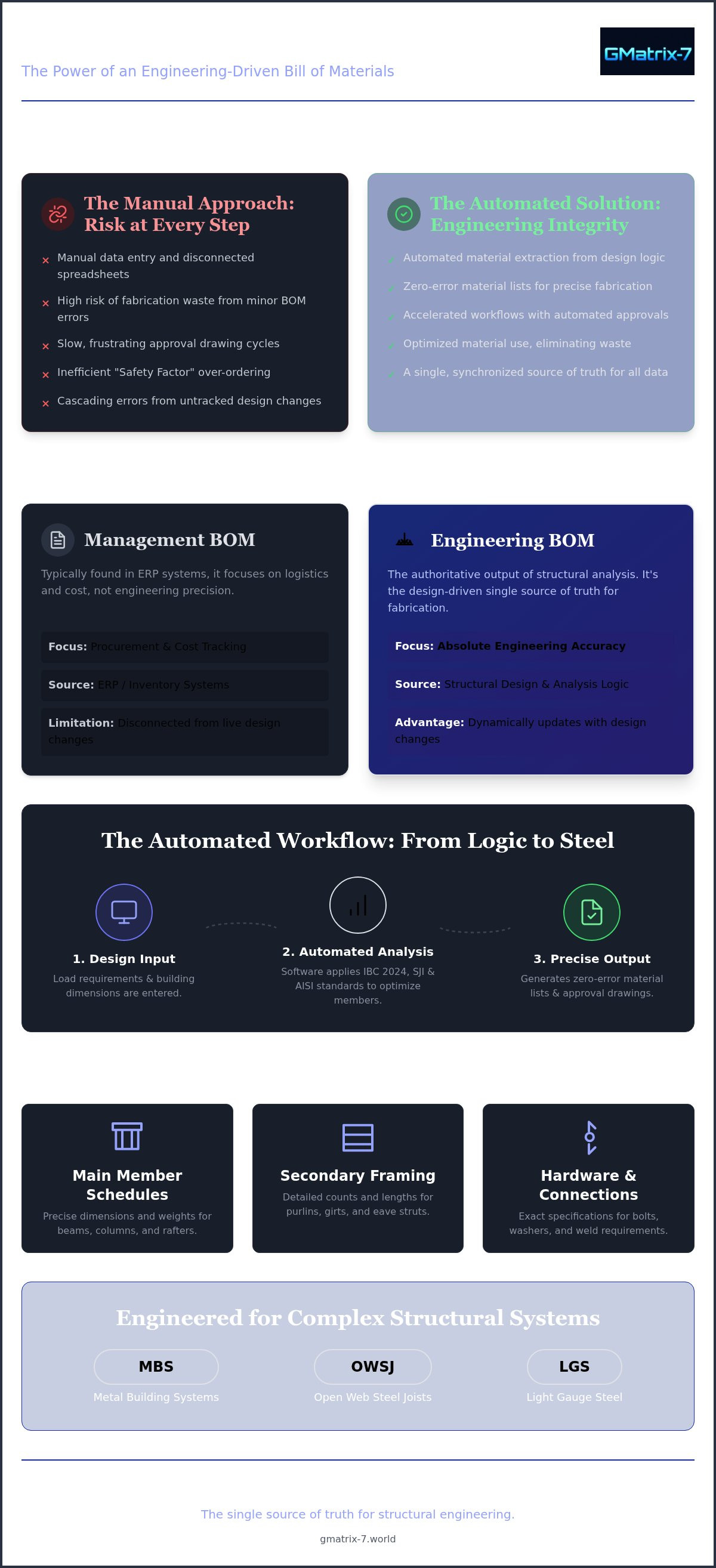
In the 2026 construction environment, the distinction between a "Management BOM" and an "Engineering BOM" is vital for profitability. A Management BOM, typically found in ERP systems, focuses on procurement and cost tracking. Conversely, an Engineering BOM is design-driven; it's the authoritative output of structural analysis. Relying on manual Excel-based lists remains a primary cause of project delays in structural fabrication. These static spreadsheets lack the dynamic intelligence to update when design changes occur, leading to cascading errors that stall shop floor operations.
The Core Components of a Structural BOM
A comprehensive structural BOM generated by advanced software provides a multi-layered view of the project requirements. It categorizes materials into distinct groups to streamline the fabrication process. These components typically include:
- Main member schedules: Precise dimensions and weights for beams, columns, and rafters.
- Secondary framing: Detailed counts and lengths for purlins, girts, and eave struts.
- Hardware and connections: Exact specifications for bolts, washers, and specific weld requirements based on joint geometry.
Why Engineering Accuracy Trumps Simple Listing
Accuracy isn't just about counting parts; it's about compliance and waste reduction. Integrating IBC 2024 standards directly into the detailing algorithm ensures that every material specification meets current safety and performance regulations. High-performance structural steel bill of materials software reduces the "Safety Factor" waste that occurs when engineers over-order material to compensate for listing uncertainties. This optimization is particularly critical for OWSJ and LGS systems where material efficiency directly impacts structural feasibility. By automating the extraction process, you achieve a higher level of optimization that supports both project sustainability and bottom-line growth. An Engineering BOM is a data-rich output of structural analysis that serves as the single source of truth for every physical component in a structure.
How Automated Detailing Generates Precise Material Lists
The transition from structural analysis to material extraction is the defining moment where design intent meets physical reality. Advanced structural steel bill of materials software operates by embedding SJI and AISI standards directly into its detailing algorithm, ensuring that every joist, girt, and column is not just listed, but engineered to the latest IBC 2024 requirements. This engineering-driven approach removes the ambiguity inherent in manual detailing, where data often becomes fragmented during the handoff between departments. By treating the BOM as a live output of structural logic, you ensure that the material list remains synchronized with the engineering model at every stage.
Human error is effectively neutralized through this automation. When dealing with the complex geometries of Metal Building Systems (MBS), manual calculations frequently fail to account for every connection plate or bolt, leading to costly field fixes. Sophisticated software utilizes "Product Memory" to maintain revisions across large-scale projects. This feature ensures that if a design change occurs in the final stages of detailing, the software recalls every previous iteration to maintain data consistency. It prevents the cascading errors that typically plague projects when engineers attempt to track revisions via disconnected spreadsheets.
From Design Inputs to Fabrication Outputs
Precision begins with the input of load requirements and building dimensions. The software processes these complex inputs to select optimal member sizes based on rigorous IBC standards, balancing structural integrity with material efficiency. This process does not just produce a list; it simultaneously generates approval drawings alongside the BOM. This synchronized output ensures that the fabricator, the engineer, and the detailer are all working from the same data set, which significantly accelerates the approval cycle and reduces lead times.
Eliminating the "Manual Error Gap"
Automation prevents critical failures such as double-counting or missing members in complex joist systems. Real-time updates are essential. When an engineering change occurs, the software immediately reflects that shift across all material lists and drawings. By integrating MBS IBC design software principles, the system ensures that every component is compliant and accounted for. This level of technical oversight is why many firms are moving toward engineering automation solutions to secure their project margins. You move from a reactive state of fixing errors to a proactive state of engineering excellence, where the material list is a guaranteed reflection of the design.
BOM Management vs. Engineering-Driven BOM Generation
The distinction between software that manages a list and software that authors it is the difference between clerical oversight and engineering mastery. Most firms rely on generic ERP systems to track inventory, yet these tools are fundamentally incapable of generating the data they manage. They're passive repositories. To achieve true optimization, you need structural steel bill of materials software that functions as an authoring tool, where the BOM is a direct, algorithmic byproduct of the structural analysis itself. This shift from management to generation ensures that your material requirements are rooted in physical reality, not just administrative data entry.
Relying on authoring tools like GMatrix-7 provides a massive return on investment by reducing detailing time by 50% through comprehensive automation. When the software authors the BOM, it eliminates the need for manual transcription, which is the stage where most errors are introduced. This "compliance-first" data generation means that every part listed is already vetted against the relevant engineering standards. You aren't just creating a list; you're creating a verified roadmap for fabrication that guarantees structural integrity and material efficiency.
The Limitations of Generic ERP BOMs
Generic ERP tools fail because they don't understand structural logic or SJI 100-2020 compliance. They treat a joist as a static part number rather than a dynamic engineered component. This lack of technical depth leads to "BOM Drift," where the material list used by procurement slowly loses synchronization with the actual engineering approval drawings. Manual data transfer between design tools and ERP systems is a high-risk activity that often results in double-ordering or, worse, the procurement of members that don't meet the latest load requirements. The cost of these discrepancies often exceeds the initial software investment in a single project cycle.
The GMatrix-7 Advantage: Integrated Design
Deploying professional structural design automation creates a single source of truth that spans from initial design to the final shipping list. This integrated approach allows for the generation of nested material lists, which are essential for optimized procurement and reducing scrap rates. GMatrix-7 validates every BOM item against structural load requirements. By ensuring that every bolt and beam is structurally justified before it reaches the list, the software provides a level of security that generic management tools can't replicate. You gain peace of mind knowing that your structural steel bill of materials software is actively guarding against engineering oversights.
Selecting Software for MBS, OWSJ, and LGS Systems
Selecting the right structural steel bill of materials software isn't a mere administrative choice; it's a strategic engineering decision. You must evaluate any potential tool based on its ability to handle the specific structural modules your firm specializes in. A generic listing tool won't suffice for the intricacies of OWSJ or MBS projects. Your priority should be a platform that automates both the BOM and the approval drawings in a single, unified workflow. This ensures that the technical specifications in your material list are always verified against the visual detailing in your drawings, eliminating the discrepancies that lead to fabrication waste.
For OWSJ projects, you need a system that integrates automated SJI compliant joist design capabilities. This ensures that every joist is engineered to meet the SJI 100-2020 standard without requiring manual cross-referencing. Similarly, the software's ability to generate load tables for composite decks and sandwich panels is essential for maintaining engineering precision. By verifying support for the latest AISI S100 standards, you guarantee that your LGS framing is compliant with the most rigorous safety benchmarks in the industry.
Critical Features for Metal Building Systems (MBS)
MBS projects demand advanced logic for secondary framing and accessories. Your software must feature automated girt and purlin spacing logic that adjusts dynamically based on structural loads and IBC design codes. It's not enough to list the primary frames. The system must also integrate cladding, trim, and fasteners into the material list to provide a comprehensive fabrication package. This level of detail prevents the "missing part" syndrome that often stalls on-site construction and erodes project profitability.
Precision in Light Gauge Steel (LGS) Detailing
In LGS framing, the high volume of components requires a system that operates with zero-error tolerance. You need software that generates automated wall and floor panel schedules ready for immediate production. Most importantly, you must ensure your LGS structural design software outputs match the specific requirements of your fabrication machines. This direct link between design data and CNC production is the hallmark of a world-class structural workflow. To secure this level of precision in your next project, implement the GMatrix-7 engineering modules to bridge the gap between design and the shop floor.
Advanced Load Table Generation: The Final Piece of the BOM
A comprehensive bill of materials is incomplete if it lacks the engineering validation required for deck and panel systems. Advanced structural steel bill of materials software must do more than count components; it must justify their application through rigorous load table generation. For composite decks and sandwich panels, these tables are the final piece of the documentation puzzle. They provide the empirical proof that the selected materials meet the project's structural requirements. Moving away from manual load capacity calculations eliminates the risk of human error and provides a massive boost to engineering productivity, ensuring your submittals are both accurate and professional.
GMatrix-7 integrates these load tables directly into the comprehensive project documentation, creating a unified package that speaks with a single voice of authority. You no longer need to jump between disconnected spreadsheets and design modules to verify if a specific panel thickness meets the required span. This seamless integration transforms the BOM from a simple list into a sophisticated engineering report. By automating these complex calculations, you secure a strategic advantage in an industry where speed and precision are the primary currencies of success.
Automating Composite Deck Load Tables
Precision in composite deck design requires the simultaneous assessment of multiple variables. The software calculates capacity based on specific span lengths, deck thickness, and concrete types, ensuring that the material listed in the BOM is structurally sound for its intended use. This automation generates professional tables ready for structural submittals, saving hours of manual drafting. Linking these outputs to a composite deck load table generator ensures total project consistency, where the physical material counts always match the engineered performance limits.
Sandwich Panel and Single Skin Optimization
Optimizing sandwich panels and single skin systems involves more than just structural integrity; it requires a detailed understanding of thermal and structural load assessments. The software automates these assessments, creating precise material counts for fasteners and accessories that are frequently overlooked in manual lists. This granular level of detail prevents on-site shortages and ensures that every component meets the rigorous standards of the project. GMatrix-7 functions as the ultimate driver of structural engineering productivity, allowing you to deliver high-performance building envelopes with absolute confidence in your data. You don't just provide a material list; you provide a battle-tested roadmap for structural excellence.
Securing the Future of Structural Detailing
Mastering the transition from manual material lists to automated, engineering-driven workflows is no longer optional for firms seeking to lead the industry. You've seen how integrating SJI 100-2020 compliance and automated IBC approval drawings directly into your detailing logic eliminates the manual error gap that erodes project profitability. True optimization requires structural steel bill of materials software that authors data rather than simply managing it, ensuring every component is structurally justified before it reaches the shop floor.
By centralizing your design inputs and leveraging advanced load table generation, you achieve a level of precision that generic ERP systems simply cannot replicate. This data-driven approach reduces fabrication waste and accelerates the approval cycle, providing the peace of mind that comes with world-class achievement. Now is the time to replace fragmented spreadsheets with a unified, battle-tested system designed for the complexities of 2026 engineering. Explore GMatrix-7 Structural Design Modules to witness how our technology drives industrial progress and secures your project margins. Your path to zero-error fabrication starts with the right engineering partner.
Frequently Asked Questions
What is the difference between a BOM and a Bill of Quantities (BOQ)?
A Bill of Materials (BOM) provides a granular list of every physical component needed for fabrication, whereas a Bill of Quantities (BOQ) is a commercial document used to estimate total costs during the tendering phase. The BOM is an internal, engineering-driven roadmap for the shop floor. In contrast, the BOQ focuses on high-level quantities for procurement and bidding rather than technical detailing.
How does structural BOM software reduce material waste?
Advanced structural steel bill of materials software reduces material waste by utilizing automated detailing algorithms that optimize nesting patterns and member lengths. It effectively eliminates the "safety buffer" over-ordering that often stems from manual entry errors. By extracting data directly from the structural model, the software ensures that procurement aligns perfectly with engineering needs, which significantly lowers scrap rates during fabrication.
Can GMatrix-7 software handle SJI 100-2020 compliant joist designs?
GMatrix-7 is fully engineered to support SJI 100-2020 compliant joist designs through its specialized OWSJ module. The software embeds these industry standards directly into its structural calculation engine. This ensures that every bar joist and open web component in the material list meets the performance benchmarks required for modern submittals. You gain total confidence in the structural integrity of your joist systems.
Does this software integrate with existing CAD platforms for steel detailing?
The software integrates with professional detailing workflows to ensure a seamless transition from structural design to fabrication. It acts as the authoritative data source for CAD platforms, generating the technical specifications needed for high-fidelity drawings. This integration ensures that your 3D models and your material lists are always synchronized, preventing the data fragmentation that typically leads to costly field fixes.
How long does it take to generate a BOM for a large metal building system?
Generating a complete material list for a large metal building system takes only minutes when using automated structural steel bill of materials software. The system processes complex structural inputs to extract every beam, column, and fastener simultaneously. This rapid generation replaces the days of manual transcription previously required, allowing your team to move from design approval to procurement with unprecedented speed and precision.
What standards are supported for light gauge steel (LGS) design?
Light gauge steel (LGS) design is supported by integrating the latest AISI S100 standards into the detailing algorithm. The software manages high-volume framing components with absolute precision, ensuring that all wall and floor panel schedules are technically sound. This rigorous adherence to AISI standards guarantees that every cold-formed member in your material list meets the safety requirements of the 2026 construction landscape.
Can I generate load tables for sandwich panels using this software?
GMatrix-7 allows you to generate professional load tables for sandwich panels and single skin systems as part of the standard documentation package. The software automates the complex structural and thermal assessments needed to determine panel capacity. These tables provide the empirical evidence required for submittals, ensuring that the materials listed in your BOM are verified against the specific load requirements of the project.
Is the BOM software compliant with the latest IBC 2024 codes?
All GMatrix-7 modules are fully compliant with the latest IBC 2024 codes to ensure your projects meet the highest safety standards. The software uses these building codes as the core logic for its automated detailing and material extraction processes. This proactive compliance ensures that your submittals are always accurate, reducing the risk of rejection during the municipal or structural review phases.


