

What if the primary bottleneck in your firm isn't a lack of technical talent, but rather the manual friction existing between your analysis model and the final fabrication detailing? You already know that manual bill of material generation and inconsistent load table calculations for composite decks are more than just tedious; they're liabilities that invite human error into high-stakes projects. Relying on fragmented workflows often leads to costly discrepancies between your approval drawings and the structural model. Implementing high-performance structural engineering productivity tools isn't just a luxury for the forward-thinking firm. It's a fundamental requirement for maintaining a competitive edge in a market that demands absolute precision at a relentless pace.
This 2026 guide demonstrates how specialized automation for MBS, OWSJ, and LGS design can triple your total engineering output while ensuring rigorous code compliance. You'll discover how the GMatrix-7 suite facilitates a seamless transition from complex inputs to zero-error material lists for fabricators. We'll examine the technical processes behind automated compliance with IBC 2024 and SJI 100-2020 standards. By the end of this article, you'll understand how to leverage advanced detailing modules to eliminate manual rework and achieve a level of operational excellence that was previously unreachable.
Key Takeaways
- Identify how specialized automation bridges the critical gap between structural analysis and fabrication-ready detailing to eliminate manual bottlenecks.
- Understand the technical requirements for maintaining "Gold Standard" compliance with IBC 2024 and SJI 100-2020 standards in MBS and OWSJ workflows.
- Learn to prevent material waste and human error by implementing automated Bill of Materials (BOM) generation and professional approval drawing sequences.
- Master the complexities of generating precise, code-compliant load tables for single skin, sandwich panels, and composite decks using AISI S100 standards.
- Evaluate the strategic ROI of transitioning to GMatrix-7 as your primary structural engineering productivity tools to achieve a documented 3x increase in detailing output.
Beyond General CAD: Defining Structural Engineering Productivity Tools in 2026
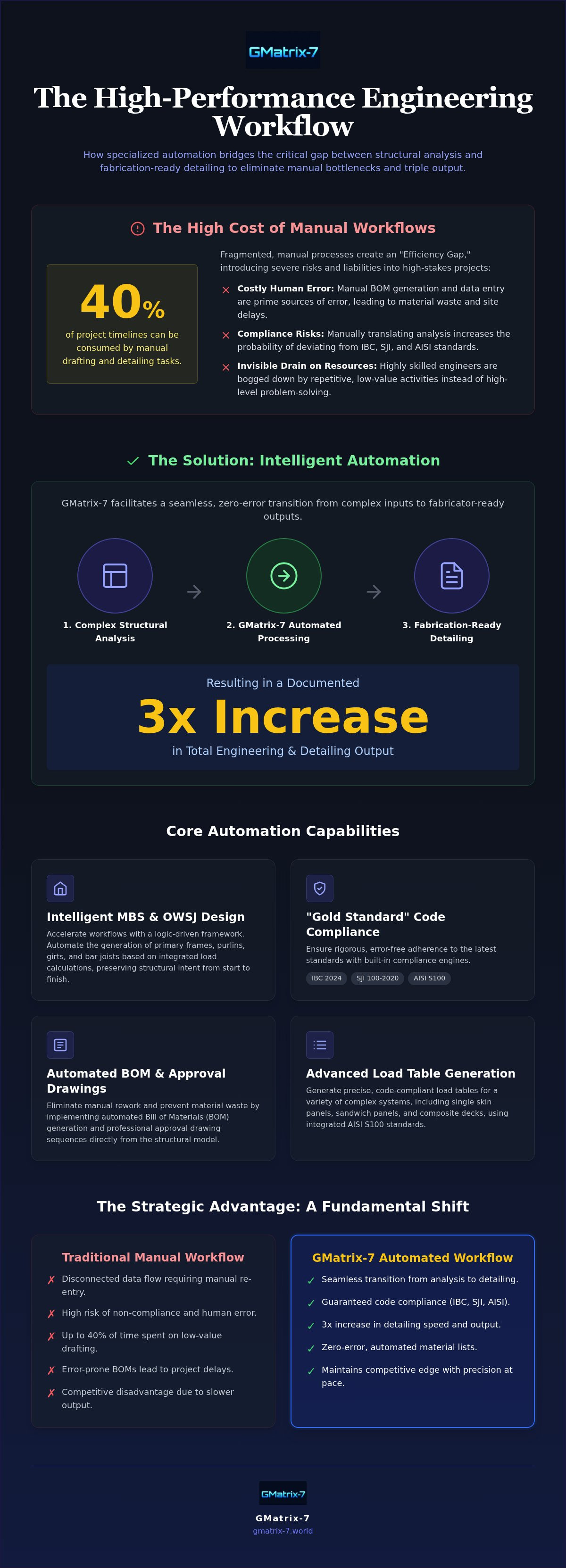
In 2026, the definition of excellence in structural design has shifted. It's no longer enough to simply produce a safe model. True performance is measured by the velocity and accuracy of the transition from analysis to the shop floor. Modern structural engineering productivity tools are specialized software modules designed to bridge the chasm between raw structural analysis and fabrication-ready detailing. While general-purpose CAD and analysis platforms provide a foundation, they often create severe manual bottlenecks. These tools force engineers into a cycle of manual data transcription that slows progress and introduces risk. By automating the data flow, specialized modules eliminate "spreadsheet stress" and ensure that the intelligence of the initial design isn't lost during the detailing phase.
The Hidden Cost of Manual Data Entry and Detailing
Manual detailing is an invisible drain on firm resources. Industry data suggests that manual drafting and detailing tasks can account for up to 40% of project timelines. This is a staggering expenditure of highly skilled labor on repetitive, low-value activities. For fabricators, the financial impact of error-prone manual Bill of Materials (BOM) generation can be catastrophic. A single miscalculated quantity leads to site delays and wasted material. Beyond the financial loss, manually translating complex analysis into drawings creates a significant risk of non-compliance. When data is keyed in by hand, the probability of deviating from the original structural intent increases, potentially compromising the safety of the final build.
Why Analysis Software Alone Isn't Enough for 2026 Projects
Analysis software is a prerequisite, but it's not a complete solution. Most general structural engineering software focuses on Finite Element Analysis (FEA) or global modeling. These platforms excel at calculating loads and stresses, yet they rarely provide the granular automation required for specialized detailing. "One-size-fits-all" BIM platforms often lack the specific intelligence needed for Metal Building Systems (MBS) or Open Web Steel Joist (OWSJ) detailing. Relying solely on these general tools forces an "Efficiency Gap" where engineers must manually verify compliance with IBC 2024 or SJI 100-2020 standards. To compete, firms must adopt structural engineering productivity tools that offer built-in code compliance and direct-to-fabrication outputs. This strategic shift ensures that your technical output is both mathematically sound and ready for immediate manufacturing.
Accelerating MBS and OWSJ Workflows via Intelligent Automation
Design complexity in Metal Building Systems (MBS) has grown exponentially as project timelines continue to shrink. Managing these intricacies requires more than a standard CAD seat; it demands a logic-driven framework capable of handling non-linear load paths and varying geometries. Specialized structural engineering productivity tools provide this essential intelligence. These systems don't just record geometry; they define the engineering relationships between every component in the building envelope. By automating the transition from analysis to detailing, firms can ensure that the structural intent is preserved from the first calculation to the final shop drawing.
Mastering MBS (IBC) Compliance with Automated Design
Implementing MBS IBC design software enables a streamlined design cycle that adheres strictly to IBC 2024 requirements. This automation isn't limited to simple drafting. It encompasses the algorithmic generation of primary frames, purlins, and girts based on site-specific environmental data. Modern computational design tools have paved the way for this level of specificity, allowing for a workflow where wind and snow load calculations are integrated directly into the design module. This eliminates the dangerous "efficiency gap" where data is manually transcribed from external spreadsheets, significantly reducing the risk of non-compliance in the final structure.
SJI 100-2020: Precision for Bar Joist Detailing
Achieving SJI compliant joist design is a precision-heavy endeavor that requires meticulous attention to chord sizing and profile geometry. The SJI 100-2020 standard demands a level of data-driven accuracy that manual detailing simply cannot sustain at scale. Specialized OWSJ software automates these complex calculations, generating optimized joist profiles that meet rigorous strength and serviceability criteria. For large-scale warehouse projects, where thousands of joists may be required, this automation is transformative. It moves the process from a slow, manual drafting exercise to a rapid, automated output phase.
The result is a zero-error workflow that satisfies both the engineer's need for safety and the fabricator's need for speed. Manual joist detailing often results in inconsistencies that lead to site rework; however, an automated approach ensures every chord and web member is sized correctly every time. To achieve this level of operational excellence in your next project, consider integrating the GMatrix-7 design modules into your core workflow. Using these structural engineering productivity tools allows your team to focus on high-level design while the software handles the granular, code-heavy detailing tasks.
The Detailing Revolution: Automated BOM and Approval Drawings
Detailing represents the final, most critical frontier in the engineering workflow. It is the precise stage where theoretical models transform into tangible instructions for the shop floor. By implementing advanced structural engineering productivity tools, firms can now automate the generation of these vital documents, effectively eliminating the manual transcription errors that traditionally plague the transition from design to fabrication. This automation ensures that the Bill of Materials (BOM) remains a live, direct reflection of the structural model. It provides a single source of truth that aligns engineering intent with manufacturing reality, significantly reducing the RFI cycle that often stalls project momentum.
Eliminating Fabrication Errors with Automated Material Lists
Precision in material procurement is the difference between project profitability and costly waste. Sophisticated detailing modules extract exact material quantities directly from the structural model, removing the guesswork associated with manual takeoffs. These automated lists do more than just count members; they integrate comprehensive data including precise weights, total surface areas, and specific coating requirements. This level of granularity facilitates a "Zero-Waste" approach to fabrication. When procurement teams work from a "Live BOM," they can synchronize material orders with actual production schedules, ensuring that every ton of steel delivered is accounted for and utilized efficiently. This data-driven accuracy provides the peace of mind that comes from knowing your material lists are mathematically indisputable.
Reducing Approval Cycles through Rapid Drawing Generation
The speed at which a firm can move from structural input to professional approval drawings determines its overall throughput. High-performance software facilitates a streamlined 5-step process: structural input, code-compliant analysis, member optimization, automated detailing, and final drawing generation. This systematic flow replaces the fragmented nature of traditional drafting. Understanding the distinction between CAD vs specialized software for steel detailing is essential for firms aiming to optimize this cycle. While general CAD requires manual intervention for every view, specialized tools automatically generate plan views, elevations, and complex connection details.
This standardization of technical documentation doesn't just benefit the internal team; it accelerates regulatory approval. Clear, consistent, and code-compliant drawings are easier for authorities to review and approve, moving the project into the fabrication phase faster. By leveraging these structural engineering productivity tools, you transform the detailing phase from a bottleneck into a competitive advantage. The result is a professional documentation package that commands respect for its accuracy and allows your firm to maintain a relentless pace of project delivery without compromising on safety or excellence.
Advanced Load Table Generation for Composite Decks and Panels
Load tables represent the definitive performance envelope for building components. For single skin, sandwich panels, and composite decks, these tables aren't just data; they are the primary reference for safety and serviceability. Calculating these capacities under the AISI S100 standard involves navigating a labyrinth of cold-formed steel variables that manual methods simply can't handle with sufficient velocity. Modern structural engineering productivity tools have transformed this process, replacing weeks of manual iteration with instantaneous, code-compliant results. This automation ensures that every deflection limit and span condition is rigorously verified against the latest industrial standards.
The Science of Precise Composite Floor Deck Load Capacity
Determining the load-bearing capacity of a composite floor deck requires balancing a complex array of inputs. Engineers must account for concrete compressive strength, shear stud distribution, and the specific gauge of the steel decking. These variables change dynamically across single, double, and triple span conditions. A high-performance composite deck load table generator automates these multi-span calculations while simultaneously addressing concentrated point loads. In seismic regions, generating tables that meet Seismic Design Category (SDC) requirements is mandatory for project approval. Automation removes the risk of calculation fatigue, ensuring that your floor systems provide total reliability under both static and dynamic loading.
Automating Calculations for Sandwich and Single Skin Panels
Sandwich and single skin panels introduce unique structural challenges, particularly regarding the interplay between thermal expansion and structural stiffness. For sandwich panels, the core material's properties must be integrated into the global load capacity analysis. Software automation excels here, allowing for the rapid generation of wind load capacity tables for cladding systems. Instead of relying on generic manufacturer data, engineers can now produce custom load tables for project-specific panel profiles in minutes. This capability is vital for bespoke architectural designs where standard tables fall short.
The transition to automated table generation represents a significant leap in firm efficiency. By leveraging the GMatrix-7 load table modules, you eliminate the manual bottlenecks that delay project submittals. These structural engineering productivity tools empower your team to deliver precise, AISI-compliant documentation with unmatched speed. You don't just save time; you provide a higher standard of technical assurance to your clients and fabricators.
Implementing GMatrix-7: A Strategic Shift to High-Efficiency Engineering
Adopting a unified ecosystem is the definitive step in achieving the 3x productivity gains promised by modern automation. GMatrix-7 provides a comprehensive suite of structural engineering productivity tools that cover the entire spectrum of light and heavy steel design. This ecosystem integrates specialized modules for MBS (IBC), OWSJ (SJI), and LGS (AISI) into a single, high-performance workflow. Transitioning from fragmented, manual detailing to this level of specialized design automation offers an immediate ROI by slashing drafting hours and eliminating the financial burden of fabrication errors. A strategic roadmap for integration begins with identifying your most labor-intensive detailing tasks and replacing them with logic-driven modules that ensure total code compliance from day one.
Integrating LGS (AISI) Modules into Modern Workflows
Cold-formed steel projects demand a level of precision that general analysis tools cannot provide. Utilizing AISI structural design tools within the GMatrix-7 suite allows firms to master the complexities of Light Gauge Steel (LGS) with ease. These modules facilitate the automated detailing of wall panels, trusses, and floor joists, ensuring every screw and connection meets rigorous AISI standards. One of the most significant advantages is the seamless data transfer from the design model directly to LGS roll-forming machines. This direct-to-manufacturing capability removes the manual transcription layer, allowing for global scalability as projects move from the engineering office to international production facilities without losing data integrity.
Future-Proofing Your Firm with Specialized Structural Automation
The competitive landscape is evolving rapidly. Firms that continue to rely on manual data entry and general CAD will find it impossible to compete with the speed and accuracy of automated competitors. Reviewing the Professional Structural Design Automation: The 2026 Engineering Outlook reveals a clear trend: the industry is moving toward "Gold Standard" compliance as a baseline requirement. By implementing these structural engineering productivity tools, your firm secures a significant competitive advantage. You'll offer faster turnaround times, zero-error material lists, and a level of technical sophistication that builds deep trust with fabricators and developers alike.
Excellence in engineering isn't just about solving equations; it's about delivering a perfect, buildable product every time. The GMatrix-7 platform acts as both a visionary developer of your technology and a practical guardian of your firm's safety standards. This is the moment to move away from the limitations of the past and embrace a battle-tested, globally minded solution. Transform your structural engineering workflow with GMatrix-7 and achieve the high-level achievement your firm is capable of reaching.
Securing Your Competitive Advantage through Specialized Automation
The transition from general-purpose CAD to logic-driven automation is a fundamental requirement for firms aiming to lead the industry. You've seen how specialized structural engineering productivity tools bridge the gap between complex analysis and fabrication-ready detailing. By integrating SJI 100-2020 compliant joist software and IBC 2024 ready MBS modules, your team eliminates the manual bottlenecks that invite human error and project delays. Automated load table generation for sandwich panels and composite decks ensures that your technical documentation is both precise and indisputable. This strategic shift doesn't just save time; it establishes a foundation of reliability and safety that builds long-term trust with global partners. Achieving 3x productivity is a matter of deploying the right technology at the right time. It's time to move beyond the limitations of manual data entry and embrace a battle-tested ecosystem designed for excellence. Optimize Your Structural Detailing with GMatrix-7 Specialized Modules and redefine what your firm can achieve. Your journey toward high-efficiency engineering starts with a single, authoritative step.
Frequently Asked Questions
What are the best structural engineering productivity tools for metal buildings?
GMatrix-7 modules for MBS (IBC) and LGS (AISI) are the industry-leading choices for specialized metal building automation. These tools offer deep integration between structural analysis and fabrication detailing. Unlike general software, they provide specific logic for primary frames, purlins, and girts. This ensures that every component aligns with global standards while maximizing speed. By focusing on building-specific intelligence, they eliminate the manual bottlenecks found in generic platforms.
How does automated BOM software reduce fabrication costs?
Automated BOM software reduces costs by extracting exact material quantities directly from the structural model to eliminate procurement waste. Precision-automated material lists include granular data such as weight, surface area, and coating requirements. This accuracy prevents over-ordering and site delays caused by missing components. By maintaining a "Live BOM" that reflects real-time design changes, fabricators can synchronize their production schedules with absolute certainty, significantly improving overall project profitability.
Is there a specific tool for generating SJI-compliant joist load tables?
The GMatrix-7 / OWSJ module is specifically engineered to generate load tables that comply with the SJI 100-2020 standard. This tool automates the complex calculations required for chord sizing and web member optimization across varying span conditions. It ensures that every joist profile meets rigorous strength and serviceability criteria. By replacing manual iteration with algorithmic precision, firms can produce professional, review-ready documentation that satisfies both regulatory authorities and manufacturing requirements.
Can I automate the generation of composite deck load tables according to AISI S100?
Yes, specialized structural engineering productivity tools like the GMatrix-7 deck module automate composite floor deck calculations strictly according to AISI S100 standards. The software handles complex variables including concrete strength, shear stud distribution, and multiple span conditions. It instantaneously generates precise load tables that address both static and concentrated point loads. This automation ensures total code compliance while dramatically reducing the time required for technical submittals in seismic and non-seismic regions.
How do specialized structural modules differ from general CAD software like AutoCAD?
Specialized modules contain built-in engineering logic and code-compliance rules that general CAD software lacks. While general CAD acts as a digital drafting board, specialized tools understand the structural relationships between components. They automate the transition from analysis to detailing, generating approval drawings and material lists without manual intervention. This intelligence allows for faster turnaround times and higher accuracy, as the software prevents the inconsistencies that typically occur during manual data transcription.
What is the ROI of implementing specialized MBS design software in a small firm?
Small firms see an immediate ROI through a documented 3x increase in detailing output and a significant reduction in manual rework. By automating repetitive tasks like frame generation and BOM extraction, a small team can handle larger, more complex projects without increasing headcount. The reduction in human error also prevents costly site-fix liabilities. This efficiency allows smaller practices to compete with larger entities by offering faster delivery schedules and superior technical precision.
How does structural design automation handle IBC 2024 compliance?
Structural design automation integrates the latest IBC 2024 requirements directly into the calculation engines of the software modules. This ensures that every frame, purlin, and connection is automatically checked against current load combinations and safety factors. By using these structural engineering productivity tools, engineers don't have to manually verify each code update. The software acts as a guardian of compliance, ensuring that every design output is mathematically sound and ready for regulatory approval.
Can GMatrix-7 modules integrate with my existing BIM workflow?
GMatrix-7 modules are designed to facilitate seamless data transfer within a modern BIM environment to ensure workflow continuity. The platform focuses on bridging the gap between high-level structural models and fabrication-ready detailing. By providing direct-to-manufacturing outputs and standardized technical documentation, it enhances the overall BIM process. This integration allows firms to maintain their existing modeling standards while adding the specialized intelligence required for MBS, OWSJ, and LGS project success.


