

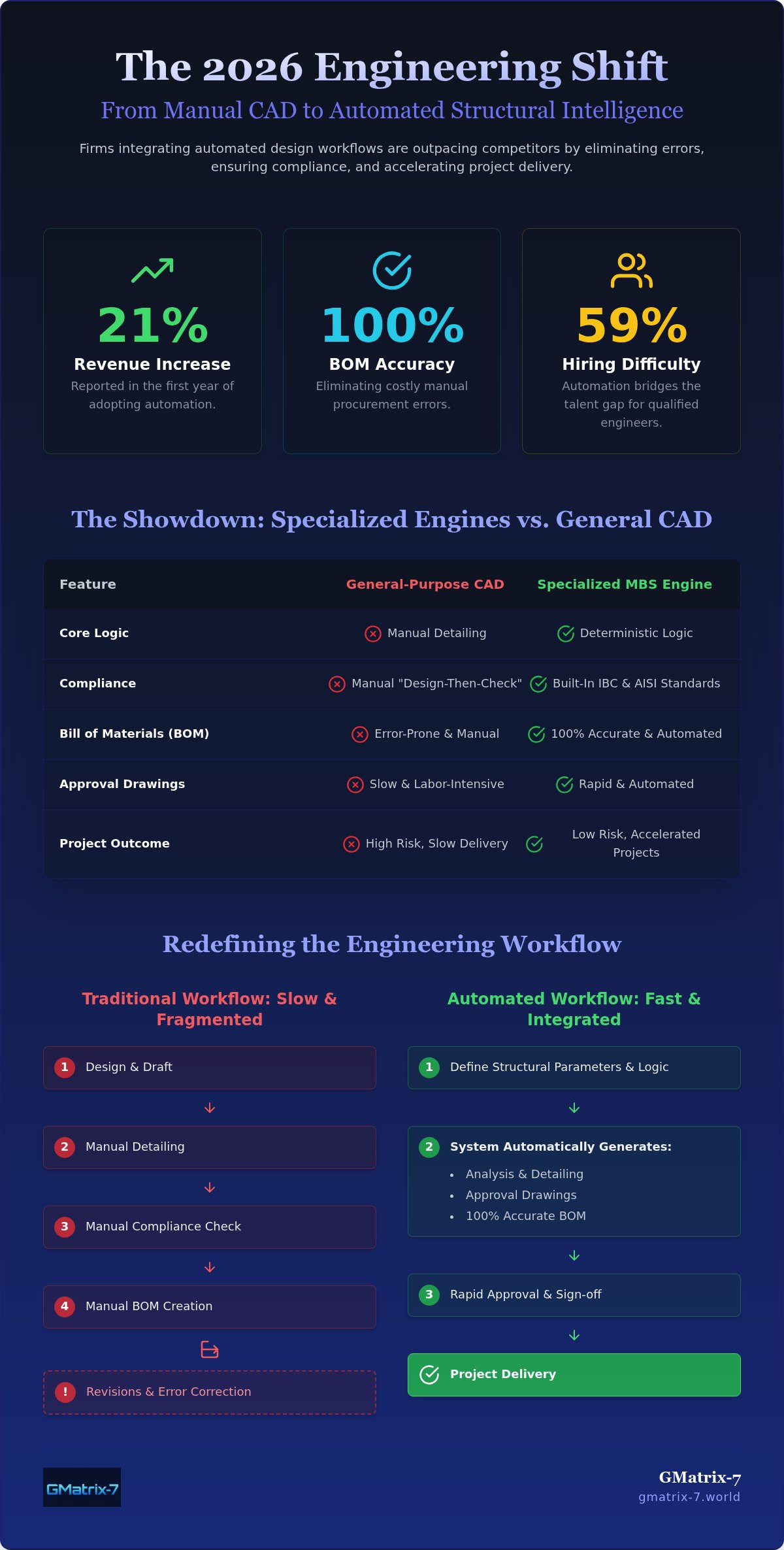
Engineering firms that fail to move beyond static CAD templates in 2026 aren't just losing time; they're forfeiting their competitive edge in a market where precision is non-negotiable. Industry data from 2025 reveals that architecture and engineering firms integrating automation reported a 21% increase in revenue within their first year. This significant growth is driven by automating MBS design workflows to bypass the traditional bottlenecks of manual data entry and regional code adjustments. You likely recognize the mounting pressure of managing IBC 2024 and 2026 compliance while struggling with high error rates in manual Bill of Material generation. We understand that the complexity of modern structural requirements often leads to slow turnaround times for approval drawings, creating friction in your project delivery timeline.
This guide demonstrates how to embed deterministic structural logic directly into your pipeline to secure 100% accurate material lists and accelerated project delivery. We'll explore the transition from manual detailing to specialized engineering suites, ensuring your load tables and approval drawings meet the highest global standards without the typical man-hour drain. By the end of this technical briefing, you'll possess the roadmap to transform your design department into a high-efficiency engine of structural excellence that remains fully compliant with the latest International Building Code updates.
Key Takeaways
- Transition from static CAD drafting to integrated engineering logic to eliminate the manual detailing bottlenecks that delay project delivery.
- Secure regulatory precision by automating MBS design workflows with deterministic logic that embeds IBC 2024 and 2026 compliance directly into the software core.
- Eliminate manual errors in material procurement with automated Bill of Material generation that guarantees 100% accuracy for every structural component.
- Shorten client approval cycles using automated drawing generation tools designed specifically for rapid sign-off and professional technical presentation.
- Leverage specialized modules for MBS, OWSJ, and LGS to create a seamless structural ecosystem that general-purpose CAD software cannot replicate.
The Evolution of Metal Building Systems: From CAD to Automated Workflows
Traditional CAD has reached its functional limit in the structural steel industry. For decades, drafting software served as a digital replacement for the pencil, yet the core process remained manual. By 2026, this approach has become the primary bottleneck for firms aiming to scale. True efficiency is found in automating MBS design workflows through deterministic engineering logic. This transition moves the engineer away from simple line-drawing and into a role of defining structural parameters that govern the entire building system. It's a shift from visual representation to data-driven execution.
The Crisis of Manual Detailing in Modern Engineering
Manual detailing is no longer just slow; it's a significant financial risk. In a high-speed construction environment, the cost of a single error in a manual Bill of Materials (BOM) can exceed the initial design fee. As IBC 2024 and 2026 regulations introduce stricter requirements for tornado loadings and seismic resilience, the manual workload has effectively doubled. General-purpose CAD tools fail to capture these MBS-specific nuances. They lack the built-in intelligence to automatically adjust connections or member sizes based on changing regional codes, leaving engineers to perform tedious, error-prone workarounds that compromise project timelines.
Defining the Automated MBS Ecosystem
A modern automated ecosystem integrates structural analysis, detailing, and documentation into one seamless loop. This methodology relies on a "single source of truth" where every structural component is linked to a central data model. This progress is a direct application of Building Information Modeling (BIM) principles. Engineers don't spend hours drafting individual components anymore. Instead, they define the structural logic, allowing the system to generate professional approval drawings and 100% accurate material lists. This shift ensures that every project is constructible from the moment the first parameter is set.
The engineering landscape has arrived at a definitive crossroads. 2026 marks the tipping point for professional structural design automation as firms struggle with a 59% difficulty rate in finding qualified candidates. Specialized modules are now the only viable way to bridge the gap between complex engineering concepts and rapid project delivery. Automation is the standard for those who demand excellence and precision in every build. It isn't just a technological upgrade; it's a fundamental requirement for maintaining a competitive edge in a compliance-heavy market.
Core Pillars of Reliable MBS Automation: Logic and Compliance
Reliability in structural engineering isn't a byproduct of chance; it's the result of rigid, deterministic logic. While general-purpose AI might excel at aesthetic generation or basic drafting, automating MBS design workflows requires a rule-based engine that understands the physics of steel. This distinction is critical. Generative models can hallucinate, but structural engineers require a "single truth" where every input leads to a predictable, compliant output. Recent research into Automating Structural Engineering Workflows highlights that true efficiency comes from agents that can manage these deterministic constraints in real-time without compromising safety.
Integrating the International Building Code (IBC) directly into the software core transforms the design process from a drafting exercise into a compliance-verified operation. High-tier MBS IBC design software ensures that every member, from the primary rigid frame to the smallest purlin, adheres to global safety standards by default. This eliminates the "design-then-check" cycle, moving compliance to the very start of the pipeline. It's about building security into the data itself.
Embedding IBC and AISI Standards into Design Logic
Digital engines must do more than just draw; they must calculate. Automated systems apply AISI S100 standards for light gauge steel (LGS) components with surgical precision, ensuring that local buckling and distortional effects are accounted for instantly. When integrating open web steel joists (OWSJ), the software maintains SJI compliance across the entire MBS frame. This real-time validation catches potential errors long before they reach the approval drawing phase, protecting your firm's professional reputation and project budget.
The Role of Structural Analysis in the Automation Loop
The backbone of automating MBS design workflows lies in the software's ability to interpret complex load paths without human intervention. Advanced modules calculate load distribution for single skin and sandwich panels, factoring in the specific thermal and structural properties of each material. Whether handling the updated wind, snow, or tornado loading requirements of IBC 2024, the system performs rigorous stress and deflection checks automatically. It ensures that the final structure isn't just visually correct, but fundamentally sound.
To see how these deterministic rules can streamline your next project, explore the capabilities of advanced structural modules designed for modern engineering demands. By shifting the heavy lifting of analysis to a compliance-aware engine, you free your engineers to focus on high-level optimization rather than manual data verification.
Specialized MBS Engines vs. General-Purpose CAD
General-purpose CAD is a horizontal tool, but metal building design is a vertical discipline. Using a generic drafting platform for a specialized structural task creates unnecessary friction. Automating MBS design workflows requires an engine that inherently understands the relationship between a rigid frame and its secondary members. In a general CAD environment, engineers must manually execute "workarounds" for every non-standard connection or gauge change. This manual intervention isn't just tedious; it's a primary source of project delays. Specialized engines replace these manual tasks with parametric intelligence, ensuring that every structural change propagates through the entire model instantly.
Static drafting is a liability in 2026. A detailed CAD vs specialized software for steel detailing comparison reveals that moving to a dedicated engine can reduce detailing time by up to 60%. This efficiency gain stems from the shift from drawing lines to defining parameters. When you adjust a building's eave height in a specialized suite, the software automatically recalculates the column requirements and girt spacings. In contrast, a general CAD user must manually update every elevation, section, and detail view, a process that invites human error and version control issues.
The Productivity Gap: A Comparative Analysis
Manual detailing is the silent killer of engineering margins. Manual Bill of Material (BOM) generation frequently results in material discrepancies that stall site work and inflate costs. Automated material lists, however, guarantee 100% accuracy by pulling data directly from the structural model. The training investment also differs significantly. While general CAD mastery requires years of learning drafting techniques, specialized module proficiency focuses on structural logic. This allows junior engineers to produce professional-grade outputs much faster than traditional methods allow.
- Speed: Automated parametric generation is up to five times faster than manual drafting.
- Accuracy: Software-generated BOMs eliminate the 3-5% error rate typical of manual lists.
- Compliance: Specialized engines have IBC and AISI rules "baked in," whereas general CAD is code-blind.
Interoperability and the Future of the Digital Thread
The digital thread must remain unbroken from the initial estimate to final erection. Specialized engines facilitate seamless data exports to CNC fabrication machinery and Building Information Modeling (BIM) environments. Non-integrated platforms often suffer from "data rot" during file conversions, where critical metadata is lost between software jumps. Maintaining data integrity ensures that the final shop drawing perfectly matches the initial structural analysis. This level of synchronization is only possible when using a dedicated engineering ecosystem designed for the specific demands of the steel industry.
Implementing Automated Documentation: From Approval Drawings to Load Tables
Documentation is the final critical link in the structural delivery chain. Automating MBS design workflows transforms the post-design phase from a manual chore into a high-speed verification process. This automation ensures that your approval drawings aren't just visual representations; they're data-rich documents that reflect the true state of the structural model. By generating these assets directly from a central engine, you eliminate the disconnect between engineering intent and field execution. This level of integration is essential for maintaining the 100% accuracy standards required in modern steel construction while simultaneously producing comprehensive Bills of Material that eliminate material waste.
Precision at scale is achieved through specialized tools like the composite deck load table generator. This system doesn't just list values; it applies rigorous deterministic logic to calculate load capacities for floor decks and roof systems under varying conditions. It ensures that every span-to-load ratio is verified against AISI and SJI standards, providing a level of security that manual spreadsheets simply cannot match. This scientific approach also extends to single skin and sandwich panels, where load tables are generated with absolute precision to meet project-specific cladding requirements.
Accelerating the Approval Process
Standardizing drawing sets for IBC submittals removes the guesswork from regulatory compliance. Automated revision management ensures that when a structural parameter changes, every elevation, plan, and detail view updates simultaneously. This synchronization reduces the feedback loop between the engineer, architect, and fabricator. It prevents the version control issues that typically plague large-scale projects, allowing for rapid client sign-off and significantly faster project commencement.
Precision in Load Table Generation
Generating precise load tables for sandwich panels and single skin cladding requires high-level structural intelligence. Automated systems calculate these tables by analyzing specific material properties and profile geometries against regional environmental loads. This rigorous approach extends to composite floor decks, where automated calculations provide definitive data on stress and deflection limits. These tables meet the highest global standards, ensuring that your submittals are technically unassailable from the moment they're delivered to the building official.
To implement these high-efficiency documentation standards in your own firm, explore how professional structural design automation can redefine your project outcomes. Moving to an automated documentation model doesn't just save time; it builds a foundation of reliability and excellence into every structure you design.
GMatrix-7: Elevating MBS Design with Integrated Structural Intelligence
GMatrix-7 stands as the definitive structural ecosystem for firms that refuse to compromise on technical integrity. It's built by engineers. By automating MBS design workflows through specialized intelligence, GMatrix-7 ensures that your engineering man-hours are spent on optimization rather than manual data entry. This is the gold standard for compliance-heavy projects where precision isn't just an objective; it's a requirement for survival in the 2026 market. Precision is now mandatory. This platform provides the authoritative oversight necessary to manage complex inputs and deliver streamlined, constructible outputs.
The GMatrix-7 Suite: A Module for Every Structural Challenge
The platform's power lies in its modularity. It provides targeted solutions for distinct structural requirements without the bloat of general-purpose software:
- GMatrix-7 / MBS (IBC): A comprehensive module for metal building systems that integrates deterministic logic with the latest building codes.
- GMatrix-7 / OWSJ (SJI): Specialized bar joist detailing that automates manufacturing data and ensures SJI compliance without manual workarounds.
- GMatrix-7 / LGS (AISI): High-precision cold-formed steel engineering that handles complex light gauge profiles with absolute accuracy.
Strategic Outcomes: Speed, Safety, and Superior Detailing
Adopting GMatrix-7 directly impacts your firm's bottom line by drastically reducing overhead. When repetitive engineering tasks are automated, you eliminate the 59% hiring challenge currently facing the industry by doing more with your existing talent. Margins are under pressure. This efficiency doesn't come at the cost of safety. Instead, the software guarantees compliance with global structural codes, protecting your professional reputation. It's more than a tool. You're securing project profitability through superior detailing and 100% material accuracy.
Securing your competitive edge starts with a strategic roadmap for digital transformation. GMatrix-7 provides the stable foundation needed to navigate this transition successfully. It's time to move beyond the limitations of legacy systems and embrace a future where structural intelligence is built into every line of code. Position your business as a leader in the 2026 engineering market by integrating the most advanced automating MBS design workflows available today.
Securing the Future of Structural Engineering Excellence
The 2026 engineering market rewards those who embrace precision and speed through digital transformation. By automating MBS design workflows, your firm moves beyond the limitations of legacy CAD and into a realm of integrated structural intelligence. This shift guarantees that your submittals are not only technically superior but also fully compliant with SJI 100-2020 and AISI S100 standards from the first iteration.
Reliability is the cornerstone of high-level achievement. GMatrix-7 provides the specialized infrastructure to generate automated load tables and 100% accurate Bills of Material, ensuring your project profitability remains secure. As a globally recognized structural engineering software leader, we help you eliminate the manual errors that compromise project timelines and budgets. It's time to redefine your engineering capabilities and set a new standard for industrial progress. We're here to help you build with absolute confidence.
Explore the GMatrix-7 Suite for Automated MBS Excellence and secure your firm's competitive edge today.
Frequently Asked Questions
What are the primary benefits of automating MBS design workflows?
The primary benefits include a significant reduction in engineering man-hours and the total elimination of manual detailing errors. By automating MBS design workflows, firms achieve 100% accurate material lists and seamless regulatory compliance. This technology enables engineers to focus on high-level optimization while the system handles repetitive calculations and documentation tasks. The result is a more profitable project cycle with faster turnaround times for critical structural deliverables.
How does MBS software ensure compliance with the latest IBC standards?
GMatrix-7 ensures compliance by embedding deterministic structural logic directly into the software core. Unlike generic tools, these modules are designed to apply IBC 2024 and 2026 standards automatically during the design phase. This proactive approach catches potential violations before they reach the approval stage. It provides engineers with the peace of mind that every rigid frame and secondary member meets the most rigorous global safety requirements.
Can automated design software handle complex load table generation for composite decks?
Yes, specialized modules can handle complex load table generation for composite decks, sandwich panels, and single skin cladding. The software utilizes precise span-to-load ratio calculations to produce documentation that meets SJI and AISI standards. This automation replaces manual spreadsheets with a scientifically rigorous engine. It ensures that every load capacity listed is technically unassailable and project-specific, providing a reliable foundation for structural submittals.
What is the difference between an authoring tool and an MBS automation platform?
An authoring tool is primarily a drafting environment used to draw lines and shapes, whereas an MBS automation platform is an engineering engine driven by structural logic. While general CAD requires manual workarounds for every connection, an automation platform defines parameters that govern the entire building system. This transition from drawing to defining ensures that any change in the model propagates instantly through all associated drawings and data sets.
How does automated BOM generation reduce material waste in steel construction?
Automated BOM generation reduces material waste by ensuring that procurement lists perfectly match the finalized structural model. Manual lists often suffer from a 3% to 5% error rate, leading to costly site delays or excess inventory. By automating MBS design workflows, you generate 100% accurate material lists that account for every bolt, girt, and panel. This precision streamlines the supply chain and protects project margins from the hidden costs of manual error.
Is specialized MBS software compatible with existing BIM environments?
Specialized MBS software is fully compatible with modern BIM environments and digital fabrication machinery. GMatrix-7 modules are designed to export clean, metadata-rich data that maintains integrity across different platforms. This interoperability prevents the data rot often associated with file conversions between non-integrated tools. It ensures that the digital thread remains unbroken from the initial structural analysis to the final shop drawings and CNC fabrication instructions.
What level of technical expertise is required to implement GMatrix-7 modules?
Implementing GMatrix-7 modules requires a professional understanding of structural engineering principles rather than mastery of complex drafting techniques. The software is built by engineers for engineers, focusing on the logic of MBS, OWSJ, and LGS systems. While the interface is intuitive, users should be familiar with IBC and AISI standards to leverage the platform's full optimization capabilities. This allows teams to produce professional-grade outputs with minimal training compared to general CAD.
How does automation improve the speed of generating structural approval drawings?
Automation improves speed by generating standardized drawing sets and managing revisions simultaneously. When a structural parameter is adjusted, the software automatically updates every elevation, plan, and detail view in the set. This eliminates the need for manual drafting of individual sheets and significantly shortens the feedback loop between the engineer and the client. It results in rapid sign-off and a faster transition from the design phase to construction.


