

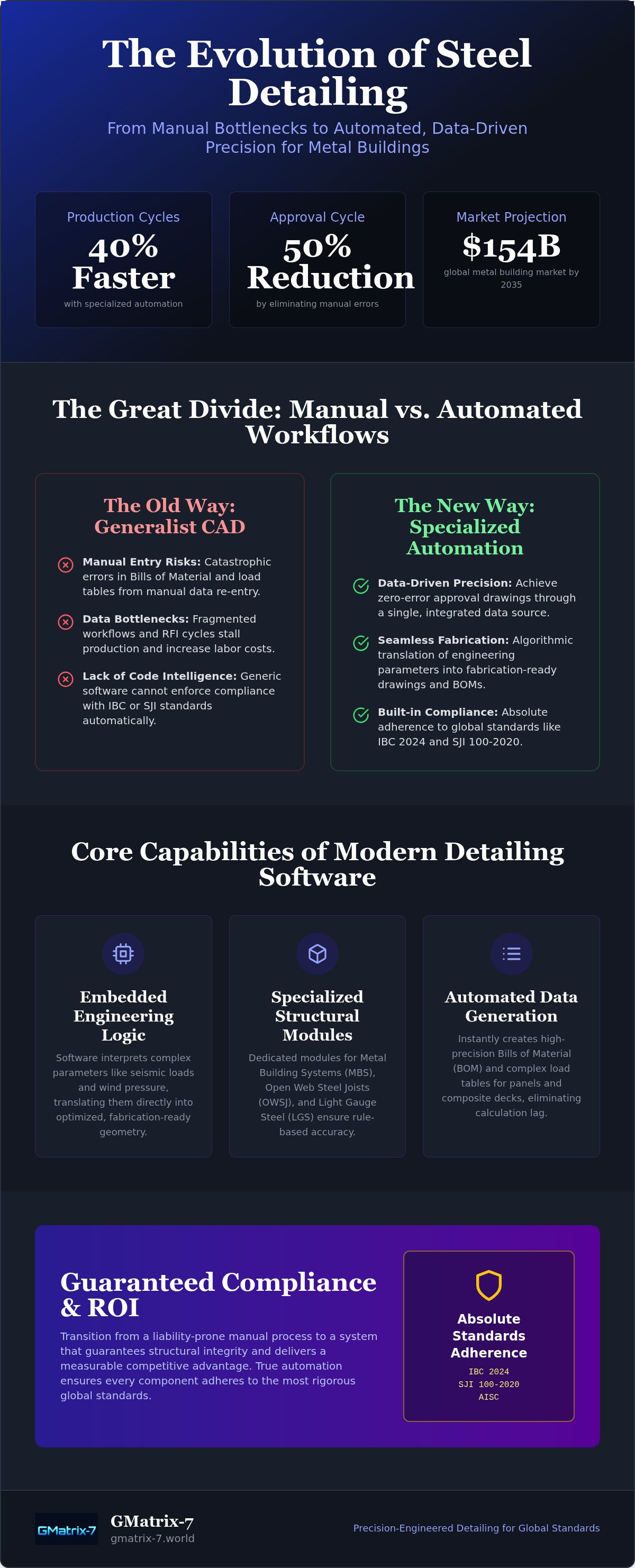
Automation in steel fabrication now delivers up to 40% faster production cycles, yet many detailing departments remain tethered to manual entry workflows that invite catastrophic error. You understand the risk of manual entry errors in Bills of Material or the exhaustion of calculating load tables for complex decks. These traditional methods are no longer sufficient for a global metal building market projected to reach 154 billion dollars by 2035. This 2026 guide explains how specialized automated approval drawing software for metal buildings transforms structural detailing from a manual bottleneck into a high-precision, data-driven competitive advantage.
We'll show you how to secure zero-error approval drawings and automated BOM generation while ensuring absolute compliance with IBC 2024 and SJI 100-2020. This overview details the transition from fragmented design models to seamless, fabrication-ready drawings that define industry excellence. You'll learn to leverage advanced engineering modules that eliminate calculation lag and position your firm as a leader in structural safety and technical optimization. By adopting these sophisticated tools, you move beyond simple CAD to an integrated system that guarantees both speed and global standard compliance.
Key Takeaways
- Transition from generic CAD drafting to a sophisticated, data-driven engineering process that eliminates detailing bottlenecks.
- Discover how to deploy automated approval drawing software for metal buildings to ensure absolute compliance with IBC 2024 and SJI 100-2020 standards.
- Eliminate manual calculation risks by automating complex load tables for single skin, sandwich panels, and composite decks.
- Streamline the transition from design to fabrication with high-precision, automated Bill of Material (BOM) generation.
- Quantify the operational ROI of specialized structural modules against traditional manual detailing costs to secure a long-term competitive advantage.
The Evolution of Steel Detailing: Beyond General CAD to Specialized Automation
Structural detailing has transitioned from a manual drafting exercise into a rigorous, data-driven engineering process. In 2026, the industry no longer views detailing as a separate task from design. Instead, it's an integrated phase where engineering logic dictates every geometric output. This shift toward "capability-to-outcome" workflows ensures that every structural component is optimized for both safety and fabrication efficiency. High-precision automated approval drawing software for metal buildings acts as the central engine for this evolution, maintaining global structural standards while eliminating the latency of traditional methods.
Modern detailing relies heavily on Building Information Modeling (BIM) to centralize data. However, the mere presence of a 3D model doesn't guarantee accuracy. True automation requires the software to interpret complex engineering parameters, such as seismic loads or wind pressures, and translate them into fabrication-ready data without manual intervention. This level of technical sophistication is what separates world-class developers from generalist CAD providers.
Why Generalist CAD Software Fails Modern Fabricators
Generic CAD platforms often become a liability in specialized metal building projects. These tools lack the built-in intelligence required to handle specific IBC 2024 or SJI 100-2020 code requirements. When detailers use generalist software, they're forced into manual RFI cycles to clarify design intent, which stalls production. The hidden costs of these manual interventions are substantial, often leading to project delays and increased labor expenses.
- Lack of Code Intelligence: Generic BIM tools don't recognize the specific nuances of Metal Building Systems (MBS) or Open Web Steel Joists (OWSJ).
- Data Transfer Bottlenecks: Moving data between a design model and a detailing engine in a generic environment often requires manual re-entry, inviting human error.
- Manual Calculation Risks: Generalist platforms require external spreadsheets for load table calculations, creating a disconnect between the engineering data and the final drawing.
The Definition of True Detailing Automation
True automation is not just about generating geometry faster; it's about embedding engineering logic directly into the detailing engine. While traditional CAD relies on manual line work and individual component placement, specialized automated approval drawing software for metal buildings uses algorithmic processing to generate entire systems based on structural inputs. This ensures that every connection, plate, and bolt adheres to the rigorous standards of the American Institute of Steel Construction (AISC) and other global bodies.
Detallers now utilize modules specifically engineered for MBS, OWSJ, and LGS systems. These modules automate the creation of complex geometries while simultaneously generating the associated Bill of Materials (BOM). True detailing automation is the algorithmic translation of engineering parameters into fabrication-ready data, reducing the approval cycle by up to 50% through the total elimination of manual entry errors.
Specialized Modules for MBS, OWSJ, and LGS: Handling Structural Complexity
Modern steel projects demand a level of engineering granularity that generalist software cannot provide. Using high-precision automated approval drawing software for metal buildings allows firms to segment structural complexities into specialized modules. This modular approach ensures that the specific logic for Metal Building Systems (MBS), Open Web Steel Joists (OWSJ), and Light Gauge Steel (LGS) is applied without compromise. Organizations like the Metal Construction Association advocate for these rigorous standards to maintain safety and structural integrity across the industry. By isolating these systems, fabricators eliminate the risk of cross-category errors that frequently plague manual drafting environments.
Specialized modules act as a guardian of safety. They don't just draw lines; they execute engineering rules based on the latest 2026 building codes. This ensures that every output is not only architecturally sound but also fabrication-ready. It's the difference between a generic representation and a data-driven engineering document. Relying on these specialized tools positions your business as a technically superior partner in a competitive global market.
MBS and OWSJ: Engineering Precision at Scale
Engineering precision at scale requires software that understands the specific language of the Steel Joist Institute. Automating complex joist detailing to SJI 100-2020 standards is a necessity for maintaining manufacturing accuracy in a fast-paced environment. The MBS module handles IBC design requirements by integrating load paths directly into the detailing engine. When you utilize SJI compliant joist design, the software validates every connection against real-world stress parameters. This eliminates the manual QA lag that traditionally stalls production. It provides a level of reliability that human-led detailing services simply cannot match at scale.
LGS and Cold-Formed Steel Automation
Cold-formed steel presents unique challenges, particularly regarding AISI S100 standards. Specialized LGS structural design software automates the documentation of framing systems with a speed that never compromises safety. High-precision algorithms generate framing plans and sections that are immediately ready for the shop floor. This integration of precision structural engineering software into modern construction workflows allows for rapid scaling of complex projects. You achieve zero-error documentation while maintaining the rigorous standards expected in 2026. If you're looking to optimize your workflow, exploring these specialized engineering modules is the next logical step toward total detailing automation.
Automating the 'Un-automatable': Load Tables and Advanced BOMs
Load table generation has remained a manual engineering bottleneck for decades. Engineers often spend countless hours verifying capacity for specific panel configurations, a process that invites human error and stalls project momentum. By utilizing automated approval drawing software for metal buildings, firms can now bypass these traditional hurdles. This technology transforms complex engineering inputs into streamlined, fabrication-ready documentation in a fraction of the time previously required.
The transition from manual calculation to algorithmic validation ensures that every structural output is backed by rigorous data. This isn't just about speed; it's about the security that comes from knowing every capacity value is calculated with absolute precision. High-level detailing modules now handle the intricate physics of various cladding and decking systems, ensuring total compliance without the typical engineering lag.
Precision Load Table Generation for Panels and Decks
The science behind a modern composite deck load table generator relies on integrating material properties directly with structural analysis engines. This allows for the automatic calculation of capacities for sandwich and single-skin panels, regardless of the complexity of the profile. By eliminating manual calculation errors in structural deck capacity, you protect the project from costly on-site failures and redesigns. This level of technical optimization is essential for maintaining a competitive edge in 2026. The software evaluates multiple span conditions and load combinations instantly, providing a comprehensive data set that would take a human engineer days to compile.
The Power of Automated Bill of Materials (BOM)
Profitability in steel fabrication is often won or lost in the Bill of Materials. Precise, automated material lists significantly reduce material waste by ensuring that every component is accounted for with pinpoint accuracy. There's a seamless integration between detailing models and procurement data, which allows for immediate ordering and inventory management.
Automated BOMs accelerate the fabrication timeline for metal buildings by removing the need for manual cross-referencing between drawings and lists. This data-driven approach ensures that the shop floor receives exactly what is required, minimizing downtime and logistical errors. This synchronization, achieved through sophisticated automated approval drawing software for metal buildings, is the hallmark of a world-class detailing operation.
Evaluating Software ROI: Precision, Compliance, and Efficiency
Evaluating the return on investment for automated approval drawing software for metal buildings requires a shift from viewing software as a mere operational expense to seeing it as a strategic asset. In 2026, the cost of manual detailing is no longer just the hourly rate of a drafter. It's the cumulative weight of human error, project delays, and the high price of compliance risks. Engineering firms that prioritize precision-driven tools see a direct correlation between software adoption and bottom-line growth. This ROI framework focuses on how specialized automation protects margins while accelerating project velocity.
Modern detailing software replaces manual labor with algorithmic certainty. While traditional CAD requires extensive manual checking, automated systems provide immediate validation against engineering rules. This shift allows firms to produce a higher volume of work with superior accuracy, effectively decoupling revenue growth from headcount expansion. The result is a leaner, more agile engineering department capable of meeting the demands of a global metal building market projected to reach 154 billion dollars by 2035.
The Cost of Non-Compliance vs. Software Investment
Built-in compliance with IBC 2024 and SJI standards acts as a safety net that manual workflows simply cannot replicate. The risks of non-compliance include rejected permits and structural failures, both of which carry astronomical costs and reputational damage. Investing in professional structural design automation provides long-term value that transcends simple drafting speed. When comparing CAD vs specialized software for steel detailing, the ROI becomes clear through the total elimination of manual QA cycles. Specialized tools integrate engineering logic directly into the drawing output, ensuring every component meets global standards before it ever leaves the detailing department.
Productivity Metrics for Modern Engineering Firms
Productivity in 2026 is measured by the velocity of a project from initial design to the shop floor. Detailing teams utilizing automated systems achieve rapid approval cycles by eliminating the back-and-forth typical of manual review. This efficiency directly impacts RFI reduction. When the detailing model is data-driven, field errors are mitigated at the source, preventing costly on-site modifications.
- Scaling Capacity: Automation allows firms to handle larger, more complex projects without a linear increase in staff costs.
- Field Error Mitigation: Precision detailing reduces weld defects and fitment issues, which can save up to 40% in production cycle time.
- Resource Optimization: Your most talented engineers can focus on complex structural challenges rather than repetitive data entry.
The decision to modernize detailing workflows is a decision to protect your firm's reputation and profitability. By choosing a system that prioritizes technical leadership and safety-first engineering, you secure a competitive advantage that is both sustainable and scalable. If you're ready to transform your detailing department into a high-precision profit center, request a quote for our world-class engineering modules today.
GMatrix-7: Precision-Engineered Detailing for Global Standards
GMatrix-7 represents the pinnacle of specialized steel automation, moving beyond the limitations of human-centric service models to provide a robust, algorithmic foundation for structural detailing. As the industry's authoritative leader, our platform delivers an integrated ecosystem where engineering logic and drawing output are inseparable. Utilizing automated approval drawing software for metal buildings allows your firm to transcend the manual bottlenecks that stifle growth; it replaces uncertainty with high-precision, data-driven results. This is the "Gold Standard" of structural engineering, where every geometric output is validated against the most rigorous global requirements.
Our suite of modules, including specialized engines for MBS, OWSJ, and LGS, provides a comprehensive solution for modern fabricators. GMatrix-7 doesn't just generate lines; it produces intelligent data. The unique capability to generate automated load tables for single skin, sandwich panels, and composite decks ensures that your engineering documentation is as resilient as the structures you design. By centralizing these complex processes within a single, sophisticated engine, we enable a seamless transition from design complexity to fabrication simplicity.
Why GMatrix-7 is the Industry Choice for 2026
The visionary leadership of Dr. Simon B. has positioned GMatrix-7 at the forefront of the 2026 engineering outlook. Our 2024 award-winning technology is the result of decades of specialized research and a commitment to safety-first automation. This is a battle-tested platform designed for global structural engineering compliance, ensuring that your projects meet IBC 2024, SJI, and AISI standards without exception. While competitors rely on manual QA processes that are inherently slower and less scalable, GMatrix-7 utilizes algorithmic validation to maintain absolute data integrity. This technical superiority allows our partners to bid on complex global projects with the peace of mind that their detailing is backed by world-class engineering logic.
Next Steps: Streamlining Your Detailing Workflow
Integrating GMatrix-7 into your existing engineering environment is a straightforward path to operational excellence. Our modules are designed to scale with your business, allowing you to handle increased project volumes without a proportional increase in headcount. The path to zero-error documentation and optimized material lists begins with a shift toward specialized automation. By removing the burden of repetitive calculations and manual BOM generation, your most talented engineers can focus on high-value structural challenges.
- Request a Technical Consultation: Discover how our MBS, OWSJ, and LGS modules can be tailored to your specific regional requirements.
- Evaluate Licensing Options: Secure a competitive advantage by adopting the industry's most advanced automated approval drawing software for metal buildings.
- Optimize Your Output: Experience the efficiency of automated load table generation and high-precision Bill of Materials.
We invite you to experience the future of structural detailing. Secure your firm's position as a leader in technical innovation and safety. Contact us today to request a quote for our professional engineering software modules and transform your detailing department into a high-precision profit center.
Securing Your Competitive Advantage in 2026 Structural Engineering
The transition from manual drafting to algorithmic precision is no longer optional for firms aiming to lead the global steel industry. By integrating specialized modules for MBS, OWSJ, and LGS, your detailing department transforms from a bottleneck into a high-velocity profit center. This evolution relies on automated approval drawing software for metal buildings to maintain absolute data integrity across every structural component. GMatrix-7 provides this world-class foundation with built-in IBC 2024 and SJI 100-2020 compliance, ensuring your projects meet the most rigorous global standards without exception.
Our 2024 industry award-winning technology eliminates calculation lag through automated load table and BOM generation. This allows your team to move seamlessly from complex design inputs to fabrication-ready documentation. It's time to replace manual risk with engineering certainty and scale your operations with confidence. Elevate your structural engineering with GMatrix-7 specialized software and secure your firm's reputation for technical excellence. We're ready to help you redefine what's possible in steel detailing and fabrication.
Frequently Asked Questions
What is the primary difference between general CAD and automated steel detailing software?
General CAD is a manual drafting tool that requires line-by-line input and lacks inherent structural intelligence. Automated detailing software integrates engineering logic directly into the geometry generation process. This ensures that every drawing adheres to structural rules automatically, eliminating the need for manual cross-checking. It replaces traditional drafting with a data-driven workflow, producing high-precision outputs that are fabrication-ready from the initial design phase.
Does GMatrix-7 support IBC 2024 and SJI 100-2020 compliance?
Yes, GMatrix-7 features built-in compliance for both IBC 2024 and SJI 100-2020 standards. This technical foundation ensures that your structural designs meet the most rigorous regulatory requirements without manual oversight. Our platform is specifically engineered to handle the technical nuances of these codes. It provides peace of mind through algorithmic validation of every connection, allowing you to execute global projects with absolute confidence in structural integrity.
Can this software generate load tables for composite decks and sandwich panels?
GMatrix-7 includes specialized tools for generating precise load tables for single skin, sandwich panels, and composite decks. The software automates complex calculations based on material properties and span conditions instantly. This replaces the traditional manual engineering bottleneck with a streamlined, data-driven workflow. You receive accurate capacity data without calculation lag. This level of technical optimization ensures your decking systems are both safe and structurally efficient.
How does automated BOM generation reduce material waste in steel projects?
Automated BOM generation reduces material waste by providing pinpoint accuracy in material lists. The software extracts data directly from the detailing model, ensuring that every bolt, plate, and beam is accounted for exactly. This eliminates the over-ordering common in manual estimates. Precise material lists streamline procurement and fabrication. It's a critical feature of automated approval drawing software for metal buildings that directly improves project profitability and environmental sustainability.
Is GMatrix-7 compatible with major BIM workflows?
GMatrix-7 is designed to integrate seamlessly with major Building Information Modeling workflows. The platform centralizes structural data, allowing for a smooth transition from architectural models to fabrication-ready detailing. This integration prevents data silos and reduces the need for manual re-entry. It ensures all stakeholders work from a single source of truth. By aligning with global standards, GMatrix-7 enhances collaboration and project velocity across the entire construction lifecycle.
What modules are available for light gauge steel (LGS) design?
GMatrix-7 offers a specialized LGS (AISI) module specifically for light gauge steel structural design. This module automates framing documentation and structural analysis according to AISI S100 standards. It handles complex cold-formed steel geometries with high-precision accuracy. This allows for rapid scaling of residential and commercial LGS projects. You achieve zero-error documentation while maintaining the rigorous safety standards expected in the modern construction industry.
How does automated detailing impact the speed of approval drawing generation?
Utilizing automated approval drawing software for metal buildings can reduce the detailing cycle by up to 50%. The platform automates the creation of professional approval drawings directly from the design model. This eliminates the weeks of manual drafting traditionally required. Faster drawing generation leads to quicker client approvals and accelerated production timelines. It transforms detailing from a project bottleneck into a significant competitive advantage for your engineering firm.
Why is specialized software necessary for MBS (Metal Building Systems)?
Specialized software is essential for Metal Building Systems because generic CAD lacks the built-in engineering logic for tapered members and complex load paths. GMatrix-7 / MBS (IBC) handles these specific structural nuances automatically. It ensures every design adheres to the unique requirements of pre-engineered metal buildings. Without this specialized focus, engineers face increased risks of non-compliance and structural errors. Specialized automation provides the technical precision required for modern MBS fabrication.


