
In 2026, relying on general-purpose CAD for complex structural projects is no longer a viable baseline; it's a calculated risk to your firm’s profitability and reputation. While traditional drafting tools offer flexibility, they often trap engineering teams in a cycle of compounding manual errors and agonizingly slow approval drawing sequences. You likely recognize the tension of managing inaccurate material lists that lead to costly site delays and wasted resources. This guide provides a definitive analysis of CAD vs specialized software for steel detailing to help you transition from manual complexity to automated precision.
We'll demonstrate how purpose-built engineering engines optimize your 2026 project workflows by integrating rigorous compliance directly into the detailing process. You'll learn how specialized modules, such as GMatrix-7 for open web steel joists and metal building systems, deliver zero-error material procurement and instant alignment with IBC 2024 and SJI standards. We'll preview the technical advantages of automated Bill of Material generation and explain why a data-driven approach is the only way to achieve scalable, high-value detailing results in a competitive global market.
Key Takeaways
- Understand why general CAD platforms lack the structural intelligence required to manage the complexities of modern 2026 engineering projects.
- Analyze the performance gap in CAD vs specialized software for steel detailing to significantly accelerate approval drawing cycles and reduce overhead.
- Learn how to automate compliance with IBC 2024 and SJI standards by utilizing algorithmic engines rather than error-prone manual drafting.
- Discover how automated Bill of Material generation ensures zero-error procurement and eliminates the risk of inaccurate material lists at the job site.
- Explore how specialized modules for MBS, OWSJ, and LGS transform technical complexity into scalable, high-value detailing workflows for global fabricators.
The Evolution of Steel Detailing: Why General CAD is Reaching Its Limit
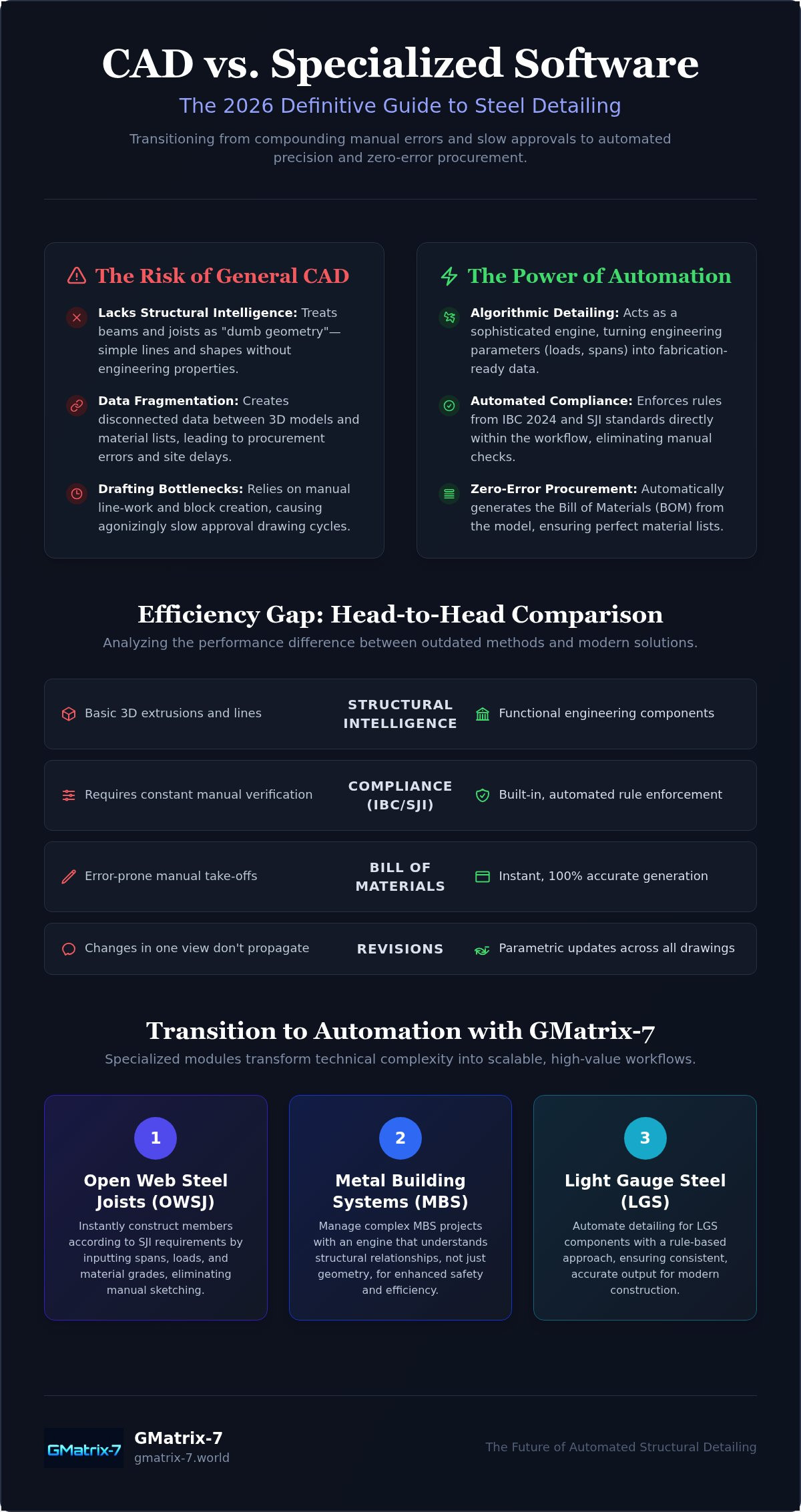
The discipline of Steel Detailing has transitioned from the tactile nature of manual drafting tables to the digital precision of 2D CAD and the spatial complexity of 3D BIM. This evolution reflects a growing demand for speed and accuracy in global construction. However, the 2026 reality is stark: general-purpose CAD tools are reaching a technical ceiling. These platforms lack the intrinsic structural intelligence required for complex Metal Building Systems (MBS) projects. When evaluating CAD vs specialized software for steel detailing, it's clear that general tools treat structural members as mere geometry rather than functional engineering components. This distinction creates a massive gap in efficiency and safety.
General CAD treats a beam as a collection of lines or a basic 3D extrusion. It doesn't understand the member's relationship to the International Building Code (IBC) or how it connects to a bar joist system. This lack of awareness forces engineering teams into a defensive posture where every output requires manual scrutiny. As projects grow in scale, the limitations of "dumb" geometry become impossible to ignore.
The Drafting Bottleneck in 2026
Manual line-work is no longer a sustainable practice for modern structural timelines. Engineers often find themselves bogged down by the high overhead of maintaining custom CAD blocks for every unique structural member. This manual geometry creation acts as a drafting bottleneck, slowing down entire engineering schedules. General-purpose tools fail to manage structural revisions effectively because a single change in one view doesn't automatically propagate through the entire project. In the ongoing debate of CAD vs specialized software for steel detailing, the inability of general tools to handle parametric updates remains a primary cause of project delays.
Data Fragmentation in General-Purpose Tools
General-purpose tools suffer from severe data fragmentation. There is a constant risk of disconnected data between the 3D model and the final material list. When you use geometry that doesn't understand its own structural properties, you inevitably invite procurement errors. These mistakes compound in large-scale projects, leading to massive site delays and wasted capital. Manual data entry is the enemy of excellence.
The psychological cost is equally high. Detailers face the exhausting burden of constant manual verification, knowing that a single missed entry in a manual take-off can derail an entire project's success. This environment breeds stress and erodes the pride of high-level achievement. Transitioning to an integrated, data-driven system isn't just about speed; it's about reclaiming the peace of mind that comes from technical certainty and rigorous automation.
What is Specialized Steel Detailing Software?
Specialized steel detailing software is far more than a digital drafting board; it's a sophisticated algorithmic engine designed to translate engineering parameters into fabrication-ready data. When evaluating CAD vs specialized software for steel detailing, it's essential to recognize that these systems are built specifically for Metal Building Systems (MBS), Open Web Steel Joists (OWSJ), and Light Gauge Steel (LGS). This fundamental shift from "drawing lines" to "defining structural parameters" allows engineers to focus on high-level design while the software handles the granular complexity of geometric generation.
These platforms don't just host a model; they enforce the rules of the 2024 International Building Code and Steel Joist Institute (SJI) specifications throughout the entire lifecycle of a project. By automating the creation of automated structural approval drawings, these engines eliminate the manual drafting cycles that traditionally delay fabrication. This transition from manual complexity to automated simplicity ensures that technical documentation is both accurate and consistent across global standards.
Algorithmic Detailing vs. Manual Drafting
Algorithmic detailing replaces manual mouse clicks with data-driven geometry generation. Instead of manually sketching a bar joist, the detailer inputs spans, loads, and material grades, allowing the software to instantly construct the member according to SJI requirements. This rule-based approach provides a massive speed advantage for standard structural assemblies, ensuring that your engineering schedule remains on track. The capability to transform complex engineering inputs into streamlined outputs is what defines a world-class detailing workflow.
Compliance-First Engineering Logic
Modern structural projects demand a compliance-first approach. Specialized detailing software integrates IBC 2024 and AISI S100 standards directly into its core engine, acting as a digital guardian against non-compliant member selection. If a design choice violates a safety standard or a structural limit, the software identifies the conflict immediately. This proactive risk management ensures that every component is optimized for safety and performance before it ever reaches the fabrication floor. You can achieve this level of rigorous precision by exploring the specialized structural modules available at GMatrix-7.
CAD vs. Specialized Software: The Efficiency Gap
The performance disparity between general-purpose drafting tools and specialized engineering platforms is fundamentally a question of data integrity. When evaluating CAD vs specialized software for steel detailing, the most critical metric is the "cost of error." General CAD requires constant manual intervention, creating a fragmented workflow where data must be re-entered or verified at every stage. In contrast, specialized engines use a unified data model that automates the transition from engineering inputs to fabrication outputs. This shift doesn't just save time; it fundamentally secures the project’s financial baseline.
In 2026, the complexity of structural projects makes manual take-offs a liability rather than a standard practice. Relying on "dumb" geometry means that the detailer is the only link between the drawing and the material list. This human link is where most project-killing errors occur. By utilizing algorithmic material extraction, firms can achieve a level of precision that manual drafting simply cannot replicate. This precision is the bedrock of world-class structural engineering.
Automated Bill of Materials: The Deciding Factor
Manual material lists are the leading source of procurement errors in modern construction. These lists often exist in disconnected spreadsheets that quickly fall out of sync with the 3D model. Implementing an automated BOM for metal buildings eliminates the "spreadsheet gap" by extracting data directly from the structural parameters. This ensures that every plate, bolt, and member is perfectly accounted for before the order is placed. Automated material lists for steel don't just improve speed; they guarantee project profitability by ensuring zero-error procurement.
The Speed of Revision Management
Engineering changes are inevitable, but they shouldn't be catastrophic. In a general CAD environment, a single revision might require a detailer to manually update 50 or more individual drawings. This process is slow, expensive, and prone to inconsistency. Specialized software maintains a "single source of truth" where one algorithmic update propagates through all automated steel shop drawings. This ensures that the shop floor always receives the most current technical documentation, drastically reducing the risk of fabricating outdated designs. Adhering to the rigorous standards of the American Institute of Steel Construction (AISC) becomes a streamlined process rather than a manual burden. This capability transforms a chaotic revision cycle into a methodical, high-value workflow.
Compliance and Risk Management: IBC 2024 and SJI Standards
Compliance is the non-negotiable foundation of structural integrity. In the critical evaluation of CAD vs specialized software for steel detailing, the ability to automate code adherence represents the ultimate safeguard against structural failure and legal liability. General CAD platforms rely entirely on the user's manual knowledge of the 2024 International Building Code (IBC). This creates a dangerous reliance on human memory in an environment where standards are constantly evolving. Specialized software bakes these rigorous global engineering standards directly into the design engine, ensuring that every member selected is inherently compliant from the first mouse click.
Achieving SJI compliant joist design requires meticulous adherence to the latest SJI 100-2020 and 100-2025 specifications. Manual drafting cycles often overlook the subtle geometric constraints and load requirements mandated by these updates. This oversight leads to costly rejections during the approval drawing phase. Specialized algorithmic engines act as a digital guardian, preventing the creation of non-compliant bar joist configurations. This proactive approach to risk management secures project timelines and protects the firm’s professional reputation.
Automating Load Table Generation
The synergy between material detailing and single skin panel load calculation is a hallmark of a modern, high-value workflow. Specialized modules calculate structural deck load capacity automatically, eliminating the risk of manual calculation errors that often plague general CAD projects. By integrating composite deck load table generator outputs directly into the detailing process, engineers ensure that the technical documentation is both accurate and data-driven. This level of automation transforms load table generation from a tedious chore into a streamlined, error-free process that validates the safety of the entire structural assembly.
Ensuring Traceability in LGS Projects
Light Gauge Steel (LGS) projects demand a high degree of precision and material traceability. Utilizing LGS structural design software ensures full compliance with AISI S100 standards while maintaining a clear data trail from the initial Bill of Materials to the final assembly. Global fabricators increasingly demand this compliance-first automation because it provides the technical certainty required for international projects. When you prioritize traceability, you don't just build structures; you build trust with your partners and clients. Ensure your next project meets these global safety standards by adopting the specialized structural detailing modules from GMatrix-7.
Transitioning to Specialized Automation with GMatrix-7
GMatrix-7 stands as the premier developer of specialized structural design and detailing modules, providing the technical infrastructure necessary to transcend the limitations of general-purpose drafting. When choosing between CAD vs specialized software for steel detailing, the decision ultimately rests on whether your firm values manual flexibility or engineering certainty. We facilitate a seamless transition from manual CAD complexity to automated simplicity, allowing your team to focus on high-level achievement rather than repetitive, error-prone drafting tasks. Our role is to provide the engines that drive industrial progress while maintaining the highest standards of safety and excellence.
Our suite includes specialized modules tailored for specific structural systems: the MBS (IBC) module for metal building systems, the OWSJ (SJI) module for bar joists, and the LGS (AISI) module for light gauge steel. These aren't just tools; they're algorithmic engines that automate the generation of approval drawings and Bill of Materials with absolute precision. By integrating these modules, you ensure your 2026 workflows are optimized for the professional structural design automation outlook that modern global fabricators demand.
The World-Class GMatrix-7 Advantage
Our commitment to engineering excellence is reflected in the data-driven precision of every output. GMatrix-7 acts as a visionary partner in your structural progress, providing a battle-tested and globally minded suite that handles the intricacies of IBC 2024 and SJI 100-2025 compliance. We understand that in a high-stakes environment, reliability is paramount. Our technology removes the psychological burden of manual verification, offering the peace of mind that comes from using a world-class suite of specialized modules. We don't just provide software; we provide a foundation for technical superiority.
Next Steps for Structural Detailing Optimization
Optimizing your workflow begins with a critical evaluation of your current automation opportunities. If your team still manually extracts material lists or drafts load tables for composite decks, you're losing valuable time and increasing the risk of site delays. Integrating GMatrix-7 modules into your existing engineering environment is a strategic move toward long-term profitability and scalability. It's time to move beyond the drafting bottleneck and embrace a workflow where complex inputs lead to streamlined, high-value results.
We invite you to experience the transition from "drawing lines" to "defining structural parameters." By adopting our specialized structural design and detailing modules, you position your business as a leader in the global steel industry. Achieve structural excellence and secure your project profitability by partnering with GMatrix-7.
Dominating the 2026 Steel Detailing Landscape
The technical divide in CAD vs specialized software for steel detailing has reached a critical tipping point. Success in today’s market requires a transition from manual line-work to algorithmic precision that guarantees both safety and profitability. By automating compliance with IBC 2024 and SJI standards, your firm eliminates the drafting bottlenecks that traditionally stall fabrication schedules. You don't just draft; you engineer with technical certainty and professional pride.
GMatrix-7 provides the world-class infrastructure needed to achieve this level of optimization. Recognized with industry awards in 2024, our suite offers specialized modules for IBC, SJI, and AISI compliance alongside advanced load table generation for composite decks and sandwich panels. These tools transform complex structural inputs into streamlined, high-value outputs. It's time to reclaim your peace of mind and lead the industry with a battle-tested engineering suite. Explore the GMatrix-7 Structural Design Suite and secure your place at the forefront of structural innovation. Your journey toward zero-error procurement begins today.
Frequently Asked Questions
What is the primary difference between CAD and specialized steel detailing software?
The primary difference lies in structural intelligence; CAD treats components as static geometry, while specialized software uses algorithmic engines to define structural parameters. When analyzing CAD vs specialized software for steel detailing, specialized tools integrate engineering codes directly into the modeling process. This shift ensures that every beam or joist is a data-driven entity rather than a simple collection of lines, allowing for automated compliance and error-free revisions.
Can specialized detailing software automate my bill of materials (BOM)?
Specialized software automates the generation of the Bill of Materials by extracting data directly from the structural model. This process eliminates the "spreadsheet gap" where manual data entry leads to procurement errors. By using an algorithmic extraction method, firms ensure that every bolt and member is accurately accounted for, which significantly reduces material waste and secures project profitability during the fabrication phase.
How does specialized software ensure IBC 2024 compliance for metal buildings?
Specialized software ensures IBC 2024 compliance by integrating the latest technical specifications directly into its core design logic. The software acts as a digital guardian, validating member selections against updated wind, snow, and earthquake load requirements. This proactive approach prevents non-compliant designs from advancing to the shop floor, providing engineers with the technical certainty required for high-stakes projects in a modern regulatory environment.
Is GMatrix-7 software compatible with SJI standards for bar joists?
GMatrix-7 is fully aligned with Steel Joist Institute (SJI) standards, specifically supporting the latest SJI 100-2020 requirements for bar joists and girders. The OWSJ module automates the detailing process based on these rigorous specifications, ensuring that every joist configuration meets global safety standards. This alignment provides a seamless transition from engineering inputs to fabrication-ready data while maintaining the highest level of structural integrity.
Does specialized software reduce the time spent on structural shop drawings?
Specialized software drastically reduces the time required for structural shop drawings by automating geometry generation and technical documentation. Instead of manually drafting individual views, the software produces fabrication-ready drawings based on the underlying structural parameters. This automation accelerates the approval cycle and ensures that revisions propagate instantly through the entire project, allowing engineering teams to maintain aggressive schedules without compromising on precision.
Can I generate load tables for composite decks using GMatrix-7?
GMatrix-7 features specialized modules capable of generating comprehensive load tables for composite decks, sandwich panels, and single-skin systems. The software calculates structural deck load capacity automatically, integrating these results directly into the detailing workflow. This capability removes the risk of manual calculation errors and provides fabricators with the data-driven documentation necessary to validate product performance for diverse construction applications.
What is the "cost of error" in manual CAD steel detailing?
The "cost of error" in manual CAD detailing includes expensive fabrication rework, significant material waste, and cascading site delays. Because general CAD lacks structural intelligence, a single manual entry mistake in a material list or a drawing revision can lead to catastrophic financial losses. Transitioning to specialized software mitigates these risks by replacing manual verification with automated precision and integrated compliance checks.
Is specialized structural software suitable for Light Gauge Steel (LGS) projects?
Specialized structural software is essential for Light Gauge Steel projects, as it ensures strict adherence to AISI S100 standards. The LGS module in GMatrix-7 automates the detailing of complex cold-formed steel assemblies while maintaining full material traceability from the BOM to the final assembly. This data-driven approach is critical for global fabricators who require technical superiority and scalable workflows for international LGS construction.


