

Structural analysis means nothing if fragmented drafting handoffs corrupt design intent before fabrication ever starts. If you lead an engineering team, you already know the quiet chaos of manual data re-entry: engineers export complex load combinations, detailers recreate geometry from scratch, and minor discrepancies trigger rounds of drawing revisions. Understanding the measurable benefits of integrated structural design software isn't merely about adopting new technology; it's about safeguarding project margins and eliminating the chronic divide between computational analysis and downstream shop deliverables.
You shouldn't have to sacrifice precision to hit aggressive commercial schedules. Discover how integrated structural design software unites analysis, code compliance, and fabrication documentation to accelerate project delivery without compromising structural integrity. We'll examine how synchronizing continuous design engines across MBS, OWSJ, and LGS structural frameworks eliminates costly detailing errors, automates approval drawings, and generates exact bills of material in minutes.
Key Takeaways
- Capitalize on the operational benefits of integrated structural design software by replacing fragmented handoffs with a synchronized, calculation-driven ecosystem.
- Compress engineering schedules through automated workflows that convert conceptual load models directly into approval drawings and structural bills of material.
- Eliminate detailing discrepancies and costly field rework by maintaining an unbroken digital thread between code analysis and fabrication documentation.
- Ensure rigorous compliance across specialized engineering frameworks, including Metal Building Systems (IBC), Open Web Steel Joists (SJI), and Light Gauge Steel (AISI).
- Identify the core criteria for evaluating structural platforms, focusing on end-to-end automation, calculation transparency, and module-specific detailing capabilities.
What Is Integrated Structural Design Software in Modern Engineering?
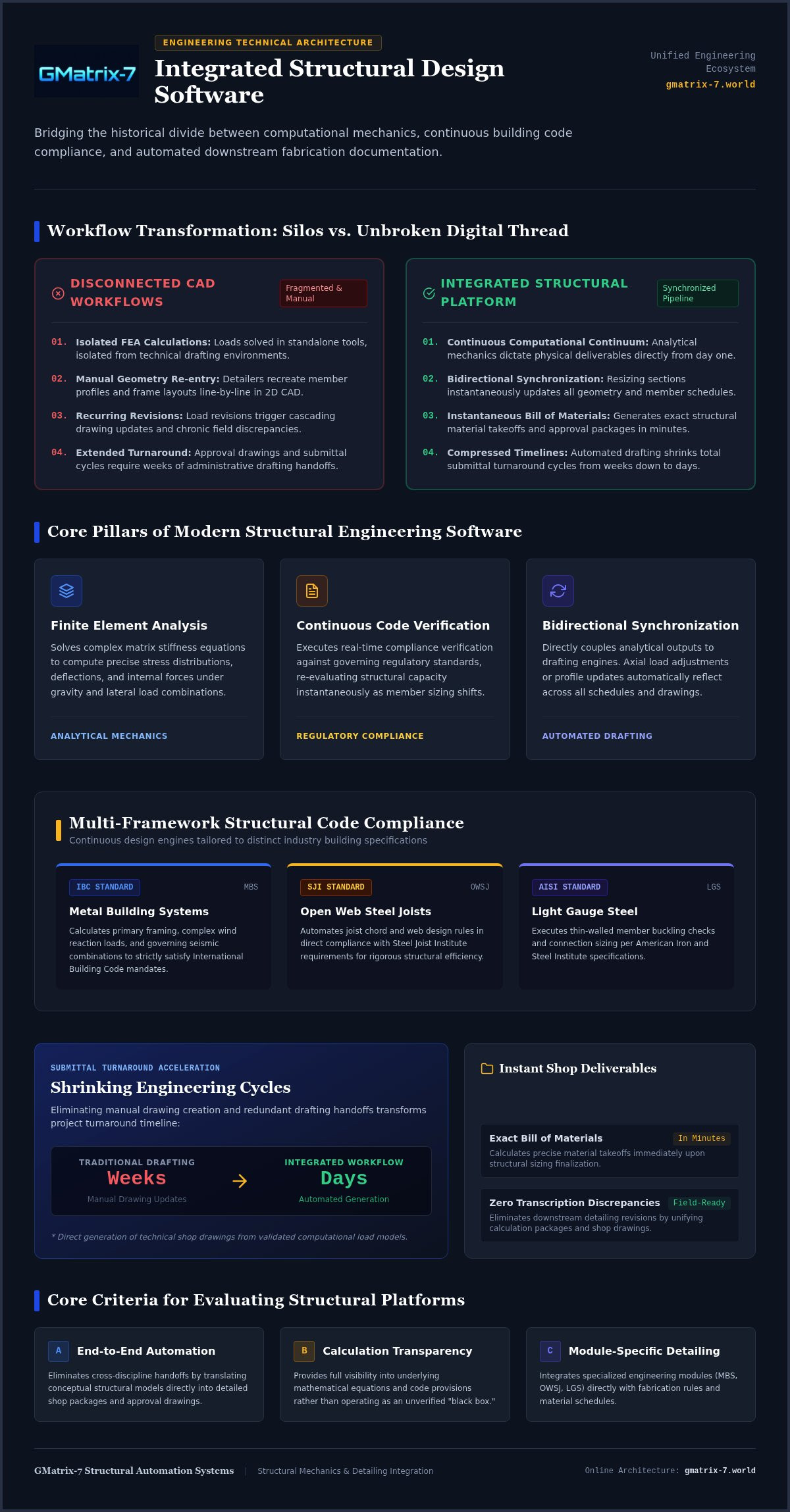
Integrated structural design software is a unified computational platform that bridges the historical divide between analytical mechanics and technical drafting. For decades, structural engineering relied on fractured workflows. Engineers calculated load distributions in standalone analysis programs, verified design criteria across disconnected spreadsheets, and tossed hand-marked sketches to drafting teams to recreate members in CAD line by line. The operational benefits of integrated structural design software originate from abolishing these silos, binding finite element modeling, real-time code compliance, and automated drafting into an unbroken digital pipeline.
The Evolution from Disjointed Tools to Unified Platforms
Engineering methodologies evolved rapidly from manual hand calculations to early computer-aided design tools that merely digitized the drafting table. While early 2D CAD programs accelerated graphic drafting, they completely isolated structural mechanics from downstream drawings. Transferring analytical reaction forces into separate drafting environments created severe productivity bottlenecks, routinely causing discrepancies between structural calculation packages and technical shop drawings. Today, advanced platforms deploy parametric modeling engines linked directly to broader Building Information Modeling frameworks, updating technical documentation instantaneously whenever underlying engineering variables shift.
Core Capabilities of Modern Structural Engineering Software
Modern integrated platforms eliminate cross-discipline guesswork by uniting four core capabilities into a single computational ecosystem:
- Finite Element Analysis (FEA): Solves complex matrix stiffness equations to compute precise stress distributions, deflections, and internal forces under demanding gravity and lateral load combinations.
- Automated Code Checking: Executes continuous compliance verification against international regulatory standards, evaluating structural capacity against governing building codes as sizing parameters shift.
- Bidirectional Synchronization: Couples analytical output directly to drafting engines. If an engineer adjusts an axial load or resizes a section, all associated geometry, member schedules, and approval drawings update automatically.
Engineering teams realize the full benefits of integrated structural design software when these components operate as a synchronized continuum, ensuring analytical precision dictates the physical deliverable from day one.
Key Benefits of Integrated Structural Design Software for Engineering Teams
Realizing the primary benefits of integrated structural design software requires connecting analytical engineering directly to physical deliverables. Moving beyond generic BIM coordination, true integration links mathematical calculations straight into technical documentation, eliminating redundant drafting phases and driving unmatched material efficiency across the entire project lifecycle.
Accelerated Project Delivery and Design Velocity
Engineering teams spend excessive hours manually redrawing frames, checking member schedules, and reconciling drafting revisions. Implementing an integrated analysis and design workflow removes these administrative bottlenecks by generating downstream technical drawings straight from computational models. As detailed in this operational review of professional structural design automation, eliminating manual drawing creation shrinks submittal turnaround cycles from weeks to days. Engineers rapidly simulate alternative load scenarios, finalize code checks, and deliver fabrication-ready packages without drafting delays.
Uncompromising Structural Precision and Code Compliance
Evolving regulatory standards leave zero room for transcription errors or manual calculation discrepancies. Unified platforms execute continuous code checks across specialized structural disciplines, validating compliance with governing building codes in real time:
- Metal Building Systems (IBC): Calculates primary framing, wind reactions, and seismic combinations to satisfy stringent building code mandates.
- Open Web Steel Joists (SJI): Evaluates chord forces, web stresses, and bar joist bearing conditions directly against current SJI standards.
- Light Gauge Steel (AISI): Verifies cold-formed member integrity, local buckling limits, and torsional stiffness per AISI specifications.
Downstream Material Optimization and Waste Reduction
Disconnected workflows often force structural engineers to over-design members to compensate for communication gaps and schedule pressures. Integrated computational algorithms calculate exact stress thresholds and load paths, enabling precise member sizing that trims unnecessary steel tonnage. Beyond structural framing, the platform evaluates specialized panel limits, generating accurate load tables for single skin, sandwich panels, and composite decks to prevent jobsite scrap. To capture these compounding efficiencies and accelerate delivery, forward-thinking practices rely on purpose-built solutions like GMatrix-7 automation software to streamline structural calculations, approval drawings, and material schedules in one unified environment.
Integrated Structural Platforms vs. Disconnected CAD Workflows
Drafting freedom in standalone CAD environments comes at an unbearable operational cost. While legacy drafting tools let technicians manipulate geometric lines without constraint, they sever the vital computational connection between structural engineering equations and final shop deliverables. When structural changes occur, detailers must manually re-enter loads, rebuild framing geometry, and revise schedules line by line. This fractured handover creates blind spots where unverified adjustments cause expensive field fit-up failures. The real-world benefits of integrated structural design software emerge directly from replacing these friction-heavy file exchanges with a synchronized parametric core.
Evaluating the Operational Breakdown of Disconnected Workflows
Manual data re-entry introduces compounding translation risks. When engineers calculate member capacities in isolated packages, detailers must interpret static calculation printouts to draft connection plates, joist seats, and purlin layouts. A single missed coordinate or outdated spreadsheet reference invalidates fabrication packages. As explored in this breakdown of CAD vs specialized software for steel detailing, disconnected processes inevitably lead to version control breakdowns where fabrication proceeds on superseded designs, triggering costly change orders.
Comparative Analysis Matrix: Integrated vs. Fragmented Tools
Consolidating design and detailing into a continuous platform removes administrative overhead, prevents drafting discrepancies, and enforces calculation traceability across deliverables.
| Operational Metric | Disconnected CAD Workflows | Integrated Structural Platforms |
|---|---|---|
| Data Synchronization | Manual re-keying from calculation sheets into CAD drawings; high risk of transposition errors. | Bidirectional parametric updates; changes to analysis instantly regenerate drawings. |
| Bill of Materials (BOM) | Manual takeoffs or detached spreadsheets; prone to material omissions and fabrication waste. | Automated structural BOM generation derived directly from validated engineering geometry. |
| Code Compliance Audit | Fragmented checks across detached calculation tools and manual verification checklists. | Embedded, continuous code verification aligned with IBC, SJI, and AISI requirements. |
| Revision Overhead | Demands manual redraws, manual cross-checking, and lengthy multi-file drafting updates. | Automated document generation; approval drawings update in minutes rather than days. |
How to Choose the Right Integrated Structural Engineering Software
Selecting an engineering platform requires looking past slick user interfaces and generic drafting claims. Realizing the operational benefits of integrated structural design software demands algorithmic rigor, calculation transparency, and direct links to shop-floor deliverables. Evaluating potential platforms against a structured three-step benchmark ensures your firm invests in software that actively compresses production timelines while safeguarding technical compliance.
Step 1: Audit Specialized Structural Module Capabilities
General-purpose structural software handles simple frames but falters when subjected to specialized framing mechanics. Ensure your candidate software includes purpose-built calculation engines tailored to complex framing sectors rather than relying on crude workarounds. Look for proven compliance modules such as SJI compliant joist design for standard bar joists and joist girders alongside dedicated LGS structural design software to resolve thin-walled, cold-formed buckling modes per AISI specifications.
Step 2: Inspect Automated Documentation and Drawing Engines
True integration does not stop at code-check utilization ratios. The software must automatically transform analytical output into clear fabrication deliverables without requiring detailers to redraw members. Audit whether the engine delivers:
- Approval Drawing Generation: Automated creation of erection views, structural plans, elevations, and structural connection schedules directly from calculated nodes.
- Automated Bill of Material (BOM) Generation: Precise material takeoffs detailing accurate member lengths, weights, and plate sizes to streamline procurement.
- Specialized Cladding Load Tables: Algorithmic generation of allowable load capacities for single skin, sandwich panels, and composite deck assemblies under varying wind and live load distributions.
Step 3: Benchmark Interoperability, Support, and User Adoption
Software adoption succeeds or fails based on implementation execution and domain expertise. Scrutinize the technical pedigree of the software developers to verify the tools are engineered by credentialed structural authorities rather than detached programmers. To maximize your team's design capacity and eliminate detailing bottlenecks, explore GMatrix-7 structural modules to modernize your firm's engineering pipeline with automated drawing generation and calculation-driven precision.
End-to-End Engineering Automation with GMatrix-7 Solutions
Engineering teams cannot afford the friction of disconnected analysis files and manual drafting queues. Founded and led by structural engineering automation pioneer Dr. Simon B., GMatrix-7 delivers an uncompromising platform engineered specifically to unite computational mechanics with instant technical deliverables. By replacing disjointed drafting handoffs with algorithmic generation, engineering firms experience the genuine benefits of integrated structural design software across every stage of project development.
Specialized Engineering Modules for Advanced Structural Steel
GMatrix-7 targets complex engineering challenges through dedicated, code-specific computational modules:
- GMatrix-7 / MBS (IBC): Automates the complete analysis and detailing of Metal Building Systems, solving primary frames, cold-formed secondary framing, and complex lateral load combinations under strict IBC mandates.
- GMatrix-7 / OWSJ (SJI), Bar Joists: Delivers exact member calculation and detailing for open web steel bar joists, validating chord sizing and web geometry directly against SJI standards.
- GMatrix-7 / LGS (AISI): Resolves cold-formed steel engineering requirements, calculating torsional limits and local member buckling to guarantee full AISI compliance.
Automated Deliverables: Approval Drawings, BOMs, and Load Tables
The true power of GMatrix-7 lies in eliminating manual drafting recreation entirely. Once the structural analysis completes, the software automatically translates mathematical models into production-ready project documentation:
- Approval Drawing Generation: Produces comprehensive structural plan views, framing elevations, and connection details, compressing review periods and accelerating client approval cycles.
- Automated Bill of Material Generation: Extracts precise material schedules, member quantities, and steel tonnage breakdowns directly from calculated engineering geometry, preventing procurement discrepancies.
- Specialized Load Table Generation: Computes verified capacity tables for single skin, sandwich panels, and composite decks, giving engineers instant performance verification across diverse roof and wall assemblies.
Transform your firm's production throughput. Transition away from disjointed CAD handoffs and deploy the verified benefits of integrated structural design software with GMatrix-7 to accelerate project delivery, ensure absolute code compliance, and maximize engineering profitability.
Engineer the Future of Structural Project Delivery
Fractured handoffs and manual drafting re-entry have held structural practices back for decades. Modern engineering demands an unbroken connection between analytical calculations and fabrication deliverables. Capturing the full benefits of integrated structural design software empowers your team to eliminate revision lag, prevent costly field rework, and safeguard project profitability.
Pioneered by structural automation innovator Dr. Simon B., GMatrix-7 provides comprehensive module coverage across MBS (IBC), OWSJ (SJI), and LGS (AISI) frameworks. By coupling core analytical code checks with the automated generation of approval drawings, accurate bills of material, and specialized load tables, the platform frees your engineers to focus on high-impact structural design. Take command of your project timelines and deliver flawless documentation every time. Accelerate your engineering workflows with GMatrix-7 structural software and set a new standard for engineering excellence.
Frequently Asked Questions
What is the primary difference between structural analysis software and integrated structural design software?
Standalone structural analysis software calculates internal forces, deflections, and moments without generating downstream physical documentation. Integrated platforms unite mathematical analysis, code compliance checking, and technical detailing into a synchronized system. Rather than forcing engineers to export calculation results to detached drafting applications, integrated platforms instantly convert computational models into erection plans, connection details, and fabrication deliverables.
How does integrated structural software ensure compliance with international building codes?
Integrated platforms embed governing regulatory equations directly into the calculation core. As structural geometry shifts, the software continually evaluates member capacities, local buckling boundaries, and stress ratios against specific industry standards. This real-time audit verifies calculations against governing international mandates, eliminating the compliance oversights common in manual spreadsheet verifications.
Can integrated structural design software eliminate manual drafting errors in steel detailing?
Yes, integrated software removes the translation errors that occur when technicians manually redraw analytical models in CAD. By coupling member engineering directly to drawing generation, any adjustment to a structural section or load parameter automatically updates the corresponding approval drawings. This direct digital link ensures that shop deliverables precisely match calculated engineering intent.
What structural steel types are supported by specialized integrated design platforms?
Advanced platforms like GMatrix-7 provide dedicated calculation modules for Metal Building Systems (IBC), Open Web Steel Joists (SJI) including standard bar joists, and Light Gauge Steel (AISI). Specialized modules also engineer cladding interfaces, generating precise load tables for single skin, sandwich panels, and composite floor decks under demanding project load cases.
How does automated bill of material generation impact project profitability and procurement?
Automated material generation extracts exact steel tonnage, element lengths, and component counts directly from finalized analytical models. Disconnected drafting workflows rely on manual takeoffs, which often lead to costly over-ordering or missing items. Deriving bills of material directly from verified engineering calculations prevents material waste and protects contractor margins during procurement.
Is integrated structural design software suitable for specialized metal building systems?
Specialized metal building systems benefit significantly from this technology due to their complex mix of tapered primary frames, cold-formed secondary members, and non-prismatic sections. Capturing the primary benefits of integrated structural design software allows pre-engineered metal building firms to automate frame optimization, verify regional wind and seismic combinations, and generate fabrication-ready documentation in a fraction of standard design cycles.


