

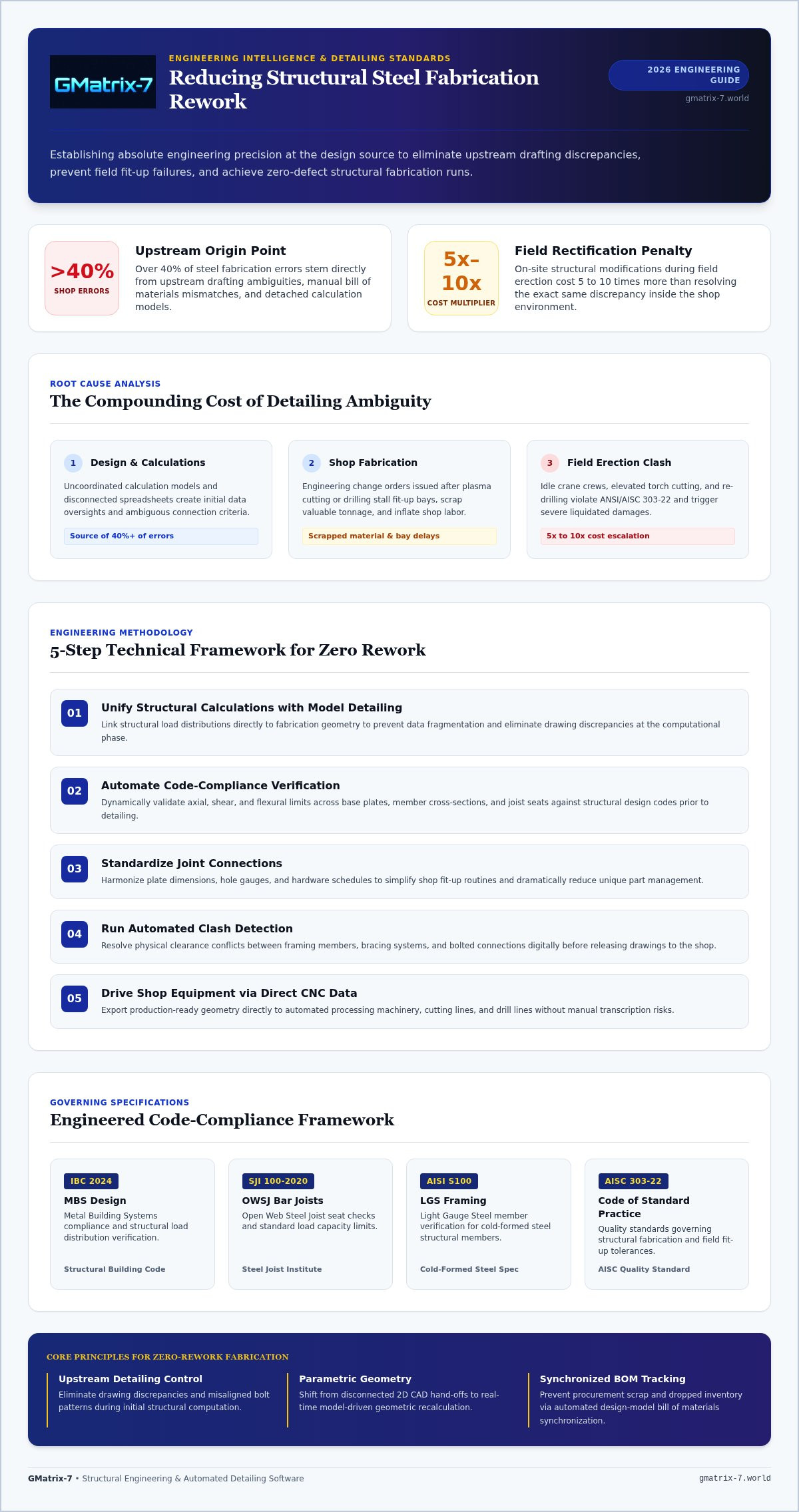
Over 40% of structural steel fabrication errors originate long before a single beam is cut or an arc is struck. They stem directly from upstream drafting ambiguities, manual bill of materials mismatches, and detached calculation models. When structural framing fails to fit during field erection, on-site modifications cost 5 to 10 times more than resolving the discrepancy in the shop. Understanding how to reduce steel fabrication rework requires moving beyond reactive shop-floor inspections and establishing absolute engineering precision at the design source.
You already know the punishing impact of escalating shop labor costs, idle crane crews, and communication gaps between detailers and fabricators. Discover proven structural engineering workflows and automated detailing strategies to eliminate costly steel fabrication rework across your operations. This 2026 engineering guide explores how single-source model synchronization, automated approval documents, and dynamic material tracking compress project turnarounds and deliver zero-rework fabrication runs from first cut to final bolt.
Key Takeaways
- Upstream Detailing Control: Eliminate drawing discrepancies and misaligned bolt patterns at the computational phase before errors propagate into expensive job-site fit-up issues.
- Workflow Automation: Discover how to reduce steel fabrication rework by establishing direct, unified data flow from initial structural calculations straight to shop fabrication documentation.
- Manual Drafting Risk Elimination: Shift from vulnerable 2D CAD hand-offs to parametric, model-driven detailing that recalculates structural geometry in real time.
- Synchronized Material Tracking: Prevent costly procurement scrap and dropped inventory by integrating automated bill of materials generation directly with the approved design model.
- Engineered Code Compliance: Deploy purpose-built design modules for MBS (IBC), OWSJ (SJI) bar joists, and LGS (AISI) framing to validate connections and guarantee zero-rework fabrication runs.
Understanding the Root Causes of Steel Fabrication Rework
Fabrication plants often blame cutting operators or weld fit-up crews when rework spikes. That diagnosis misses the real culprit. Upstream drafting ambiguities and uncoordinated revisions account for over 40% of steel shop fabrication errors. Misaligned bolt patterns, incorrect member lengths, and missing weld callouts rarely originate at the saw or drill line. Instead, they begin as digital oversights within uncoordinated calculation packages. Understanding how to reduce steel fabrication rework requires isolating where the data chain fractures between structural design and shop execution.
Upstream Detailing Inconsistencies vs. Shop-Floor Deficiencies
Shop-floor variances like thermal cutting distortion or machine calibration drift are manageable through standard quality controls. Detailing discrepancies, by contrast, are systemic. When structural engineers provide ambiguous connection criteria, detailers often make unverified assumptions during structural steel detailing. These oversights flow directly into shop fabrication documents. Issuing engineering change orders after plasma cutters start slicing plates scraps valuable tonnage, stalls fit-up bays, and inflates shop labor costs.
The Compounding Cost of Field Rectification
A tolerance lapse that slips past shop inspection turns catastrophic once structural members reach the job site. Rectifying framing clashes in the field costs 5 to 10 times more than resolving them inside the shop. Field crews must halt erection sequences, leave rented cranes idling, and resort to torch-cutting or re-drilling connections at elevation. These invasive modifications introduce structural safety hazards, violate ANSI/AISC 303-22 quality standards, and trigger substantial liquidated damages. Knowing how to reduce steel fabrication rework fundamentally depends on catching dimensional clashes during the engineering phase, long before steel ever ships.
5 Steps to Eliminate Structural Steel Rework in Modern Fabrication
Eliminating shop errors requires an interconnected framework that locks design integrity directly to the production floor. As demonstrated in the landmark NIST capital facilities study, data fragmentation between designers and fabricators bleeds billions of dollars annually. Mastering how to reduce steel fabrication rework demands replacing disconnected spreadsheets and manual drafting hand-offs with a closed-loop digital methodology. Follow these five technical steps to ensure zero-defect throughput:
- Unify Structural Calculations with Model Detailing: Link engineering load distributions directly to fabrication geometry to prevent design discrepancies.
- Automate Code-Compliance Verification: Validate all framing members against active structural standards prior to generating drawing packages.
- Standardize Joint Connections: Harmonize plate dimensions, hole gauges, and hardware schedules to simplify shop fit-up routines.
- Run Automated Clash Detection: Resolve clearance conflicts between framing members, bracing systems, and bolted connections digitally.
- Drive Shop Equipment via Direct CNC Data: Export production-ready geometry directly to automated processing machinery without manual transcription.
Automating Structural Calculations and Model Verification
Manual load calculations and disconnected design spreadsheets invite transcription slips that propagate into cutting files. Engineering teams must automate analytical verification across every framing member. Specialized engineering calculation platforms instantly check axial, shear, and flexural limits against IBC 2024, SJI 100-2020, and AISI S100 specifications. This dynamic validation guarantees that base plates, member cross-sections, and joist seats maintain structural adequacy before entering detailing queues.
Connection Standardization and Automated Clash Detection
Congested framing nodes represent prime failure points during field erection. Establishing standardized bolt diameters, uniform plate thicknesses, and consistent hole spacings slashes the volume of unique parts shop crews must manage. Automated multi-member clash routines check physical bolt clearances and weld access across complex joints. Reviewing the technical analysis in CAD vs specialized software for steel detailing illustrates how purpose-built engineering environments prevent high-density connection interference far better than generic drafting tools.
Direct Digital Integration with Fabrication Equipment
Eliminating manual paper drawing interpretation at cutting tables removes the primary vector of shop-floor dimensional drift. Transfer verified digital part geometry directly into automated saws, plate-processing lines, and drilling systems. When CNC machine centers run from unified structural data, cutting operations preserve ANSI/AISC 303-22 fabrication tolerances without human miscalculation. Fabricators seeking to understand how to reduce steel fabrication rework can explore the specialized modules at gmatrix-7.world to seamlessly connect validated engineering calculations directly with production-ready detailing outputs.
Manual Drafting vs. Automated Detailing: Rework Risk Comparison
Traditional 2D drafting methods treat structural drawing sets as isolated collections of lines, arcs, and text blocks. When detailers draw shop sheets manually, they must individually coordinate plan views, elevation cuts, and connection callouts across dozens of disconnected files. Automated detailing platforms replace this manual chore. By generating shop drawings straight from an underlying structural calculation model, automated systems ensure that every dimension remains mathematically coupled to the approved design. Evaluating this procedural contrast reveals exactly how to reduce steel fabrication rework at the drafting board.
Human Error Exposure in 2D Drafting Environments
Manual drafting relies on human memory and visual cross-checking across fragmented sheets. When an engineer resizes an end-plate or modifies a span, detailers must track down every corresponding elevation, section cut, and schedule to adjust callouts by hand. Inevitably, fatigue leads to uncoordinated revisions and orphaned dimensions. Fabricators receiving these contradictory prints are left guessing. According to AISC standard practice guidelines, shop drawings must unambiguously define member lengths and hole gauges. Yet 41% of steel fabricators report that operational scrap and rework originate directly from these drafting skill gaps and manual translation slips.
Parametric Synchronization and Single-Source Detailing
Parametric engineering software eliminates manual transcription errors by establishing a single source of structural truth. When an analytical member size updates, the parametric model updates every connected piece automatically. Purlin punch locations, clip-angle clearances, and weld lengths recalculate simultaneously without human drafting intervention.
- Instant Model Propagation: Modify a column profile once, and every associated base plate, stiffener, and connection drawing updates in real time.
- Synchronized Detailing Views: Eliminate conflicting annotations by deriving all sections and elevation details from a unified mathematical model.
- Guaranteed Fit-Up Accuracy: Maintain exact dimensional integrity throughout fabrication documentation prior to releasing cutting orders.
Adopting this level of parametric control serves as practical insurance for busy engineering offices. As outlined in the analysis on professional structural design automation, removing manual drafting friction compresses delivery schedules and protects margins. Mastering how to reduce steel fabrication rework requires transitioning away from static drafting tools toward integrated, computational detailing workflows.
Synchronizing Bills of Materials to Prevent Material Waste
Procurement errors can cripple a fabrication run before the first bundle of steel arrives in the yard. When material takeoffs rely on manual spreadsheet data entry, discrepancy rates rise fast. Transposing two digits in a profile designation or miscalculating cut lengths leads to purchasing incorrect raw structural sections. With structural steel scrap values hovering at only $150 to $250 per ton in 2026, dropping misordered beams into scrap bins forces massive financial write-downs. Solving how to reduce steel fabrication rework requires direct synchronization between physical engineering models and purchasing schedules.
The Mechanics of Automated BOM Generation
Automated Bill of Material Generation extracts accurate member lengths, steel grades, plate dimensions, and fastener counts directly from structural algorithms. By removing keyboard entry between detailing departments and purchasing software, this automation eliminates clerical errors. According to the Fabricators & Manufacturers Association benchmarking survey, shops using manual cut planning suffer drop scrap rates of 5% to 8%. Dynamic nesting routines feeding off synchronized data drop scrap rates below 2.5%, cutting raw inventory waste by more than half.
- Programmatic Data Extraction: Generate comprehensive material lists instantly from underlying structural mathematics.
- High-Yield Nesting Integration: Export clean piece-mark dimensions into plate and bar nesting algorithms to maximize stock utilization.
- Upstream Change Propagation: Recalculate cutting schedules dynamically whenever member configurations or thicknesses change.
Tolerances, Material Takeoffs, and Inventory Control
Precision procurement goes beyond matching piece counts; it requires accounting for physical mill variations. ANSI/AISC 303-22 establishes rigorous standard tolerances, including length variances of ±1/16 in. for bearing ends. Synchronized material takeoffs automatically incorporate these cutting allowances and mill cambers into procurement lists. This precision prevents downstream shortages that halt production lines and eliminates excess material buffers that tie up working capital.
Precise piece-mark tracking aligns raw material intake with erection sequencing, maintaining clear material flow across the shop floor. To prevent procurement errors and eliminate inventory scrap across your production pipelines, integrate automated bill of materials generation with GMatrix-7 today.
Accelerating Rework-Free Output with GMatrix-7 Engineering Software
Preventing production errors requires tools designed around structural reality rather than generic drafting commands. GMatrix-7 provides specialized engineering modules that merge rigorous structural calculations with automated drawing generation. Instead of handing disconnected spreadsheets to third-party drafting teams, engineering firms run complete structural analyses, design checks, and detailing protocols in one computational pass. This closed loop forms the ultimate safeguard when solving how to reduce steel fabrication rework across complex industrial programs.
Targeted Modules for Complex Structural Framing
Different structural framing topologies involve unique failure points during shop fit-up. GMatrix-7 addresses these risks with purpose-built design environments:
- GMatrix-7 / MBS (IBC): Automates analysis, code checking, and drafting for pre-engineered metal building systems under IBC 2024 standards. It links tapered frame calculations directly to plate profiles and flange braces.
- GMatrix-7 / OWSJ (SJI), Bar Joists: Generates fully compliant open web steel joist documentation adhering to SJI 100-2020 standards, ensuring seat depths and panel point geometries align with supporting beams.
- GMatrix-7 / LGS (AISI): Leverages proven cold-formed steel engineering protocols via LGS structural design software to design stud framing, purlins, and track connections per AISI S100 specifications.
Generating Flawless Approval Drawings and Documentation
Drawing ambiguities trigger expensive pauses in fabrication. GMatrix-7's Approval Drawing Generation creates comprehensive, code-compliant drawing sets within minutes. Every plan, elevation, and connection detail mirrors the exact underlying analytical model, leaving zero room for shop-floor misinterpretation. Detailers no longer spend days reconciling callouts or checking manual revisions across disjointed sheets.
Equally critical is the platform's Automated Bill of Material Generation. By extracting piece marks, plate schedules, and bolt inventories directly from approved designs, GMatrix-7 keeps procurement teams perfectly aligned with structural requirements. The software also supports generating single skin, sandwich panels, and composite deck load tables to ensure comprehensive building enclosure accuracy. Deploying this computational precision proves that mastering how to reduce steel fabrication rework is entirely achievable through integrated engineering automation.
Achieve Zero-Rework Fabrication Through Engineering Automation
Relying on manual drafting coordination and separate spreadsheets guarantees costly shop scrap and field rectification. Eliminating these operational risks permanently requires shifting quality control upstream into the structural modeling phase. When analytical calculations dynamically control fabrication geometry, dimensional clashes disappear. True mastery over how to reduce steel fabrication rework begins by unifying engineering design, automated drawing production, and procurement data into a single verified stream.
GMatrix-7 equips structural teams to lead this transition. With specialized modules built for MBS (IBC), OWSJ (SJI) bar joists, and LGS (AISI) framing, the platform eliminates detailing bottlenecks before production starts. Its automated approval drawing generation enforces strict code compliance, while direct bill of materials extraction prevents clerical errors that lead to wasted tonnage. You don't have to accept rework as an inevitable project cost. Explore GMatrix-7 structural engineering modules to protect project margins and deliver error-free structural framing on every build.
Frequently Asked Questions
What is the most common cause of rework in structural steel fabrication?
Upstream drafting discrepancies and drawing ambiguities account for over 40% of steel fabrication errors. These errors typically manifest as mismatched bolt hole patterns, uncoordinated member lengths, or conflicting section cuts. When detailers interpret uncoordinated structural plans manually, they introduce dimensional clashes that propagate straight into CNC machinery and shop fit-up bays, forcing costly torch-cutting, re-drilling, and re-welding before assemblies can ship.
How does automated structural engineering software reduce steel fabrication rework?
Automated engineering platforms link mathematical calculations directly to shop drawing generation within a single computational environment. Understanding how to reduce steel fabrication rework relies on eliminating manual drafting translations. By programmatically updating connected views, details, and schedules whenever analytical member sizes change, automated software ensures fabrication documents match verified design physics. This unified flow prevents dimensional drift, connection clashes, and uncoordinated revision tracking.
What is the typical cost impact of steel rework identified at the construction site?
Correcting structural framing clashes in the field costs 5 to 10 times more than resolving them in the fabrication shop. Field modifications require mobilizing emergency equipment, idling contracted crane crews, and torch-cutting or re-drilling connections at elevation under hazardous conditions. These intrusive modifications compromise structural integrity, disrupt erection sequences, and expose fabricators to heavy liquidated damages under commercial construction contracts.
Can automated bill of materials generation prevent material procurement mistakes?
Yes, automated bill of materials generation extracts cut lengths, structural profiles, steel grades, and hardware quantities directly from the engineering model. This programmatic hand-off eliminates manual keyboard entry mistakes between engineering offices and purchasing software. Synchronizing procurement lists directly with verified geometry keeps shop drop rates below 2.5%, allowing purchasing teams to order exact raw inventory matching shop-floor production schedules.
How does connection standardization help reduce shop-floor fabrication errors?
Standardizing connection details rationalizes bolt diameters, plate thicknesses, and hole gauges across an entire framing system. Limiting unique connection configurations reduces the setup adjustments machine operators must execute at drilling and punching stations. This geometric consistency minimizes shop fit-up confusion, simplifies non-destructive weld inspection, and ensures assembly teams fabricate multi-member framing nodes without misinterpreting complex, one-off joint details.
How do GMatrix-7 engineering modules ensure compliance with current building codes?
GMatrix-7 integrates active building codes directly into its computational engines. Specialized modules like GMatrix-7 / MBS (IBC), GMatrix-7 / OWSJ (SJI), Bar Joists, and GMatrix-7 / LGS (AISI) run automated checks against IBC 2024, SJI 100-2020, and AISI S100 standards. These built-in analytical routines validate member capacities, deflections, and connection geometries before detailing begins, showing teams how to reduce steel fabrication rework through rigorous code-compliant design automation.
Does GMatrix-7 provide physical steel fabrication or erection services?
No, GMatrix-7 develops structural engineering software and does not offer physical steel fabrication or on-site construction labor. The company licenses specialized design and detailing modules for pre-engineered metal buildings, open web steel joists, and light gauge framing. Structural engineers, fabricators, and detailers utilize GMatrix-7 technology to generate automated approval drawings and synchronized bills of materials that prevent costly manufacturing errors inside their own facilities.


