

Manual load table generation isn't just a drain on engineering resources; it's a liability that threatens the structural integrity of complex projects. You've likely spent hours auditing fragile spreadsheets or wrestling with rigid manufacturer tools that refuse to accommodate non-standard profiles. This friction between design precision and project deadlines creates a bottleneck that high-level engineering firms can no longer afford. Utilizing sophisticated composite deck load capacity software is the only way to bridge the gap between theoretical design and fabrication reality.
You deserve a workflow where accuracy and speed coexist. This 2026 engineering guide will show you how to master automated generation to ensure total SDI compliance and structural precision. We'll examine the shift toward batch-generated tables, the seamless integration of load data with Bills of Material, and how to maintain absolute control over every structural parameter. It's time to eliminate manual entry errors and adopt a system built for excellence. By the end of this guide, you'll have the roadmap to transform your technical inputs into streamlined, professional outputs that define industry standards.
Key Takeaways
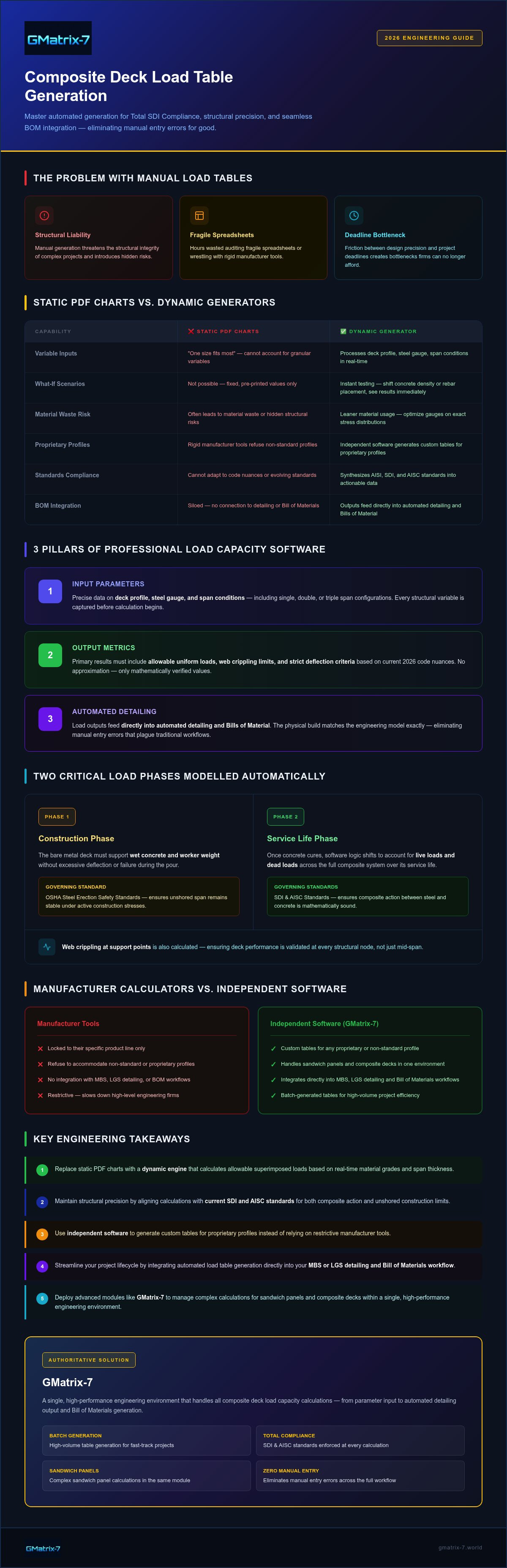
- Replace static PDF charts with a dynamic engine that calculates allowable superimposed loads based on real-time material grades and span thickness.
- It's essential to maintain structural precision by aligning calculations with current SDI and AISC standards for both composite action and unshored construction limits.
- Use independent composite deck load capacity software to generate custom tables for proprietary profiles instead of relying on restrictive manufacturer tools.
- Streamline your project lifecycle by integrating automated load table generation directly into your MBS or LGS detailing and Bill of Materials workflow.
- Deploy advanced modules like GMatrix-7 to manage complex calculations for sandwich panels and composite decks within a single, high-performance engineering environment.
What is a Composite Deck Load Table Generator?
A composite deck load table generator is a high-performance calculation engine designed to bridge the gap between structural theory and site execution. It functions as a sophisticated software interface that calculates allowable superimposed loads based on specific variables like span length, metal thickness, and material grade. In the high-velocity construction environment of 2026, relying on static PDF charts is a strategic failure. These legacy documents are insufficient for modern fast-track projects because they cannot account for the granular variables that define high-performance builds. Utilizing advanced composite deck load capacity software allows engineers to move beyond manual look-ups and embrace dynamic, parameter-driven data generation. This transition is the foundation of Total Structural Compliance, ensuring every deck profile meets rigorous safety standards without the inefficiency of over-engineering.
The Shift from Static Tables to Dynamic Generators
Static tables assume a vacuum. They provide a "one size fits most" approach that often leads to material waste or hidden structural risks. Dynamic generation allows for rigorous what-if scenario testing during the design phase. You can instantly see how a shift in concrete density or a subtle change in rebar placement alters the load outcome. This level of precision is vital when applying composite construction principles to complex, multi-story structures. A professional load table generator is a specialized tool that synthesizes AISI and SDI standards into actionable data, ensuring your structural integrity is never left to approximation. By calculating these values in real-time, firms can optimize their designs for the specific demands of the project rather than settling for the limitations of a pre-printed chart.
Core Components of a Professional Generator
To achieve engineering excellence, the software must process a sophisticated array of inputs to produce high-fidelity outputs. Professional-grade composite deck load capacity software focuses on three primary pillars of data:
- Input Parameters: The engine requires precise data on the specific deck profile, steel gauge, and span conditions, including single, double, or triple span configurations.
- Output Metrics: The primary results must include allowable uniform loads, web crippling limits, and strict deflection criteria based on 2026 code nuances.
- Automated Detailing: These metrics don't exist in isolation. In an integrated environment like GMatrix-7, these outputs feed directly into automated detailing and Bills of Material.
This integration ensures that the physical build matches the engineering model exactly. Automation eliminates the manual entry errors that frequently plague traditional workflows. It's about more than just speed; it's about the security that comes from a data-driven, error-free process.
The Engineering Logic of Automated Load Capacity Calculation
Precision in composite deck engineering requires a rigorous adherence to SDI (Steel Deck Institute) and AISC standards. Automated calculations aren't just about speed; they ensure the composite action between steel and concrete is mathematically sound. High-performance composite deck load capacity software eliminates the guesswork by modeling the mechanical bond created by deck embossments. This precise modeling transforms a simple metal sheet into a structural diaphragm capable of bearing significant superimposed loads. By synthesizing complex inputs into a single, cohesive model, the software ensures that every square foot of the floor system performs as intended under peak stress.
A critical distinction exists between construction phase loads and long-term service loads. During the pour, the bare metal deck must support wet concrete and worker weight without excessive deflection or failure. This phase is governed by OSHA steel erection safety standards, which ensure that the unshored span remains stable under active construction stresses. Once the concrete cures, the software shifts its logic to service life loads, factoring in live loads and dead loads across the full composite system. This capability-to-outcome pattern allows for leaner material usage, as engineers can optimize gauges based on exact stress distributions rather than vague safety margins. Addressing web crippling at support points is equally vital. The software calculates concentrated load distribution to prevent localized buckling, ensuring the integrity of the entire span.
SDI and AISI Compliance in 2026
Navigating the latest AISI S100 standards for cold-formed steel design is a complex task that leaves no room for manual error. Automated compliance checks are far superior to manual verification because they provide instant validation for IBC approval. This rigorous approach is particularly vital when working with light-gauge systems. Engineers seeking to master these nuances often utilize LGS structural design software to bridge the gap between AISI requirements and real-world application. These tools ensure that every calculation meets the most current global standards for structural safety.
Factoring Superimposed Loads and Deflection
Calculations must distinguish between dead loads, live loads, and long-term superimposed loads to prevent structural fatigue. Modern generators handle L/360 or L/240 deflection limits automatically, flagging any span that exceeds allowable tolerances. This automation is essential for high-specification floor systems where vibration analysis is a primary concern. By integrating these parameters early, you can ensure a stable, quiet floor that exceeds client expectations. If you're ready to optimize your next project, exploring the advanced engineering modules within GMatrix-7 provides the precision required for world-class results.
Manufacturer Calculators vs. Independent Engineering Software
Manufacturer-provided calculators often present a seductive but limiting proposition. These brand-locked tools are designed to facilitate the sale of specific products rather than provide a holistic engineering solution. In contrast, independent composite deck load capacity software like GMatrix-7 offers a versatile, battle-tested engine that operates with absolute structural neutrality. This independence is a critical asset for firms that prioritize data ownership and cross-platform flexibility. By investing in a standalone system, you secure a robust structural design environment that remains functional regardless of manufacturer server status or third-party tool updates. It's about maintaining a gold standard in engineering documentation without being tethered to a single supplier's ecosystem.
The Limitations of Proprietary Web Tools
Proprietary web tools frequently harbor hidden biases toward the manufacturer's most profitable solutions rather than the most structurally efficient ones. This lack of transparency can lead to over-engineered designs that inflate project costs and material waste. Storing critical engineering data on third-party servers also leaves your project timeline vulnerable to external outages or tool deprecation. Most importantly, these tools fail to integrate with professional structural design automation workflows. This disconnect creates manual data silos that slow down the transition from design to detailing, introducing unnecessary friction into your professional workflow.
Why Custom Profile Generation Wins
Independent software empowers you to generate load tables for any profile, including unique geometries for sandwich panels or single-skin cladding. This capability is indispensable for fabricators who need to produce their own certified load catalogs for non-standard or proprietary products. It allows you to maintain strict compliance with OSHA steel erection safety standards while optimizing the deck for specific site conditions. You gain the ability to input custom parameters that manufacturer tools simply don't support, such as unique embossment patterns or non-standard steel grades.
Batch processing is another high-value advantage of independent engines. Instead of entering data for every single span manually, you can generate comprehensive tables across entire product lines in seconds. This speed doesn't compromise accuracy; it enhances it by applying a consistent, data-driven logic to every calculation. Owning your engineering engine means owning your outcomes. It provides the peace of mind that comes from knowing your structural documentation is the product of rigorous, independent verification rather than a manufacturer's sales algorithm. This level of control is what separates industry leaders from those merely following a pre-set path.
Integrating Load Tables into the Detailing and BOM Workflow
The transition from engineering calculation to physical fabrication is often where projects falter due to manual data re-entry. High-performance composite deck load capacity software eliminates this vulnerability by creating a seamless data thread from the initial design to the final Bill of Materials (BOM). This integrated approach ensures that every span limit and load requirement identified during the engineering phase is preserved in the detailing phase. By automating this data transfer, firms eliminate the manual re-entry error trap that frequently leads to costly on-site modifications and structural non-compliance. Utilizing advanced composite deck load capacity software allows you to bridge this gap with absolute precision.
A professional workflow follows a methodical four-step progression to ensure structural excellence:
- Step 1: Define structural parameters within the MBS or LGS module, including deck geometry and material properties.
- Step 2: Execute the load table generator to establish maximum span limits based on the project's specific superimposed loads.
- Step 3: Auto-populate approval drawings with precise technical data, ensuring the visual representation matches the underlying math.
- Step 4: Export the Bill of Materials (BOM) directly from the validated design to guarantee procurement accuracy.
Automating Approval Drawings and Material Lists
Technical documentation should be a byproduct of design, not a separate manual task. When load table data flows directly into your drawings, you provide a clarity that drastically reduces the RFI cycle. Clearer engineering data means fewer questions from the field and faster approvals from regulatory bodies. This efficiency is a primary reason why firms are moving away from generic CAD tools in favor of specialized software for steel detailing. These advanced systems ensure every material list is backed by a validated load table, providing a security that manual processes simply cannot match.
Material Optimization and Waste Reduction
Project profitability is often decided in the detailing phase. By using precise load tables, you avoid the common pitfall of over-engineering, which leads to excess steel usage and inflated costs. Accurate detailing ensures you use exactly what is required for structural safety, no more and no less. GMatrix-7 streamlines the engineering-to-fabrication pipeline by linking these critical phases in a single environment. This cohesion is the driver of modern industrial progress, turning complex data into high-value results. If you are ready to optimize your procurement and detailing, you can explore the GMatrix-7 MBS and LGS modules to see this integration in action.
GMatrix-7: The Authoritative Solution for Load Table Generation
GMatrix-7 stands as the definitive standard for engineering firms that refuse to compromise on structural precision. It's the premier choice for MBS IBC design software and OWSJ (SJI) engineering, providing a level of depth that generic web tools cannot replicate. This high-performance composite deck load capacity software serves as a guardian of safety for global structural projects, ensuring every calculation withstands the most rigorous scrutiny. Whether you're generating load tables for single skin, sandwich panels, or complex composite decks, the system delivers a seamless transition from technical complexity to operational simplicity. It's a world-class engine built for those who value excellence and demand a battle-tested solution for their most critical infrastructure projects.
Unified Modules for MBS, OWSJ, and LGS
The core strength of this ecosystem lies in its unified architecture. Having a single source of truth for all structural steel components eliminates the fragmentation that plagues traditional engineering workflows. You achieve absolute consistency in reporting and documentation, regardless of whether you're analyzing a metal building system or a light-gauge structure. The OWSJ module ensures SJI compliant joist design while simultaneously coordinating with deck analysis, creating a synchronized model that reflects real-world conditions. This cross-module synergy is what allows fabricators and engineers to produce world-class results with significantly reduced manual oversight. It's about creating a cohesive technical environment where every input feeds a larger, more accurate structural narrative.
Future-Proofing Your Engineering Firm
Staying ahead of code cycles is a commercial necessity, not a luxury. GMatrix-7 ensures you remain compliant with IBC 2024 and upcoming 2026 standards through automated updates that reflect the latest global engineering nuances. Partnering with a technologically advanced developer like Dr. Simon B. provides the stability and innovation required to dominate the 2026 market. This isn't just about purchasing a license; it's about adopting a battle-tested structural design engine that evolves alongside the industry.
Securing a GMatrix-7 license positions your firm as an authoritative leader, ready to tackle the most demanding projects with absolute confidence. You gain the ability to generate comprehensive Bill of Materials and professional approval drawings that set the standard for clarity and accuracy. It's time to transition from fragmented, unreliable tools to a unified ecosystem that prioritizes excellence above all else. By integrating these advanced modules into your workflow, you ensure that your firm remains at the cutting edge of industrial progress and structural safety.
Mastering Structural Precision in 2026
The transition from manual look-up tables to dynamic, automated generation represents a fundamental shift in structural engineering. By moving away from restrictive manufacturer tools, you gain total control over your data and the ability to generate custom profiles for any project. Integrating these calculations directly into your detailing and Bill of Materials workflow eliminates the manual re-entry errors that threaten project timelines and profitability. Modern firms are increasingly turning to composite deck load capacity software to secure their competitive edge and ensure absolute structural precision in every build.
GMatrix-7 provides the authoritative framework needed to dominate this high-stakes environment. Featuring SJI and AISI compliant design modules and automated approval drawing generation, it's the engine of choice for leading global structural fabricators. You can now optimize your structural workflows with the GMatrix-7 load table generator to achieve unparalleled accuracy and speed. Adopting this unified ecosystem ensures your firm remains a pioneer in industrial progress. It's time to embrace the future of automated engineering and lead your team toward a new, world-class standard of excellence.
Frequently Asked Questions
What is the difference between a composite deck and a non-composite deck load table?
A composite deck load table accounts for the mechanical bond between the steel decking and cured concrete, utilizing embossments to facilitate shear transfer. Non-composite tables only evaluate the structural capacity of the bare metal deck. Composite systems generally allow for much higher superimposed loads because the two materials function as a single structural unit. This distinction is critical for engineers who need to optimize floor systems for high-specification commercial builds.
How does a load table generator handle unshored construction spans?
The generator calculates the bare metal deck's capacity to support the weight of wet concrete and active construction loads before the slab cures. It analyzes these unshored conditions to prevent excessive deflection or structural failure during the pouring process. By establishing these limits automatically, the software ensures site safety and eliminates the need for costly temporary supports. This calculation is a vital component of professional structural design and risk management.
Can I generate load tables for custom sandwich panel profiles?
You can generate load tables for proprietary sandwich panel profiles by inputting unique geometry, core density, and skin thickness into the system. Unlike manufacturer-locked tools, this software provides the flexibility to model non-standard configurations. This capability is essential for fabricators who develop custom cladding or roofing systems that must meet specific thermal and structural performance criteria. It ensures your proprietary products are backed by rigorous, code-compliant engineering data.
Is GMatrix-7 software compliant with SJI 100-2020 standards?
GMatrix-7 is fully compliant with SJI 100-2020 standards via its dedicated OWSJ (SJI) module. The software provides authoritative design and detailing for bar joists, ensuring every calculation adheres to the latest Steel Joist Institute requirements. This rigorous compliance is necessary for securing IBC approval and maintaining the structural integrity of metal building systems. It provides engineers with the security that their joist and deck designs meet all current safety regulations.
How does automated load table generation reduce material waste?
Automated generation allows you to determine the exact steel gauge and span configuration required for a specific load, preventing the waste associated with over-engineering. Instead of relying on broad safety margins, the software uses precise math to identify the most efficient material usage. This data-driven approach reduces the total weight of steel required for a project. It's a high-value strategy for improving project profitability while maintaining absolute structural excellence.
What inputs are required to generate a professional composite deck load table?
Generating a professional table requires inputs like deck profile geometry, steel gauge, material yield strength, and concrete density. You also need to define span conditions and the specific superimposed loads the system must support. Using sophisticated composite deck load capacity software ensures these variables are processed through a validated engineering engine. This results in precise output metrics, including allowable uniform loads and web crippling limits, which are essential for structural documentation.
Does the software support both US and Canadian structural codes?
The software supports the latest IBC and AISI standards, providing the flexibility needed for projects across North America. It handles the specific nuances of US structural codes and can be adjusted for regional requirements as needed. This global engineering scope allows firms to maintain a consistent workflow regardless of project location. It ensures that your load tables and structural designs are always compliant with the governing regulations of the local jurisdiction.
How do I integrate generated load tables into my approval drawings?
You can integrate tables by utilizing the automated export features within the composite deck load capacity software environment. This data flows directly into the approval drawing module, auto-populating technical schedules with validated engineering metrics. It removes the risk of manual entry errors and ensures your technical documentation is perfectly synchronized with the structural design. This seamless integration accelerates the RFI cycle and provides clearer data for fabricators and site inspectors.


