
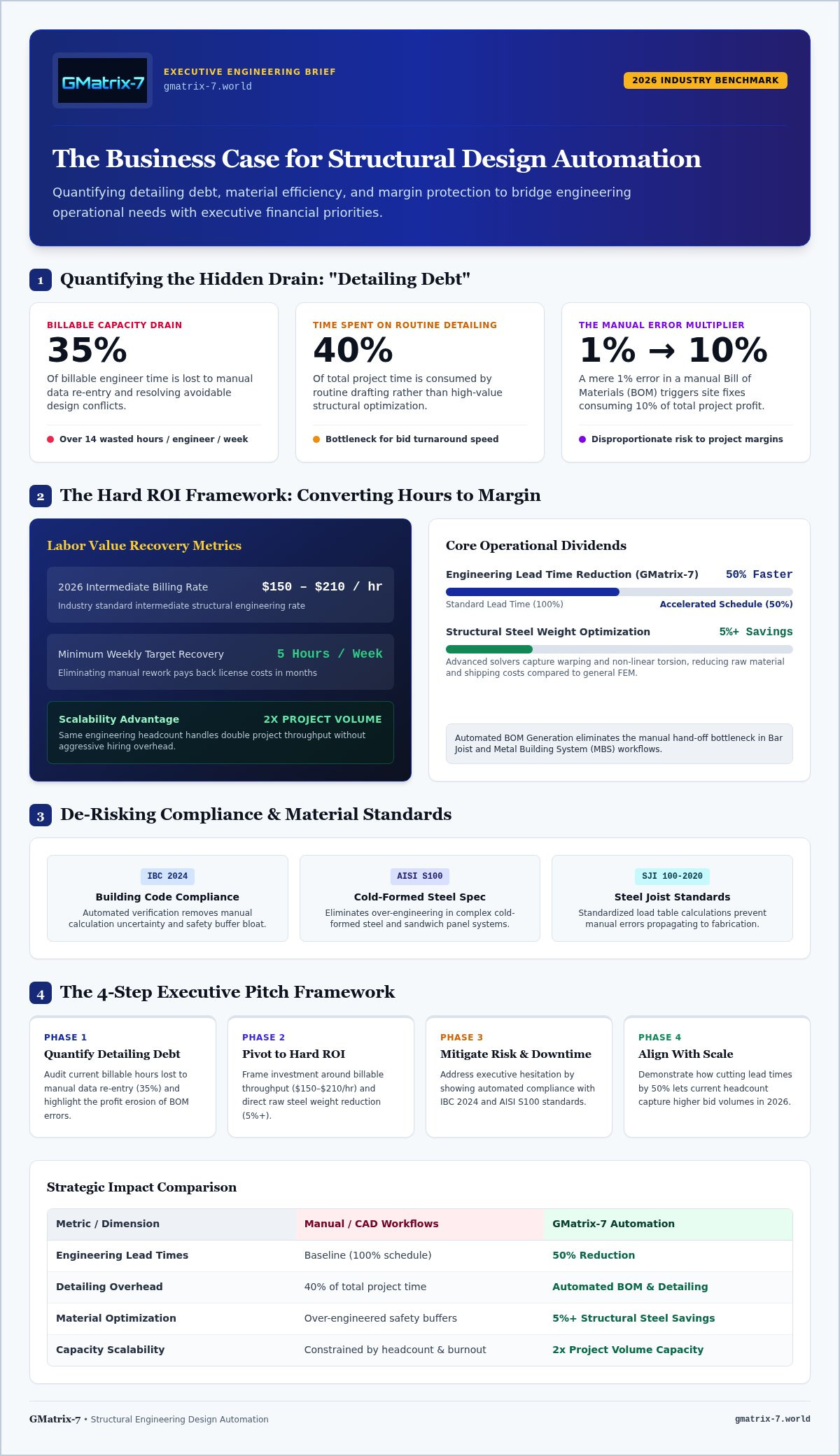
The average structural engineer loses 35% of their billable time to manual data re-entry and resolving avoidable design conflicts. That represents over 14 hours per week of wasted expertise that could be spent on high-value optimization. You likely recognize that manual calculation errors and slow turnaround times are costing your firm more than just lost bids; they're driving away your best talent through sheer burnout.
Mastering the art of convincing management to invest in engineering software requires shifting the conversation from technical features to measurable margin protection. This article delivers a strategic framework to transform your operational needs into a compelling business case that secures executive approval for advanced automation. We'll provide the tools to bridge the gap between engineering requirements and C-suite financial priorities.
We'll explore how to quantify the recovery of unbilled labor hours and demonstrate how specialized tools like GMatrix-7 reduce engineering lead times by 50%. You'll learn to present a data-driven argument that highlights material savings and risk mitigation. This methodical approach ensures your firm remains a leader in the competitive 2026 market while maintaining the highest standards of structural integrity.
Key Takeaways
- Identify and quantify "detailing debt" to demonstrate how manual drafting and BOM inaccuracies drain your project's profitability and engineering capacity.
- Master a results-oriented framework for convincing management to invest in engineering software by pivoting from technical features to hard ROI metrics.
- Address executive concerns regarding implementation downtime by highlighting the risk mitigation benefits of automated compliance with IBC 2024 and AISI S100 standards.
- Execute a structured four-step pitch that prioritizes the bottom line, ensuring your request for automation tools doesn't conflict with high-level corporate strategy.
- Learn how specialized ecosystems like GMatrix-7 eliminate the manual bottleneck, reducing lead times by 50% while optimizing material usage through automated BOM generation.
Quantifying the Hidden Costs of Manual Engineering Workflows
Manual workflows in structural engineering create a silent drain on profitability known as detailing debt. When your team relies on manual drafting, they spend approximately 40% of project time on routine detailing rather than high-level design optimization. This inefficiency isn't just a technical hurdle; it's a financial liability that compounds with every project. When you begin developing a formal business case, you must highlight that a mere 1% error in a Bill of Materials (BOM) can trigger site fixes that consume 10% of total project profit. These hidden costs make convincing management to invest in engineering software a matter of firm survival.
Beyond direct costs, consider the opportunity cost of your current bottleneck. If your engineers are buried in repetitive detailing, they aren't submitting new bids. Every unsubmitted bid represents thousands in potential revenue left on the table for faster competitors. Additionally, the high staff turnover seen in 2026 is often a direct result of burnout from these repetitive, low-value tasks. Replacing a senior structural engineer costs significantly more than the annual license for an automation tool, yet many firms continue to ignore this retention crisis.
The Reality of Error-Prone Documentation
Manual load table generation for composite decks or sandwich panels often leads to over-engineering. Engineers frequently add excessive safety buffers to compensate for manual calculation uncertainty, which results in massive material waste. This approach also increases the risk of non-compliance with the latest IBC 2024 or SJI 100-2020 standards. The Manual Error Multiplier is the exponential increase in cost that occurs when a single drafting oversight propagates through fabrication and onto the construction site.
Benchmarking Your Current Throughput
To build your case, you must measure your current Time-to-Approval for complex Metal Building Systems (MBS). Analyze the specific bottlenecks in your Bar Joist detailing workflows where manual hand-offs occur. You'll likely find hundreds of invisible hours spent on manual material lists that never appear in project schedules but consistently delay delivery. Identifying these gaps is the first step in convincing management to invest in engineering software that automates these high-risk touchpoints. Transitioning from CAD-heavy workflows to specialized structural design automation isn't just about speed; it's about reclaiming the precision required for modern global standards.
Building a Data-Driven ROI Case for Structural Automation
Management often perceives new software as a high-capital expenditure, yet a data-driven approach reframes it as a margin-protection asset. Transitioning from "soft ROI" arguments, such as improved user experience, to "hard ROI" metrics like increased billable throughput is essential. By utilizing data-driven investment analysis methods, you can demonstrate exactly how specialized licenses pay for themselves within months. In the 2026 market, where intermediate engineering billing rates average $150 to $210 per hour, recovering even five hours of manual rework per week generates thousands in annual value per engineer.
The most compelling financial lever is material optimization. Advanced solvers capture warping and non-linear torsion effects, often reducing total structural steel weight by 5% or more compared to general-purpose FEM tools. For high-volume fabricators, this translates into massive savings in raw material costs and shipping logistics. Convincing management to invest in engineering software becomes a simple mathematical exercise when you prove that the same headcount can handle twice the project volume. This scalability allows the firm to leverage professional structural design automation to capture market share without the overhead of aggressive hiring.
Efficiency Gains in MBS and OWSJ Projects
The speed differential between CAD vs specialized software for steel detailing is staggering. While traditional CAD workflows require manual drafting for every approval drawing, specialized automation generates complete drawing sets in minutes. This acceleration is particularly impactful for SJI compliant joist design, where automated compliance checks reduce manufacturing lead times significantly. Furthermore, using a specialized composite deck load table generator eliminates days of manual spreadsheet verification, allowing for instant technical documentation that meets global standards. These rapid outputs ensure your firm wins more bids by providing the fastest accurate quotes in the industry.
The 'Material List' Profit Multiplier
Automated BOM generation serves as a profit multiplier by eliminating the "buffer" material typically ordered to cover manual counting errors. In Light Gauge Steel (LGS) and metal building projects, precision detailing ensures that every member is accounted for with zero waste. This accuracy reduces the labor hours spent on manual material reconciliation and prevents costly site delays. Implementing automated design solutions ensures that your technical documentation is as precise as the final fabricated product, protecting your project margins from the first calculation to the final bolt.
Overcoming Management Objections: Risk, Compliance, and Training
Management's hesitation often stems from a fear of operational disruption rather than a lack of belief in the technology's potential. To address the implementation lag, you must present a strategy for a zero-downtime rollout. This involves phased integration where automation tools run parallel to existing workflows on non-critical path projects first. By demonstrating a methodical transition, you neutralize the objection that new software will paralyze current production. When pitching new technology to leadership, emphasize that specialized structural tools offer a level of reliability that generic CAD add-ons cannot match. Specialized vendors provide the security and precision required for high-stakes industrial applications.
Compliance represents a formidable competitive edge in the 2026 regulatory environment. Modern software ensures direct adherence to IBC 2024 and AISI S100 standards out of the box, shielding the firm from the risks of manual oversight. Waiting until 2027 to modernize will likely double your technical debt as competitors adopt these standards to win high-stakes contracts. Convincing management to invest in engineering software today is an exercise in future-proofing. It protects the firm's reputation and ensures that your output remains the industry gold standard while others struggle with manual updates.
Mitigating the Learning Curve
A successful transition requires protecting active project deadlines through phased implementation plans. By automating documentation, you allow junior engineers to produce professional-grade outputs faster; this effectively shortens their onboarding period. Automation captures senior-level expertise within the software logic, ensuring consistency across the entire team. Leveraging specialized vendor support reduces the burden on internal IT departments, allowing them to focus on core infrastructure rather than troubleshooting specialized engineering modules. This approach turns a potential training hurdle into a streamlined professional development opportunity.
Legal and Regulatory Risk Management
Automated structural analysis significantly reduces professional liability insurance risks by eliminating common manual calculation errors. Ensuring SJI 100-2020 compliance for bar joist manufacturing is no longer a manual checklist task but a built-in software feature. When convincing management to invest in engineering software, compare the nominal cost of a license against the catastrophic expense of a regulatory audit or a structural failure. The peace of mind provided by rigorous, data-driven compliance is an invaluable asset for any risk-averse executive team. Investing in accuracy is the most effective way to safeguard the firm's long-term stability.
The Step-by-Step Framework for a Successful Software Pitch
A successful pitch isn't about technical features; it's about business outcomes. To secure approval, you must follow a methodical presentation structure that aligns with executive priorities. Start with a concise Executive Summary that leads with the bottom line: how much profit is currently being lost and how much can be recovered. By convincing management to invest in engineering software through a financial lens, you position yourself as a business-minded strategist rather than just a technical lead. This approach ensures your proposal is viewed as a profit-generating initiative rather than a simple IT expense.
Next, define the Problem Statement using the internal "hidden cost" data identified in your benchmarking. Be specific about manual bottlenecks and the resulting "detailing debt" mentioned previously. Once the pain is clear, present the Solution as a strategic asset. Highlight how specialized modules for MBS, OWSJ, and LGS eliminate these specific friction points. The Financials step is where you provide the hard evidence: the payback period, projected ROI, and material savings. Finally, conclude with an Implementation Roadmap. Proving you have a plan for a phased rollout removes the fear of operational downtime and solidifies your case for investment.
Speaking the Language of the C-Suite
Executives don't buy "load table generation"; they buy market responsiveness. When presenting your case, translate technical capabilities into commercial advantages. "Automated detailing" should be described as "increased billable capacity" that allows the firm to take on more projects without adding overhead. Shift the focus from technical features to risk mitigation. Highlighting how automation prevents litigation and compliance audits speaks directly to the primary concerns of leadership. This linguistic shift is critical for convincing management to invest in engineering software while maintaining a focus on long-term stability.
Visualizing the Impact
Data is more persuasive when it's visual. Use "Before and After" workflow diagrams to show the dramatic reduction in manual touchpoints for approval drawings. A 12-month ROI projection chart can clearly illustrate the point where the software pays for itself and begins generating pure profit. Don't forget to mention the competitive landscape. If your competitors are already automating their workflows, your firm is effectively falling behind in speed and accuracy. Visualizing this gap creates a sense of commercial urgency that prompts immediate action. To begin building your firm's competitive edge, request a demonstration of the GMatrix-7 automation suite.
Strategic Advantage: Why GMatrix-7 is the Executive Choice
GMatrix-7 represents the pinnacle of structural design technology, serving as the global gold standard for MBS IBC design software. It's a comprehensive ecosystem that integrates specialized modules for LGS, OWSJ, and Bar Joists into a single, high-performance platform. This integration eliminates the fragmented workflows that cause the detailing debt discussed in previous sections. When convincing management to invest in engineering software, you aren't just pitching a license; you're proposing a partnership with an industry leader in engineering automation expertise. It's a strategic move that transforms your department into a world-class entity.
The complexity of cold-formed steel requires more than generic CAD tools. The precision offered by GMatrix-7's LGS structural design software ensures that every thin-walled section is optimized for both safety and material efficiency. This specialized focus provides the technical validation required for convincing management to invest in engineering software that prioritizes both safety and profitability. By adopting this technology, you provide your team with the capability to achieve high-level excellence while maintaining a bold, ambitious stance in the global market.
Total Engineering Automation
GMatrix-7 delivers a seamless transition from complex structural inputs to streamlined outputs, handling the entire workflow from initial design to final Bill of Materials generation. The software's load table generators for sandwich panels and composite decks provide accuracy in minutes rather than days, directly supporting IBC 2024 and SJI 100-2020 standards. This level of precision is essential for maintaining global compliance and reducing professional liability. It transforms the engineering department into a driver of industrial progress, ensuring every project meets the most rigorous safety benchmarks through a methodical, data-driven process.
Taking the Next Step
To move from strategy to execution, schedule a proof-of-concept demonstration specifically tailored for your management team. This session will illustrate how the software addresses your firm's unique bottlenecks and specific project types. You can also request a custom ROI analysis based on your specific project volume to solidify the financial justification for the transition. By taking this step, you join the ranks of elite global fabricators who use GMatrix-7 to dominate the market through superior speed and accuracy. It's time to secure your firm's future as a technologically advanced and fundamentally stable partner in the structural steel industry.
Securing Your Firm’s Competitive Future
The transition from manual detailing to automated structural design is no longer a luxury; it's a fundamental requirement for maintaining industrial relevance. By quantifying detailing debt and presenting a data-driven ROI case, you transform technical needs into a powerful commercial mandate. Success in convincing management to invest in engineering software hinges on your ability to link automation directly to margin protection and risk mitigation. You've established the groundwork for a more profitable, compliant, and efficient engineering department.
GMatrix-7 provides the rigorous framework necessary to meet IBC 2024, AISI S100, and SJI 100-2020 standards while eliminating the manual bottlenecks that stifle growth. Leading global structural fabricators already utilize these specialized modules to eliminate material waste and maximize billable capacity. You now possess the strategic framework to lead your firm toward a new era of optimized production and intellectual rigour. It's time to replace repetitive manual tasks with high-level design excellence and reclaim your team's valuable time.
Schedule a GMatrix-7 Executive Demo to secure your 2026 budget approval and begin the journey toward total engineering automation. Your firm is ready to achieve world-class results.
Frequently Asked Questions
How long does it typically take to see an ROI on engineering software?
Most firms realize a full return on investment within three to six months. When you're convincing management to invest in engineering software, focus on the immediate recovery of unbilled labor. If an intermediate engineer bills at $180 per hour, saving just 14 hours of manual rework per week generates over $125,000 in annual value. This rapid payback period transforms the software from a capital expense into a high-yield operational asset.
What is the biggest mistake engineers make when pitching to management?
The most frequent error is focusing on technical features rather than commercial outcomes. Executives prioritize margin protection, risk mitigation, and billable capacity over specific software solvers or interface aesthetics. Instead of explaining how the warping torsion solver works, demonstrate how it reduces raw steel tonnage by 5%. Shifting the narrative toward market responsiveness and competitive advantage is the most effective strategy for convincing management to invest in engineering software.
Can specialized software like GMatrix-7 integrate with our existing CAD tools?
GMatrix-7 is engineered to eliminate the manual friction often found in generic CAD environments. It automates the generation of approval drawings and fabrication details directly from the structural design data. This ensures that your output remains consistent with global industry standards while removing the detailing debt associated with manual drafting. The software acts as a specialized layer that transforms complex inputs into high-precision technical documentation without requiring manual CAD post-processing.
Is it better to buy a comprehensive suite or individual modules for MBS and LGS?
A comprehensive suite provides the greatest ecosystem synergy by connecting design, analysis, and BOM generation in a single loop. However, individual modules for MBS (IBC) or LGS (AISI) allow for a phased implementation that minimizes operational risk. Choosing an integrated ecosystem ensures that data flows seamlessly between different structural types. This prevents the siloing that occurs when firms use disconnected point solutions for different project categories.
How does automated BOM generation specifically reduce project costs?
Automated Bill of Material generation eliminates the buffer material typically ordered to compensate for manual counting errors. By providing an exact material count in minutes, the software prevents costly site fixes and over-ordering. This precision directly impacts the bottom line by reducing raw material waste and shipping costs. It also reclaims hundreds of engineering hours otherwise spent on tedious manual reconciliation, allowing your team to focus on high-value design optimization.
What are the risks of continuing with manual detailing in 2026?
Continuing with manual detailing in 2026 exposes your firm to significant regulatory and commercial risks. You face increased professional liability if calculations don't meet the latest IBC 2024 or SJI 100-2020 standards. Additionally, manual workflows are too slow to compete with firms using 7D automation solvers. This leads to lost bids, reduced project margins, and high staff turnover as engineers burn out from repetitive, low-value drafting tasks.
Does GMatrix-7 support the latest 2024 IBC and SJI standards?
Yes, GMatrix-7 provides direct, out-of-the-box compliance with IBC 2024, SJI 100-2020, and AISI S100 standards. This built-in regulatory adherence shields the Engineer-of-Record from audit risks and litigation. As codes evolve, the software updates its internal logic to ensure your designs remain at the gold standard of global safety. This automated compliance is a primary selling point when justifying the investment to risk-averse executive leadership teams.
How do we handle training for our engineering team without losing billable hours?
We recommend a phased implementation strategy that protects your active project deadlines. GMatrix-7's automated documentation features actually help junior engineers produce professional-grade outputs faster, effectively shortening their onboarding period. By leveraging our expert support team, you reduce the internal IT burden and ensure a smooth transition. This methodical approach allows your team to gain proficiency without sacrificing billable hours or compromising project delivery schedules.


