

In 2026, a manual structural engineering quality control checklist isn't just an outdated tool; it's a liability that invites catastrophic rework and compliance failure. You've likely felt the mounting pressure of evolving IBC and SJI standards while wrestling with manual review processes that bottleneck project timelines. The anxiety of discovering a detailing error after fabrication has already begun is a burden no lead engineer should carry. It's a high-stakes environment where even a minor oversight in OWSJ or LGS specifications leads to significant material waste and delayed approvals.
Mastering these essential quality control protocols is the only way to eliminate manual errors and ensure total IBC, SJI, and AISI compliance. This article provides a standardized QC framework designed for the modern engineering landscape. We'll examine how to integrate automated validation into your design workflow to secure faster approval drawing turnaround times and optimize your bill of material accuracy. By moving from fragmented checks to a rigorous, data-driven system, you'll gain the professional confidence that every output meets the highest global standards for safety and precision.
Key Takeaways
- Shift from reactive manual reviews to proactive software validation to handle the precision requirements of modern MBS and joist projects.
- Implement a rigorous structural engineering quality control checklist that anchors every project in total IBC, AISI, and SJI regulatory compliance.
- Neutralize common failure points in complex connections by establishing automated "Check-Gates" at critical design milestones.
- Eliminate manual entry errors and reduce material waste through the automated generation of precise Bills of Material and approval drawings.
- Secure a competitive advantage by delivering zero-error load tables and documentation that accelerate project approval timelines.
The Evolution of Structural Engineering Quality Control in 2026
Structural engineering is undergoing a fundamental shift. By 2026, the industry has moved decisively from reactive correction toward proactive software validation. Traditional manual checklists are no longer adequate for the sheer complexity of modern MBS projects. These legacy methods fail to capture the intricate interdependencies of high-performance buildings, leading to late-stage discoveries that threaten project viability. The widespread adoption of IBC 2024 standards across jurisdictions has heightened engineering accountability, making a digital structural engineering quality control checklist an absolute necessity for compliance.
Defining the 'Gold Standard' for digital structural documentation requires a move toward integrated validation. It's no longer enough to check a box at the end of a project. Quality control must exist as a persistent layer throughout the design phase. This evolution ensures that every deliverable, from OWSJ detailing to LGS specifications, aligns with the most current safety and performance requirements without slowing down the production cycle.
The Cost of Detailing Errors in Modern Fabrications
A single detailing error in a shop drawing triggers a cascading failure of costs. It begins with incorrect fabrication, leading to immediate material waste and logistical bottlenecks. In the 2026 market, these errors directly impact project ROI. Beyond the balance sheet, detailing mistakes erode the trust between engineers and fabricators. Implementing a standardized structural engineering quality control checklist within an automated environment provides the psychological benefit of certainty. It allows teams to operate with professional confidence, knowing that structural engineering principles are enforced at every connection point.
Transitioning to a Data-Driven QC Mindset
Relying on "gut feeling" reviews is a liability that modern firms can't afford. The industry is transitioning to a data-driven mindset where every design decision is backed by algorithmic validation. Professional structural design automation, such as GMatrix-7 / MBS (IBC), has become the new industry baseline. This technology reduces human-error margins by automating the most tedious aspects of the review process. The benefits of this transition are clear:
- Standardized inputs lead to predictable, high-quality outputs.
- Automated compliance checks against AISI and SJI standards are applied instantly.
- Significant reduction in manual review time accelerates project timelines.
Moving beyond manual oversight isn't just an efficiency play. It's a commitment to excellence that separates market leaders from those struggling with rework and delays. By anchoring the workflow in data, engineers ensure that precision is built into the project from the very first input.
The Comprehensive Structural Design QC Checklist Pillars
Engineering excellence isn't an accident. It's the result of a systematic structural engineering quality control checklist that leaves nothing to chance. While many firms rely on generic oversight, market leaders in 2026 utilize a four-pillar framework designed for specialized steel systems. This approach moves beyond simple observation to provide a rigorous validation of every design decision. These pillars ensure that high-complexity projects, from Metal Building Systems (MBS) to Open Web Steel Joists (OWSJ), transition from digital models to physical structures without technical friction.
Code Compliance and Standard Adherence
Compliance is the primary pillar of any professional review. You must verify IBC 2024 requirements for Metal Building Systems to prevent jurisdictional delays and ensure occupant safety. For joist detailing, strict adherence to SJI 100-2020 is non-negotiable for all OWSJ bar joist specifications. When working with light gauge materials, utilize GMatrix-7 / LGS (AISI) to ensure your modules meet the latest AISI S100 standards. This level of technical rigor eliminates the "compliance anxiety" that often bottlenecks project timelines during the final approval phase.
Load Table and Capacity Verification
Precision in load table generation is the difference between structural integrity and catastrophic failure. You must confirm load table accuracy for both sandwich panels and single skin cladding, accounting for project-specific environmental variables. Validating composite deck load tables against unique constraints is equally vital to ensure long-term performance. This meticulous process mirrors the standards found in a structural engineering QA review checklist, which prioritizes load path verification and thermal restraint parameters. Verifying deflection limits early in the design phase prevents costly field modifications later.
Automated Bill of Materials (BOM) Integrity
Documentation integrity is where engineering capability meets commercial outcome. Automated BOM generation removes the human factor that often leads to material shortages or overages. You should cross-reference material lists with approval drawings to ensure zero discrepancy across all project files. When you automate your design workflow, you validate steel material lists against actual fabrication capabilities. This level of precision ensures exact counts for every fastener and structural connector. By anchoring your structural engineering quality control checklist in automated data, you reduce material waste and protect the project's bottom line.
Mitigating Risk in MBS and Joist Detailing Workflows
Identifying common failure points in Metal Building Systems (MBS) is the primary step toward achieving zero-error fabrication. Most structural risks emerge at complex connections where manual detailing often overlooks subtle geometric conflicts or load path discontinuities. Automated detailing through GMatrix-7 / MBS (IBC) reduces the human factor by enforcing consistent design logic across the entire project. This systematic approach ensures that every connection is battle-tested before a single piece of steel is cut. It transforms the engineering process from a series of manual guesses into a rigorous, data-driven operation.
A frequent industry objection suggests that automated tools act as a "black box" that hides critical engineering decisions. High-level platforms solve this by providing transparent, verifiable data outputs that engineers can audit with ease. Peer-review protocols remain a cornerstone of excellence, ensuring that automated documentation undergoes rigorous validation. Integrating a comprehensive structural engineering QA review checklist ensures that every automated output aligns with established safety standards. This hybrid approach of software precision and professional oversight creates a reliable safety net for high-stakes projects.
Precision in Steel Joist Detailing
Accuracy in OWSJ design requires a focused review of web and chord member alignment. You must verify that end-seat depths and bearing requirements meet the specific demands of the primary frame. When using GMatrix-7 / OWSJ (SJI), the software generates steel shop drawings that match manufacturer-specific tolerances automatically. This level of detail is essential for maintaining the integrity of the structural engineering quality control checklist. It eliminates the guesswork that often leads to field modifications and project delays. Every joist is optimized for both material efficiency and structural performance.
MBS Approval Drawing Verification
Standardizing the review of anchor bolt plans and frame elevations is vital for seamless on-site assembly. You should verify clear spans and eave heights against architectural constraints to prevent inter-disciplinary conflicts. Utilizing specialized MBS IBC design software significantly reduces errors in these high-value deliverables. This automated verification process ensures that frame elevations are accurate and that all structural components fit perfectly within the planned envelope. It's a methodical progression from complex inputs to streamlined, error-free outputs that secure faster project approvals.
Integrating QC into the Automated Engineering Workflow
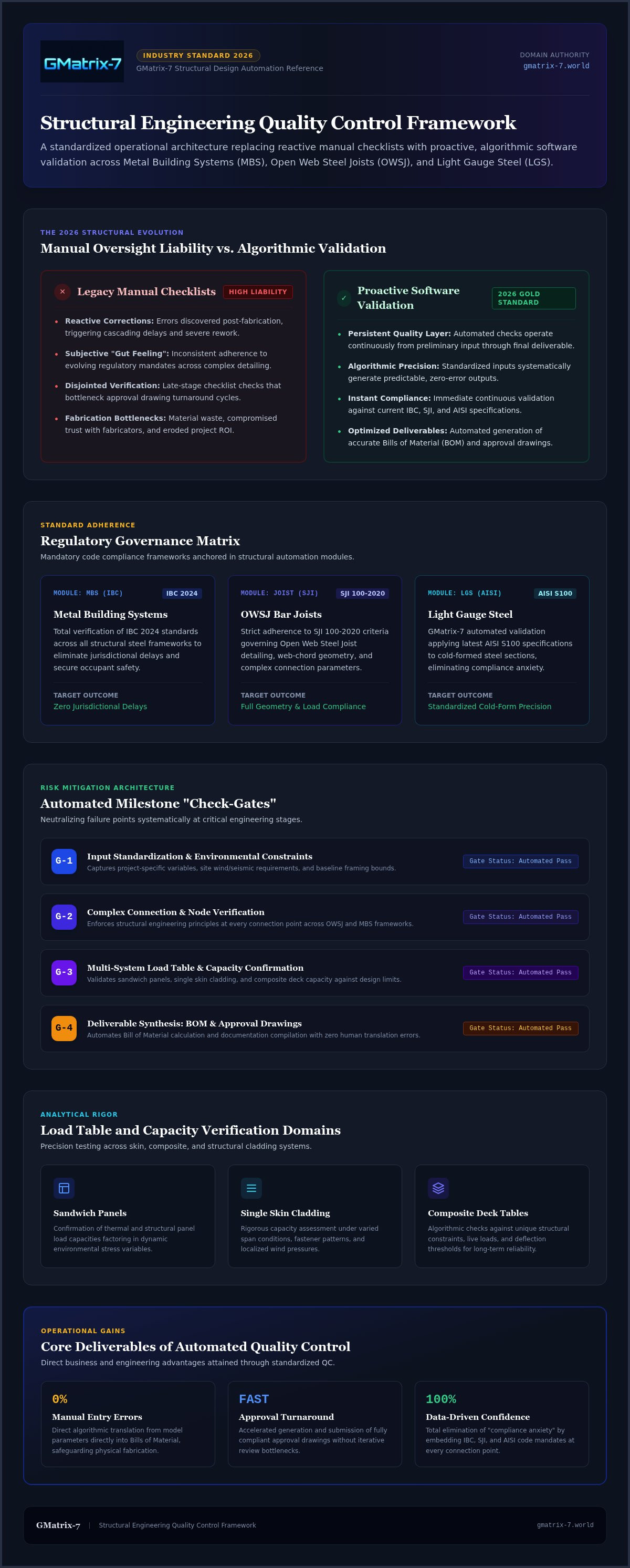
Scaling engineering excellence requires more than individual experience; it demands a repeatable, firm-wide framework. A robust structural engineering quality control checklist must be embedded directly into the digital environment to be effective. By establishing "Check-Gates" at critical project milestones, you transform a static document into a dynamic safeguard. This integration ensures that high-level precision is maintained from the initial parameter setup through to the final documentation audit. It moves your firm beyond manual oversight toward a state of continuous, automated validation.
Step 1: Input Validation and Parameter Setup
The integrity of any automated output depends entirely on the accuracy of the initial data. You must confirm site-specific wind, snow, and seismic loads before the design phase begins. Standardizing material grades and section properties within the software environment prevents downstream discrepancies that lead to costly rework. Input validation serves as the non-negotiable foundation of structural integrity. Without this initial rigor, even the most advanced design tools cannot guarantee compliance with IBC 2024 standards.
Step 2: Automated Validation and Conflict Detection
Modern engineering demands a level of geometric complexity that manual reviews cannot feasibly manage. Running automated clash detection for structural members identifies interferences long before they reach the fabrication floor. You should utilize software alerts to flag any components exceeding code-defined stress ratios instantly. This proactive approach allows you to compare LGS structural design software outputs with preliminary sizing to ensure consistency. It's a methodical process that leverages built-in validation tools to maintain safety without sacrificing project speed.
Step 3: Final Documentation Audit
The final gate in your workflow is the rigorous audit of all project deliverables. You must review automated BOMs for logic and completeness, ensuring that material counts align perfectly with the design intent. Verifying load tables for composite floor decks against SJI standards is essential for long-term structural performance. This step ensures that all SJI compliant joist design documents are signed and sealed with absolute accuracy. Closing the loop by using QC feedback to optimize your software settings ensures that your workflow remains at the cutting edge of industrial progress.
Adopting a software-driven QC framework is the only way to secure a competitive advantage in a high-stakes market. You can optimize your engineering workflow today by integrating these automated validation gates into your standard operating procedures.
Achieving Zero-Error Documentation with GMatrix-7
GMatrix-7 transforms the structural engineering quality control checklist from a defensive obligation into a strategic asset. By automating the most labor-intensive verification tasks, the platform allows engineers to focus on high-level optimization rather than tedious manual reviews. This shift doesn't just reduce the risk of human error; it fundamentally changes the speed at which a firm can deliver certified, code-compliant documentation. Firms that adopt this technology move beyond the limitations of manual oversight and embrace a future where precision is a built-in feature of the design process.
GMatrix-7 / MBS (IBC): Precision Without Compromise
Generating professional approval drawings requires a level of detail that manual calculation bottlenecks often compromise. GMatrix-7 / MBS (IBC) automates this entire documentation cycle, ensuring total IBC compliance without the need for constant manual intervention. This automation streamlines the critical handoff from engineering to fabrication, preventing the common discrepancies that lead to field errors. By utilizing a software-driven structural engineering quality control checklist, you guarantee that every frame elevation and anchor bolt plan meets the highest industry standards for accuracy. It's a methodical progression that ensures your technical output is both intellectually rigorous and commercially ready.
Optimizing Load Table Generation
Precision in load table data is a non-negotiable requirement for modern cladding and flooring systems. The composite deck load table generator within GMatrix-7 delivers precise capacity data instantly, accounting for all project-specific constraints. This speed allows engineers to validate sandwich panel and single skin designs against global safety standards without delaying the project schedule. Choosing a specialized platform highlights the stark contrast in CAD vs specialized software for steel detailing, where general-purpose tools often fall short of the technical rigor required for high-stakes steel projects. This specialized approach eliminates the risks of manual entry and ensures that every load table is data-driven and battle-tested.
Positioning your firm as a leader in professional structural design automation is about more than current efficiency. It's about future-proofing your engineering workflow for 2027 and beyond. As regulatory standards become more stringent, the ability to generate error-free Bills of Material and load tables will define market superiority. GMatrix-7 provides the technological foundation to maintain this excellence, ensuring that your firm remains at the forefront of industrial progress and structural safety. You aren't just providing a tool; you're becoming a guardian of safety and a driver of industrial progress.
Securing Engineering Excellence through Automated Precision
The transition from manual oversight to automated validation is no longer optional for firms seeking market leadership in 2026. By implementing a rigorous structural engineering quality control checklist within a software-driven framework, you eliminate the catastrophic risks of detailing errors and material waste. This systematic approach ensures every project adheres to the latest IBC 2024 and SJI 100-2020 standards without sacrificing the speed of your delivery. You aren't just checking boxes; you're building a foundation of reliability and safety that protects both your reputation and your project's ROI.
GMatrix-7 provides the technological foundation to master this complexity through advanced AISI, SJI, and IBC automation modules. You gain the ability to generate automated load tables and Bills of Material with industry-leading precision, securing a seamless handoff to fabrication. It's time to move beyond the limitations of legacy review processes and embrace a workflow that guarantees safety and high-level achievement. Request a GMatrix-7 Demo to Automate Your QC Workflow and experience the peace of mind that comes from total structural accuracy. Your firm's path to future-proof precision starts today.
Frequently Asked Questions
What are the most critical points in a structural engineering QC checklist?
A comprehensive structural engineering quality control checklist prioritizes four critical pillars: code compliance, load path verification, geometric accuracy, and documentation integrity. You must verify that every connection aligns with IBC 2024 and SJI 100-2020 standards while ensuring that load paths are continuous. This rigorous approach prevents the cascading costs of detailing errors. By anchoring your review in these pillars, you secure the professional confidence that every deliverable is fabrication-ready and structurally sound.
How has IBC 2024 changed structural quality control requirements?
IBC 2024 introduces heightened accountability for digital structural documentation and more stringent requirements for Metal Building Systems (MBS). It mandates a shift from manual oversight toward verifiable, data-driven validation. Engineers must now prove that automated outputs meet specific performance criteria for seismic and wind loads. This update forces firms to integrate more sophisticated validation gates into their standard workflows. It's no longer enough to rely on legacy methods; modern compliance requires digital precision.
Can automated software really replace manual structural engineering reviews?
Automated software doesn't replace the engineer's ultimate authority, but it does eliminate the manual review bottlenecks that lead to fatigue-based errors. It serves as a persistent, built-in QC layer that validates thousands of complex connections in seconds. While the engineer provides the visionary oversight, tools like GMatrix-7 handle the technical rigor of checking stress ratios and code adherence. This synergy allows firms to achieve zero-error documentation while significantly accelerating their project approval timelines.
What is the best way to verify an automated Bill of Materials (BOM)?
The most efficient way to verify an automated Bill of Materials (BOM) is to cross-reference the output against the final approval drawings. You should check for logic, completeness, and alignment with specific fabrication capabilities. Professional software removes the human factor by generating precise counts for fasteners and structural connectors directly from the design model. This systematic validation ensures that material lists are accurate. It protects the project's bottom line by preventing costly material overages.
How do I ensure SJI 100-2020 compliance in joist detailing?
Ensuring SJI 100-2020 compliance requires the use of specialized software modules that enforce these standards at the input stage. You must verify web and chord member alignment while confirming that end-seat depths meet bearing requirements. Utilizing a module like GMatrix-7 / OWSJ (SJI) automates this compliance check, generating detailing that is inherently compliant. This proactive approach eliminates the need for manual recalculations. It ensures that every bar joist is optimized for performance and safety.
What role does load table accuracy play in overall structural safety?
Load table accuracy is the fundamental baseline for structural safety in cladding and flooring systems. Incorrect data leads to catastrophic failures or significant material waste due to over-engineering. Precise generation of load tables for composite decks and sandwich panels ensures that the structure handles environmental variables like snow and wind correctly. By using a data-driven generator, you eliminate the risks of manual entry errors. This level of precision provides the security required for high-stakes industrial projects.
How can GMatrix-7 help reduce material waste in steel projects?
GMatrix-7 reduces material waste by generating highly precise Bills of Material and optimized structural detailing. It eliminates the "buffer" materials often added to compensate for manual detailing uncertainties. By automating the documentation process, the software ensures that every component is sized exactly for its intended load. This precision leads to a significant reduction in scrap and rework. It transforms your structural engineering quality control checklist into a driver of both environmental and financial efficiency.
What is the difference between a design check and a detailing check?
A design check focuses on the global structural integrity, ensuring that loads, stresses, and deflection limits meet code requirements. In contrast, a detailing check examines the granular specifics of connections, dimensions, and fabrication readiness. While design checks confirm the building won't fail, detailing checks ensure the building can be constructed accurately. Both are essential components of a professional review. Integrating both into an automated workflow ensures that theoretical safety translates perfectly into physical excellence.


